IV. Law for PP (25.5%)
 Call Kai
 Learn
Learn Practice Test
 Spaced Repetition
 Match
Match Flashcards
 Knowt Play
1/242

Earn XP
Description and Tags
4.1 The Canadian Legal System, 4.2 Contract Law; Elements, Principles, and Applications, 4.3 Tort Law; Elements, Principles, and Applications, 4.4 Civil Law in Quebec, 4.5 Business, Employment, and Labour Law, 4.6 Dispute Resolution, 4.7 Intellectual Property; Intellectual Property Issues, 7.8 Expert Witness, 7.9 Bonds and Construction Liens, 7.10 International Law, 7.11 Environmental Law, 7.12 Workers Compensation and OH&S, 7.13 Human Rights and Privacy Legislation, 7.14 Further Areas of Law
Name | Mastery | Learn | Test | Matching | Spaced | Call with Kai |
|---|
No analytics yet
Send a link to your students to track their progress
243 Terms
The Canadian Constitution
Source of legal authority in Canada.
Made up of statutes and conventions from both British and Canadian parliaments.
Canada is a constitutional monarchy.
Primary Features of the Canadian Constitution
The division of powers between the federal and provincial/territorial governments.
The creation of the courts.
The charter of rights and freedoms.
The “Rule of Law”
Law is necessary to keep peaceful order.
Law applies to everyone equally.
No one can have unrestricted power to limit rights, unless authorized by law.
Common Law
Rules established by previous court decisions.
As judges interpret and apply statutes and common law rules, more law is created.
Most of Canada and US use the British common law system.
Statute Law
Federal and provincial governments can enact statutes. Statute laws must be compatible with the Constitution to be enforceable.
Statutes relevant to architecture, engineering, and geoscience include those governing joint and several liability in negligence, construction lien rights, formalities of contracts, and workers’ compensation requirements.
Judges then interpret these statutes.
Legislation frequently gives certain other agencies the power to create regulations that may be considered law. For example, a provincial Association of Engineers and Geoscientists may enact bylaws
Federal and Provincial Statutes and Regulations
Must be constitutional.
Statutory authority can be delegated (municipal governments (bylaws), professional regulations).
Public Law
Relates to the public as a whole, such as constitutional law, administrative law, criminal law, and international law.
Private Law
Private Law
Relates to definition, regulation, and enforcement of rights among individuals.
Usually within provincial jurisdiction.
Criminal Law
Deals with crimes and penalties.
Civil Law
Defines and protects the private rights of citizens (contracts, torts, family law). Not public law.
Not criminal law, not common law. A more codified version of common law. All law is statute based.
Administrative Law
Administrative agencies of government, including rulemaking, adjudication, and enforcement (i.e. boards, commissions).
Ensures that the government and its agencies deal with people fairly and lawfully, protecting our rights and ensuring they act in a fair and just way.
Constitution Act, 1867
Provides constitutional framework for federal and provincial powers respectively.
Constitutional Framework
A constitutional framework provides the fundamental rules and principles that govern a country. It defines the powers of both the federal and provincial governments, overrides other laws, and includes both written and unwritten rules.
Charter of Rights and Freedoms
Part of the Canadian constitution.
Codifies individual rights as related to government action, including organizations like APEGS.
Does not apply to interactions between private parties. Only for government infringements like laws.
Some rights apply to criminal cases (counsel, remain silent), others include freedom of religion, speech, right not to be discriminated against.
Prohibited grounds of discrimination are listed.
Supreme Court of Canada
Hears matters of national importance.
Federal Court
Deals with matters in the federal realm (national security, defence, criminal law, immigration, intellectual property).
Federal court of appeal >
Federal Court and Tax Court of Canada (tax matters).
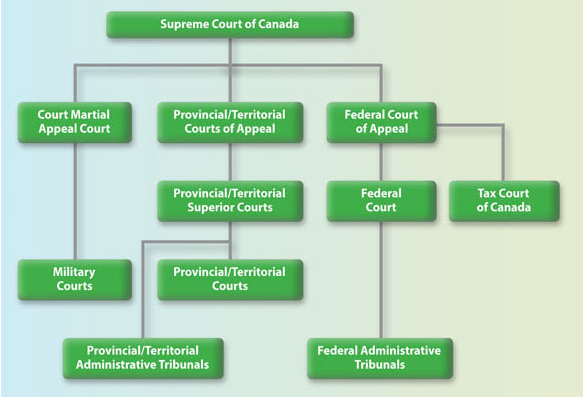
Provincial Court (in Sask)
Court of appeal (SK: court of appeal) >
Superior trial (SK: court of king’s bench) >
SK Provincial Court (small claims court, most criminal and some family law).
Judges are federally appointed and paid.
Includes most private law (property rights, contracts, negligence, construction liens).
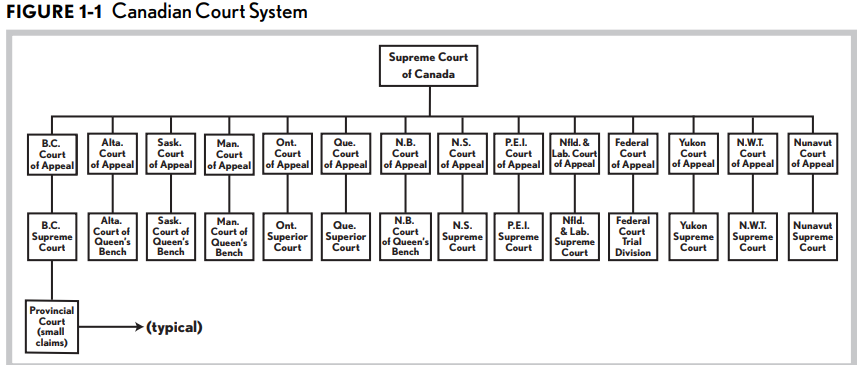
Small Claims Court
Jurisdiction limited by subject matter and value of claim (< $30,000).
Case Law
Past cases become less applicable as law changes.
Beware of cases currently being appealed.
All relevant cases must be considered.
Construction disputes are fact specific.
Contract Disputes
Contracts are voluntary, often need not be in writing, define rights and responaibilities.
Key area of law for construction disputes.
Tort Disputes
Duty to not harm those in the community (intentionally or unintentionally).
Negligence is a common type of tort in engineering/construction disputes.
Adminstrative Tribunals
Specialized tribunals are staffed by experts in the area and have delegated powers.
Tribunals have great latitude to regulate their own processes.
Self-regulating professions are essentially administrative tribunals.
Civil Code in Quebec - As Compared to Common Law
Quebec uses a civil law system that differs from the common law system in force throughout the rest of Canada. Canadian common law does in fact apply in Quebec with respect to certain matters, such as criminal law, patent law, and other areas of federal jurisdiction. However, relationships between private individuals are governed by the Civil Code of Quebec.
Law governing private relationships includes tort, contract, employment, business organization, insurance.
In a common law jurisdiction, there are areas of law for which no statute exists, and the basis for the law is the body of case law decided by judges in the past. In Quebec, in contrast, the Civil Code is an attempt to codify the basic principles of law in all areas.
The law does not result in much difference to a design or construction professional with respect to many aspects of practicing one’s profession in Quebec or elsewhere in Canada. Basic principles of negligence, contract formation, insurance, and other matters are fairly consistent across the country.
Claims and Disputes
Resolving disputes is time, money, and energy intensive.
Most disputes involve contract law and negligence/tort law, but procedural law is important.
Construction companies typically involve many parties, so are complicated.
Allocation of risk influences outcome.
A good understanding of contract and negligence law helps professionals not only in analyzing and resolving disputes but also in avoiding disputes in the first place.
Primary Methods of Dispute Resolution
Negotiation
Mediation
Arbitration
Litigation (not voluntary for defendant)
Depends on the nature of the dispute and relationship of the parties.
Negotiation (Definition and Advantages)
A discussion to resolve the dispute through compromise.
Best learned through practice.
Privileged: Matters discussed during negotiations cannot be referred to in court proceedings if the negotiations fail.
Advantages:
Parties control the process, so it can be private.
Parties control the outcomes, so eliminates uncertainty.
Less costly.
Mediation (Definition and Procedure)
Assisted Negotiation; a third party facilities settlement by encouraging compromise.
Mediator helps the parties be objective and keep the process moving forward. Everything is “off the record” and the parties can be frank with the mediator.
If no settlement is reached, the communications are privileged.
Procedure:
Opening statements, discussion, break out sessions where the mediator meets with the parties individually, more discussion.
Arbitration (Definition, Advantages and Disadvantages)
A private trial process where the parties set the rules.
Proponents of arbitration argue that it is less expensive than litigation, but this is not always the case if the parties are uncooperative.
Parties must decide who will act as arbitrator (or court appoints), terms of reference, rules of procedure to be applied, law to be applied (jurisdiction).
Advantages:
Privacy
An arbitrator with specialized knowledge can be selected.
Disadvantages:
Split proceedings results if not all parties agree to arbitrate.
Arbitrators must be paid, and schedule must be accommodated.
Third parties cannot be forced to participate (except sometimes as a witness), which may result in third party claims being a second hearing with a different judge/arbitrator and can lead to inconsistent findings.
Mandatory Binding Arbitration
When the parties agree by contract before any dispute arises that they will arbitrate disputes that arise and be bound by the outcome.
Voluntary Binding Arbitration
When the parties agree to arbitrate after a dispute has arisen but still will be bound by the outcome.
Non-Binding Arbitration
Arbitrator gives an advisory opinion.
Litigation (Definition and Disadvantages)
Use of court system to resolve disputes.
An independent party (judge or jury) decides the case on the evidence presented at trial.
The judge controls the process.
Litigation is often the only way to deal with unreasonable parties.
Slow and expensive.
Can be many defendants in one lawsuit.
Disadvantages:
Risky (all or nothing)
Uncertain outcome
Expensive
Time consuming
Emotionally taxing
Parties lose control over process and outcome (unlike negotiation or mediation)
International Law for Professional Practice
International treaties are enforceable to the extent they have been adopted through domestic legislation and can also be used to interpret ambiguous domestic legislation.
NAFTA allows Canadian professionals to work legally in the US with a work visa. (Right to work, not the right to practice a profession - may need license to consult, etc.)
Tax treaties prevent duplication of income taxes.
Contract
Enforceable voluntary agreement (depends on if the courts uphold the contract).
Sets out rights, responsibilities, and liabilities of parties, but also allocates risk and obligations between or among parties.
Terms are express or implied.
Most contacts need not be written.
Only parties privy to the contract can sue on it.
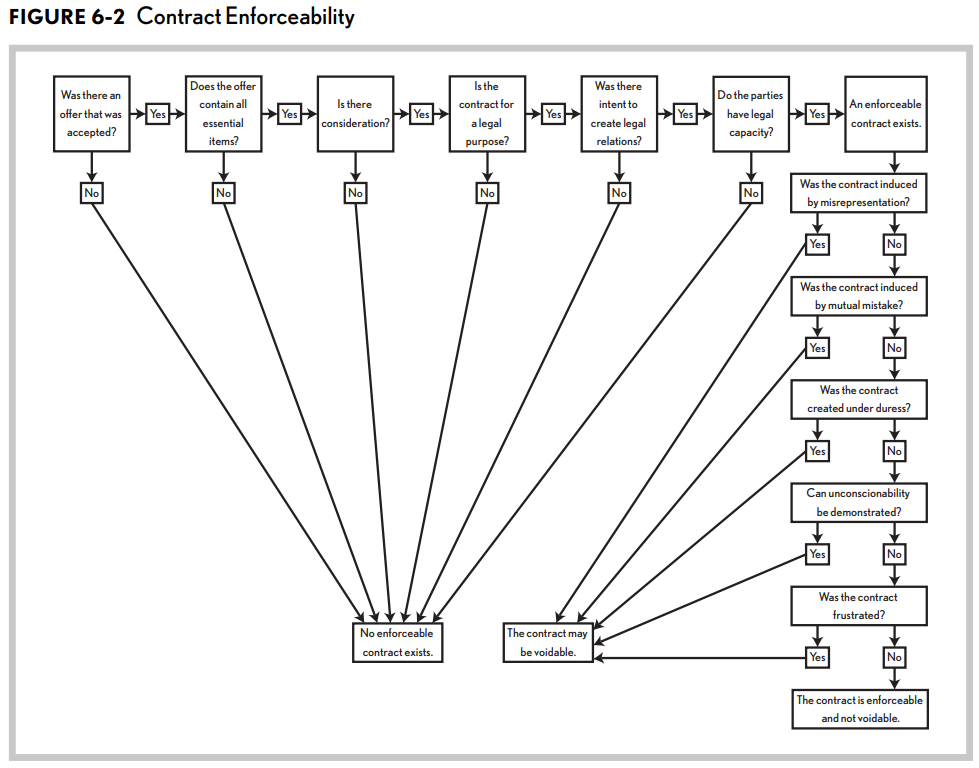
Essential Elements of a Contract
Essential elements to be enforceable:
Offer and acceptance
Consideration
Capacity to contract
Intention to create legal obligations
Lawful purpose
Contract Element: Offer and Acceptance
Offers must contain all essential terms.
Acceptance must be unequivocal agreement, or else it is a counteroffer.
Invitation to treat: call for offers (not an offer).
Rejection: Must be communicated to the offeror; counteroffer has effect of a rejection.
No general duty to negotiate in good faith unless required by agreement/statute (may be changing).
Contract Element: Consideration
Each party must give (or promise) something of value.
Is a prerequisite of an enforceable contract.
Lack of consideration will result in an unenforceable promise to give a gift.
The consideration given by each party does not have to be of equal value.
Forbearance (giving up the right to sue) may be valid consideration.
Amendments must have fresh consideration.
Contract Element: Capacity
Minors, substance users, someone not in their right mind.
Contract may be voidable by person lacking capacity.
Contract Element: Intention to Create Legal Obligations
Court will not enforce “agreement to agree”.
Contract Element: Lawful Purpose
Void if contrary to statute (cannot contract out of rights/laws) or common law (contrary to public policy).
Agreements to Agree
Not enforceable by contract, may be in the form of a letter of intent or MOU.
Letter of Intent/Memorandum of Understanding
Expression of intention to form a contract in the future.
Dangers:
Parties may not appreciate they are unenforceable.
Parties may commence performance without ever creating a formal contract.
On the urging of one of the parties, it may be interpreted by the court as an enforceable contract. If there is wording to suggest that it is accepting an offer or bid, the letter would be more properly considered a contract, but many terms of the contract would be unclear and have to be inferred by the court.
Voiding a Contract
Mistake
Misrepresentation
Duress
Unconscionability
Frustration
Void: Mistake
Mistake must be material (significant).
Mistake must be mutual (both parties must have been mistaken).
No remedy if the mistake was not mutual.
Mistake must have been made at the time the agreement was made.
Misrepresentation
Untrue factual statement that induces the other party to enter the contract.
Fraudulent (intentional false statement, most serious).
Negligent (statement carelessly made).
Innocent (difficult to obtain a remedy).
Damages are generally available for fraudulent and negligent misrepresentation.
Common case arises with subsurface soil conditions (expensive to drill/test).
Duress
Improper pressure, threats or coercion used to induce a party to enter into a contract. Must be extreme pressure (i.e. not freely given consent).
Unconscionability
So unfair, oppressive, and one sided that the courts won’t enforce it.
Generally requires extreme inequality of bargaining power at the time of contact formation. Fine line between legitimate business power and duress.
Frustration
Occurs when an unforseen event makes performance impossible or of no value.
Event must not be a risk that was anticipated by the parties.
Force Majeure Clause: Prescribes the consequences of unlikely events.
Pandemics, etc.
Amendment of Contracts
Must be agreed upon by both parties.
Original contract may specify formalities for amendment (must be obeyed).
Requirements of a contract apply (agreement, consideration, certainty of terms, intention to create legal obligations).
Amendments may be voided for the same reasons as a contract.
Formalities often waived.
Waiver
When a party (by words or conduct) relieves the other party of the duty to perform. A party can not rely on the strict requirements of a contract selectively or inconsistently.
Where by word or by conduct, a party to a contract causes another party to reasonably believe that certain rights will not be enforced, and where subsequent enforcement of those rights would be unfair, Canadian courts generally rule that a waiver has occurred. Many exceptions and legal requirements exist.
Estoppel
To be stopped. A party is estopped from enforcing rights that it has waived.
Requires a clear expression that the waiving party intended to waive its rights, and reliance by the party benefitting.
Ex: If a lease requires rental payments on the 1st but the landlord consistently accepts payments on the 3rd, then the landlord is estopped from requiring payments on the 1st. They would have to provide reasonable written notice that they intend to enforce the original terms of the lease.
Repudiation
When one party (by words or actions) makes it known that it does not intend to perform its obligations under the contract. Without justification, constitutes a fundamental breach.
Anticipatory Breach
When one party lets the other know, before the time for performance, that it will not be performing its obligations.
Principles of Interpretation
How the court interprets contracts.
Give effect to the objective intention of the parties.
Apply the canons of contract construction.
If necessary, consider additional evidence.
The court should not rewrite the contract for the parties, but rather interpret the contract the parties made.
The Intention of the Parties
Courts aim to give effect to the intention of the parties.
Establish the objective intention of the parties by reviewing the terms of the contract.
Intent of the parties governs in a conflict between intent of the parties and the literal interpretation of a clause (objective).
Objective Intention: What reasonable parties would have intended by agreeing to the specified terms.
What the parties subjectively intended is not relevant.
Canons of Construction
Guiding principles (not laws).
Plain and ordinary meaning (the golden rule).
Special meaning (if required).
Reading the contract as a whole.
Giving effects to all parts of the contract (no part should be treated as inoperative, surplus, or meaningless).
Restriction by express provisions (special provisions added to the contract>general provisions).
Commercial purpose (presume the parties did not intend a commercially unreasonable result).
Read the words in context.
Contra proferentem (construe ambiguous provisions against the party that who drafted the contract).
Additional Evidence in Contract Disputes
The contract is the primary evidence.
Parole Evidence Rule: Where the contract is clear and unambiguous extrinsic evidence of the parties’ intentions will not be considered. (Facts, i.e. background, are still considered to prevent injustice).
Where the contract is ambiguous, subsequent conduct of the parties may be considered.
Drafting Contracts (Important Points)
Principle Purposes:
Reflect the business arrangement between the parties.
Clearly allocate risk between the parties to minimize the likelihood of disputes.
Provide protections and incentives for the parties.
Carefully consider the fundamental elements.
Consider what ifs and make the assumption that there will be problems throughout the term of the contract.
Transfer of Risk and Obligation
A key aspect of contract negotiation is distributing risks and obligations between the parties.
Risks can be assigned to a party, shared between the parties, or transferred to a third party (supplier, insurer, bonder).
Costs are minimized when risks are optimally distributed.
Procurement
Buyers start by appointing a consultant.
Buyers must select a procurement process early on.
Call for tenders.
Negotiation.
Request for proposals.
Government is obligated to use a formal tender process because it is fair and transparent (prevents negotiation).
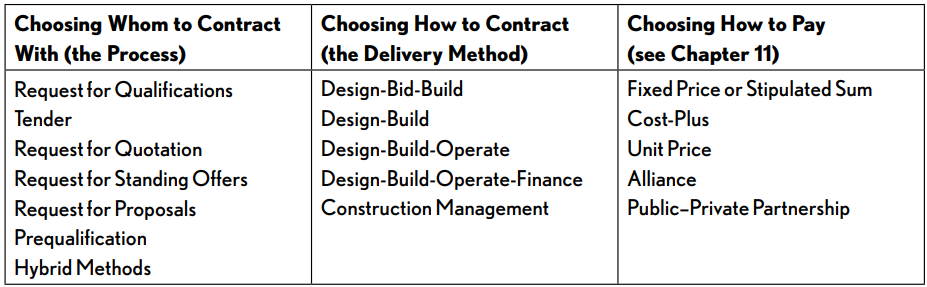
Request for Qualifications
A process used to choose a project participant based solely on the qualifications of the respondents, rather than on other criteria like price. Requests for qualifications are often used for selecting professionals. They can also be used for selecting design-builders, participants in an alliance agreement, or participants in public–private partnerships.
Given the increased levels of trust and the longer-term nature of the relationship between the buyer and the seller in alliance agreements and public–private partnerships, many buyers have found that bottom-line price may not be the only desirable selection criteria.
Request for Proposals
Less detailed scope of work than tenders.
Do not follow the tendering protocols but good faith and farness may still be required.
Calling a tender a request for proposals or vice vera will not make the document enforceable as such, it will be enforced for what the document actually is.
Tendering
For maintaining neutrality in the selection of a supplier: formal evaluation of published and transparent criteria.
The law of contract applies (when a seller submits a bid in response to an invitation, the bid may be considered acceptance).
Large amounts of money at stake (failure to abide by the rules result in lost contracts for bidders and liability for buyers - need to know the rules).
Law of mistake applies (courts are reluctant to allow bid withdraws).
Bid depositories resolve some of the problems (sealed bids).
Tendering replaces negotiation (negotiating with bidders is not permitted unless call for tenders clearly indicates that negotiation is part of the process).
Bid shopping is not proper, but there is no remedy for it in Canada.
Bidding Process Stages
Preparation of bid documents
Solicitation/invitation of bids
Pricing by potential sellers
Submission of bids
Evaluation by the buyer
Award of the contract
Project Delivery Method (Selection Factors)
Depends on the nature of the project.
Transparency and fairness requirements for public projects necessitate the tender process.
Influenced by labour and materials markets.
Innovative delivery models are sought to alleviate usual conflicts between buyers and sellers.
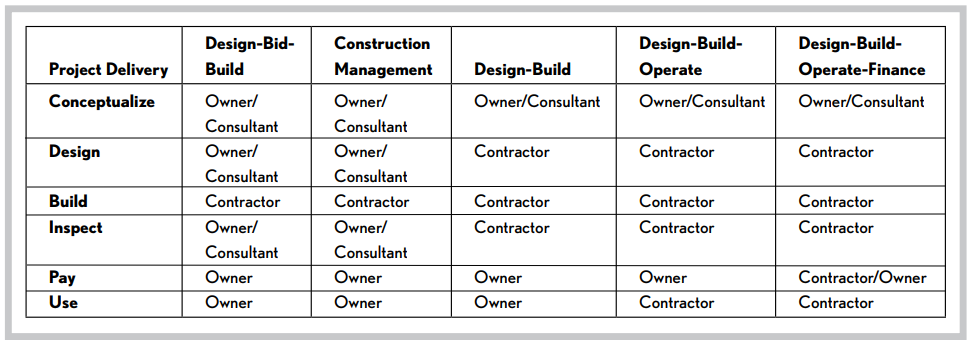
Project Delivery Methods
Design-Bid-Build: Buyer and consultant design the project entirely, contractor builds it, consultant inspects it, buyer pays and puts it into service.
Construction Management: Owner contracts directly with the trades instead of hiring a general contractor. PM is the owner itself or a construction manager that is hired to manage the process but does no physical work on site.
Design-Build: Buyer conceptualizes, hires one party to design, build, and inspect it, buyer pays and puts it into service. Minimal control for buyer but it is a one stop shop.
Design-Build-Operate: Same as design-build, but the contractor is responsible for operations for a length of time after the build phase is complete. Alleviates some quality risk.
Design-Build-Operate-Finance: Same as design-build-operate, but the contractor invests in the project as part of the contract. (Typical for a P3).
Method defines the contract.
International and Interprovincial Trade Agreements
Set rules for the transfer of goods and services.
May influence procurement and dispute resolution.
International Agreements: NAFTA, WTO.
Interprovincial Agreements: Agreement on Internal Trade (AIT), New West Partnership.
Treaties have criteria for determining which transactions they cover.
Methods of Payment
Fixed price (lump sum)
Cost plus (payment for labor, equipment, materials plus a % for profit and overhead)
Public private partnership
Method of payment often defines the form of contract (fixed price/lump sum and cost plus are types of contracts).
Standard Form Contracts
Created by industry groups for use by their members, generally favour the interests of their members over the other party.
Most standard form contracts require modification to suit the context.
Often used without modification to save time (but can lead to far greater litigation costs).
Often good starting points but rarely good end points.
Construction Contract Types & Standard Contracts
Fixed Price: All risk and obligation is transferred to the contractor. Prices is modified during the project often. Commonly CCDC2.
Cost Plus: Many of the cost risks are placed on the owner. CCDC3 - has issues.
Unit Price: Stipulated $ for each unit or wuantity of work performed (roads, earthwork, pipelines). CCDC4.
Construction Management: CCDC5A-where construction manager is solely a manger. CCDC5B-where the construction manager at some point becomes at risk. CCA17-individual trades are contracted directly with the owner but the construction manager signs on behalf of the owner.
Design-Build: CCDC14-some issues.
Alliance Agreements: Intended to diffuse the historically adversarial relationship of parties in a construction project. It typically involves all the major parties, including the owner, significant contractors, and design professionals. The key terms of such an agreement are that all parties agree that there will be no liability for poor performance or defective work, and that all parties will share in the success or failure of the project from an economic perspective.
Public Private Partnerships: Partnership between the public and private sectors where there is a sharing of risk, responsibility and reward, and where there is a net benefit to the public.
Integrated Project Delivery: An owner engages a team that consists of a contractor, architectural and engineering consultants, and significant construction trades at an early stage to assist with developing a design. Once finished, the design is then constructed by the same team.
Professional Service Agreements
Define the scope of work and expected outcomes.
Fixed price, cost plus, % of construction costs.
Limitation of liability clauses protect the consultant from claims in excess of the available insurance.
May give the owner alternative remedies in the event the claim is not covered by insurance.
Field review clauses are controversial; the scope and purpose of the review should be clearly set out.
Engineering Service Agreements
Commonly use standard form contract ACEC31.
The parties should address site inspections, copyright, limitation of liability, and termination in detail when using the standard form.
Geoscience Service Agreements
Commonly used standard form contract: AAPG.
The parties should address the scope of services, the responsibility for workers compensation insurance premiums, termination, and liability in detail when using the standard form contract.
Licensing Agreements
License = Grant of Rights.
Exclusive License = Licensee obtains the exclusive right to use the rights granted by the licensor.
Grant Provision: Defines the scope of the license (most important).
Commonly used in intellectual property and real property.
The license fee may be based on profits made by the license.
Standard Contract Clauses
Scope of the Work: Detailed, functional/general, or performance criteria.
Contract Time: time is of the essence, both parties, schedule.
Changes: Modifying terms.
Damages and Bonuses: Liquidated damages clauses are enforceable; penalty clauses are not enforceable.
Warranty: Defect repair.
Termination
Indemnification: Each party typically indemnifies the other against their negligence.
Exclusion: Purports to completely exclude the damages or remedies available to the innocent party upon the occurrence of specified events. Always construed against the drafting party if it goes to court and it is ambiguous.
Limitation: Purport to contain or limit the damages or remedies available to the innocent party upon the occurrence of specified events. Ex- Limitation against consequential damages.
Dispute Resolution: Provision that defines the process to be followed in resolving disputes Ex-Notice of claim.
Contracts Required to be in Writing to be Enforceable
The Statute of Frauds was enacted to combat a number of fraudulent practices in the law of evidence and required certain transactions to be evidenced in writing.
Transfer of land.
Contract in which one party becomes a cosigner or “surety.'“
Agency and Authority
Agent: A person authorized to act on behalf of another party (the principal). (Engineer is the agent of the owner). Personally bound for contracts they enter into outside of their authority.
Actual Authority: An actual agreement between the agent and the principle.
Apparent Authority: The representation by the principle to a third party. Can be developed by past actions (allowing the agent to act outside of authority may expand the scope of authority).
The principal is bound by the actions of the agent that are within the scope of agency. They are deemed to have gained knowledge of facts given to the agent (imputed knowledge).
Indemnity
An agreement to bear the financial loss of another party for a specified event.
Insurance policies are contracts of indemnity.
Many reflect the common law that each party is responsible for the harm it causes.
Change Orders
Changes to the scope of work frequently occur.
Extra: Increase in contract price.
Credit: Decrease in contract price.
Change orders result from design changes (error, cost saving, regulations) and unforseen conditions.
Extras for Design Negligence
Contractors are entitled to extras resulting from design changes.
Owners may have the right to recover the costs of design changes from the consultant, but generally waive this amount if it is small.
Impact Cost
Occur when extra work is requested that may impact the schedule and efficiency of the rest of the work.
Contractors incorporate all impact costs when agreeing to a price for an extra.
The parties may agree that the contractor retains the right to claim impact costs at some later time.
Performance Under Protest
Filed for when the owner instructs the contractor to do extra work before a price is agreed on. Reserves the right to dispute payment for a change directive later.
Ideally the parties agree on cost before the work is done.
Unforeseen Conditions
Conditions that are known to be possible but not expected to occur.
Commonly lead to extras (or credits).
During tender, the owner is required to divulge all known information about unforeseen conditions.
Contract may shift the risk of unforeseen conditions onto the contractor, but courts often don’t like this.
Bidders don’t have time to thoroughly assess the risks associated with unforeseen conditions.
Economically inefficient to have the contractor bear the risk of unforeseen conditions.
Contract Termination (Cases)
Complete performance
Mutual agreement
Frustration
Breach
Termination Clauses
The parties may incorporate a termination clause into the contract.
Termination clauses specify acts that justify termination of the contract.
Contractual Limitation Clauses
Limit tort duties of care.
Only apply between parties of a contract. May be relevant to whether a party to the contract owed a duty of care to a third party.
Breach of Contract
Occurs when one of the parties fails to meet its obligations under the contract.
After a breach occurs, if the parties are unable to negotiate a settlement, a third party (judge, arbitrator) will decide the matter.
Damages are the most common remedy.
Simple Breach of Contract
Does not entitle the innocent party to put an end to the contract.
Does entitle the innocent party to sue for damages.
Fundamental Breach of Contract
Deprives the innocent party of all of the benefit of the contract (i.e. not paying). Entitles the innocent part to terminate the contract and to sue for damages, or to continue to perform and sue for damages.
Remedies for Breach of Contract
Damages: Monetary compensation the court orders the at fault party to pay the innocent party.
Specific Performance: A court order requiring completion of the contract.
Injunction: A court order requiring a named party to do or not do something.
Declaratory Order: Statement by the court of the rights and obligations of the parties.
Damages
Most common remedy for breach.
Calculated as compensation required to put the innocent party in the position they would have been in but for the breach.
Mitigation: The innocent party must take reasonable steps to minimize the loss suffered.
Causation: The innocent party can only recover losses that were caused by the breach; speculative losses can not be recovered.
Remoteness: Only damages that are reasonably proximate to (not too remote) the breach can be recovered.
Courts are hesitant to award damages unless it is clear that the money was or will be spent on rectifying the breach.
Typically based on the cost of performance.
Consequential Damages (Definition and Clause)
Consequential damages cover indirect losses, such as business interruption losses.
Consequential Damages Clauses:
Exclusion or limitation clause that restricts the ability to claim for lost profit or other damages indirectly related to the claim being made. Allows parties to provide products at reasonable prices even if failure of the product may lead to a large loss.
Liquidated Damages Clause
Compensation is agreed to by the parties at time of contract formation (genuine pre estimate of damages). If excessive, will likely be an unenforceable policy.
Bonus Clause
Additional payment for performance that exceeds minimum requirements.
Diminution of Value
Where the cost of rectifying damages will be excessive compared to the rectification benefits, damages may be based on diminution of value.
Quantum Meruit
Actual value of services rendered.
The amount it is worth when it is not appropriate for the remainder of the contract to be enforced, but compensation is given for the work already done.
Requires that there be no valid contract in place for the work in issue.
May be used to compensate for constructive changes that are not within the contract.
Exemption Clause
Purport to completely exclude the damages or remedies available to the innocent party to the contract.
Courts construe exclusion clauses against the party that drafted them, so they must be clear and identify the liabilities excluded (only when there is ambiguity).
i.e. exclusion, exculpatory, exception, escape, and protective.
Limitation of Liability Clauses
Limit liability for the contract.
Courts construe clauses against the party that drafted them, so they must be clear and identify the liabilities excluded (only when there is ambiguity).
Used to allocate almost any type of risk with exclusion clauses.
Common Causes of Contract Breach
Inability
Inadvertence
Disagreement