Unit 3 Evolutionary Biology
 Call Kai
 Learn
Learn Practice Test
 Spaced Repetition
 Match
Match Flashcards
 Knowt Play
1/157

Earn XP
Description and Tags
University of Arkansas
Name | Mastery | Learn | Test | Matching | Spaced | Call with Kai |
|---|
No analytics yet
Send a link to your students to track their progress
158 Terms
Why do asexual lineages multiply faster than sexual lineages?
All progeny can produce offspring. In sexual lineages, half are male, who cannot reproduce by themselves. This halves their rate of replicatiom.
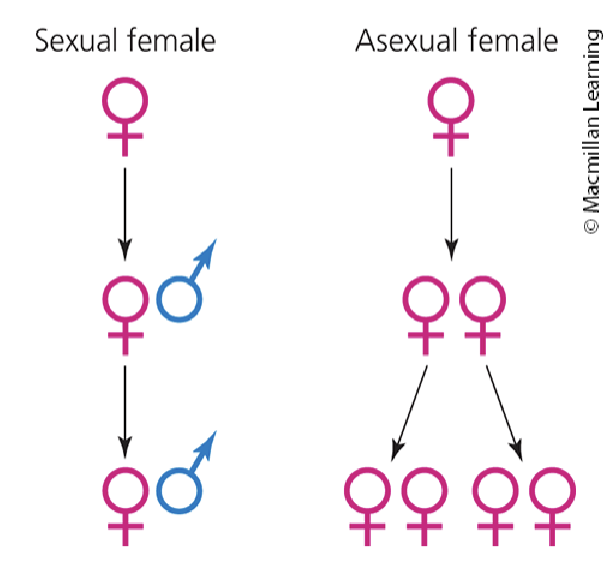
What is the search cost of sex?
Males and females must locate each other in order to mate. Can involve time, energy, and risk of predation.
What is the reduced relatedness cost of sex?
Sexually reproducing organisms only pass half of their alleles to their offspring, halving the relatedness between parents and progeny.
What is the risk of sexually transmitted infections cost of sex?
Mating between sexes provides an effective means of transmission for many pathogens, a risk avoided in asexual populations.
What is the combining beneficial mutations benefit of sex?
By combining alleles of genes from two different individuals, sexual reproduction can bring separate beneficial mutations together in a single individual faster than would be expected if they had to arise spontaneously in the same genome.
What is the generation of novel genotypes benefit of sex?
Through recombination, meiosis provides an opportunity for paired chromosomes to cross over, creating gametes with unique combinations of alleles.
What is the faster evolution benefit of sex?
Offspring of sexual parents will be more genetically variable than offspring of asexually reproducing parents. This can speed the evolutionary response to selection of sexual populations and is critical for maintaining resistance to parasites (Red Queen effect).
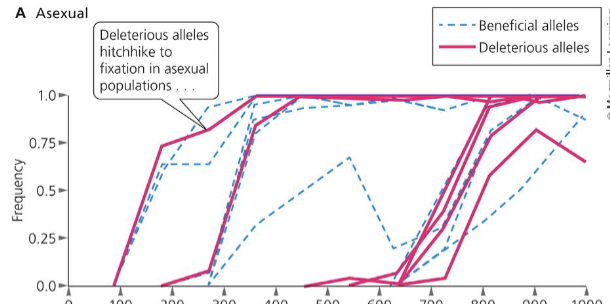
What is the clearance of deleterious mutations benefit of sex?
Asexual lineages don’t have recombination to get rid of the negative mutations. Only selection has that detail.
What is the Red Queen hypothesis?
It’s about the coevolution between parasites and their hosts. Recombination produces new varieties so hosts can evade their parasites. “You have to run as fast as you can just to stay in the same place”.
What is Muller’s ratchet?
Deleterious mutations cannot be purged in asexual lineages and accumulate over generations. Increases genetic load
What is genetic load?
The burden imposed by accumulated deltrious mutations.
What is the physical linkage of alleles at multiple oci?
The further apart two loci are, the less they are linked. Loci that are adjacent to each other are tightly physically linked.
How does recombination and sexual reproduction help against deleterious materials?
They allow beneficial to spread in the absence of deleterious materials.
What is anisogamy?
Sexual reproduction involving the fusion of dissimilar gametes.
Larger gametes (eggs) produced by females
Smaller gametes (sperm) produced by males
In anisogamy, what are eggs and sperm?
Eggsa re expensive and sperm are cheap.
What are females limited by and what are males limited by in anisogamy?
Females limited by fecundity.
Males limited by access to mates.
What is mongamy?
One male pairs with one female.
What is polgyny?
Males (attempt to) mate with multiple females.
What is polyandry?
Females (attempt to) mate with multiple mates.
What are characteristics of monogamy?
Shared parental care, defense, and mate guarding.
Potentially limited reproductive output or quality.
Sexual and social monogamy.
What are characteristics of polygny?
Sperm is cheap
Males can greatly increase fitness by fertilizing many females.
Involved competition for mates.
What are characteristics of polyandry?
Females can hedge their bets to obtain high-quality or diverse alleles from multiple mates.
Costs of courtship rejection may outweigh costs of multiple mating.
More nuptial gifts can provide greater benefits to female and offspring.
What is sexual conflict?
The evolution of phenotypic characteristics that confer a fitness benefit to one sex but a fitness cost to the other.
What can sexual conflict lead to?
Antagonistic coevolution and arms race between males and females.
What did Fisher propose?
Frequency dependent selection.
What is frequecy dependent selection?
For autosomal genes, half come from ale function and the other half come from female function.
As number of daughters increase, large fitness gains to those producing rare males, selection favors more sons.
Equilibration, process generates its own natural selection.
What promotes 50:50 evolution?
Frequency dependent selection.
What is Bateman’s principle?
The sex that invests more in reproduction will have less variance in reproductive success and the other sex will compete for access to mates.
Can asymmetrical parental care alter operation sex ratio (OSR)?
Yes! Slower rate of reproduction by females lead to male-biased OSR (more eager males than available females)
What is Operational sex ratio (OSR)?
Ratio of males to females capable of reproducing at a given time. Competition and sexual selection
What is sexual selection?
Differential reproductive success resulting from competition for mates. Typically stronger in males.
Direct male-male competition and attracting females/ female choice
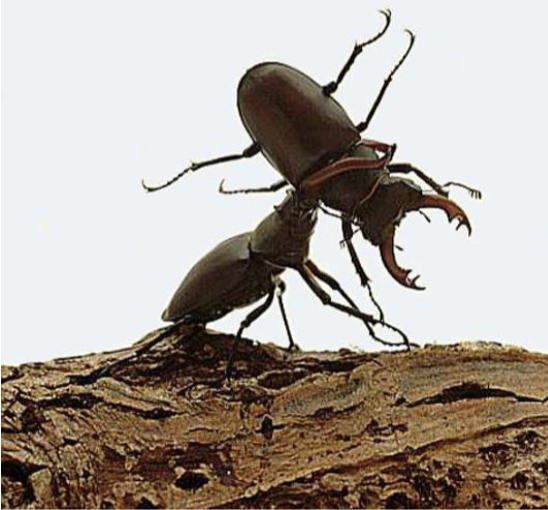
What is this an example of?
Direct male competition.
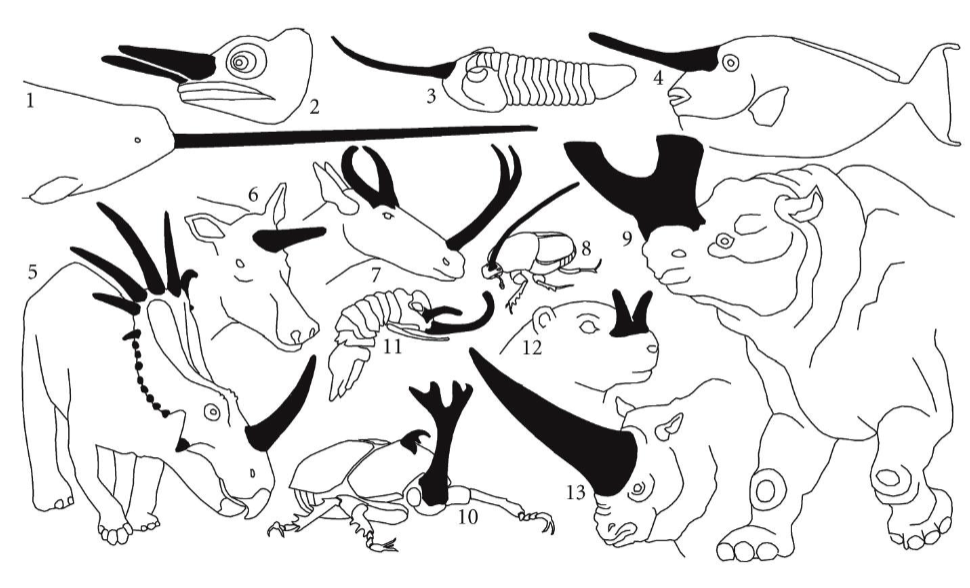
What are armaments?
Hornlike structures have evolved independently in the males of diverse animals.
What does male-male competition lead to?
Results in extreme variance in reproductive success.
What are the direct benefits of female choice?
Benefit the female directly. Benefits during gestation or the act of child care. Examples: Food, nest sites, and protection.
What are indirect benefits of female choice?
Benefits that affect the genetic quality of the female’s offspring. Often involve selection of male ornamentations. Disease resistance. Reproductively successful offspring.
What are “good genes” indicators?
Bright coloration and handicaps.
What is bright coloration?
Indicator of parasite/disease resistance.
What are handicaps?
Honest indicator of general fitness genes.
What makes up an honest signal?
The animal has to incur a cost to display it. Only the animals that can afford the costs can produce them. Stronger
Does sexual selection have the ability to promote sexual dimorphism
Yes, sexual selection can.
What is sexual dimorphism?
A difference in form between males and females of a species, often in features that are used in courtship displays or in contests.
How does sperm competition come into play in sexual selection?
Arise after mating, when males compete for fertilization of a female’s eggs.
What is cryptic female choice?
Arise after mating when females store and separate sperm from different males and bias which sperm they uses to fertilize eggs.
Why is evolution of interactions among species important?
Adaptation to the biotic (living) environment can induce reciprocal change as each interacting species evolves in response to selection imposed by the other.
Does adaptation to abiotic (nonliving) environment cause the environment to change?
No, since species are adapting to their environment It doesn’t cause the environment to experience change.
What is coevolution?
The joint evolution of two or more ecologically interacting populations or species, each of which evolves in response to selection imposed by the other.
What is mutualistic coevolution?
A relationship between species where BOTH benefit.
What is antagonistic coevolution?
A relationship in which one or both species are negatively affected by the other.
What is an endosymbiont?
Mutualistic organism that lives within the body or cells of another organism.
What general feature is necessary for mutualism to persist?
The benefits for each partner must outweigh the costs for each partner.
What risk(s) come with increased reliance on mutualism?
The more mutualistic/interdependent species are on each other, the risker it becomes if that interaction fails. Codependency arises.
What does coevolution between enemy species lead to?
“Arms race”. Ongoing adaptation in one lineage, as a direct response to continued adaptation in the lineage’s enemies.
Why does a coevolution “arms race” continue without end?
The living (biotic) environment is evolving as well. As an organisms adapts more to its predators in order to survive, it’s predators adapt more in order to catch their prey.
In antagonistic coevolution, is there equal selection pressues between prey and predators?
No, it’s not equal. The prey experiences more pressure to evolve in order to survive better. Both parties still have selection pressure.
What is virulence?
The harm done by a pathogen to the host during the course of infection.
Varies dramatically among human pathogens.
What is the coincident evolution hypothesis of virulence?
Virulence is not be the target of selection; it evolves as an incidental side-effect of selection on other traits.
What is an example of the coincident evolution hypothesis of virulence?
Tetanus is caused by Clostridium tetani bacteria which produces a potent neurotoxin. This bacteria does not normally live in humans, the ability to produce tetanus toxin is probably reflect selection during its life in the soil.
What is the short-sighted evolution hypothesis for virulence?
Pathogens may experience many generations of evolution within an individual host before they have the opportunity to move to a new host.
Enhance virulence might be selectively favored, even if it reduces the transmission of the pathogen to a newhost.
What is the trade-off hypothesis of virulence?
A virulent strain might increase its frequnecy in the total population if, tin the process of killing its hosts, it increases its chances of being transmitted to a new host.
Costs of harming their host weighs against the cost of being transmitted to a new host.
What are the two forms of mimicry?
Batesian and Mullerian
What is batesian mimcry?
Involves non-toxic mimics resembling toxic/dangerous models. Deceptive signal. A parasitic benefit.
Example: Hoverflies mimicking wasps. One species benefits from looking the same.
What is mullerian mimicry?
Involves communities of toxic species evolving to resmeble each other. Honest signal. Mutual benefit.
Example: Bee and wasps have same coloration, both can sting. Both species mutually benefit from looking the same
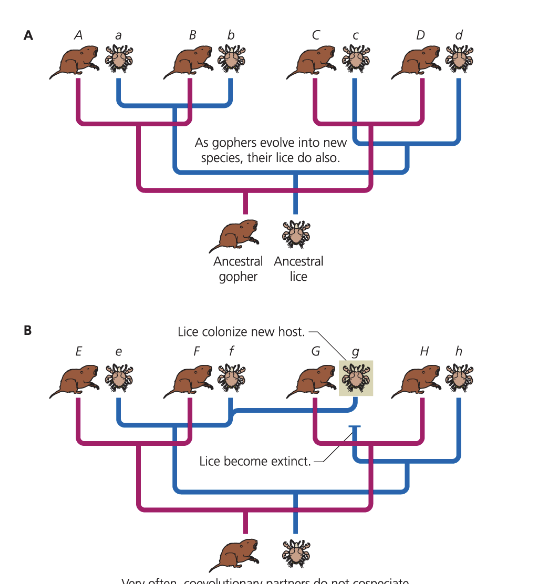
What is codivergence?
Parallel divergence of ecologically assocaited lineages.
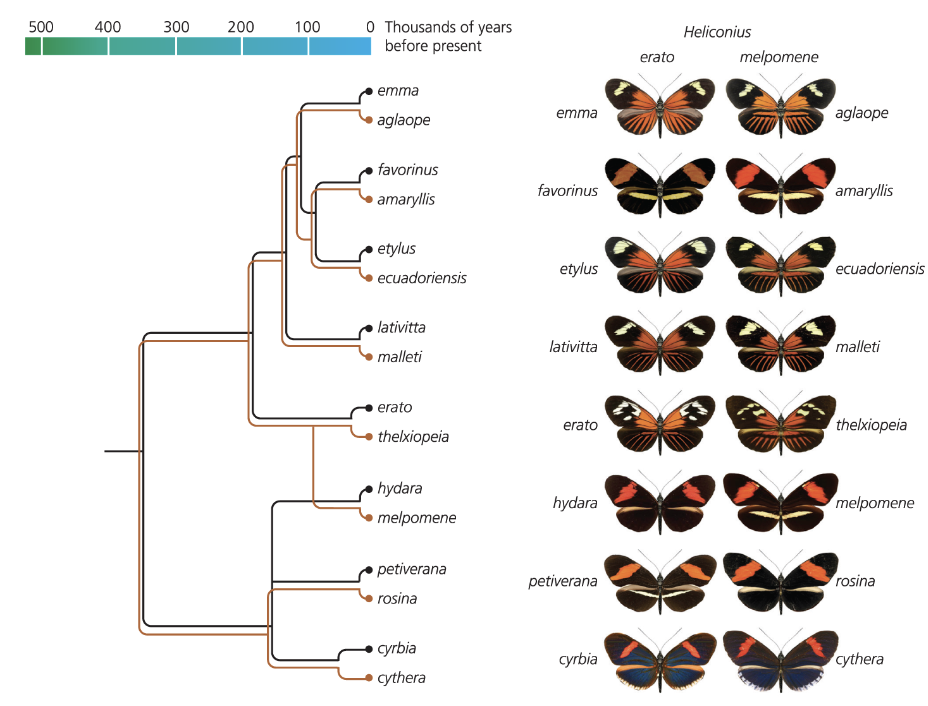
What is cospeciation?
Occurs when a population speciates in response to, and in concert with, another species.
What is the fundamental units of biodiversity?
Species.
What is a species?
A seperately evolving meta-population lineage.
What is a meta-population?
A group of spatially separated populations of the same species that interact at some level.
What is phylogenetic species concept?
The smallest possible group descending from a common ancestor and recognizable by unique, derived traits.
Useful for systematics: focuses on phylogenetic history
Emphasizes products of a history of evolutionary divergence.
What is biological species concept?
Species are group of potentially interbreeding populations that are reproductively isolated from other such groups.
Works pretty well for sexually reproducing animals.
Emphasizes process by which species arise.
What are geographic barriers?
Extrinsic properties of landscapes can prevent gene flow. Allopatry
What are reproductive barriers?
Species do not exchange genes because they have evolved features that prevent gene exchange. Sympatry
What are isolating mechanisms (or isolating barriers)?
Biological properties of individuals which prevent the interbreeding of populations that co-occur. Behavioral, morphological, physiological, genetic, or biochemicals features of individual organisms.
What is premating?
Timing of reproduction (temporal isolation), courtship signals or pollinator preferences (behavioral isolation)
What is postmating/prezygotic?
Damage to female reproductive tract, failure to deposit sperm, failure to fertilize eggs even if egg and sperm come in contact (gametic incompatibility)
What is postzygotic?
Hybrid inviability, hybrid sterility, ecological inviability, behavioral sterility.
Is speciation a gradual process?
Yes it is!
Does prezygotic isolation or postzygotic isolation evolve faster?
Prezygotic isolation evolves faster.
For pre-zygotic isolation, does it evolve faster in sympatric or allopatric species pairs?
It evolves faster in sympatric species pairs.
Is the time required for full reproductive isolation to evolve varible?
Yes, the time is variable!
In postzygotic isolation, does heterogametic sex or homogametic sex evolve more rapidly?
The heterogametic sex evolves more rapidly. Known as Haldane’s rule.
What is character displacement?
Trait evolution that arises as an adaptive response to competition between species.
When populations occupy the same environment, what type of difference between species arises?
Sympatry, and character displacement is the key mechanism.
When populations are physically/geographically seperated, what type of difference between species arises?
Allopatry.
What is the key difficulty that needs to be overcame with polyplodization?
A new polyploid must found a sustainable population.
Usually overcome this problem by abandoning sex and founding an asexual clone.
Is asexual reproduction more common in plants or animals?
More common in plant. Explains why the origin of species through polyplodizaiton is much more common in plants.
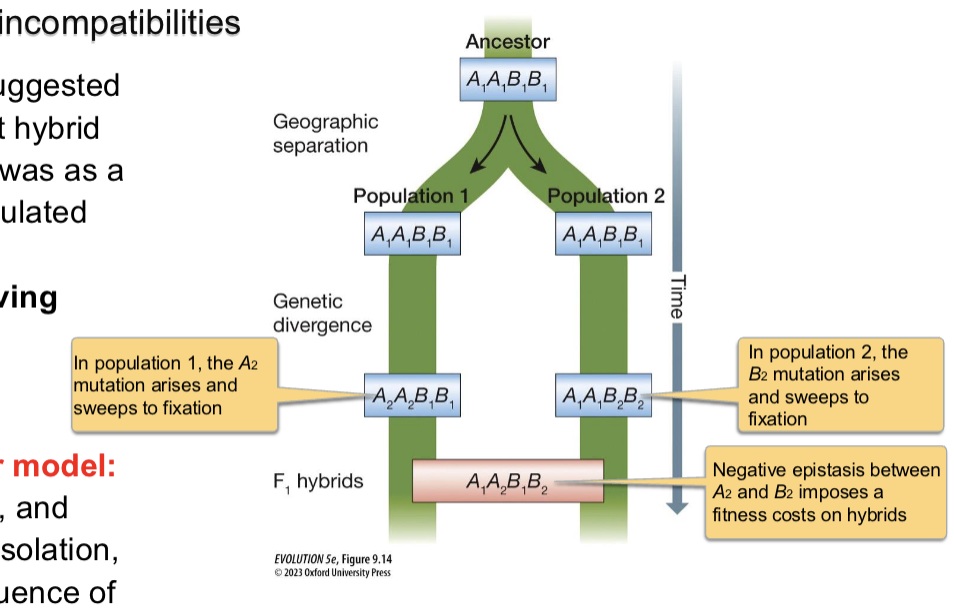
What are the Dobzhansky-Muller incompatibilities?
Hybrid incompatibility, and hence, reproductive isolation evolves as a consequence of epistasis.
Why should we care about hybridization?
It can facilitate adaptation and some policy implications of hybridization.
What is allopatric speciation?
Reproductive isolation that happens when two populations of the same species become isolated from each other due to geographic changes.
What is reinforcement?
Natural selection favors prezygotic isolation mechanisms that prevent the formation of hybrids with reduced fitness. Postzygotic isolation must evolve in allopatry.
What is sympatric speciation?
Reproductive isolation evolves without geographic isolation. Requires nonrandom mating based on genetic or phenotypic factors.
What is parapatric speciation?
Geographic barrier only partially separates populations. Some gene flow is possible.
What is isolation by distance?
Populations tend to breed with those in close proximity. Causes variation across the range of the species.
What is ecological speciation?
Selection for different ecological traits in different niches creates reproductive barriers. Can lead to pre- and postzygotic isolation.
In which book did Darwin first lay his foundations for understanding speciation?
The Origin of Species.
What is the crux of Darwin’s idea?
When organisms compete, selection should favor those individuals that are least like their competitors. Consequently, populations that compete should diverge.
What happens over time in Darwin’s idea?
Populations would become so different that they would no longer be the same species.
What concept challegned Darwin’s idea of speciation?
Physical isolation being necessary. It prevented the gene exchange between incipient species.
What is May’r allopatric model of speciation?
Speciation typically beings when populations become separated by a physical barrier that prevents gene exchange; i.e., populations diverge when they are in allopatry.
What are the two main routs of Mayr’s model?
Dispersal and Vicariance.