6.1 Stimuli & Responses
 Call Kai
 Learn
Learn Practice Test
 Spaced Repetition
 Match
Match Flashcards
 Knowt Play
1/114

There's no tags or description
Looks like no tags are added yet.
Name | Mastery | Learn | Test | Matching | Spaced | Call with Kai |
|---|
No analytics yet
Send a link to your students to track their progress
115 Terms
Stimulus
A change in an organism's internal or external environment
Why is it important that organisms can respond to stimuli ?
Organisms increase their chance of survival by responding to stimuli
What is a tropism ?
● Growth of a plant in response to a directional stimulus
● Positive tropism = towards a stimulus; negative tropism = away from stimulus
When tropism occurs towards the stimulus, it's...
Positive
Types of phototropism and gravitropism
Positive phototropism - part of plant grows towards light
Negative phototropism - part of plant grows away from light
Positive gravitropism - part of plant grows toward gravity
Negative gravitropism - part of plant grows away from gravity
Plant growth factors
● Hormone-like chemicals which regulate plant growth in response to directional stimuli
● Produced in plant growing regions (tips of shoots/roots)
● Diffuse from cell to cell / phloem mass transport
How does IAA effect elongation of cells ?
● Inducting increasing the plasticity (ability to stretch) of their cell walls.
● The acid growth hypothesis: It involves the active transport of hydrogen ions from the cytoplasm into spaces in the cell wall → disrupts the hydrogen bonding in cellulose→ allows more diffusion of water → causing the cell wall to become more plastic via turgor
Summarise the role of growth factors in flowering plants
● Specific growth factors e.g. Auxins (IAA) move via diffusion (or phloem) from growing regions (shoot / root tips) where they're produced
● To other tissues where they regulate growth in response to directional stimuli (tropisms)
● By stimulating or inhibiting cell elongation
Describe how indoleacetic acid (IAA) affects cells in roots and shoots
IAA is synthesised in cells at the tip of the shoot
● In shoots, high concentrations of IAA stimulates cell elongation
● In roots, high concentrations of IAA inhibits cell elongation
Explain phototropism
1. Cells in the tip of the shoot produce IAA, which is then transported/diffuses down the shoot.
2. IAA initially transported evenly throughout all regions as it begins to move down the shoot.
3. Light causes IAA to move from the light side to the shaded side of the shoot.
4. A greater conc of IAA builds up on shaded side than on the light side.
5. As IAA causes elongation of shoot cells and there is a greater conc of IAA on the shaded side of the shoot, the cells on this side elongate more.
6. The shaded side of the shoot elongates faster than the light side, causing the shoot tip to bend towards the light.
Explain phototropism in flowering plants
1. Cells in tip of shoot/root produce IAA
2. IAA diffuses down shoot/root (initially evenly)
3. IAA moves to shaded side of shoot / root (so conc. ↑ compared to light side ) as a result of light
4. In shoots, this stimulates cell elongation on shaded side, whereas in roots this inhibits cell elongation
5. Shaded side grows faster so shoots bend towards light, whereas roots bend away from light
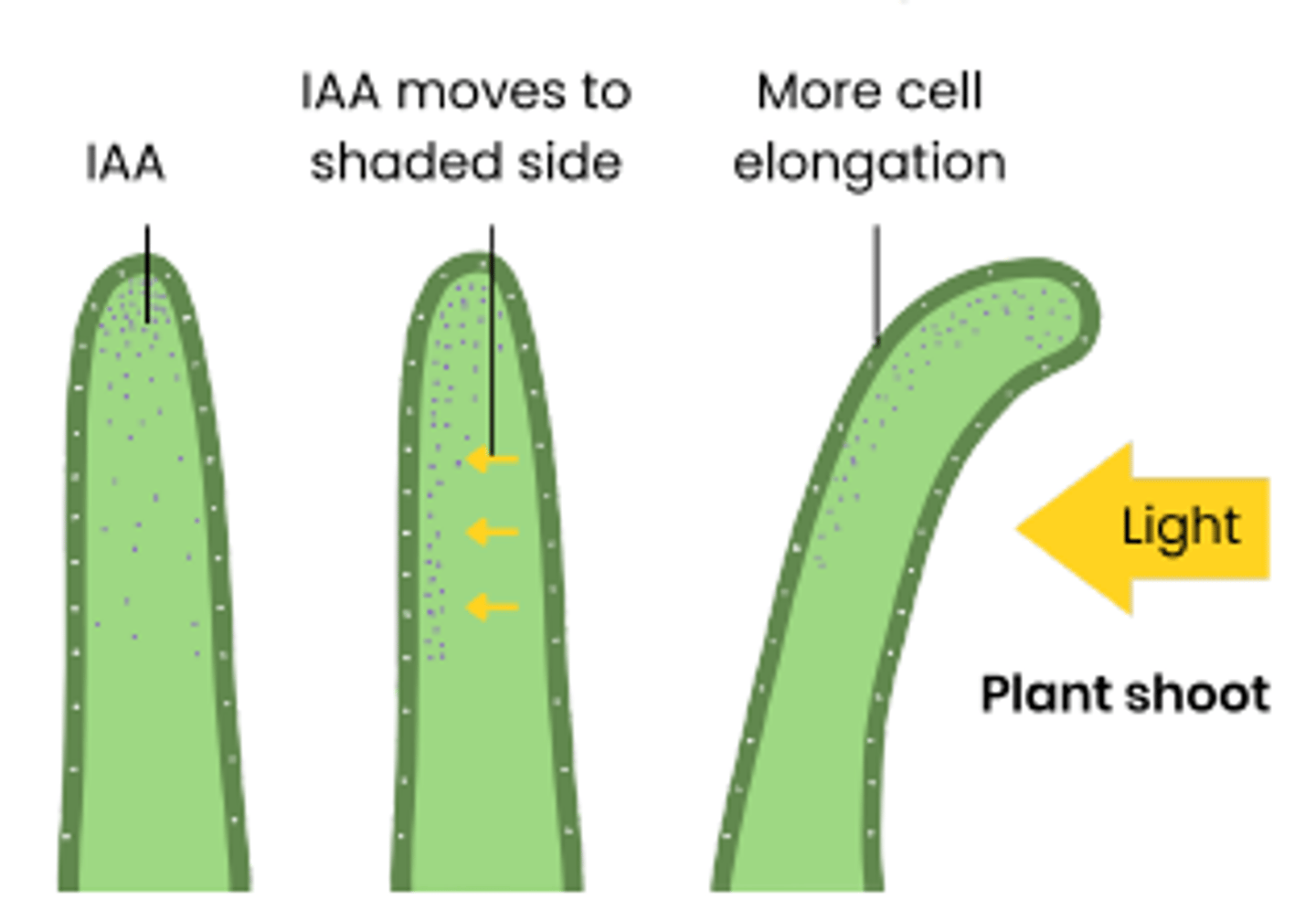
Explain why shoots show positive phototropism due to the mechanism of IAA eg) H+ actively transported into cell wall
1. IAA diffuses to shaded side of shoot tip.
2. As IAA diffuses down shaded side, it causes active transport of H⁺ ions into cell wall.
3. Disruption to H-bonds between cellulose molecules & action of expansins make cell more permeable to water (acid growth hypothesis).
4. Cells on shaded side elongate faster due to higher turgor pressure.
5. Shoot bends towards light.
How might positive phototropism be beneficial for a plant?
Grow towards the light, more light-dependent and light-independent reaction
Explain gravitropism in the roots
1. Cells in the tip of the root produce IAA, which is then transported along the root.
2. The IAA is initially transported to all sides of the root.
3. Gravity influences the movement of IAA from the upper side to the lower side of the root.
4. A greater concentration of IAA builds up on the lower side of the root than on the upper side.
5. As IAA inhibits the elongation of root cells and there is a greater conc of IAA on the lower side, the cells on this side elongate less than those on the upper side.
6. The relatively greater elongation of cells on the upper side compared to the lower side causes the root to bend downwards towards the force of gravity.
Explain gravitropism in flowering plants
1. Cells in tip of shoot/root produce IAA
2. IAA diffuses down shoot/root (initially evenly)
3. IAA moves to lower side of shoot / root (so conc. increases)
4. In shoots this stimulates cell elongation, whereas in roots this inhibits cell elongation
5. So shoots bend away from gravity whereas roots bend towards gravity
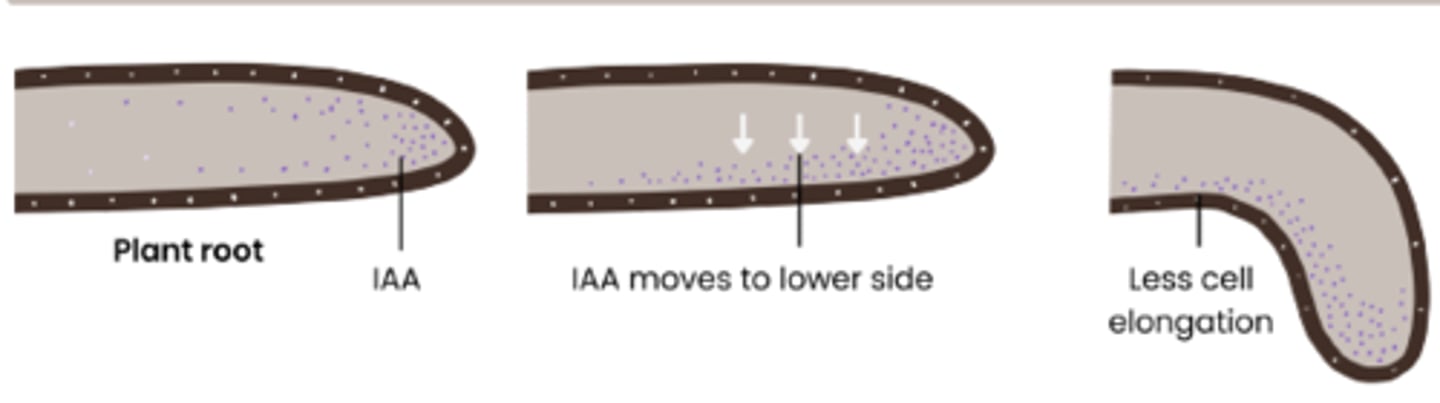
Why might positive gravitropism be beneficial for a plant?
● Roots can anchor the plant if they are deep in soil away from light → stability
● Improved absorption of water and mineral ions
A high concentration of IAA has a different effect in shoots compared to roots. Describe this difference.
In positive phototropism in shoots, high concentrations of IAA stimulate cell elongation.
In positive geotropism in roots, high concentrations of IAA inhibit cell elongation on the lower side.
Negative phototropism in roots (as a result of light entering the soil in daytime )
● During the day, small amounts of sunlight can penetrate the soil.
● When light hits a root, it causes IAA to move to the shaded side. In roots, high conc. of IAA inhibits cell elongation.
● So cells on shaded side of root elongate slower than those on lit side.
● Causing root to bend away from the light.
● This makes it even more likely that the root will grow deeper into the soil and reach more nutrients and water.
Negative gravitropism in shoots (as a response to being tilted towards gravity ect)
● If plant been knocked onto its side, the shoot will bend to grow vertically upwards.
● When the shoot is on its side, gravity causes IAA to move to lower side of shoot.
● In shoots, IAA stimulates cell elongation. So, cells on lower side of shoot elongate faster than those on upper side.
● Causing shoot to bend away from the force of gravity.
● So the plant will grow closer to the sun, increasing the chances of it being in direct sunlight.
Explain the importance of IAA in allowing plant growth (5)
● Made at top moves to shaded side
● Causing cells on this side to elongate so grows toward the light
● Allows cells to grow by increasing plasticity of cell wall
● More light to produce ATP & reduced NADP (during LDR)
● More GP reduced into Triose phosphate (during LIR)
● More glucose and organic material available to make new cells
Darwin and his son conducted the first experiments on phototropism.
Plant 1- Control
Plant 2- Tip removed
Plant 3- Opaque cap covering tip
Plant 4- Transparent cap covering tip
What results would you expect and what does this show ?
Plant 1- Grew towards the light (bent)
Plant 2- Grew vertically (straight)
Plant 3- Grew vertically (straight)
Plant 4- Grew towards light (bent)
The tip of a shoot is responsible for detecting light and coordinating a response.
Contrast mammalian hormones (M) and plant growth factors (PGF).
(CASTS)
CONCENTRATION:
M- response not always dependent on conc.
PGF- response proportional to conc.
ACTION:
M- bind to complementary proteins in/ on target cells
PGF- can affect all cells
SYNTHESIS
M- specialised cells
PGF- various tissues in growing regions
TRANSPORT
M- circulatory system
PGF- diffusion or phloem translocation
SPEED
M- faster-acting (homeostasis)
PGF- slower-acting (plant growth)
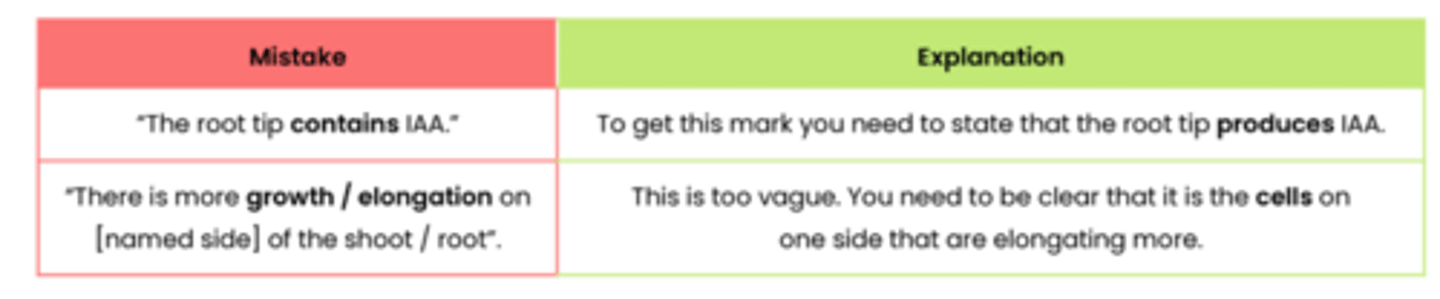
Exam insight: common mistakes ❌
Taxis and kinesis
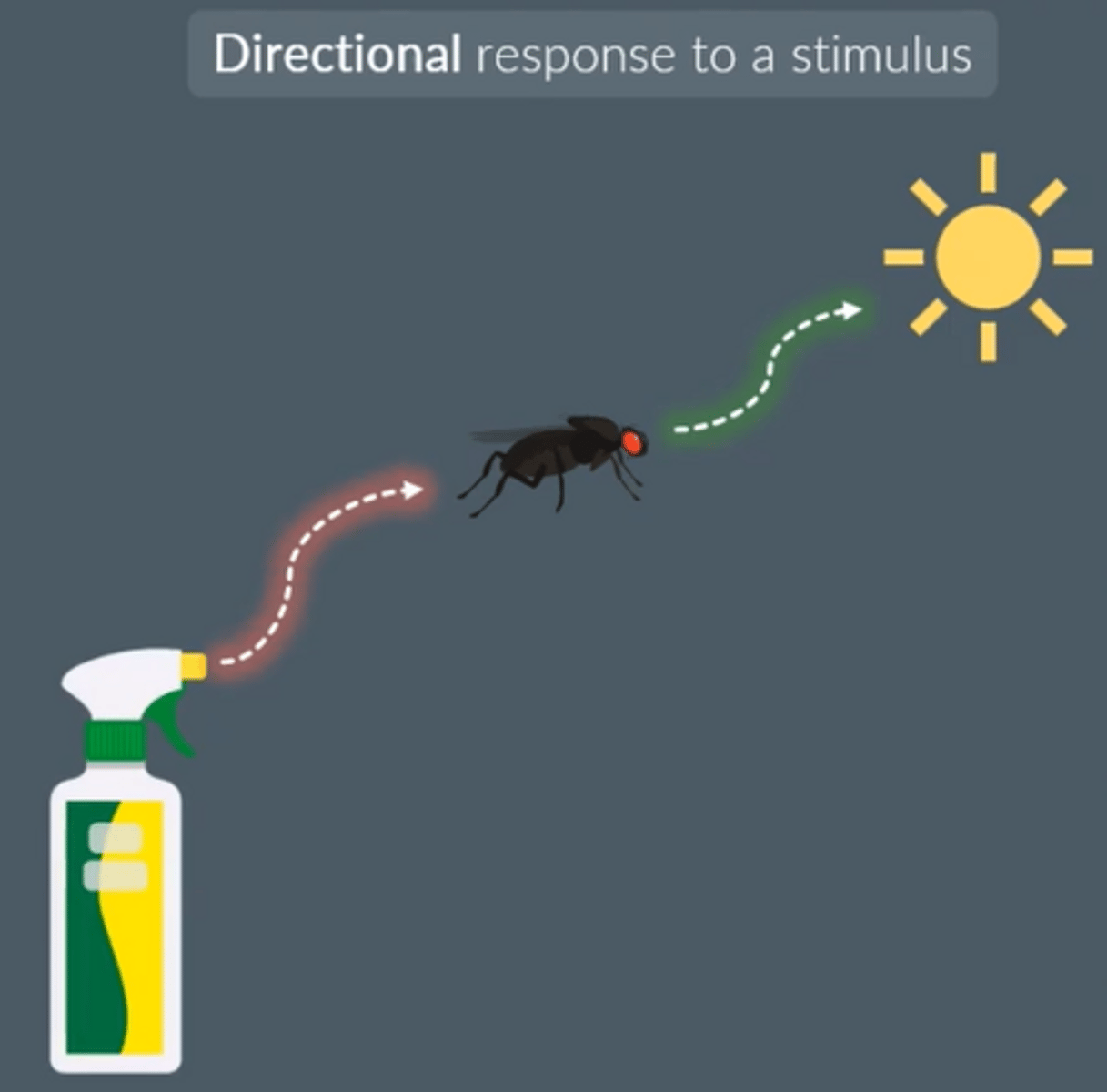
Simple responses that help a mobile organism to find and stay in a favourable environment.
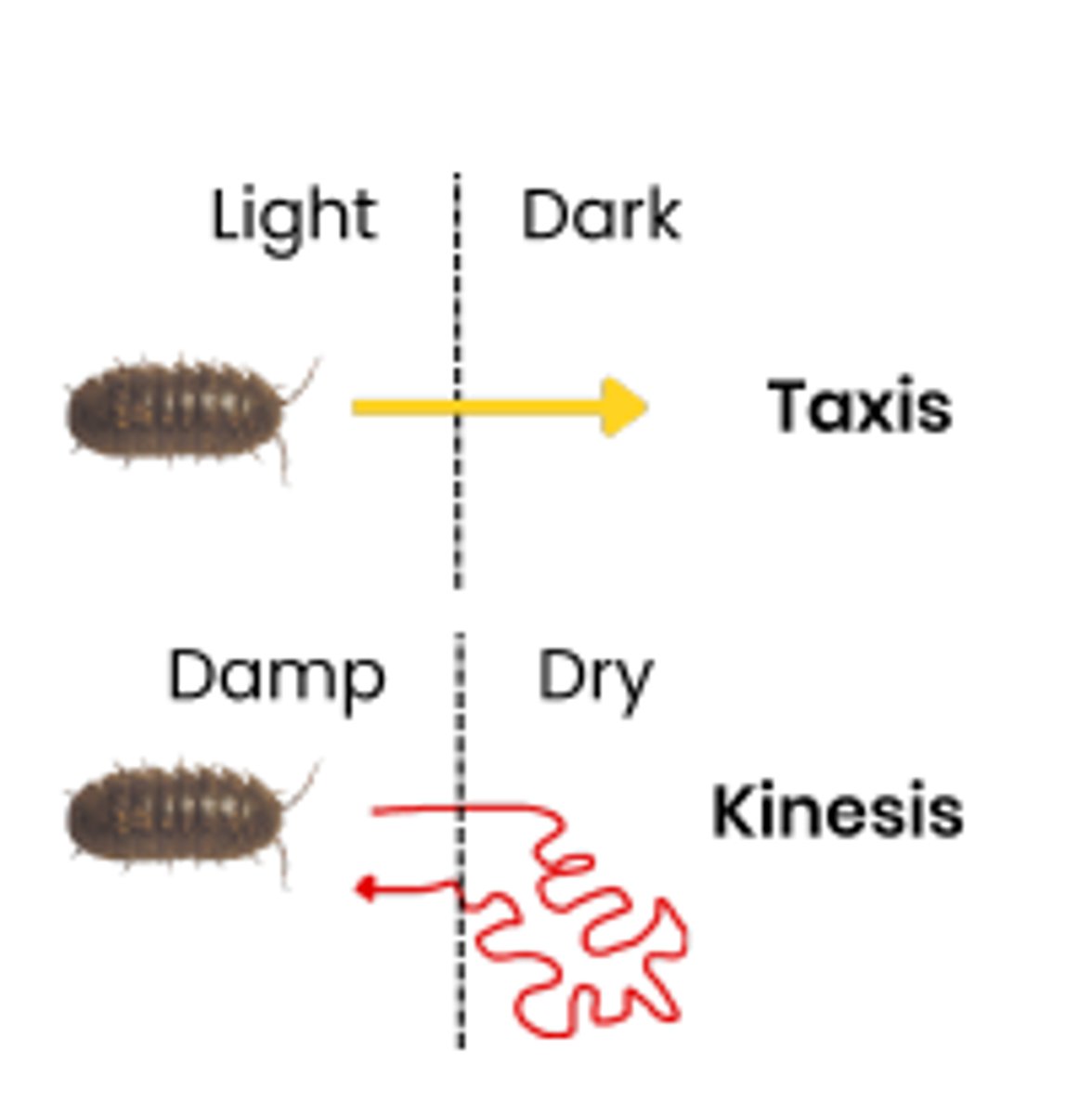
Describe how taxis (tactic response) can maintain a mobile organism in a favourable environment
● Directional response
● Movement (of whole body) towards or away from a directional stimulus
E.g. bacteria moves towards light
Describe how kinesis (kinetic response) can maintain a mobile organism in a favourable environment
● Non-directional response to a stimulus
● Speed of movement or rate of direction changes in response to a non-directional stimulus
● Depending on intensity of stimulus
E.g. Woodlice moving faster in drier environments to increase their chance of moving to an area with higher humidity to prevent drying out
Many organisms respond to temperature and humidity via kinesis rather than taxis. Why?
Less directional stimuli; often no clear gradient from one extreme to the other.
E.g. woodlice changes how it moves (kinesis) until it reaches favourable area instead of towards or away (taxis)
How could a student recognise kinesis in an organism's movement ?
1. Organism crosses sharp division between favourable & unfavourable environment: turning increases (return to the original favourable environment).
2. If organism moves considerable distance into unfavourable environment: turning slowly decreases; begins to move in long, straight lines; sharper turns (lead organism to new environment).
Give a difference between a taxis and a kinesis
Kineses do not involve a directional movement, taxes do.
Kinesis - moving from favourable to unfavourable environment
● Decreases speed
● Increases rate of turning
● This increases the chance of it returning to the favourable environment.
Kinesis; unfavourable → favourable env
● Increases speed
● Decreases rate of turning - moves in long straight lines
● Increases it's chance of finding a favourable environment.
Once in favourable environment:
● Decreases speed
● Increases rate of turning
Why is kinesis non directional but taxis is directional ? (this is for my understanding)
Kinesis is non-directional as the organism doesn't turn towards or away from the stimulus itself - the turning is random.
Taxis is directional because the organism does move towards or away from the stimulus itself - not randomly.
Contrast taxis, kinesis and tropism
● Taxis and kinesis are the movement of a whole organism.
● Tropism is the growth response of a part of a plant.
● Kinesis is non directional
● Taxis and tropism are both directional
Explain the protective effect of a simple (e.g. 3 neurone) reflex
● Rapid as only 3 neurones and few synapses (synaptic transmission is slow)
● Autonomic (doesn't involve conscious regions of brain) so doesn't have to be learnt
● Protects from harmful stimuli eg. escape predators / prevents damage to body tissues
Required practical 10
Investigation into the effect of an environmental variable on the movement of an animal using either a choice chamber or a maze.
Describe how the effect of an environmental variable on the movement of an animal (eg. woodlice) can be investigated using a choice chamber
1. Set up choice chamber (different compartments) to create different environmental conditions
○ Eg. humidity → add a drying agent to one side and damp filter paper to other
○ Eg. light → shine a light but cover one half with black card
2. Control other environmental conditions
○ Eg. if investigating humidity control light intensity with a dim even light above
3. Use a teaspoon to place a set number of animals eg. 12 woodlice on centre of mesh platform
and cover with lid
4. After a set amount of time eg. 10 minutes record the number of animals in each section
5. Repeat after gently moving woodlice back to centre
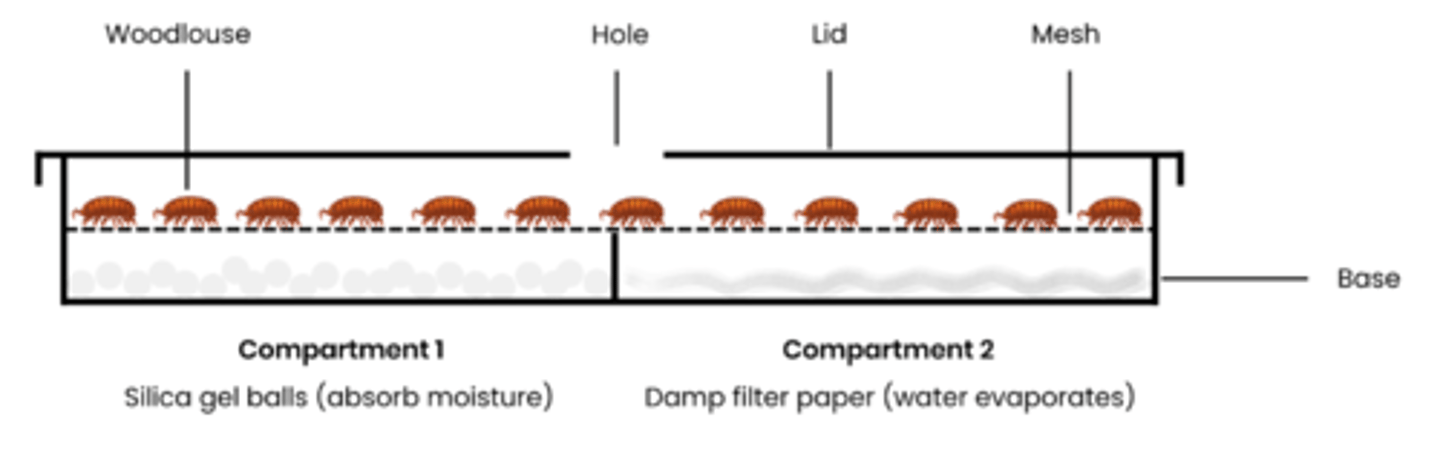
The woodlice were left for 15 minutes before their movement was recorded when investigating the effect of humidity. Explain why. (2)
● Time to establish humidity / for substance to absorb water / water from paper to evaporate
● Woodlice no longer affected by handling
● So that behaviour is typical of that humidity
Explain how you would ensure the safe and ethical handling of animals.
(2)
● Safely - cover open wounds / wash hands with soap after
○ To minimise risk of infection
● Ethical - handle carefully / return to habitat ASAP
Explain why a mesh platform is used when investigating the effect of
humidity. (1)
● To keep woodlice a safe distance from drying agent
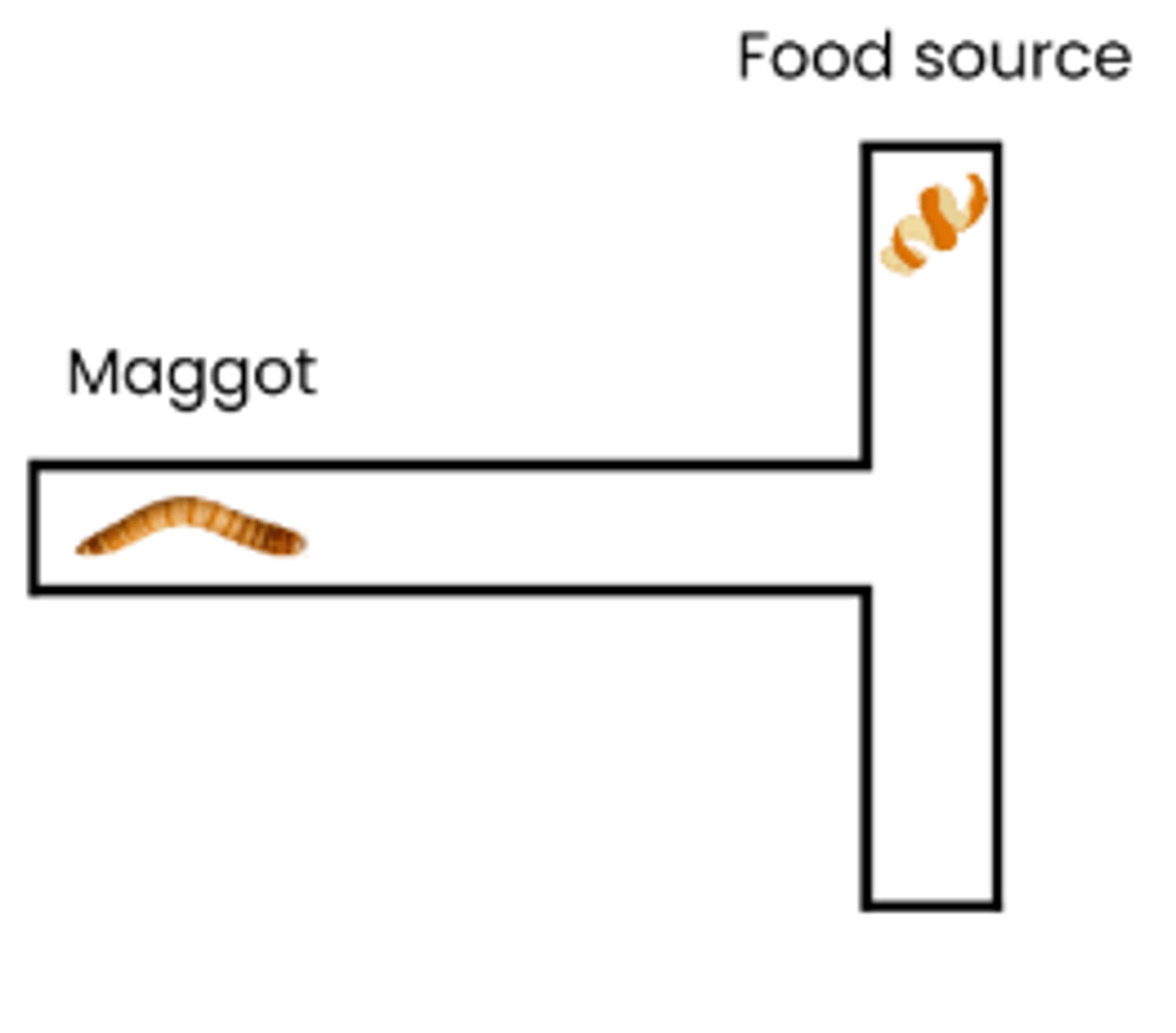
Describe how the effect of an environmental variable on the movement of an animal (e.g. maggots) can be investigated using a maze
Mazes are used to investigate turning behaviour in response to different environmental conditions:
1. Change environment at one end of T shape e.g. add food source
2. Place animal e.g. maggot in stem of T
3. Record whether animal turns towards or away from food source
4. Repeat with a large number of maggots
○ Wipe / clean maze between trials
5. Repeat with food on other side of T
Explain why the same organism is not used more than once. (2)
● Reduces stress on maggots
● Prevents chance of learned behaviours
Explain why a clean petri dish / maze is used each time. (2)
● Animals may leave chemicals / scents
● Which influence behaviour of other animals
Explain which statistical test should be used to analyse results
● Chi-squared
● As data are categorical and comparing frequencies
● To see if there is a significant difference between observed and expected frequencies
○ Expected = equal numbers each side
Name the 3 coordination centres in the body and describe what each of them coordinates.
● Brain - coordinates information from the receptor cells and send signals to the muscles and glands.
● Spinal cord - Coordinates messages from the brain and receptor cells and coordinates reflexes.
● Pancreas - coordinates the glucose levels in the blood.
How does a stimulus lead to a response being carried out by the body?
● Stimulus is converted into an electrical impulse by the receptors.
● The electrical impulse passes along sensory neurones to the central nervous system (CNS).
● The CNS coordinates an appropriate response and an electrical impulse is sent along motor neurones to the effector, which carries out the response.
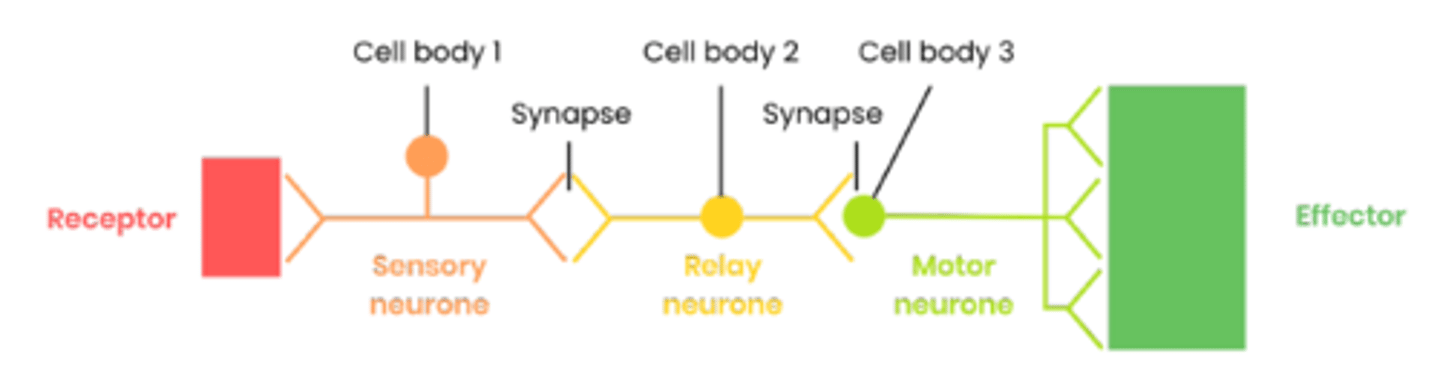
Describe how a reflex action occurs via a reflex arc
● The stimulus is detected by a receptor.
● An electrical impulse passes along a sensory neurone to the spinal cord (part of the CNS).
● At a synapse between a sensory neurone and a relay neurone, a chemical diffuses across the gap and stimulates a new impulse which passes along the relay neurone.
● The same process occurs at a synapse between a relay neurone and a motor neurone.
● At the effector, an appropriate response is carried out.
Give the order of a reflex arc
Receptor detects stimulus → sensory neuron → relay neuron in CNS coordinates response → motor neuron → response by effector
What is the difference between a reflex pathway and a conscious pathway?
● Within a reflex pathway, the coordination centre is a relay neurone found in the spinal cord/unconscious parts of the brain.
● In a conscious pathway, the coordination centre is in the conscious part of the brain.
Describe how an electrical impulse is transferred to the next neurone
● Electrical impulse causes neurotransmitters (chemicals) to be released into the synapse.
● Neurotransmitters diffuse across the synapse to the next neurone.
● Neurotransmitters bind to receptors on the next neurone, causing the electrical impulse to be passed on to the
Sensory neurone
● Converts a receptor-generated signal (stimulus → generator potential → action potential) into an electrical nerve impulse that the CNS can process.
Pacinian corpuscle
● Receptor found deep under animal's skin
● Sensory neurone in centre, surrounded by layers of tissue
● Only responds to mechanical pressure from the environment (e.g. pressing finger to cheek)
Receptors...
Only respond to specific stimuli
Describe the basic structure of a Pacinian corpuscle
lamellae: layers of connective tissue
gel surrounding these tissue allowing diffusion/movement of sodium ions
sensory neuron running in middle with negative charge inside
sodium ion channels connected to membrane of sensory neurons which open in response to mechanical pressure → depolarization in sensory neuron
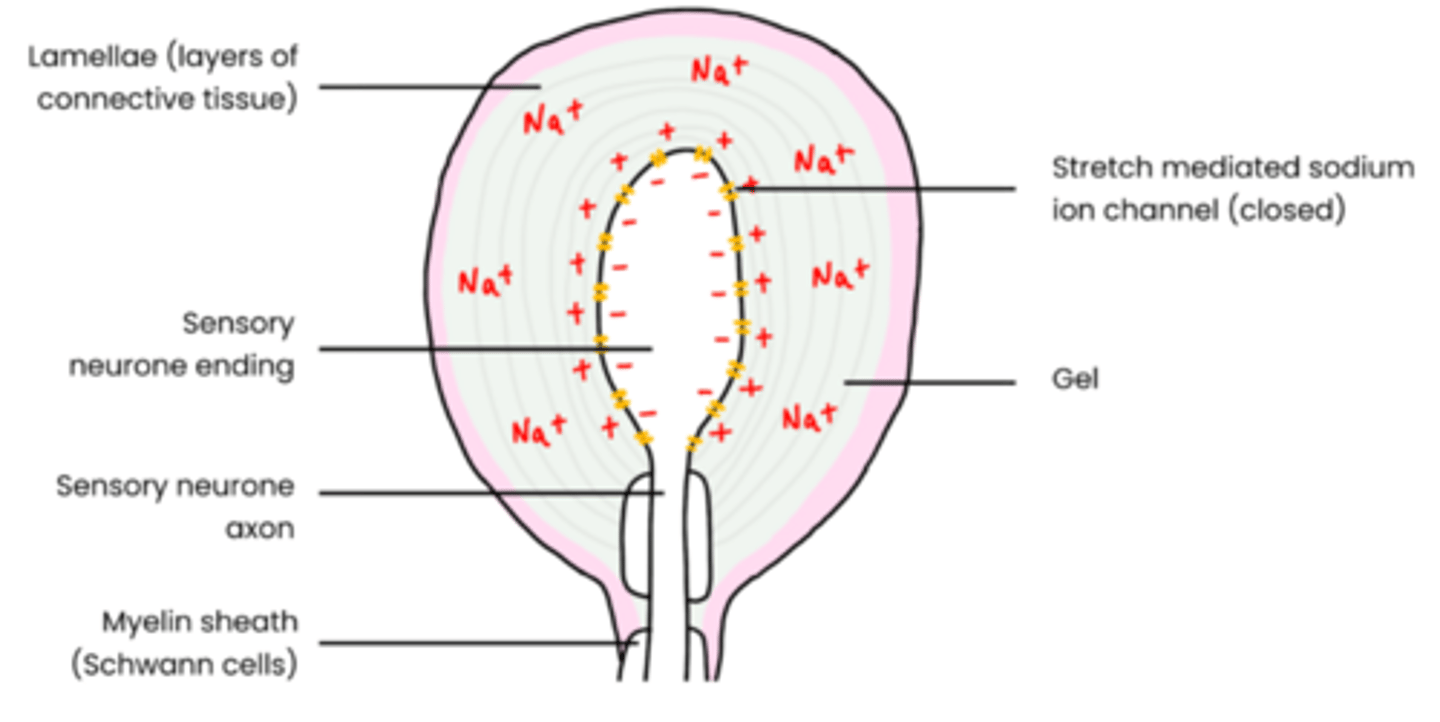
Stretch mediated sodium channels
Transport proteins in the membrane of the sensory neurone, which open when the membrane is stretched/under mechanical pressure
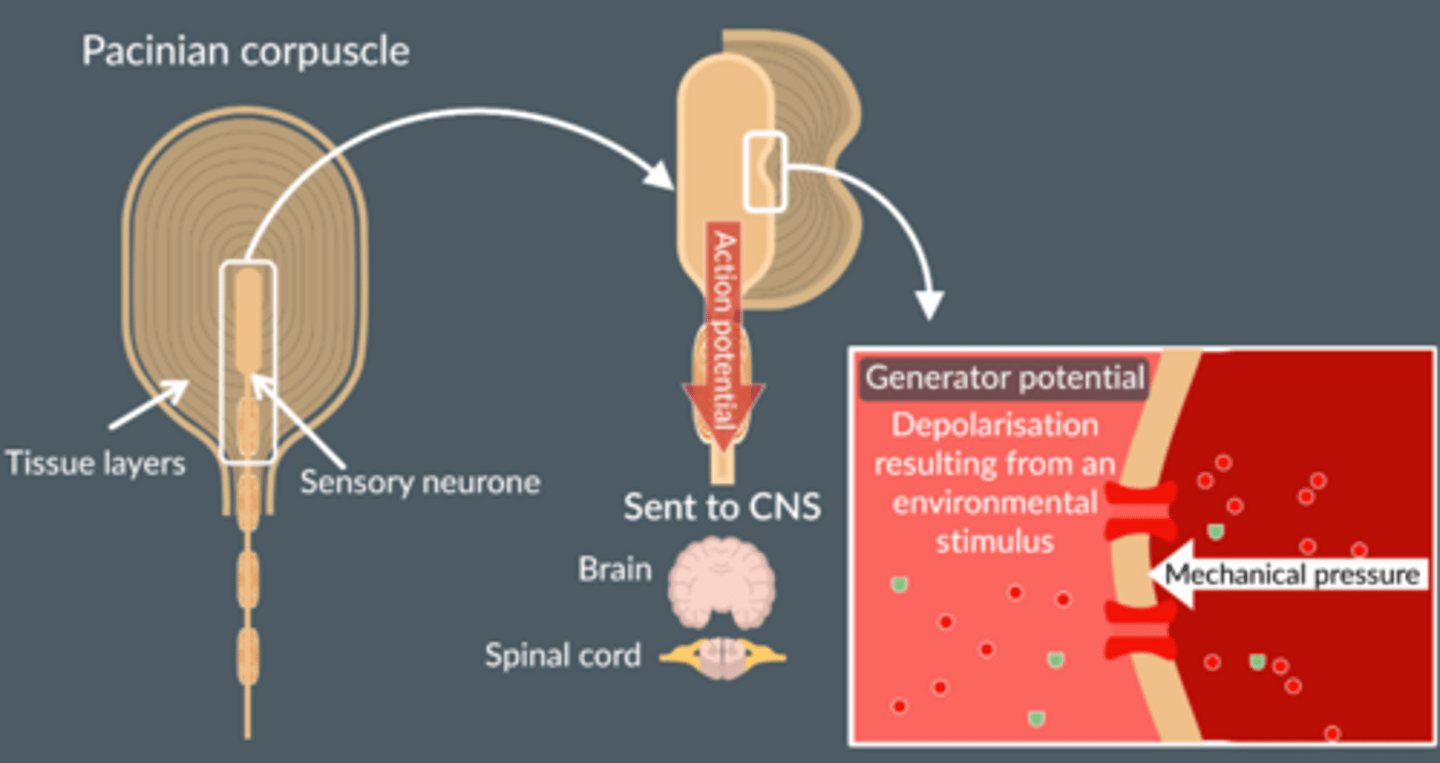
Describe how a generator potential is established in a Pacinian corpuscle
1. Mechanical stimulus e.g. pressure deforms lamellae and stretch-mediated sodium ion (Na+) channels open
2. So Na+ diffuse into sensory neurone
○ Greater pressure causes more Na+ channels to open and more Na+ to enter
3. This causes depolarisation, leading to a generator potential
○ If generator potential reaches threshold, it triggers an action potential, which is then sent to CNS
Pacinian corpuscle diagram
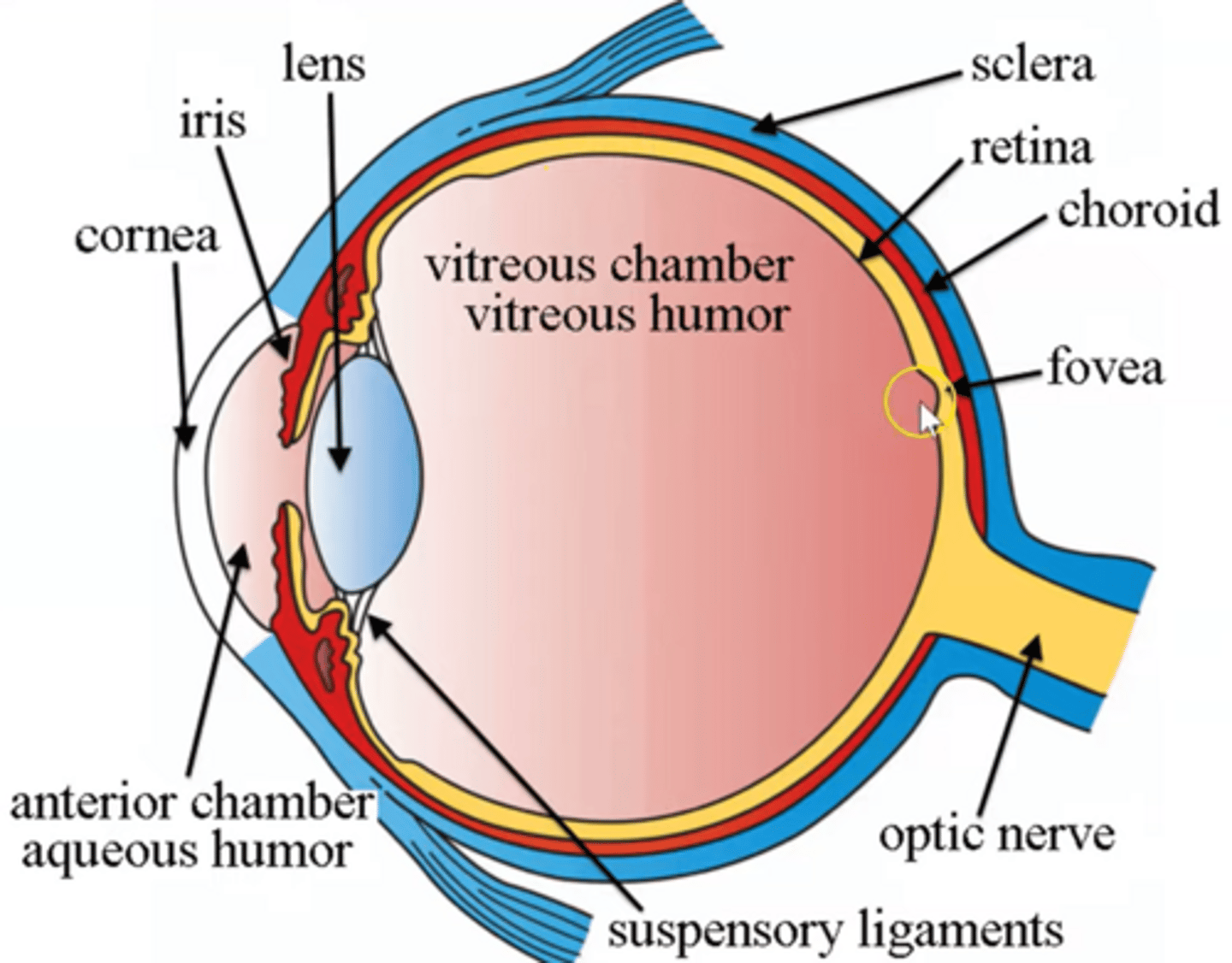
Retina
● A light-sensitive layer at the back of the eye where light is focused
● Retina has receptor cells for light, which allow us to detect light intensity + light colour.
● Most light falls on fovea (centre of retina)
Explain what the Pacinian corpuscle illustrates
● Receptors respond only to specific stimuli
○ Pacinian corpuscle only responds to mechanical pressure
● Stimulation of a receptor leads to the establishment of a generator potential
○ When threshold is reached, action potential sent (all-or-nothing principle)
What features are common to all sensory receptors ?
● Act as energy transducers which establish a generator potential.
● Respond to specific stimuli.
Synapse
A junction between 2 neurones that transfers an action potential
(or between a neurone and a muscle fibre)
What are rod and cone cells?
● Photoreceptors in the retina connected to sets of sensory neurones
● The axons of these sensory neurones form the optic nerve (transfer impulses from retina to brain)
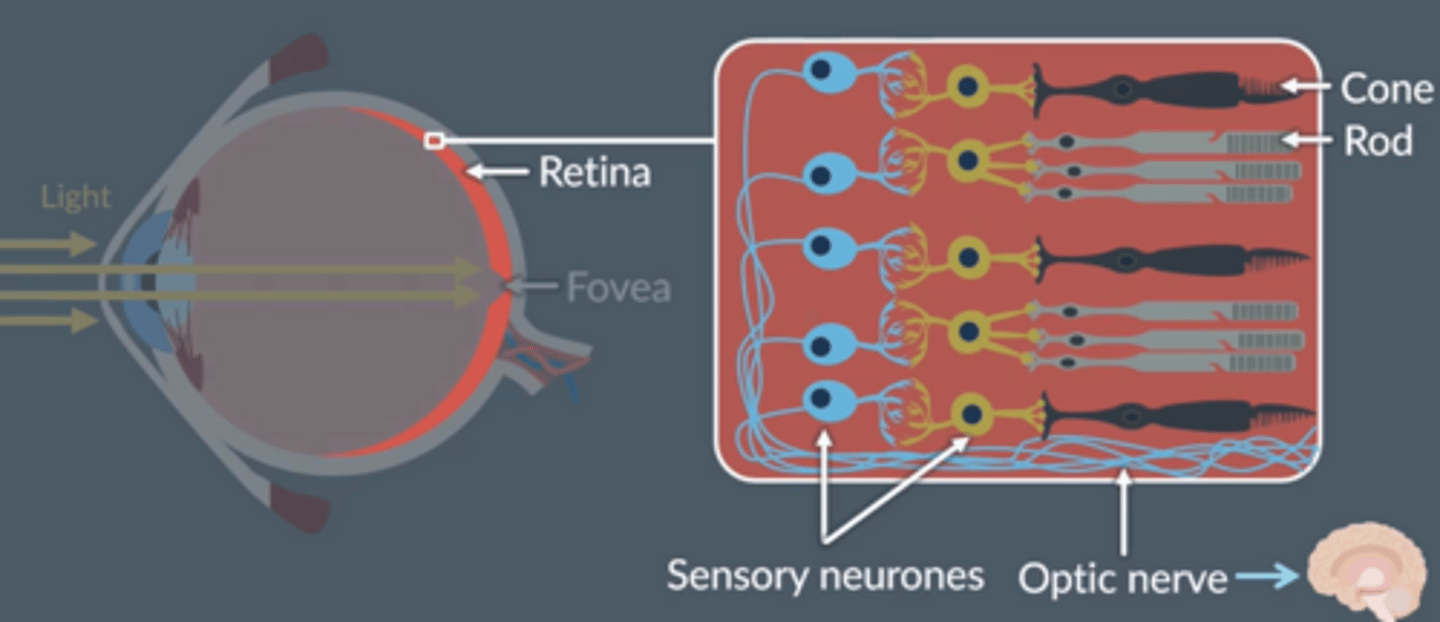
Where are rod and cone cells located in the retina ?
Rod: evenly distributed around periphery but NOT in central fovea
Cone: mainly central fovea, no photoreceptors at blind spot
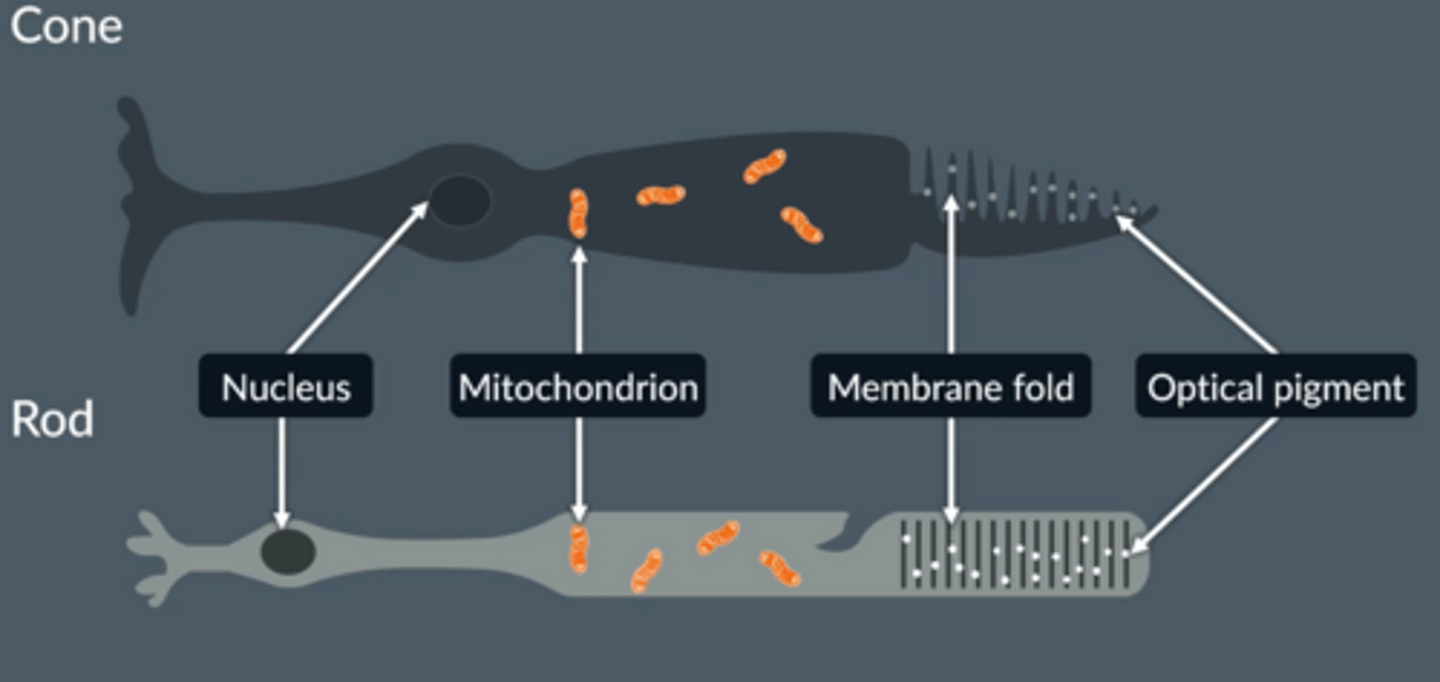
Features of rod and cone cells
Nucleus
Mitochondria
Membrane folds dotted with optical pigment
Iodopsin
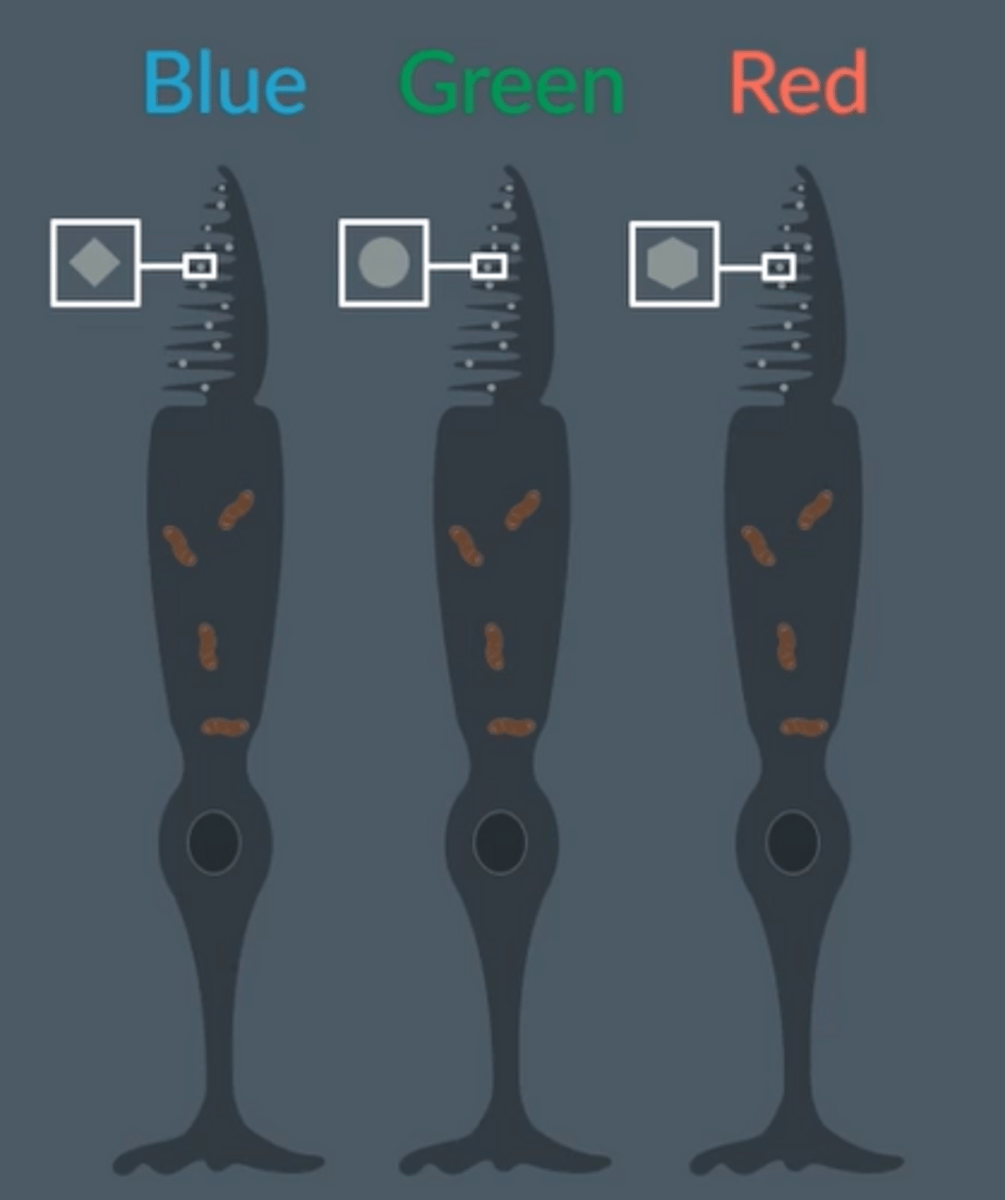
● Pigments in cone cells, only broken down (bleached) in high light intensities, so action potentials only generated if high enough light intensity to break down enough pigment.
● Can be red, green or blue
● They all absorb different wavelengths of light
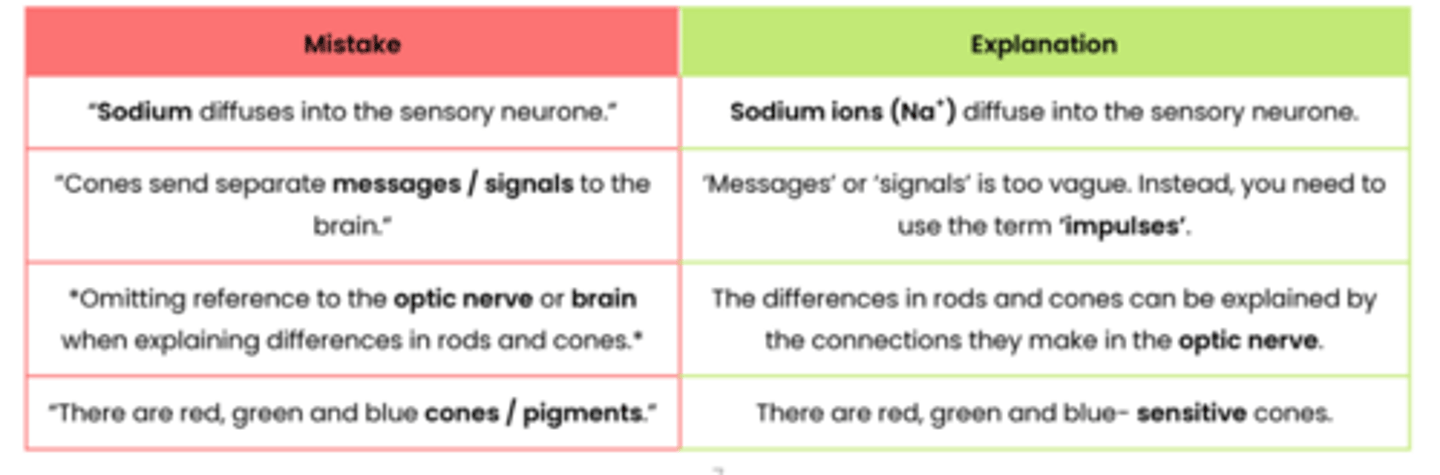
Bipolar neurone
A neurone of the retina that receives impulses from the rods and cones, and transmits them to a ganglion neurone.
Rod/cone cells → Bipolar neurons → Ganglion neurons → Optic nerve → Brain
How is a generator potential established in rod cells ?
Receptors detect a specific stimulus, if stimulus is large enough a generator potential is established → action potential
Compare rods and cone cells
ROD
● One type of rhodopsin (pigment)
many connected to one sensory neurones
● Greater number than cones
● Distributed more in periphery of retina (where light intensity is at lowest)
● Poor visual acuity (seeing in dark)
● High sensitivity
CONE
● R, G, B types of iodopsin (pigment)
● Fewer numbers than rods
● Fewer at periphery, concentrated in fovea
● High visual acuity
● Low sensitivity
Explain the differences in sensitivity to light for rods & cones in the retina
RODS are MORE sensitive to light
● Several rods connected to a single bipolar cell/sensory neurone
● Spatial summation to overcome threshold (as enough neurotransmitter released) to generate an action potential.
● (Rod cells must produce many generator potentials to trigger a single action potential in the sensory neurone)
CONES are LESS sensitive to light
● Each cone connected to a single neurone
● No spatial summation
● Generator potential is often not exceeded. So, cone cells only respond to high light intensity.
Outline the pathway of light from a photoreceptor to the brain.
photoreceptor → bipolar neuron → ganglion cell of optic nerve → brain
Spatial summation
The sum of multiple synapses firing at different locations at one time to create a net effect.
What is meant by having a high visual acuity ?
The ability to distinguish 2 objects that are very close together.
Explain the differences in visual acuity for rods & cones in the retina
Rods give lower visual acuity
● Several rods connected to a single neurone
● So several rods send a single set of impulses to brain (so brain can't distinguish between separate sources of light. 2 close dots together can't be resolved and so will appear as a single blob)
Cones give higher visual acuity
● Each cone connected to a single neurone (their own)
● Cones send separate (sets of) impulses to brain (so can distinguish between 2 separate sources of light)
Explain the differences in sensitivity to colour for rods & cones in the retina
Rods allow monochromatic vision
● 1 type of rod / 1 pigment
Cones allow colour vision
● 3 types of cones - red-, green- and blue-sensitive
● With different optical pigments → absorb different wavelengths
● Stimulating different combinations of cones gives range of colour perception
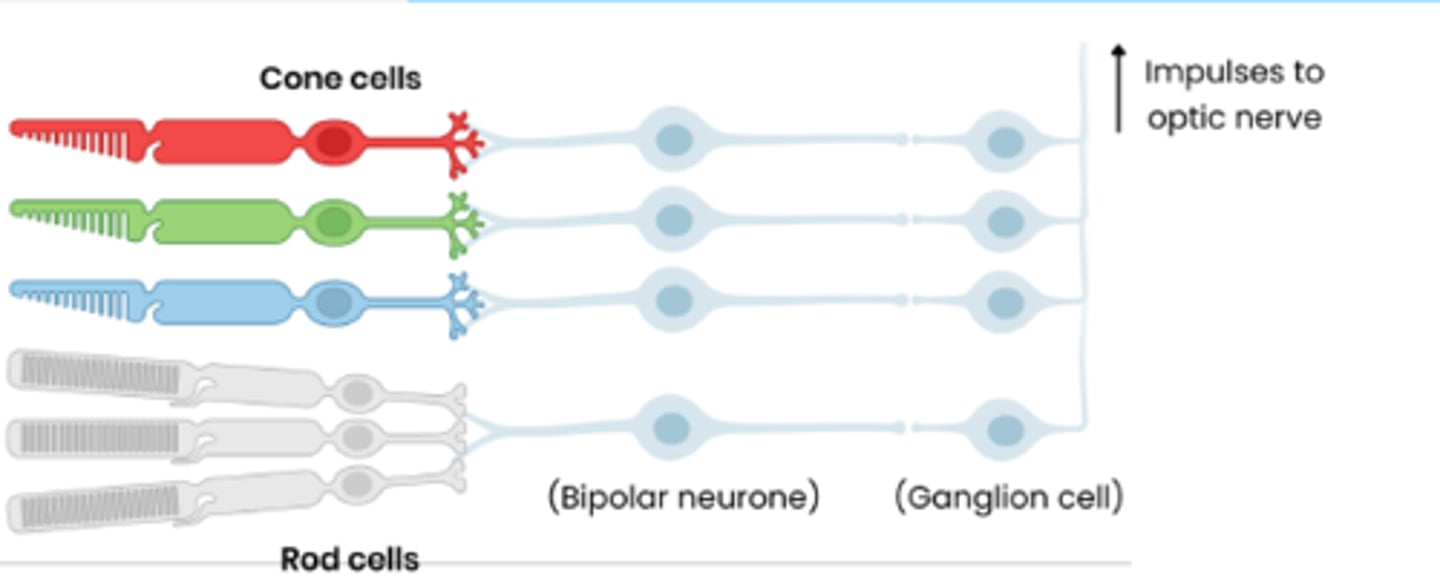
Common errors to AVOID (flashcards say what is actually correct)‼️
● Sodium ions (Na+) diffuse into the sensory neurone.
● 'Messages' or 'signals' is too vague. Must say 'impulses'.
● The differences in rods and cones can be explained by the connections they make in the optic nerve.
● There are red, green and blue- sensitive cones.‼️
What is retinal convergence and what does it cause ?
● More than one receptor attached to a sensory neurone (rods)
● Low visual acuity and high light sensitivity
Vision → other parts of the retina → high sensitivity to light.
● Many rods in other parts of retina;
● Rhodopsin (pigment) in receptors / rod cells very sensitive to light / works in low light;
● Rods connected in groups to ganglion cell / neurone;
● Summation;, e.g. if enough light above threshold hits any cells in the group, then nerve impulses sent to brain/along optic nerve;
Explain why vision using the fovea has high visual acuity.
● Each receptor/cone (in fovea) connected to it's own neurone
● Rods in other parts share a neurone;
When the image is focused on the fovea, the person sees the object in colour.
Explain why.
● Colour detected by cone cells;
● Fovea contains mainly cone cells;
● 3 types of cone cells, each sensitive to different wavelength (red, green or blue)
Describe how the number and distribution of rods and cones across the retina would differ in a nocturnal mammal from the number and
distribution in a human.
Explain your answer.
● More rods and fewer cones present;
● Rods at the fovea / rods not mainly at periphery; rods have high sensitivity / show retinal convergence /converse for cones;
● Rhodopsin 'bleached' at low light intensities / iodopsin 'bleached'; at high light intensities;
(bleached = broken down)
Exam insight: common mistakes ❌
CONTROL OF HEART RATE
Cardiac muscle is myogenic. What does this mean?
● Contraction of heart is initiated within the muscle itself, rather than by nerve impulses (so it's not neurogenic)
● BUT the RATE of contraction is controlled by a wave of electrical activity
Label the sinoatrial node (SAN), atrioventricular node (AVN), Bundle of His and Purkyne tissue on a diagram of the heart
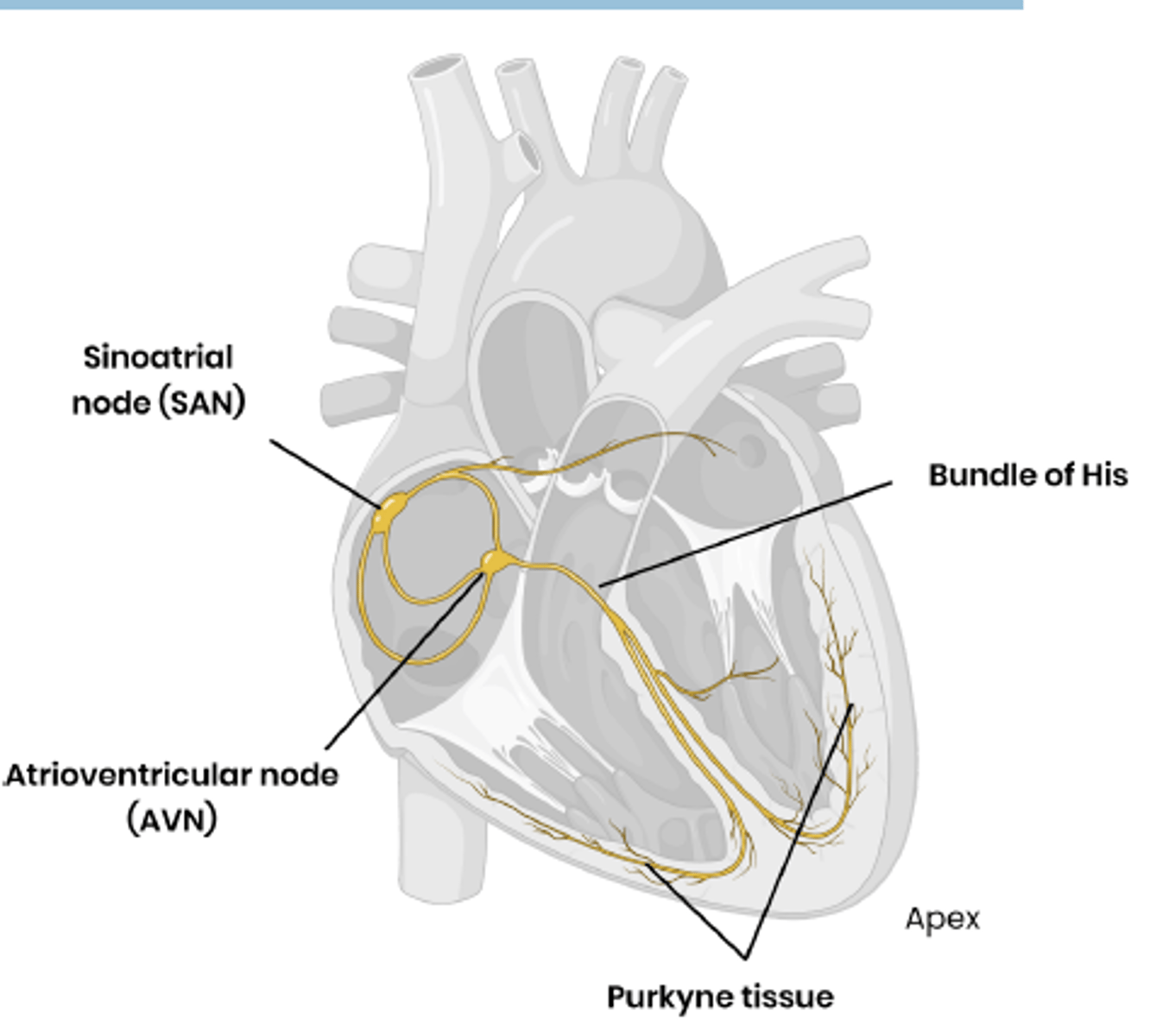
SAN
● Sinoatrial node; specialised muscle cells located in wall of right atrium.
● Acts as a pacemaker by generating an impulse/wave of depolarisation that causes the atria to contract
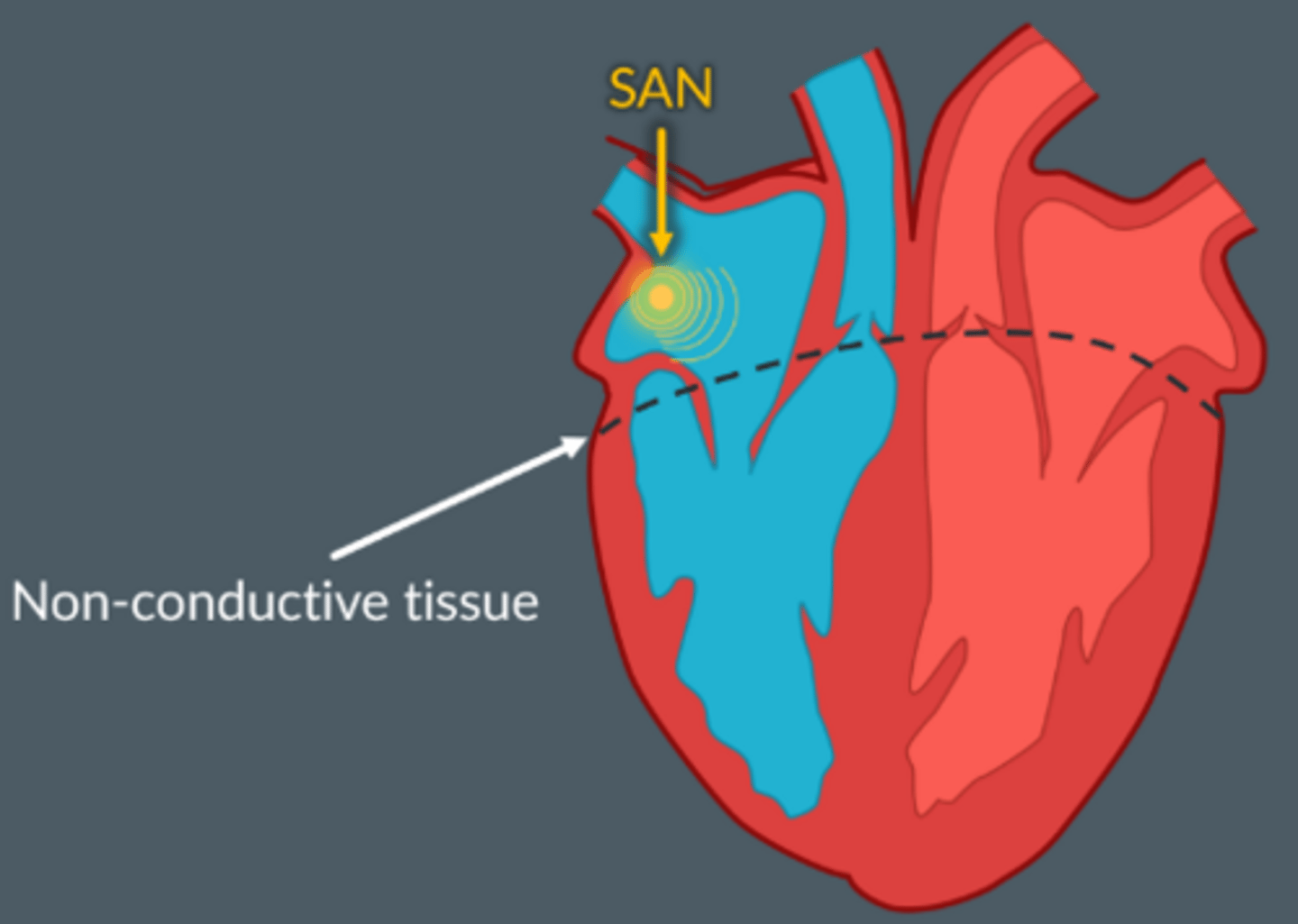
What stops the electrical impulse released by the SAN from passing from the atria to the ventricles ?
What would happen if this didn't happen ?
A wall of non-conductive tissue (atrioventricular septum - imagine it runs horizontally)
Otherwise, the ventricles would contract at the same time as the atria.
AVN
● Atrioventricular node; specialised cells near lower end of right atrium in the wall that separates the 2 atria
● That receive electrical activity from the SAN.
● Slight delay before AVN sends out impulses so that ventricles can fill with blood before contraction.
Purkyne fibres
Specialised muscle fibres in the walls of the ventricles that convey electrical activity to the apex (highest bit) of the heart.
Bundle of His
Collectively made up of purkyne fibres, carry the impulse from the AVN to the base of the ventricles
Septum of heart
Runs vertically down the middle;
Separates right side of heart from left side; bundle of His runs through the septum
Non conductive tissue
In the walls between atria and ventricles - blocks electrical impulses from passing directly from the atria to the ventricles.
Runs horizontally
Formula for cardiac output
Cardiac output = stroke volume x heart rate
CO = V x R
Describe the myogenic stimulation of the heart and transmission of a
subsequent wave of electrical activity
1. SAN acts as pacemaker → generates myogenic impulses across both atria, causing atria to contract simultaneously
2. Non-conducting tissue between atria and ventricles (imagine horizontal line) prevents impulse passing directly to ventricles
○ Preventing immediate contraction of ventricles
3. AVN delays impulse whilst blood (fully) leaves atria.
○ Allowing atria to fully contract and empty before ventricles contract
4. AVN sends impulses down Bundle of His which branches into purkyne fibres alone ventricles
○ Causing ventricles to contract simultaneously from the base up (apex to top)
Describe how a heartbeat is initiated and coordinated.
● SAN sends myogenic impulses across both atria causing atrial contraction.
● Non-conducting tissue prevents Impulses reaching the ventricles.
● AVN delays impulse whilst blood (fully) leaves atria.
● AVN sends impulses down Bundle of His (which branches into purkyne fibres) to apex of the heart, causing ventricles to contract from base up.
Base up
Contraction of ventricles from the bottom to the top (apex to the base)
Autonomic nervous system
● Regulates involuntary action of glands & muscles (e.g. heart rate, respiration, digestion)
● Relies on a network of receptors and effectors to respond to stimuli
● 2 divisions: symp + parasymp
Sympathetic nervous system
Stimulates effectors and speeds up processes such as heart rate (fight or flight)
↑ INCREASES HEART RATE
Parasympathetic nervous system
Inhibits effectors and slows down processes such as heart rate, involved in normal resting conditions.
↓ DECREASES HEART RATE
What is the link between the SAN and the autonomic nervous system ?
● The SAN initiates the heart beat
● It can change its rate of initiation in response to stimulation from the autonomic nervous system
What is the body's cardiac control centre ?
Medulla oblongata; it receives impulses from receptors and sends them to the sinoatrial node, changing the way the SAN fires and so overall heart rate.
Where are chemoreceptors and pressure receptors located?
Chemoreceptors and pressure receptors (baroreceptors) are located in the aorta and carotid arteries