molec bio 20+27+28
 Call Kai
 Learn
Learn Practice Test
 Spaced Repetition
 Match
Match Flashcards
 Knowt Play
1/58

There's no tags or description
Looks like no tags are added yet.
Name | Mastery | Learn | Test | Matching | Spaced | Call with Kai |
|---|
No analytics yet
Send a link to your students to track their progress
59 Terms
what is genetic variation?
differences in alleles of genes found within individuals in a population
what is natural selection?
one of the processes that guides the process of evolution
what is evolution?
changes is inheritable traits overtime
what is studied in population genetics?
the properties of genes in a population
evolution results in a change in the genetic composition of a population
what is genetic variation?
the raw material for selection
what can change allele frequencies?
natural selection
poly morphism
SNP (single-nucleotide polymorphisms)
what is allele frequency?
finding out:
what % of alleles are dominant?
what % of alleles are recessive?
what is genotype frequency?
finding out:
what % of genes are homozygous dominant (HH)?
what % of genes are homozygous recessive (hh)?
what % of genes are heterozygous (Hh)?
what is phenotype frequency?
finding out:
what % of a phenotype exists
(eg. what % of flowers in a flower field are white/purple/pink? )
what is the Hardy-Weinberg principle?
proportions of genotypes do not change in a population if…
no mutations take place
no genes are transferred to or from other sources
random mating is occurring
the population size is very large
no selection occurs
if all of the Hardy-Weinberg principles are correct/true, what is that called?
Hardy-Weinberg equilibrium
how do you calculate the frequency of genotypes/alleles
with the hardy-weinberg equation:
p²+2pq+q²=1
p=frequency of dominant allele
q= frequency of recessive allele
what is a mutation?
main source of genetic variations
makes evolution possible, without mutation, there would not be any genetic variations
other evolutionary processes are usually more important in changing gene frequency
what is gene flow?
movement of alleles from one population to another
animal physically moves into a new and different population
drifting of gametes or immature stages into an area
mating from adjacent populations
what is nonrandom mating?
assortative mating
phenotypically similar individuals mate together
increases proportion of homozygous individuals (HH)
disassortative mating
phenotypically different individuals mate
creates excess of heterozygotes (Hh)
what is a genetic drift
in small populations, allele frequencies may change by chance alone
magnitude of genetic drift is related to the population size
what is the bottleneck effect?
most of a population does not survive, some of the phenotypes (and genotypes) do not survive and are eliminated from the gene pool
what is the founder effect?
movement of a small population to a different area, and then some of the phenotypes (and genotypes) are eliminated in the same way a bottleneck effect is.
what is artificial selection?
human made changes to get a desired result.
ex. golden retrievers or food like corn
what is natural selection
non human change
ex. giraffe necks becoming longer to reach leaves over time
what are the 3 conditions for natural selection?
variation must exist among individuals in a population
variation among individuals must result in differences in the future generations
variation must be generically inherited
what is evolution?
the historical record of change over time
are evolution and natural selection the same?
no, they are different. evolution is driven by natural selection.
what is survival of the fittest?
fitness means how many offspring survive
if a large bug lays lots of eggs, but dies early and a small bug dosent lay lots of eggs , that that means the intermediate bug who lays a good amount of eggs and lives a long time is the fittest
what is frequency-dependent selection?
fitness of a phenotype depends on its frequency within the population
what is negative frequency-dependent selection
rare phenotypes can be favored by natural selection
what is positive frequency-dependent selection?
favors the common form
tends to eliminate the variation
oddballs stand out
what is oscillating selection
selection favors one phenotype at one time and another at another time
why do heterozygotes have more of an advantage than homozygotes?
because it keeps both alleles in the population than just the dominant
why is sickle cell not eliminated from the gene pool?
being a sickle cell carrier is advantageous to malaria, giving resistance to malaria as the disease cannot enter the sickled cells.
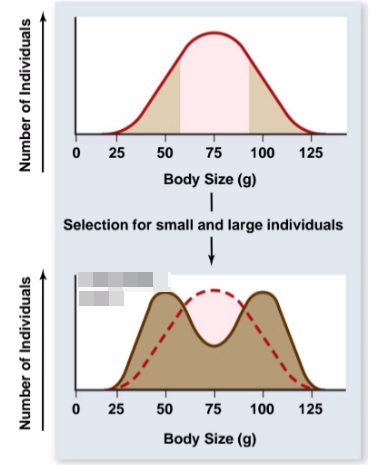
what is disruptive selection
acts to eliminate intermediate types.
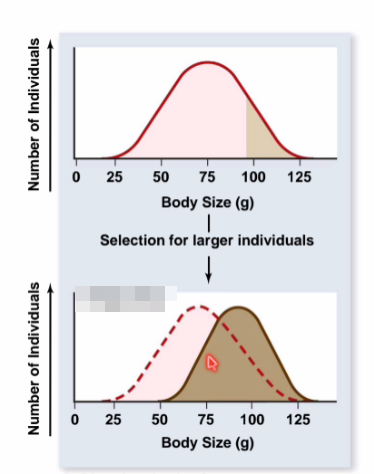
what is directional selection?
acts to eliminate one extreme
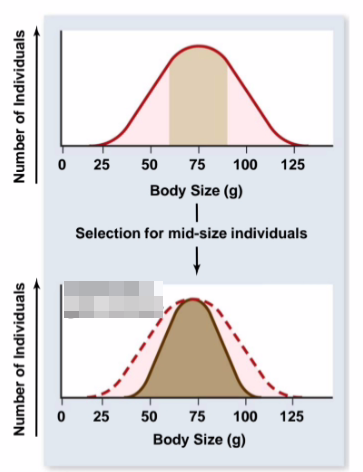
stabilizing selection
acts to eliminate both extremes and makes the intermediate more common by getting rid of the extremes
how do we track evolution over time/in the past?
we studied fossil evidence and also genomes and DNA from the past.
we can also study populations in a lab with short lifespans (ex. fruit flies) or in field experiments
in the guppy experiment, why do the guppies upstream lose their bright colors?
because of the predators, the guppies had to evolve into duller colors to blend in with their environments and to be safe from the predators.
why does copper resistant grass end up in random fields where there is no copper soil?
because of genetic drift, and wind can carry the copper genotype (in pollen) out elsewhere.
why is there a limit to selection?
you can only go so far with genotypes, and get so many different variables of genees.
the creatures can only be mutated so much and they themselves have physical limits.
does every phenotype have a genetic basis to it?
not every phenotype does. fly eyeballs are “generated” at random, so are human fingerprints. they’re all different.
what are the characteristics of a virus
no cell membranes
can be DNA or RNA based
may or may not have enzymes
do not have ribosomes
do no produce ATP
how do viruses make their protein coats without ribosomes?
by stealing host cells ribosomes and using them for making proteins
what are visuses? (whats their function?)
they are
obligate intracellular parisites
(they HAVE to live inside of host cells and steal off of the host cell)
what is the basic structure of a virus?
nucleic acid, with optional enzumes, wrapped in a CAPSID protein coat (made out of capisomeres) and some have an optional viral envelope with also optional protein spikes
what is a virion?
virus when it is outside of the cell
in virions…
some viruses store specialized enzymes with nucleic acid cores
many animal viruses have an envelope made out of host cell membrane viral proteins
characteristics of viruses:
found in every kind of organism
there is more kinds of viruses than organisms
how does a host range affect viruses and their host cells?
each type of virus has a limited host range,
ex. HIV → immune cells
HEP. → liver cells
rabies → neurons
can viruses be dormant?
they can. the chickenpox virus can stay in the system forever after it has been treated.
how does a virus replicate their DNA for replication?
they hijack host cells and take their ribosomes to create new virus DNA.
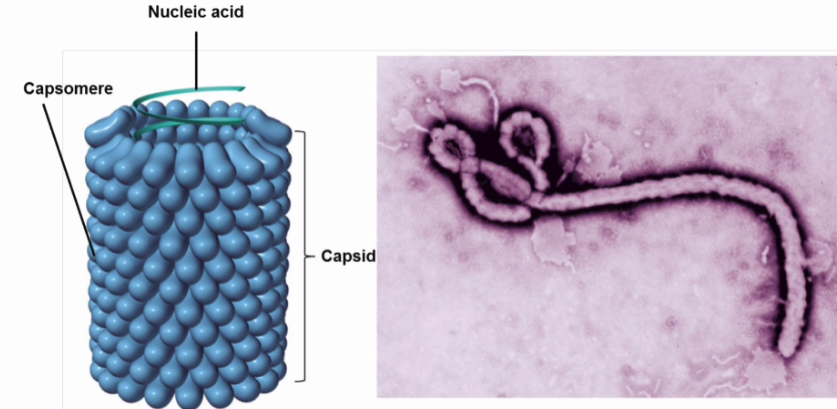
what kind of virus shape is this?
helical
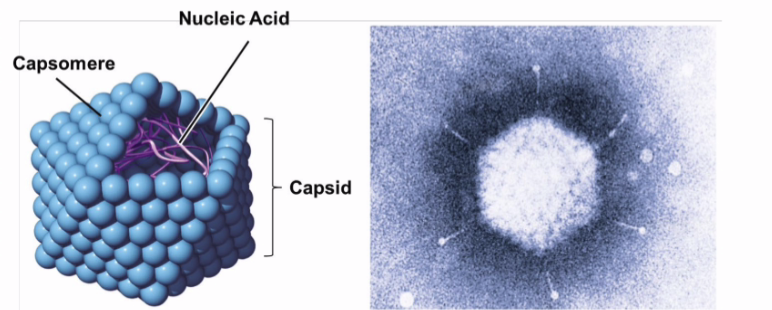
what kind of virus shape is this?
polyhedral / icosahedral (soccer ball shape)
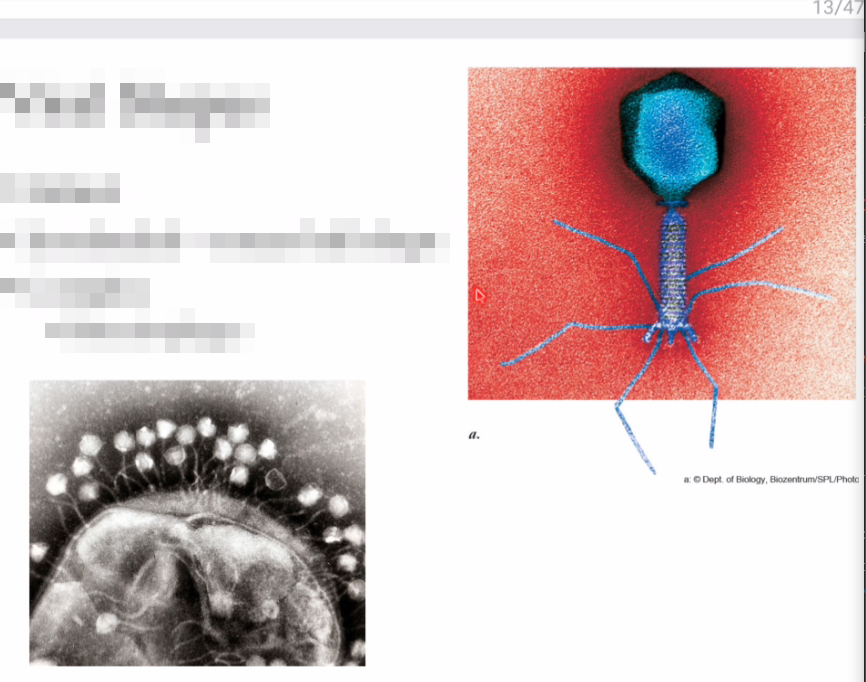
what kind of virus shape is this?
complex like bacteriophages
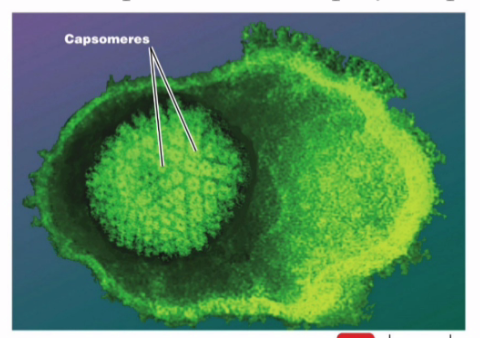
what kind of virus shape is this?
enveloped virus
what are some DNA viruses?
double stranded | dsDNA
single stranded | ssDNA
what are some RNA viruses?
double stranded | dsRNA
single stranded | ssRNA POS
single stranded | ssRNA NEG
retrovirus | RNA → DNA
what do bacteriophages do?
they are viruses that infect bacteria from the inside out
what are the stages of the lytic cycle of a bacteriophage?
ATTACHMENT: bacteriophage attaches to a bacteria
PENETRATION: injects bacteriophage dna into bacteria
BIOSYNTHESIS: bacteriopgage DNA and structure is being synthesized with the host ribosomes
MATURATION: new bacteriophage are existing inside of the host cell
RELEASE: new mature bacteriophages burst out of the host cell and are ready to infect other bacterias
what happens in the lysogenic cycle?
after the penetration phase of the lytic cycle, the bacteriophage DNA instructions on how to build other phages is synthesized into the host cell DNA without beginning to build new phages.
host cell undergoes mitoses as usual with the new bacteriophage replicating
cell can resume in a dormant state OR go back into the lytic cycle to begin new phage synthesis
what is the HIV infection cycle?
ATTACHMENT: virus attaches to a human T cell with its own enzymes
ENTRY into the T cell
REVERSE TRANSCRIPTION: the enzymes that the virus had brought, initiates reverse transcription from the HIV dsRNA → dsDNA
INTEGRATION: new retrovirus DNA gets included into the host T cell DNA, host cell lives on with new DNA
DORMANCY: T cell chills out with the dormant DNA
BIOSYNTHESIS: begins making new HIV viruses
ASSEMBLY: HIV virus is assembled
RELEASE: HIV leaves out the cell without popping or killing the cell
what are ways that medicine can prevent viruses from affecting us? (4 items)
blocking entry
blocking replication with reverse transcriptase inhibitors
blocking integration into host cell DNA
blocking maturation