3. Emotion and Learning
 Call Kai
 Learn
Learn Practice Test
 Spaced Repetition
 Match
Match Flashcards
 Knowt Play
1/26

There's no tags or description
Looks like no tags are added yet.
Name | Mastery | Learn | Test | Matching | Spaced | Call with Kai |
|---|
No analytics yet
Send a link to your students to track their progress
27 Terms
What is involved in observational learning?
A basic form of learning
where animals learn about danger/ group norms etc by observing the reactions of other group members
How does wild monkeys’ fear of snakes demonstrate observational learning?
captive monkeys can learn the fear of snakes from wild monkeys
there has been no direct negative consequence for the captive monkey, yet a stimulus becomes threatening because of observational learning
What is involved in the chameleon effect in observational learning?
people unconsciously mimic the postures of the people they interact with resulting in pro-social behaviour
overt copying of body posture and actions is most likely when people are in comfortable social interaction
the mirroring of action seems to facilitate social interaction
What does this research show support for?
During a mock marketing task, an experimenter mimicked the posture of half the participants, coping their body orientation (e.g. leaning forward), the position of their arms, and the position of their legs
participants who had been mimicked were more helpful (picking up dropped pens) and generous towards other people (donating to charity) than those who were not mimicked
the chameleon effect and prosocial behaviour
What is involved in emotion mimicry?
when observing the emotional response of another individual, learning is facilitated by simulation
we are in the same motor state of another person and hence we feel what they are feeling
How is emotion mimicry investigated using Electromyography (EMG)?
electromyography (EMG) discriminates positive (zygomaticus) and negative (corrugator) emotions
these effects are quite subtle and cannot be seen with the eye, but the weak muscle activity can be recorded with electrodes in EMG
studies show slight zygomaticus cheek activity when shown picture of someone smiling (within one second)
more activation of corrugator muscle when shown a frown
How is mimicry unconscious?
this emotion mimicry response appears to be automatic
e.g. when a face is completely irrelevant to a person’s task and is ignored, the emotion is still mimicked
and even if the emotional face is subliminal and people are unaware of its presence, mimicry of emotions still takes place
What are primary reinforcers in classical conditioning?
our emotions can be direct and powerful experiences, such as the fear of a snarling dog
direct emotional stimuli do not have to be learned
food and water are also powerful emotional primary reinforcers about how to act in the world and stay alive
What are secondary reinforcers in the context of classical conditioning?
money will not keep you warm or feed you
however, we have learned to associate it with primary reinforcers: through exchange it can provide these things - it is positive via association
What were the foundational ideas for classical conditioning?
dogs started to salivate before the food was presented
the dog was responding to an event associated with and predicting the food
What is involved in emotional classical conditioning?
autonomic conditioning: bodily responses, arousal, such as rapid heart rate, sweating.
the most widely studied is fear conditioning. A harmless/neutral stimulus can evoke fear responses, such as in phobias
evaluative conditioning: a conscious preference to like a stimulus more or less: most widely studies is advertisements
Example of classical conditioning SS
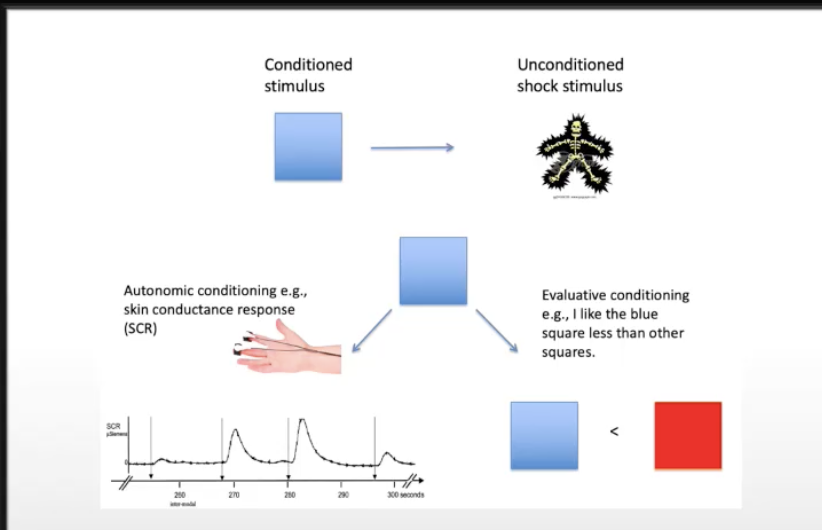
Where is autonomic physiological conditioning mediated in the brain?
And what is seen in lesion cases
the amygdala
patient with amygdala damage has no SCR (autonomic response) but is aware of the stimulus associated with the shock
Where is evaluative conditioning mediated in the brain?
And what is seen in lesion cases
evaluative conditioning conscious explicit report mediated by the hippocampus
lesions to the hippocampus have normal SCR (autonomic response) to conditioned stimulus but cannot report that the stimulus predicts shock
What is involved in extinction?
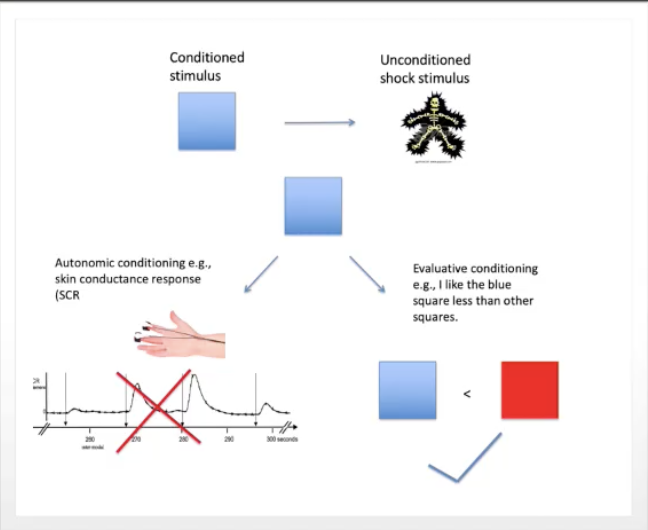
after association has been formed, then present the conditioned stimulus without the shock
the autonomic response is observed for a few trials but then declines
in contrast the reduced liking of the stimulus can remain for a long time afterwards
the resistance to extinction makes advertising potent
How has conditioning been seen in advertising?
evaluative conditioning; more concerned with learned emotional responses of preferences and attitudes
conditioned stimulus might be an everyday consumer product like coffee, paired with a positive unconditioned stimulus such as a famous movie star or attractive model
neutral product becomes associate with the positive stimulus, becoming more positively evaluated by people
the autonomic arousal response only lasts a short time but the preference may remain long after
How might activating emotions bypass rational thought and inhibitory processes?
pairing attractive people with a product can be more effective than providing facts like fuel economy, engine power and transmission type
How does evaluative conditioning occur unconsciously?
although people can report the relationship between the unconditioned and conditioned stimulus when preferences are changed, this awareness is not always necessary
this lack of awareness is what can make advertising (e.g. product placement) effective on social media and in movies
preference is acquired but we do not know where it came from
What is the method used to demonstrate evaluative conditioning?
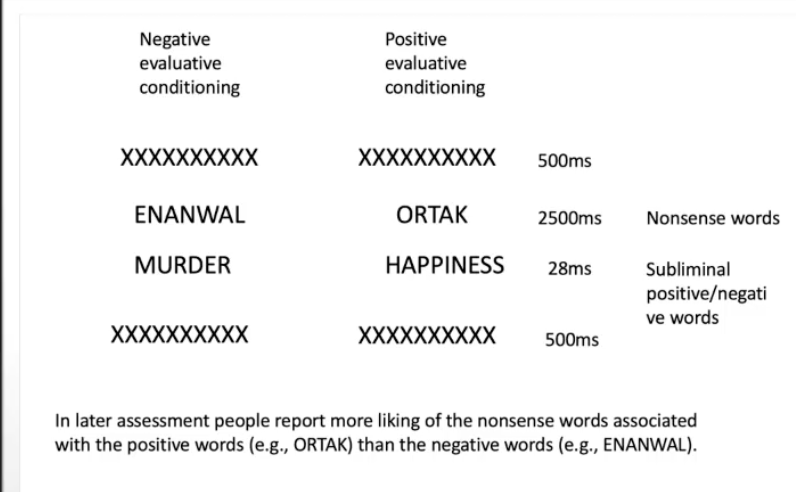
ppts presented with nonsense words
told to passively observe the nonsense words. No need to actively remember
due to masking there was no awareness that the briefly presented positive and negative words were present
results suggest unconscious conditioning can make us like different things, even nonsense words
What is involved in the mere exposure effect?
possible to change an emotional response without any associations with positive or negative stimuli
simply by passively presenting neutral stimuli, people tend to like them more
stimuli that have been presented in the past are preferred more than novel stimuli
the effect is observed across a range of objects and tasks (liking, pleasantness rating and forced choice)
the effects seem to be non-conscious, as people cannot recall they have seen the stimuli before; effect is stronger when they are unaware of the stimuli
What is involved in the perceptual fluency model? (Bornstein and D’Agostino)
the mere exposure effect is bigger when ppts are not aware of the stimulus due to brief exposure and pattern masking
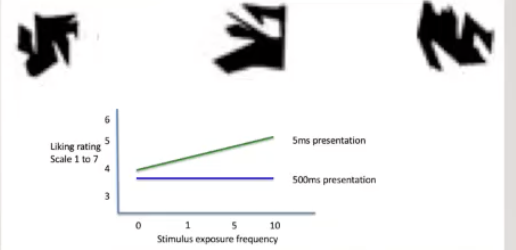
explains why mere exposure effects tend to be stronger when ppts are not aware that they have already seen the pre-exposed stimuli
after exposure to a stimulus we process it more fluently - we detect this subtle improvement in processing fluency and find it rewarding
What is involved in operant conditioning?
the link between a response and a subsequent outcome
e.g. press button and get food: reinforce and increase behaviour
what was a neutral action starts to take on emotional value
How is operant conditioning related to emotion?
rewards are desired and positive outcomes of motivated behaviour
rewards can increase and maintain the frequency and strength of the behaviour they are contingent on
How is operant conditioning related to social rewards/punishments?
how others respond to our behaviour shapes and influences what we do and say in the world
being successful or prestigious is rewarding - it feels good
we are motivated to play status games and improve our position in society
What did Spreckelmeyer (2009) find regarding operant conditioning and the anticipation of monetary vs social rewards?
32 Germans asked to hit a button as fast as possible when a white target square appeared on screen, during an fMRI scan
to generate reward anticipation, target presentation was preceded by a cue signalling the reward that would be presented if the button was hit fast enough
circle cues presented different levels of potential reward, while the triangle announced no outcome independent of reaction time
how is a gender difference also seen?
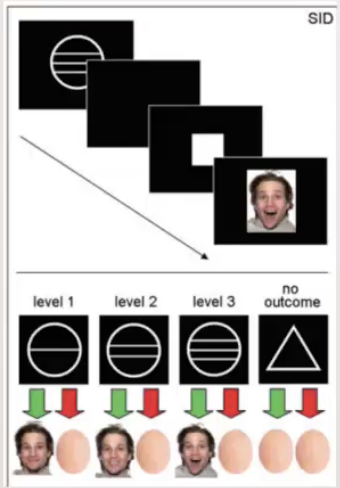
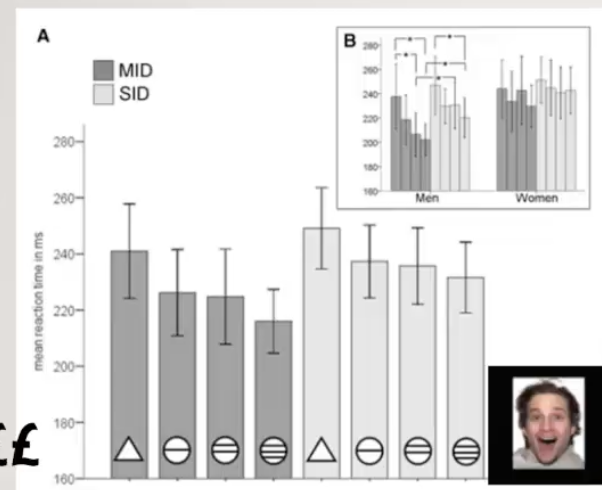
no different between social and monetary rewards
significantly faster reaction times for all levels of reward compared to ‘no outcome’ trials
men reacted faster to cues signalling high money rewards than high social rewards while reacting equally slow to cues signalling low reward
How was Spreckelmeyer’s study on anticipation of monetary and social reward and gender seen in the brain using fMRI?
fMRI during the anticipation phase
Men’s activation in the prospect of monetary rewards encompassed a wide network of mesolimbic brain regions compared to only limited activation for social rewards
women’s activation was more equal for monetary and social rewards
What did Izuma, Saito and Sadato find regarding the processing of monetary rewards in the striatum?
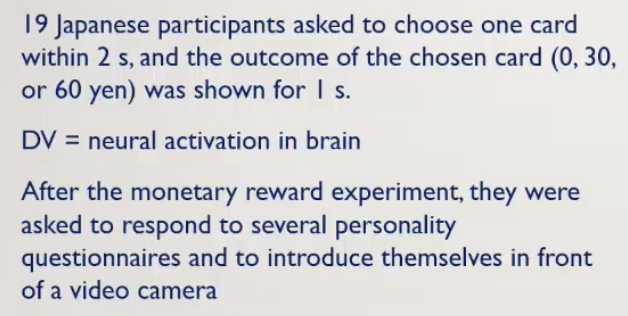
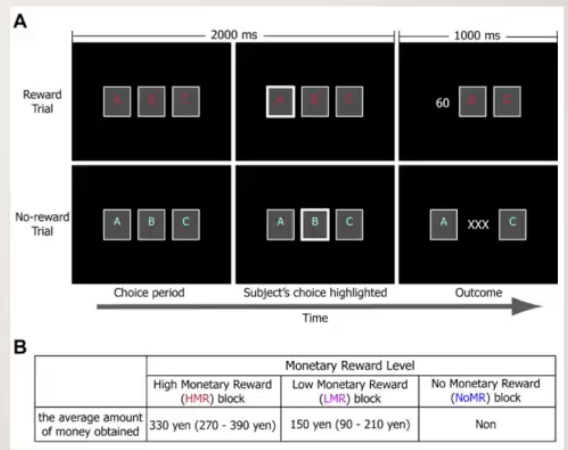
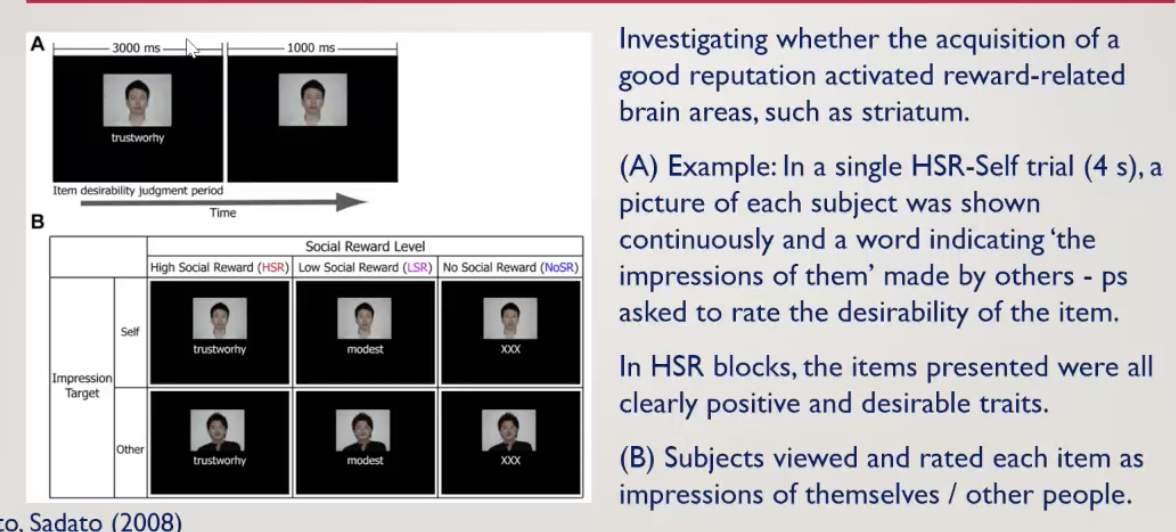
told they would be evaluated and the results shown to them in study 2 - the emotional reward task
STUDY 2
investigating whether the acquisition of a good reputation activated reward-related brain areas, such as the striatum
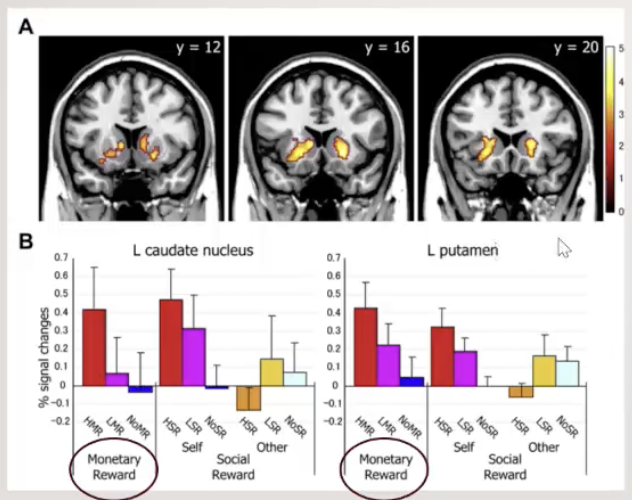
increased striatum activation in high reward conditions (red bar) compared to no reward condition (blue bar)
financial rewards activate the reward centre of the brain
positive feedback about our reputation activates the same reward centre of the brain as money