Plant reproduction, seed dispersal & germination
 Call Kai
 Learn
Learn Practice Test
 Spaced Repetition
 Match
Match Flashcards
 Knowt Play
1/17

There's no tags or description
Looks like no tags are added yet.
Name | Mastery | Learn | Test | Matching | Spaced | Call with Kai |
|---|
No analytics yet
Send a link to your students to track their progress
18 Terms
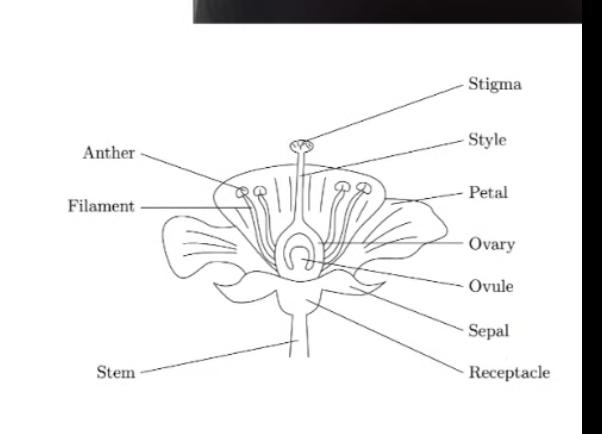
The anther
The site of meiosis - 4 haploid cells “each is called a pollen grain”. Then, they undergo mitosis BUT THEY DO NOT SEPARATE. Only the nuclei undergo mitosis: haploid nuclei a → 2 haploid nuclei = 3 haploid nuclei in ONE pollen grain. 2 nuclei in each pollen grain will be male gametes, 1 will help with fertilization
The ovum
Site of meiosis - produces 4 haploid cells, but the unequal division of the cytoplasm/organelles leads to only 1 haploid cell and 3 polar nuclei. This egg goes through multiple rounds of mitosis to produce 8 haploid cells. 7 of these cells are helper cells, only 1 will be the haploid egg.
Pollination
Transfer of pollen from anther to stigma through wind/animals.
Fertilization
Pollination is the transfer of pollen grains from the anther to the stigma.
After pollination, a tube cell (also called the helper cell) within the pollen grain grows a pollen tube down the style and into the ovary.
The pollen tube carries two haploid sperm nuclei (male gametes) to the ovule.
One sperm nucleus fuses with the egg cell to form a diploid zygote (2n). This is fertilisation.
The zygote undergoes mitosis to form an embryo, which later develops into the seed.
The second sperm nucleus fuses with the two haploid polar nuclei in the central cell.
This process is called triple fusion because three haploid nuclei fuse together:
n+n+n=3n
Triple fusion produces a triploid endosperm (3n).
The endosperm surrounds and nourishes the developing embryo.
Because two fusion events occur, the process is called double fertilisation, a feature unique to flowering plants.
Petal
Attracts pollinators
Stamen
Anther + filament.
Filament
Holds up anther to position the pollinator so it’ll come in contact with the pollen
Stigma
Captures pollen, it’s sticky
Style
Long tube that positions stigma to allow this pollination to happen
Sepal
protects the developing flower
Ovule
meiosis and seed development
Cross pollination
Transfer of pollen to one stigma from a different anther. More genetic diversity than self-pollination.
Methods of promoting cross pollination
Using wind/animal pollinators to go from x plant to y plant
Have separate male & female flowers/plants
Male anthers and female stigmas developing at different times
Self incompatibility
A mechanism where the pollen grain fails to develop when it reaches the ovary of the same plant. If alleles from pollen grains match alleles from stigma, fertilization does not occur. Eg. pollen grains have S1S2 alleles , stigma has S1S3 alleles, S1 and S1 are the same so fertilization is not successful/does not occur, but S2 and S3 is successful and fertilization will occur.
Dispersal of seeds
Parents do not want their offspring planted near them, so instead they ensure their seeds are dispersed everywhere. They do this by:
Seeds being hidden by fruit (eg. apple) so animals eat them and the seeds are dispersed via stool being released
Seeds being hidden in a hook shell so it hooks onto an animal and will be put down elsewhere
Wings on the seeds so the wind will pick them up and put them elsewhere.
What does a seed consist of
An embryo, food stores (starch and studd from the endosperm tissue), and a protective seed coat called the testa. It is dormant until it becomes active & germinates.
What do seeds need to germinate
1) Water. When water enters the seed through the microscopic pore on the testa, which causes the seed to swell (imbibition). The seed coat softens and then splits, the addition of water also allows for metabolism where enzymes become active and the seed can respire.
2) Oxygen. The embryo needs to do aerobic cellular respiration to make ATP to grow and allow for cell division.
3) Warm temperature. Respiration is directed by enzymes, which are directly affected by temperature. Too cold = enzymes don’t work efficiently, too warm = enzymes denature and respiration cannot occur = no growth = no germination
Steps of germination
1) Water enters, the seed absorbs the water and swells up, also becoming metabolically active.
2) Enzymes activate and start breaking down food stores from the endosperm, starch is broken down into glucose, proteins into amino acids, and these are transferred to the embryo
3) The embryo receives the glucose, enzymes, etc. and uses oxygen to respire and thus make ATP and grow
4) The radicle emerges, it grows downward and becomes the root, which anchors the cell and allows for absorption of water and minerals.
5) The shoot (pumule) grows upward and pushes through the soil.
6) The cotyledons grow leaves since the food stores are used up and when leaves form, photosynthesis begins.