Micro Exam 3
 Call Kai
 Learn
Learn Practice Test
 Spaced Repetition
 Match
Match Flashcards
 Knowt Play
1/61

There's no tags or description
Looks like no tags are added yet.
Name | Mastery | Learn | Test | Matching | Spaced | Call with Kai |
|---|
No analytics yet
Send a link to your students to track their progress
62 Terms
Chemical Analysis of Microbial Cell
• 70% water
• Proteins
• 96% of cell is composed of 10 elements:
96% of cell is composed of 10 elements:
carbon
hydrogen
oxygen
nitrogen
phosphorus
sulfur
potassium
calcium
magnessium
iron
nutrition
process by which chemical substances (nutrients) are acquired from the environment and used for cellular activities
– influence of adaptation
essential nutrients
must be provided to an organism
macronutrients
required in large quantities; play principal roles in cell structure and metabolism
• proteins, carbohydrates
micronutrients or trace elements
required in small amounts; involved as enzyme cofactors and in maintenance of protein structure
• manganese, zinc, nickel, cobalt, molybdenum, copper
inorganic nutrients
atom or molecule that contains a combination of atoms other than carbon & hydrogen
– metals & their salts (magnesium sulfate, ferric nitrate, sodium phosphate), gases (oxygen, carbon dioxide) & water
organic nutrients
contain carbon & hydrogen atoms & are usually the products of living things
– methane (CH ), carbohydrates, lipids, proteins & nucleic acids
Potassium
essential to protein synthesis and membrane function
Sodium
important to some types of cell transport
Calcium
cell wall and endospore stabilizer
Magnesium
component of chlorophyll; membrane and ribosome stabilizer
Iron
component of proteins of cell respiration
Environmental factors fundamentally affect the function of metabolic
enzymes
Factors include:
– temperature
– oxygen requirements
– osmotic pressure
– pH
– electromagnetic radiation – barometric pressure
– ecological associations
Understanding microbial ecological niches =
ability to control microbial growth
3 cardinal temperatures
most single cell organisms are poikilothermic
Minimum temperature
lowest temperature that permits a microbe’s growth & metabolism
Maximum temperature
highest temperature that permits a microbe’s growth & metabolism
Optimum temperature
promotes the fastest rate of growth & metabolism
Psychrophiles
optimum from to °C
– range from -10 to 20 C
Psychotolerant
– optimum to °C
–range of 4 to 35°C (grow slowly in cold)
Mesophiles
optimum from to °C
–range of 10 to 45°C
–majority of human pathogens & normal flora
Thermophile
optimum 67 to 72 °C
–range from 45 to 80°C
–compost pile or hot water heater
Extreme thermophiles
range >70 °C
–hot springs & deep ocean vents
–CM highly saturated lipids
Archae
unique enzymes; ↑G+C%; no PG; saturated CM lipids
–ex) Taq polymerase in PCR
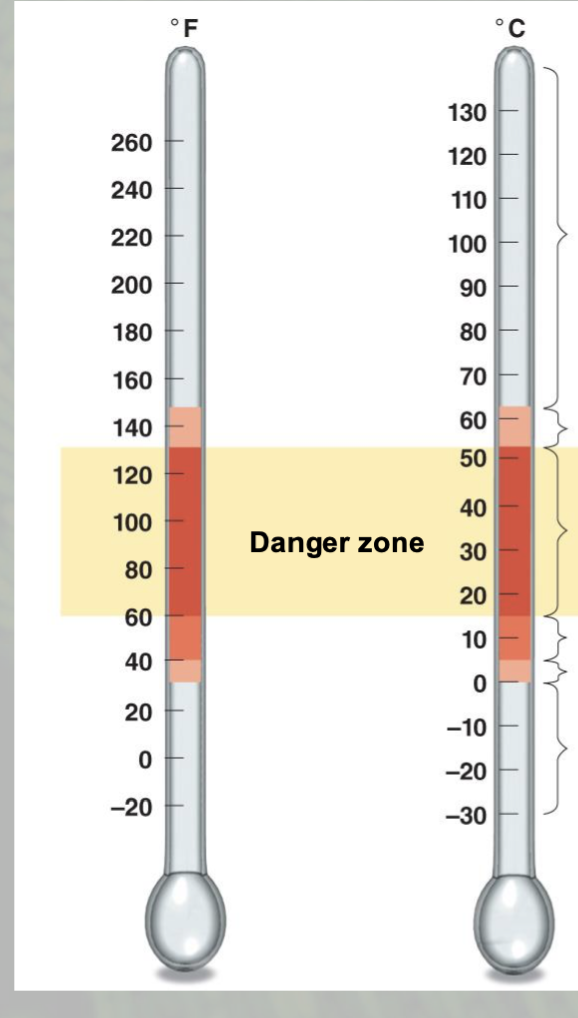
Food Preservation
Temperatures in this range destroy most microbes, although lower temperatures take more time.
Very slow bacterial growth.
Rapid growth of bacteria; some may produce toxins.
Many bacteria survive; some may grow. Refrigerator temperatures; may allow slow growth of spoilage bacteria, very few pathogens.
No significant growth below freezing.
pH
• pH is a measure of the hydrogen ion concentration of a solution
• defined as the degree of acidity or alkalinity of a solution (0 – 14 scale)
pH of pure water is
7 = neutral
The optimum pH range for most organisms is
pH 6 to 8 because acid & base can be:
The optimum pH range for most organisms is pH 6 to 8 because acid & base can be:
– damaging to proteins – especially enzymes
– damaging to CM & other parts of cell (even DNA)
The effects of pH
– related to the concentration of acid in the medium & the protection that bacterial cell walls sometimes provide
Changes in pH can lead to
– denaturing of enzymes & other proteins
– interference with pumping ions at the cell membran
Many bacteria produce large quantities of acids as they metabolize & grow
leads to high acid concentration = toxic environment
Acidophiles
grow at extreme acid pH (0 to 5.5)
– hot springs Archaea
– Euglena mutabilis and Thermoplasma
Alkalophiles
grow between pH 8.5 to 12
– Proteobacteria in Mono Lake (Ca) live at pH 12
Natronomonas pharaonis
grows optimally at pH 8.5 in 3.5M NaCl (soda lakes)
Proteus (neutrophile)
metabolizes acidic urea to colonize urinary system
fungi can grow at—— pH than bacteria
lower
Helicobacter pylori
• Gram (-) spirochete w/ high motility
• found in stomach ~ pH 2-2.5
• causes peptic ulcers, gastric & esophageal cancer
• Produces toxins that cause inflammation & damage
– symptoms made worse by ↑stress, environmental factors & diet
• not acid-tolerant
• protects itself from HCl acid by growing in protective mucus layers of stomach
• Breaks down urea in stomach & produces NH +
Helicobacter pylori
(ammonia) to neutralize the microenvironment
• Treated w/ antibiotics
Oxygen
As oxygen is utilized it is transformed into several toxic products:
Most cells have developed enzymes that neutralize these chemicals:
If a microbe is not capable of dealing with toxic oxygen (anerobic) it is forced to live in oxygen free habitats.
As oxygen is utilized it is transformed into several toxic products
singlet oxygen ( O2),superoxide ion (O2-), peroxide
(H2O2), and hydroxyl radicals (OH )
Most cells have developed enzymes that neutralize these chemicals:
superoxide dismutase, catalase
Aerobe
utilizes oxygen and can detoxify it
Obligate aerobe
cannot grow w/o oxygen
– fungi, protozoa, Micrococcus & Bacillus
Faculative anaerobe
utilizes oxygen but can also grow in its absence (catalase+)
– prefers O2 but can survive w/o it
Microaerophilic
requires only a small amount of oxygen (1%-15%)
– optimum growth at 5 O2
Anaerobe
does not utilize oxygen
Obligate anaerobes
lacks the enzymes to detoxify oxygen so cannot survive in an oxygen environment
Aerotolerant anaerobes
do no utilize oxygen but can survive and grow in its presence
– Lactobacillus
Osmotic Pressure
Water availability & its solute concentration causes microbes to exist under hypotonic or isotonic conditions
Halophiles
require a high concentration of salt (salt lakes or ponds)
– Halobacterium (optimum growth in 25% NaCl)
Osmotolerant
do not require high concentration of solute but can tolerate it when it occurs
– Staphylococcus aureus (0.1%-20% NaCl)
Water activity
(Aw) is a measure of water that is available for use by an organism
Aw is ↓ by adding ________ to a solution
solutes
Aw is ↓ by adding solutes to a solution
– solute concentration of solution
– osmotic pressure & ↓Aw (inversely related)
– Enzymes require an aqueous environment to function
– ↓Aw →↓enzyme function =↓metabolism & death of cell
The Aw of pure water is
~1.00
Most organisms require an Aw of—- to——for metabolic activity & growth
0.90
1.00
Most organisms require an Aw of 0.90 to 1.00 for metabolic activity & growth ex
– Staphylococcus aureus → can grow at ~0.85 Aw
• grows on our salty skin
– Fungi → can grow at ~0.70 Aw
Salts/sugars =
decrease Aw = used as food preservatives
Nonionizing radiation
can be used to decontaminate items
– Ultraviolet light, microwaves, infrared radiation
– endospores can survive large doses of non-ionizing radiation
– UV light can cause mutations in DNA (T-T dimers) & sometimes kill organisms
– Some organisms have enzyme systems to repair certain kinds of DNA damage (soil bacteria)
Ionizing radiation
can fully sterilize many items
– gamma rays, x-rays, electron beams
– generate ions that destroy DNA &
proteins