Mobility and Soft Tissue Mobility
 Call Kai
 Learn
Learn Practice Test
 Spaced Repetition
 Match
Match Flashcards
 Knowt Play
1/44

There's no tags or description
Looks like no tags are added yet.
Name | Mastery | Learn | Test | Matching | Spaced | Call with Kai |
|---|
No analytics yet
Send a link to your students to track their progress
45 Terms
What are the 9 intervention categories of PT?
- Patient Client instruction
- Airway Clearance Techniques
- Assistive Technology
- Modalities
- Functional Training
- Integumentary repair and protection
- Manual therapy
- Motor control/Movement training
- Therapeutic exercise
What is therapeutic exercise?
provides healing stimulus for the restoration of joint ROM, neuromuscular strength and power, as well as aerobic and anaerobic metabolic system
integrity.
What is Motion?
ability of joint or tissue to be moved passively
What is Mobility?
ability of body structures or segments to
move so that ROM for functional activities is allowed
What is functional mobility?
ability of an individual to initiate, control, or sustain active movements of the body to perform motor tasks
PROM
Movement of segment within unrestricted ROM that is produced entirely by an external force
AROM
Movement of a segment within unrestricted ROM that is produced entirely by an active contraction of muscles crossing the joint
AAROM
Movement of a segment within unrestricted ROM that is produced by an active contraction with assistance (outside force)
What are the ROM principles?
- Alignment and stabilization
- intensity
- dosage
- speed
- frequency
- mode
What are the Guidelines of Self-assisted ROM?
• Edu pt on value of motion
• Teach it correctly!
• Watch for substitute motions
• Be careful with equipment (if used)
• Make sure pt is safe
• Modify/progress as necessary
What are Self-Assisted ROM techniques?
- Wand exercises
- Overhead pulleys
- powder board
- reciprocal exercise unit
What is Flexibility?
ability to rotate a joint(s) smoothly and
easily through an unrestricted, pain-free ROM
• Dynamic
• Passive
What is hypomobility?
decreased mobility or restricted motion at
a single joint or series of joints
What are the causes of hypomobility?
- Contracture
- Shortness
- Tightness
What's a contracture?
adaptive shortening of muscle-tendon unit and
other soft tissues surrounding joint
• Results in significant resistance to passive/active stretch and limited
ROM...almost complete
• loss of motion
• Develop 2 to prolonged joint positioning, neurologic conditions, or
trauma
What is shortness?
Partial loss of motion
What is tightness?
Restricted motion due to adaptive shortening of muscle or soft tissue
What is Myostatic contracture?
• MT unit is shortened but no apparent muscle pathology
• May be a decrease in # sarcomere units in series, but no decrease in individual sarcomere length
What is an athrogenic and periarticular contracture?
Result of intra-articular pathology including adhesions, synovial
proliferation, joint effusion, irregularities in articular cartilage, or
osteophyte formation
What is a Psuedomyostatic contracture?
• Result of hypertonicity, muscle
• guarding or pain
• Associated with CNS lesion
What is a Fibrrotic contracture and an irreversible contracture?
Normal tissue replaced with non-extensive, fibrotic
adhesions and scar tissue
What is stretching?
therapeutic technique designed to increase soft tissue extensibility with the intent of improving flexibility and ROM by elongating (lengthening) structures that have adaptively shortened
What are the target structures and mechanical properties of stretching?
contractile and non-contractile components of musculotendinous units
Noncontractile Tissue
Tissue that cannot actively shorten, for example, skin, ligament, and cartilage
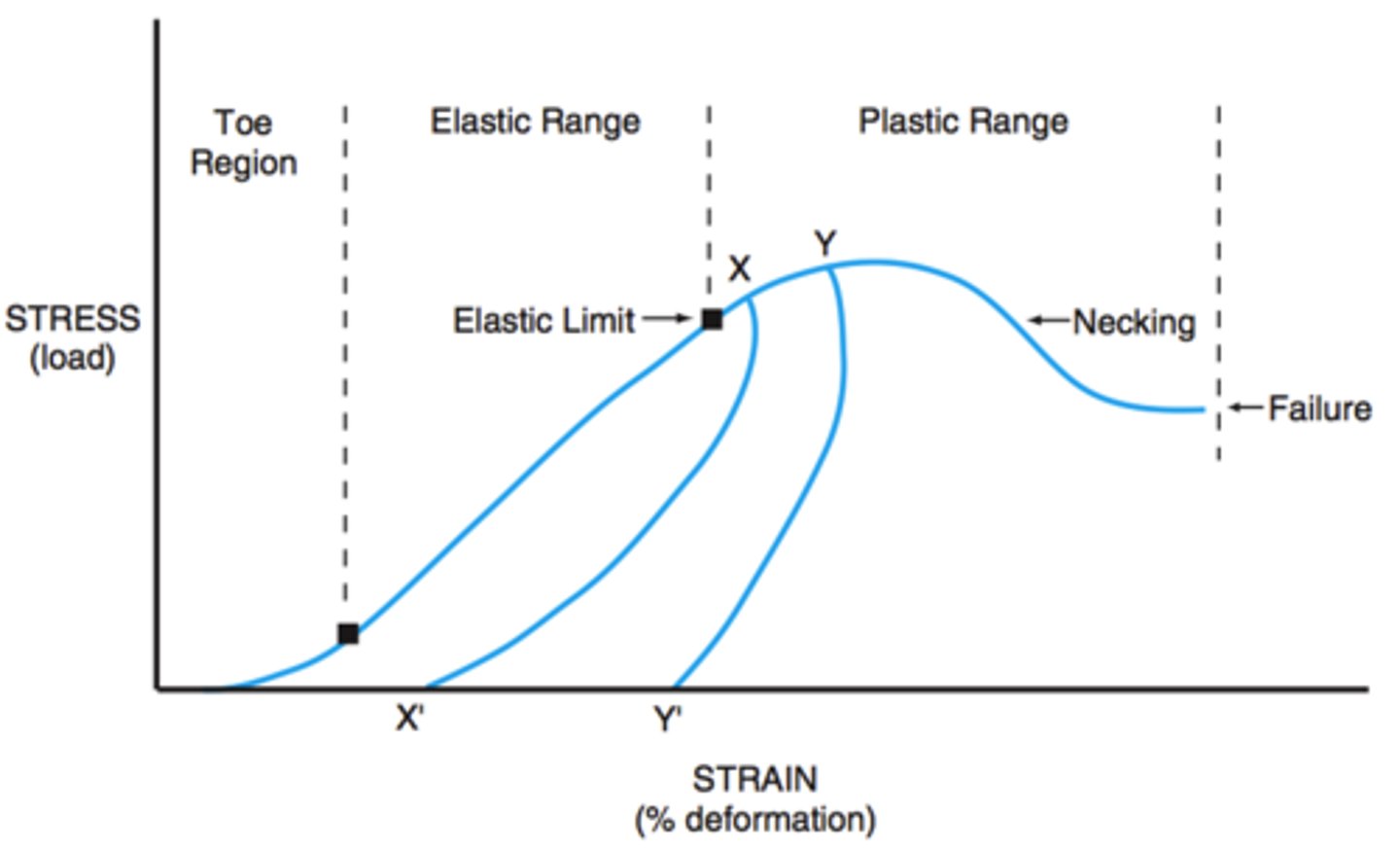
What is the plastic deformation of connective tissue?
Stretch intensity that pulls connective tissue into plastic region of stress-strain curve
What does the noncontractile tissue's response to stretch depend on?
- rate
- creep
- stress-relaxation
- cyclic loading and C.T Fatigue
How does the rate affect response to stress?
Tissue becomes stiffer when load applied at a faster rate
How does the creep affect response to stress?
- Low-magnitude loads applied for long periods of time
- Amount of elongation depends on amount of force and time duration
How does stress relaxation affect the response to stress?
• Resistance to stretch gradually declines when stretch is applied for a period of time
• Underlying principle for prolonged stretching (hrs, days)
• Length increases may only be transient? (Weppler and Magnusson, PT, 2010)
How does the cyclic loading and C.T> Fatigue affect the response to stress?
• Repetitive loading in short period may cause failure at strain levels lower than what is
• needed for a single load
Contractile Tissue
muscles and tendons
What is sarcomere give?
Mechanical disruption of cross-bridges as myofilaments slide apart
What are the neurophysiological properties of stretching?
Muscle/soft tissue extensibility
Neuromuscular relaxation includes:
stretch reflex and reflexive muscle relaxation
What is the stretch reflex?
increased tension that resists lengthening and could compromise effectiveness of a
stretch
• When stretch reflex is activated in a muscle being
lengthened, decreased activity (inhibition) may occur on the opposite side [reciprocal inhibition]
How would you minimize activation of the stretch reflex?
slowly apply a low intensity prolonged stretch
What is reflexive muscle relaxation?
with prolonged stretch, GTO has an inhibitory effect on muscle tension [autogenic inhibition]
• Apply a low-intensity, slow stretch force to muscle to allow GTO to fire
and inhibit tension
What is the Sensory theory in stretching?
Increases in muscle extensibility observed immediately after stretching and after short-term (3-8 weeks) stretching are due to alteration in sensation only (not an increase in muscle length).
- Psychological factors play a role in observation of increased muscle extensibility,
specifically the change in perception of the stretch
What are interventions to increase soft tissue mobility?
- stretching
- neuromuscular facilitation
- muscle energy techniques
- joint mobilization/manipulation
- soft tissue mobilization
- neural tissue mobilization
What is static stretching?
What is Static progressive stretching?
What is cyclic stretching?
What is ballistic stretching?
Connective tissue deformation (aka stretch) depends on ______ and ______ of loading. which includes: _______, ________, & _______
magnitude; rate; Intensity, speed, & duration
What is the importance of frequency in stretching?
Healing and remodeling time is needed between repetitive stretches to
allow for increasing flexibility and tensile strength of the tissues.