Heat Transfer Quiz Questions
 Call Kai
 Learn
Learn Practice Test
 Spaced Repetition
 Match
Match Flashcards
 Knowt Play
1/94

There's no tags or description
Looks like no tags are added yet.
Name | Mastery | Learn | Test | Matching | Spaced | Call with Kai |
|---|
No analytics yet
Send a link to your students to track their progress
95 Terms
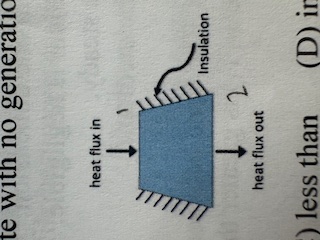
A cone frustum is conducting heat at steady state with no generation. If the frustum is insulated as shown, the heat flux in is ______ the heat flux out.
A) Equal to
B) greater than
C) less than
D) impossible to tell
B
Fourier’s Law applies for processes where the heat is transferred by ___.
A) convection
B) radiation
C) conduction
D) all (a), (b) and (c)
C
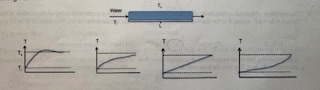
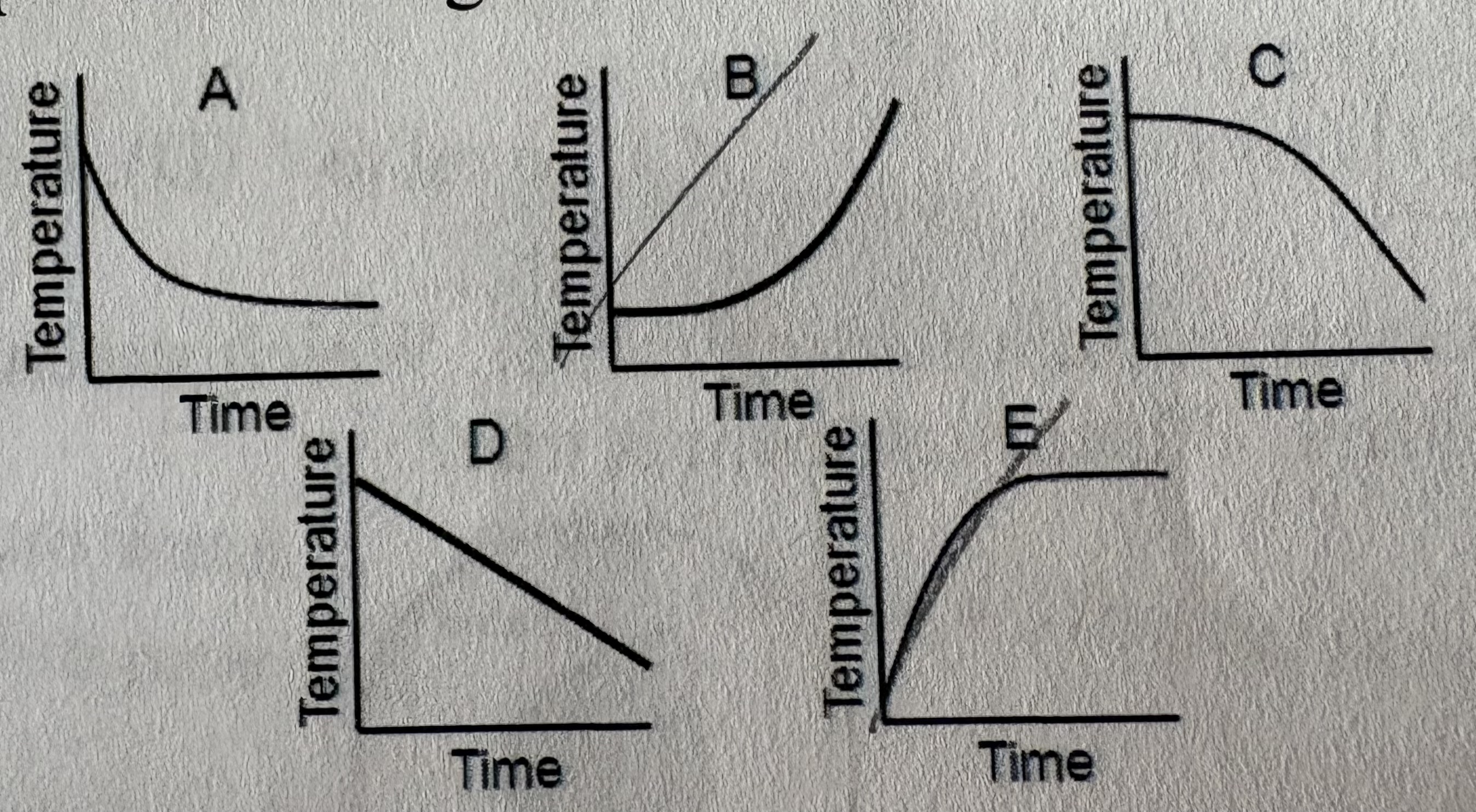
Water flows through a tube of length L with a mean temperature (Ti). The tube is held at a uniform surface temperature (Ts) greater than Ti. Which temperature profile best represents the mean temperature of the water as it flows through the tube?
B
Consider two walls, A and B, with the same surface areas and the same temperature drops across their thicknesses. The ratio of their thermal conductivities is kA/kB = 4 and the ratio of the wall thickness is LA/LB = 2. The ratio of heat transfer rates through the walls qA/qB is:
A) 0.5
B) 1
C) 2
D) 4
E) 8
C
Consider steady one-dimensional heat conduction through a plane wall, a cylindrical shell, and a spherical shell of uniform thickness with a constant thermophysical properties and no thermal energy generation. The geometry in which the variation of temperature in the direction of heat transfer will be linear is:
A) Plane Wall
B) Spherical Shell
C) Cylindrical Shell
D) All of them
E) None of them
A
The variation of temperature in a plane wall is determined to be T(x) = 110 - 60x where x is in m and T is in C. If the thickness of the wall is 0.25 m, the temperature difference between the inner and outer surfaces of the wall is:
A) 15 C
B) 45 C
C) 60 C
D) 80 C
E) 95 C
A
The heat conduction equation in a medium is given in the simplest form as d²T/dx² = 0, where the parameters have their usual meaning. Which of the following statements is incorrect?
A) Heat transfer occurs by conduction in one dimension
B) The thermal conductivity of the medium is negligible
C) Heat transfer through the medium is steady
D) There is no heat generation within the medium
B
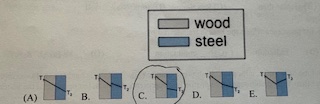
A composite wall consists of wood and steel. The bond between the wood and steel is not perfect, resulting in small air gaps at the interface. If temperature 1 (T1) is greater than temperature 2 (T2), at steady state what temperature distribution could result?
C
The variation of thermal conductivity of a metal with temperature is often correlated using an expression of the form k = k0 +bT where k is the thermal conductivity and T is the temperature (in K). The units of b in SI system is
A) W/m K
B) W/m
C) W/m K²
D) None, b is just a number
C
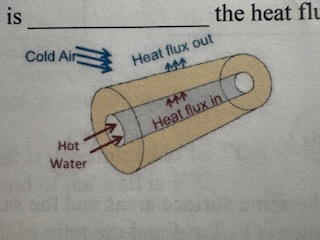
A pipe carrying hot water experiences an external cross flow of cold air. Given steady state conditions and no heat generation, the heat flux into the pipe wall is ____ the heat flux out of the pipe wall.
A) equal to
B) greater than
C) less than
D) unrelated to
B
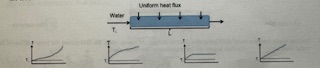
Water enters a tube of length L with a mean inlet temperature (Ti). The water is heated with a uniform heat flux through the tube. Which temperature profile best represents the mean temperature of the water as it flows through the tube?
D
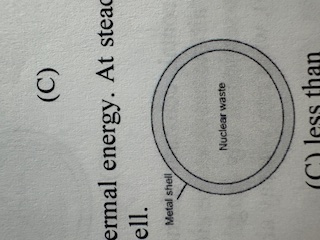
Nuclear waste inside a metal shell generates thermal energy. At steady-state, the amount of energy generated is ____ the energy leaving across the metal shell.
A) greater than
B) equal to
C) less than
B
The heat conduction equation in a medium is given as (1/r)(d/dr)(rk(dT/dr)) + Q = 0. Which of the following statements is incorrect?
A) The medium is of cylindrical shape
B) The thermal conductivity of the medium is constant with respect to r
C) Heat transfer through the medium is steady
D) There is heat generation within the medium
E) Heat conduction through the medium is one-dimensional
B
The variation of temperature in a plane wall is determined to be T(x) = 52x - 25, where x is in m and T is in C, the thickness of the wall is ____ if T at the end of the wall is 1 C.
A) 0.1 m
B) 0.2 m
C) 0.25 m
D) 0.4 m
E) 0.5 m
E
For specified tube outside diameter, higher BWG means higher ____.
A) tube thickness
B) cross-sectional area
C) weight per unit length
D) none of these
B
The heat flux (from outside to inside) across an insulating wall with thermal conductivity, k = 0.04 W/m K and thickness 0.16 m is 10 W/m². The temperature of the inside wall is -5 C. The outside wall temperature is
A) 25 C
B) 30 C
C) 35 C
D) 40 C
C
Newton’s law of cooling applies for processes where the heat is transferred by ___.
A) convection
B) radiation
C) conduction
D) all (a), (b) and (c)
A
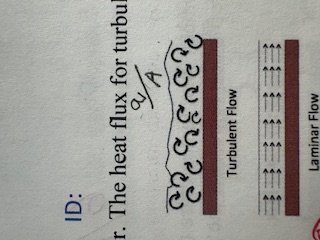
A hot plate is being cooled by flowing air. The heat flux (and heat transfer coefficient) for turbulent air flow is _____ that for laminar flow.
A) less than
B) greater than
C) the same as
B
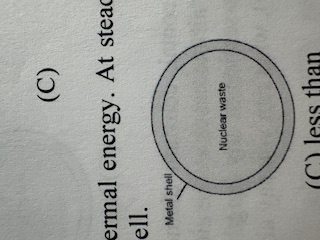
Nuclear waste inside a metal shell generates thermal energy. At steady-state, the flux across the inner surface of the metal shell is ____ the flux across the outer surface of the metal shell.
A) greater than
B) equal to
C) less than
A
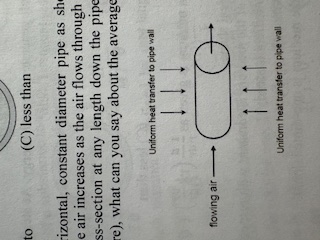
Air is flowing steadily through a horizontal, constant diameter pipe as shown below. The pipe wall is heated uniformly so that the temperature of the air increases as the air flows through the pipe. You may assume that the air temperature is constant across the cross-section at any length down the pipe. If the air pressure remains constant (pressure drop is small enough to ignore), what can you say about the average velocity of air in the pipe?
A) velocity remains constant because pipe is rigid so air can’t expand or change density
B) velocity will increase in the flow direction because density decreases as air temperature increases
C) velocity remains constant since flow is steady
D) velocity will increase because increased temperature indicates the air molecules are moving faster and have higher kinetic energy
E) velocity will decrease because hot pipe walls will increase friction in flowing air
B
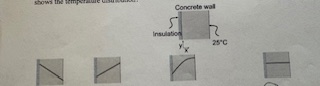
A concrete wall is insulated on one side and exposed to ambient air at 25 C on the other. If the air is constant and there is no heat generation in the wall, after an extended period of time, which of the following shows the temperature distribution?
D
The thermal conductivity of a substance may be defined as the rate of heat transfer per unit length per unit temperature difference. The primary dimension of thermal conductivity in the mass-length-time-temperature system is:
A) M²L/T²theta
B) M²L²/Ttheta
C) L²/MT²theta
D) ML/T³theta
E) ML²/T³theta
D
For pipe flow, the Nusselt number is defined by one of the following. The symbols have their usual meaning. Which one is correct?
A) pCp/uk
B) hD/Cp
C) hD/k
D) Cpu/k
C
A cylindrical mixing tank is to be scale up to a larger size such that the volume of the larger tank is 64 times that of the smaller one. If the tanks are geometrically similar, the ratios of diameters and heights between the two is closest to ____.
A) 1.71
B) 2.08
C) 3
D) 4
E) 1.5
D
The temperature at the inner and outer durfaces of a 15-cm thick plane wall are measured to be 40 C and 28 C, respectively. The expression for steady, one-dimensional variation of temperature in the wall is
A) T(x) = -40x +28
B) T(x) = 40x - 80
C) T(x) = 28x + 40
D) T(x) = -80x + 40
E) T(x) = 40x +28
D
In which mode of heat transfer is the Reynolds number important?
A) conduction
B) convection
C) conduction and convection
D) radiation
B
Which of the following is not a fundamental dimension?
A) mass
B) length
C) temperature
D) energy
E) time
D
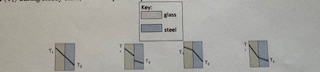
A block of glass and steel are placed against each other on one side such that the bond between them is perfect and the contact resistance is negligible. If temperature 1 (T1) is greater than temperature 2 (T2) during steady-state, what temperature profile would result?
D
The primary driving force for forced convection is ____.
A) Shear forces
B) Buoyancy forces
C) Pressure forces
D) Surface forces
C
Most correlations for the convection heat transfer coefficient use dimensionless Nusselt number, which is defined as ____.
A) h/k
B) k/h
C) hLc/k
D) kLc/k
E) k/pCp
C
During pool boiling, the critical heat flux for the onset of film boiling is larger for a ____.
A) less dense fluid
B) denser fluid
C) there is no difference
D) impossible to tell
B
Internal forced flows are said to be fully developed once the ____ at a cross section no longer changes in the direction of flow.
A) Temperature distribution
B) Entropy distribution
C) Velocity distribution
D) Pressure distribution
E) None of the above
C
Which of the following forced convection heat transfer correlation accounts for the liquid viscosity effect for viscous liquids?
A) Dittus-Boelter equation
B) Sieder-Tate equation
C) Colburn equation
D) None of these
B
When boiling a saturated liquid, there is a characteristic regime where the heat flux reduces despite increase in the temperature of the heating element. This unique characteristic is attributed to:
A) burnout
B) nucleate boiling
C) film boiling
D) Weissenberg effect
E) thermal radiation
C
The ____ number is a significant dimensionless parameter for forced convection and the ____ number is a significant dimensionless parameter for natural convection.
A) Reynolds, Grashof
B) Reynolds, Mach
C) Reynolds, Eckert
D) Reynolds, Schmidt
E) Grashof, Sherwood
A
Heat transfer coefficients for a vapor condensing on a surface can be increased by promoting:
A) Rolling action
B) Film condensation
C) Dropwise Condensation
D) None of these
C
Air flows in a heated 5 cm by 8 cm cross section rectangular duct at velocity of 4 m/s at 1 atm and 15 C. The density and viscosity of air under these conditions are 1.225 kg/m3 and 1.802 × 10⁻⁵ Pa s, respectively. The Reynolds number for this flow is:
A) 13,605
B) 16,745
C) 17,690
D) 21,770
B
When boiling a saturated liquid, one must be careful while increasing the heat flux to avoid burnout. Burnout occurs when the boiling transitions from ____ boiling.
A) Free convection to nucleate
B) Free convection to film
C) Film to nucleate
D) Nucleate to film
E) None of the above
E
In regenerators, hot and cold fluids are separated by a wall and heat is transferred by conduction through the wall and convection to and from the wall.
True or False?
False
Recuperators, regenerators and direct contact heat exchangers are the main classes of heat exchangers.
True or False?
True
Fouling introduces additional thermal conductance in heat transfer equipment.
True or False?
False
Double-pipe heat exchangers are examples of regenerators.
True or False?
False
The log mean temperature difference for counter-flow and parallel flow heat exchangers are identical when the:
A) cold fluid is heated to a certain temperature by condensing steam (isothermal fluid)
B) outlet temperature of both the hot and cold fluid are the same
C) outlet temperature of hot fluid is less than the outlet temperature of the cold fluid
D) none of these statements are valid
A
The primary driving force for natural convection is
A) shear forces
B) buoyancy forces
C) pressure forces
D) surface forces
E) none of the above
B
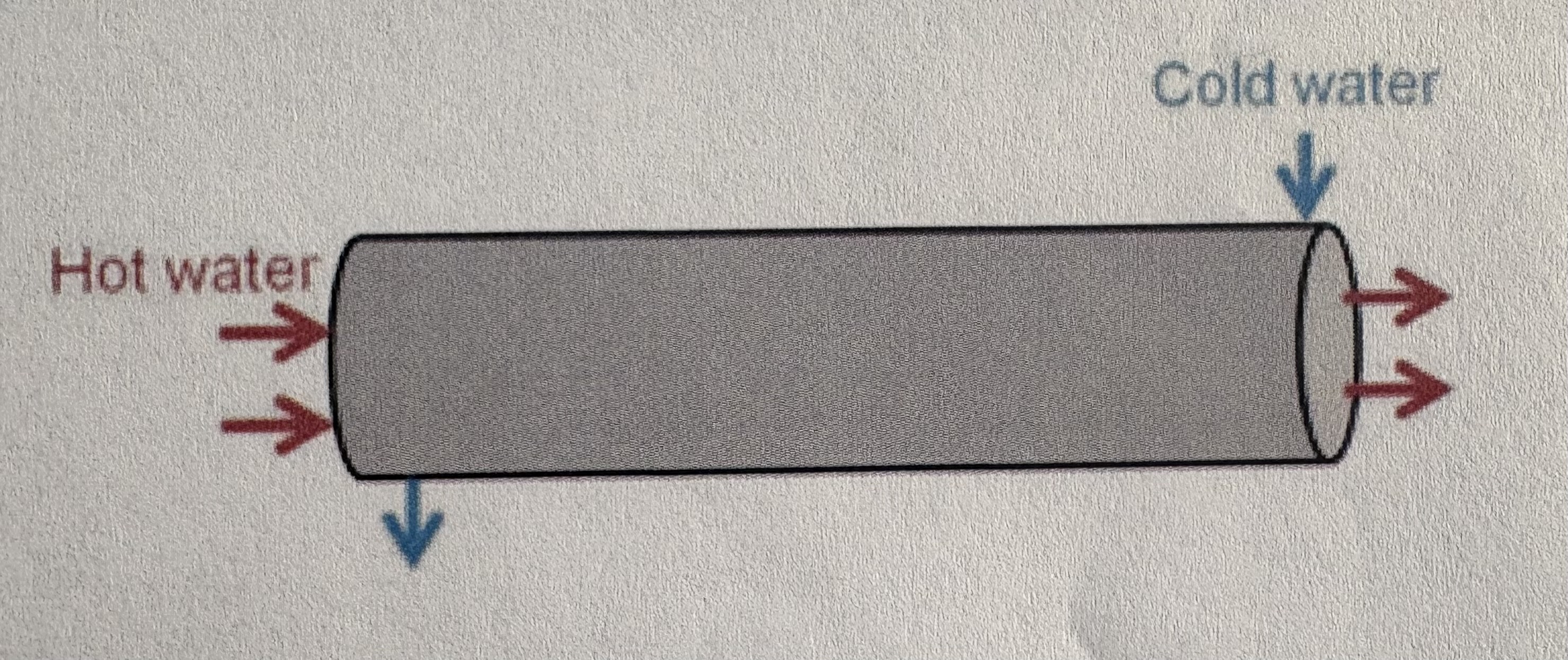
In a countercurrent double pipe heat exchanger, 2 kg/s of hot water flows through the inner tubes and 6 kg/s of cold water flows in the outer tubes. Which flow will experience the largest temperature change?
A) cold water
B) hot water
C) the change will be the same for both
D) impossible to tell
B
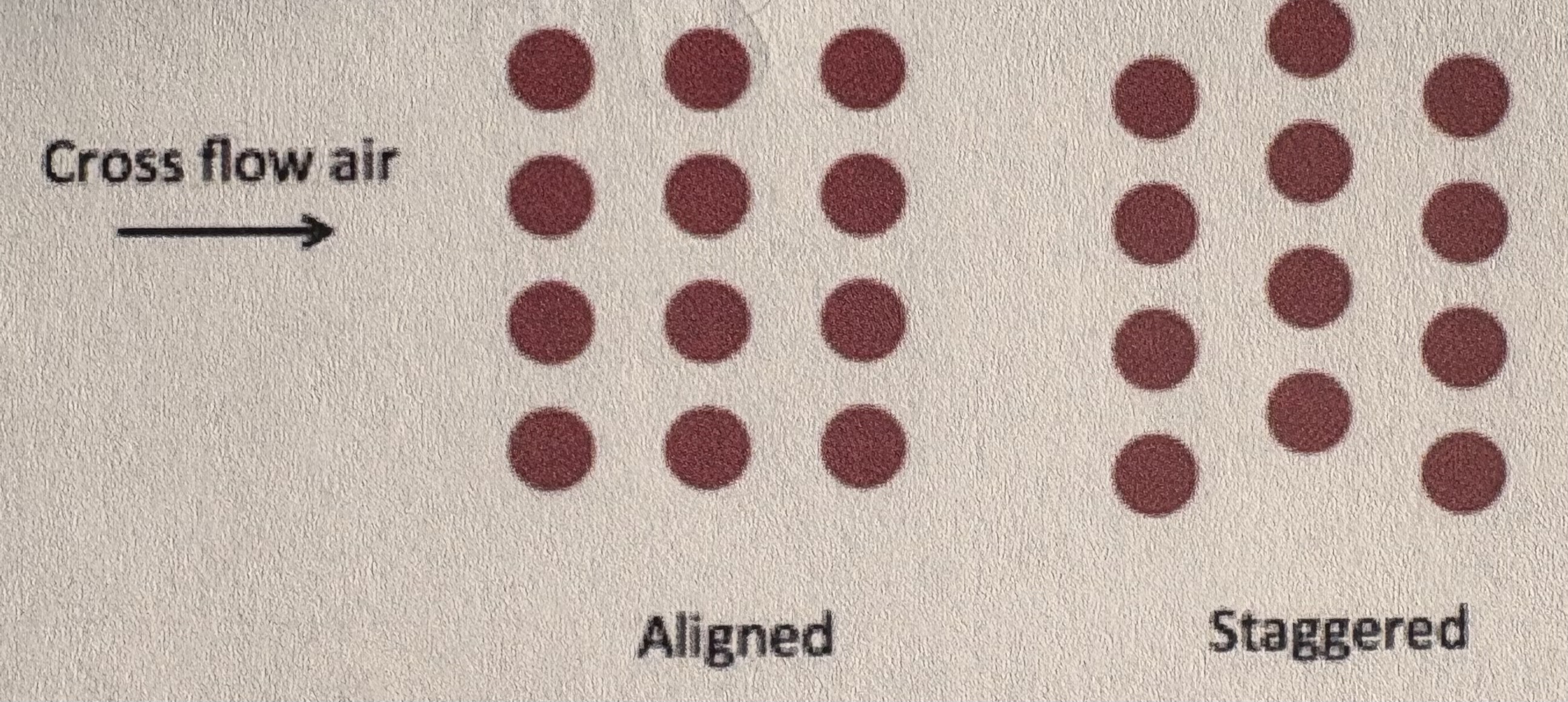
Laminar cross flow air enters an aligned tube bank. Converting the tube bank from an aligned arrangement into a staggered arrangement would ____ the heat transfer rate.
A) increase
B) decrease
C) not change
D) impossible to tell
A
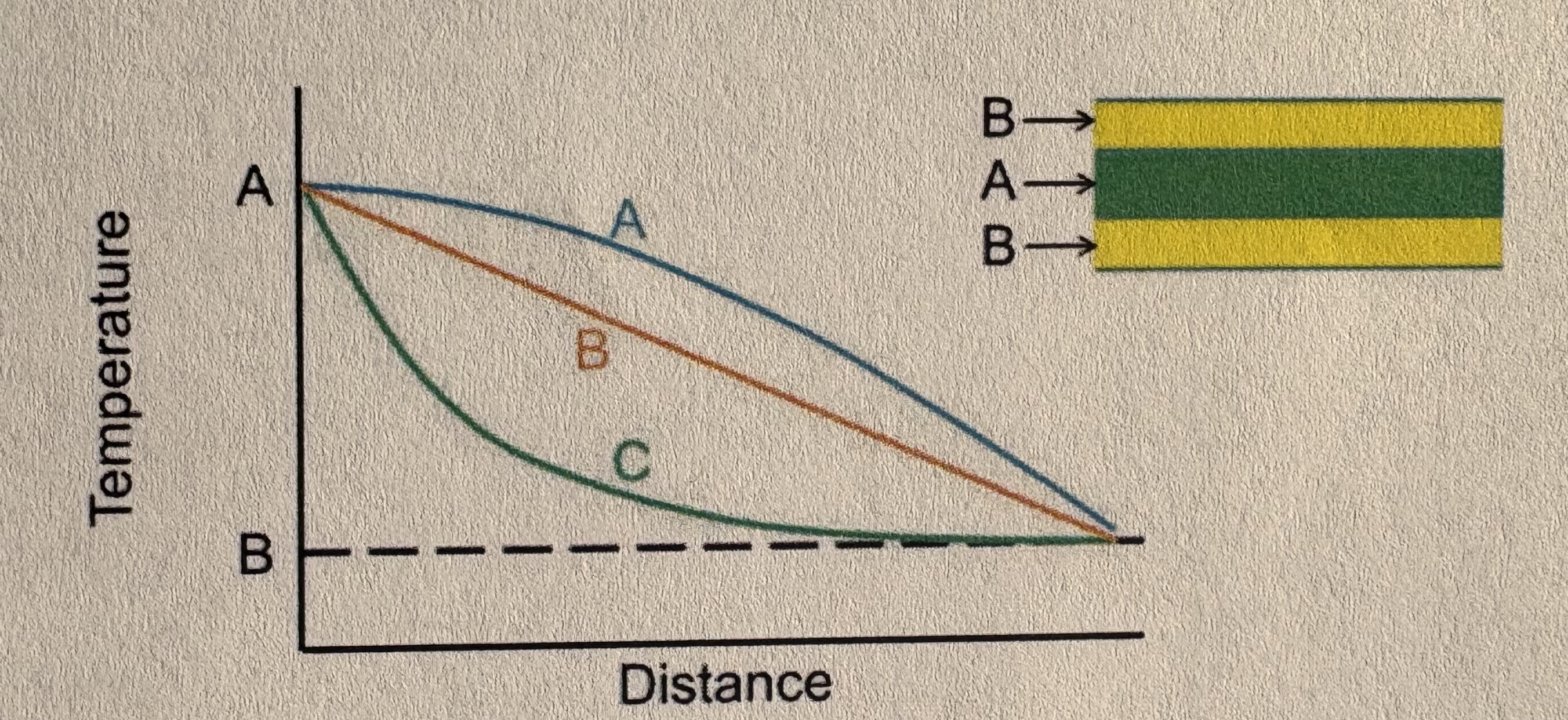
Liquid A is fed to a tube of a heat exchanger and the coolant (Liquid B) is fed to the shell side of the exchanger. The coolant temperature does not change because it is at its saturation temperature. Which plot best represents how the temperature of A changes with distance down the tube?
A) A
B) B
C) C
D) None of these
C
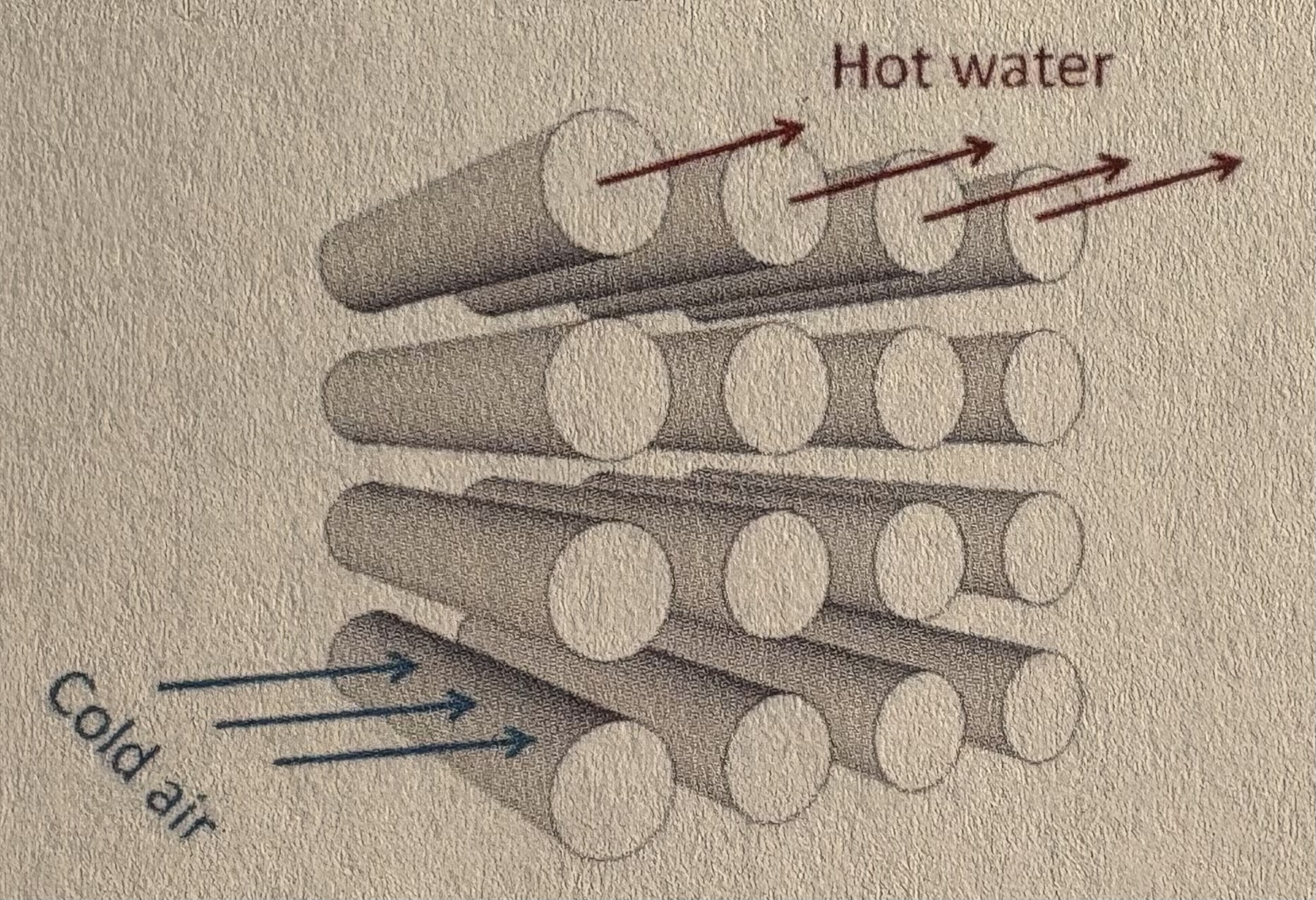
In a cross-flow heat exchanger, hot water flows through the tubes and cold air flows on the shell side. If the mass flow rates are identical, which fluid will experience the largest temperature change?
A) Air
B) water
C) the temperature change will be the same for both
A
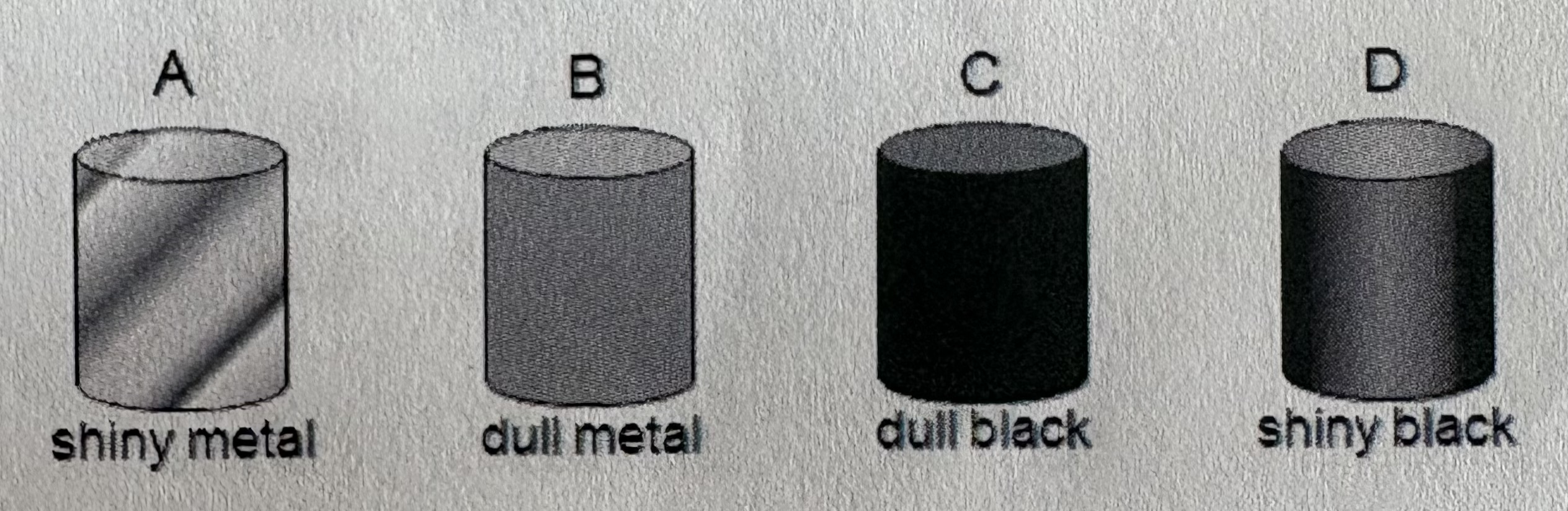
Four containers are filled with warm water and are allowed to cool on the kitchen counter. Heat losses due to conduction through the bottom and due to natural convection are negligible. Which container cools the slowest?
A) A
B) B
C) C
D) D
E) They all cool down at the same rate
A
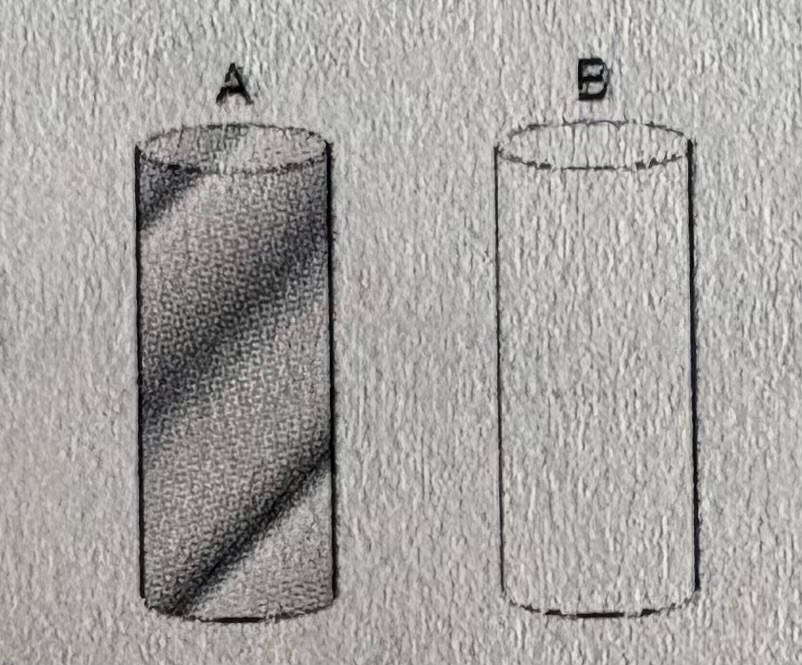
Consider two shiny metal rods. One rod is painted white. They are both warmed to the same temperature and then placed in a room with cool surroundings. Heat losses due to conduction through the bottom and due to natural convection are negligible. Which rod cools the fastest?
A) A
B) B
C) They both cool down at the same rate
B
If 55% of the energy from a gray body is reflected, what is the emissivity of the body?
A) 0.15
B) 0.25
C) 0.45
D) 0.55
E) Impossible to tell
C
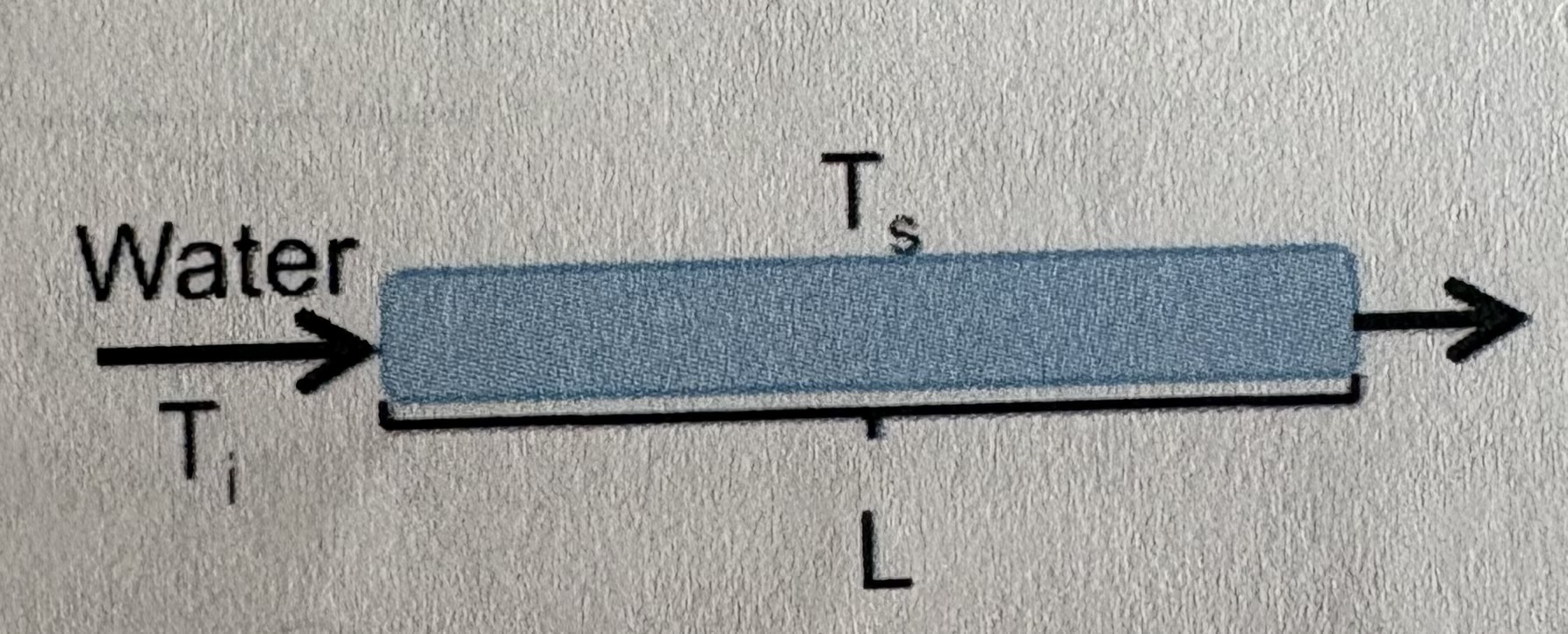
Water flows through a tube of length L with a mean inlet temperature (Ti). The tube is held at a uniform surface temperature (Ts) greater than (Ti). Assuming fully developed, laminar flow, the heat flow _____ when the mass flow rate is doubled. Assume that the mean temperature of the water at the outlet is equal to Ts.
A) stays the same
B) increases
C) decreases
D) impossible to tell
B
Heat transfer coefficients for a vapor condensing on a surface can be decreased by promoting:
A) Rolling Action
B) Film Condensation
C) Dropwise Condensation
D) None of these
B
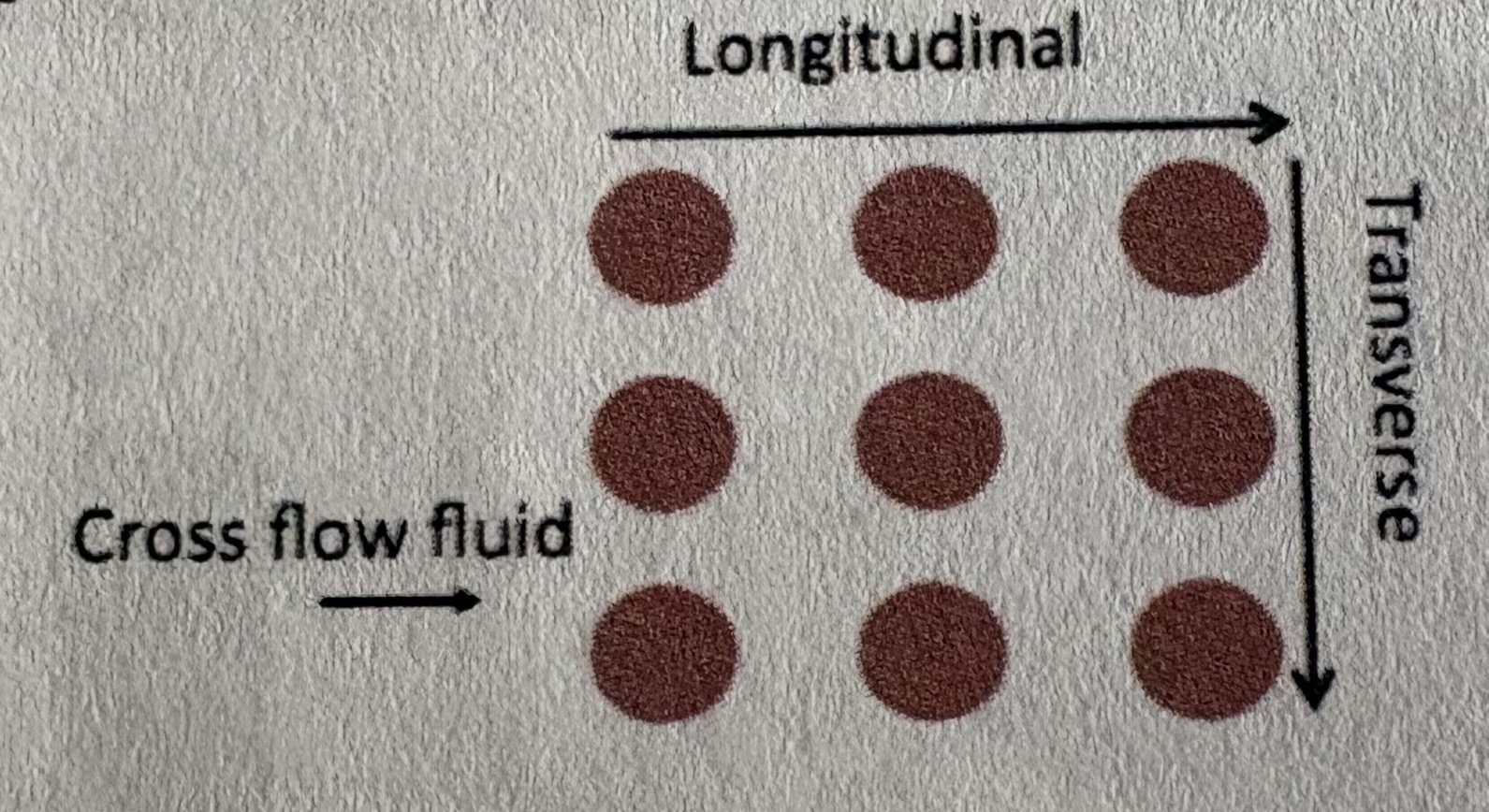
Turbulent cold air flows over an aligned 3×3 hot-tube bank. Doubling the number of tubes in the _____ direction, while maintaining the same tube spacing, would result in the highest outlet air temperature.
A) longitudinal
B) transverse
C) either
B
When your hand is a short distance away, a _____ muffler feels hotter. They are both at the same temperature.
A) shiny
B) rusted
C) both would feel the same
D) impossible to tell
B
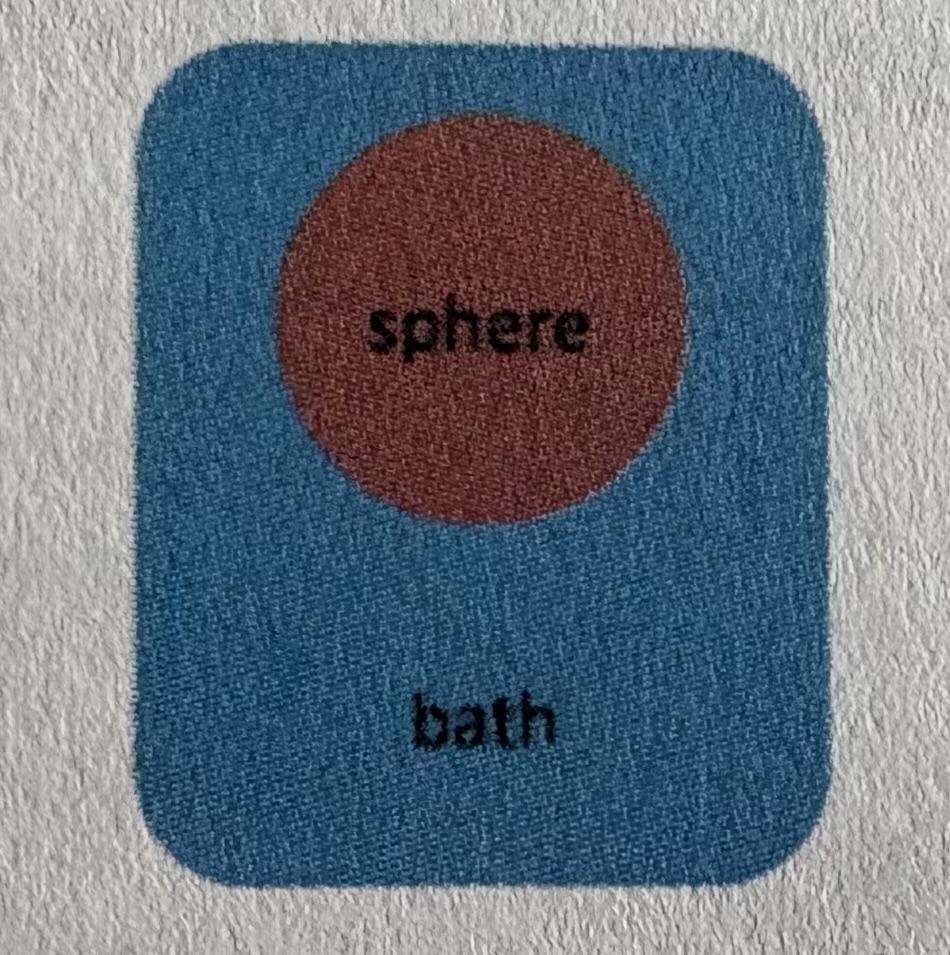
A hot sphere is placed in a cold-water bath. The temperature at the center of the sphere will be close to the temperature at the surface of the sphere when the material has a _____.
A) high thermal conductivity
B) high density
C) low heat capacity
D) large surface area to volume ratio
A
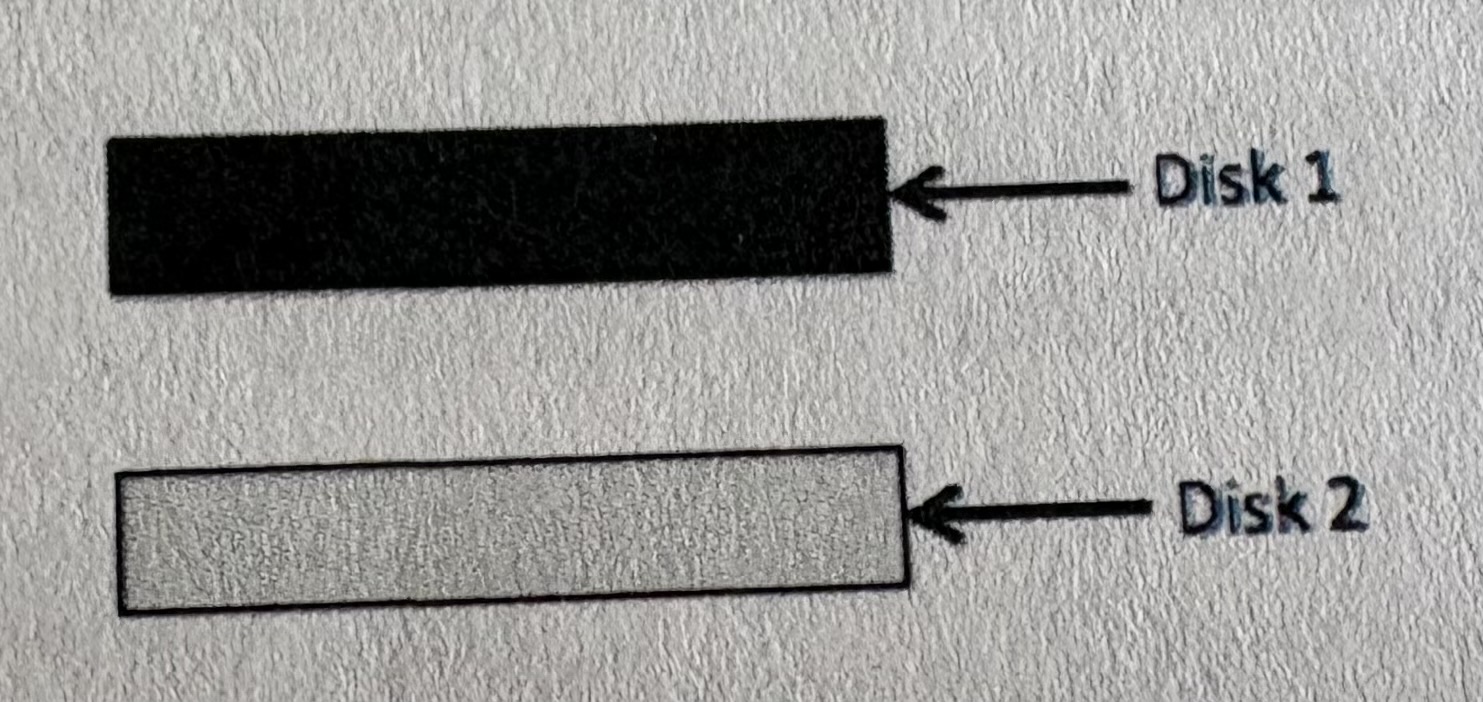
Two infinitely long parallel disks are in a vacuum. Disk 1 is a black body maintained at 25 C. Disk 2 is diffuse and opaque and is also maintained at 25 C. The net radiation leaving disk 1 is _____ than that leaving disk 2.
A) greater than
B) less than
C) the same as
D) not enough information
A
An object generates thermal energy under steady conditions, making it hotter than its surroundings. It has a large thermal conductivity and a small convective heat transfer coefficient. The object’s power is turned off. How does the object’s temperature change over time?
A) A
B) B
C) C
D) D
E) E
A
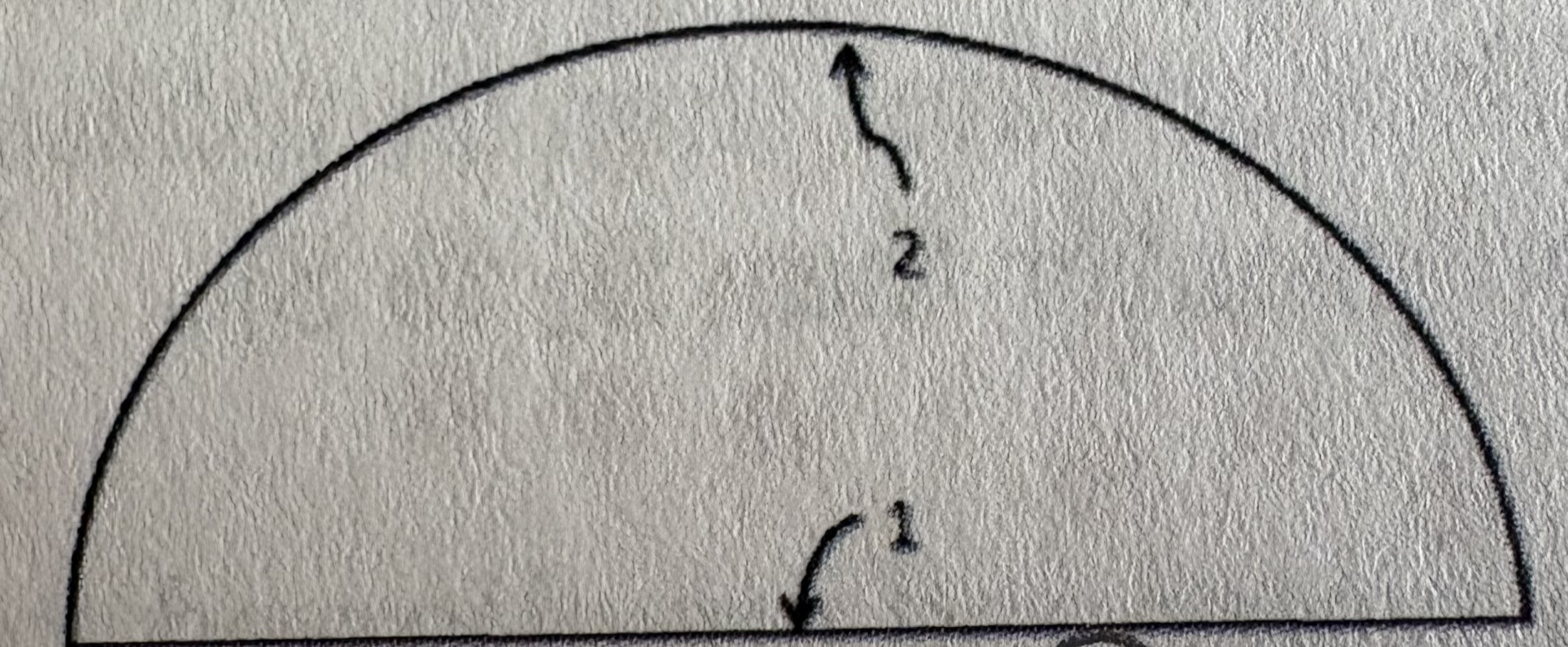
There is a long, heated duct that has a semi-circle cross-sectional geometry. The view factor (F22) of the curved surface (2) to itself is _____.
A) 0
B) 0.36
C) 0.50
D) 0.64
E) 1
B
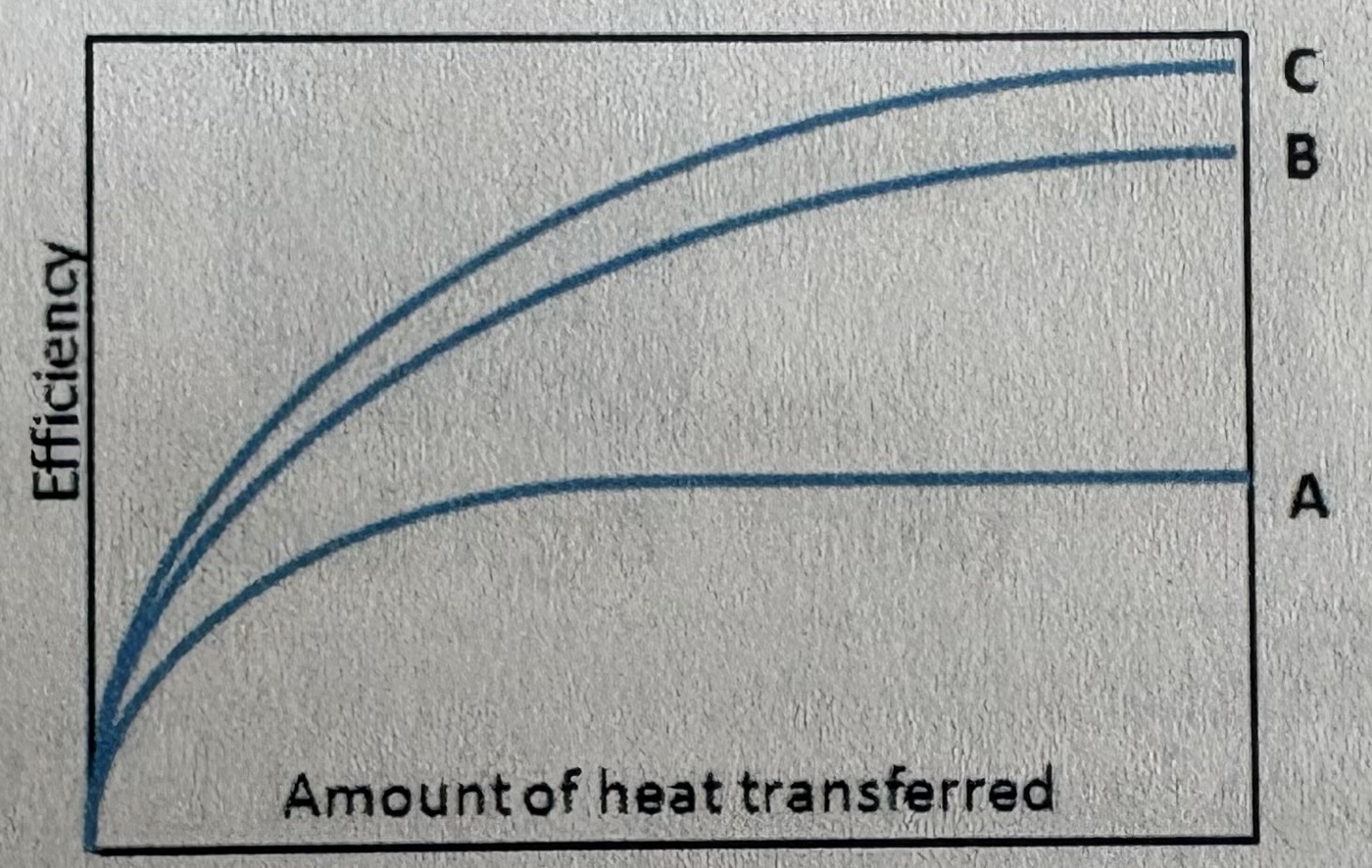
Profiles of heat exchanger efficiency versus amount of heat transferred are given for parallel, counter, and cross-flow heat exchangers. If the shell and tube side fluids have the same heat capacity rate, which curve could represent the parallel flow heat exchanger?
A) A
B) B
C) C
D) Impossible to tell
A
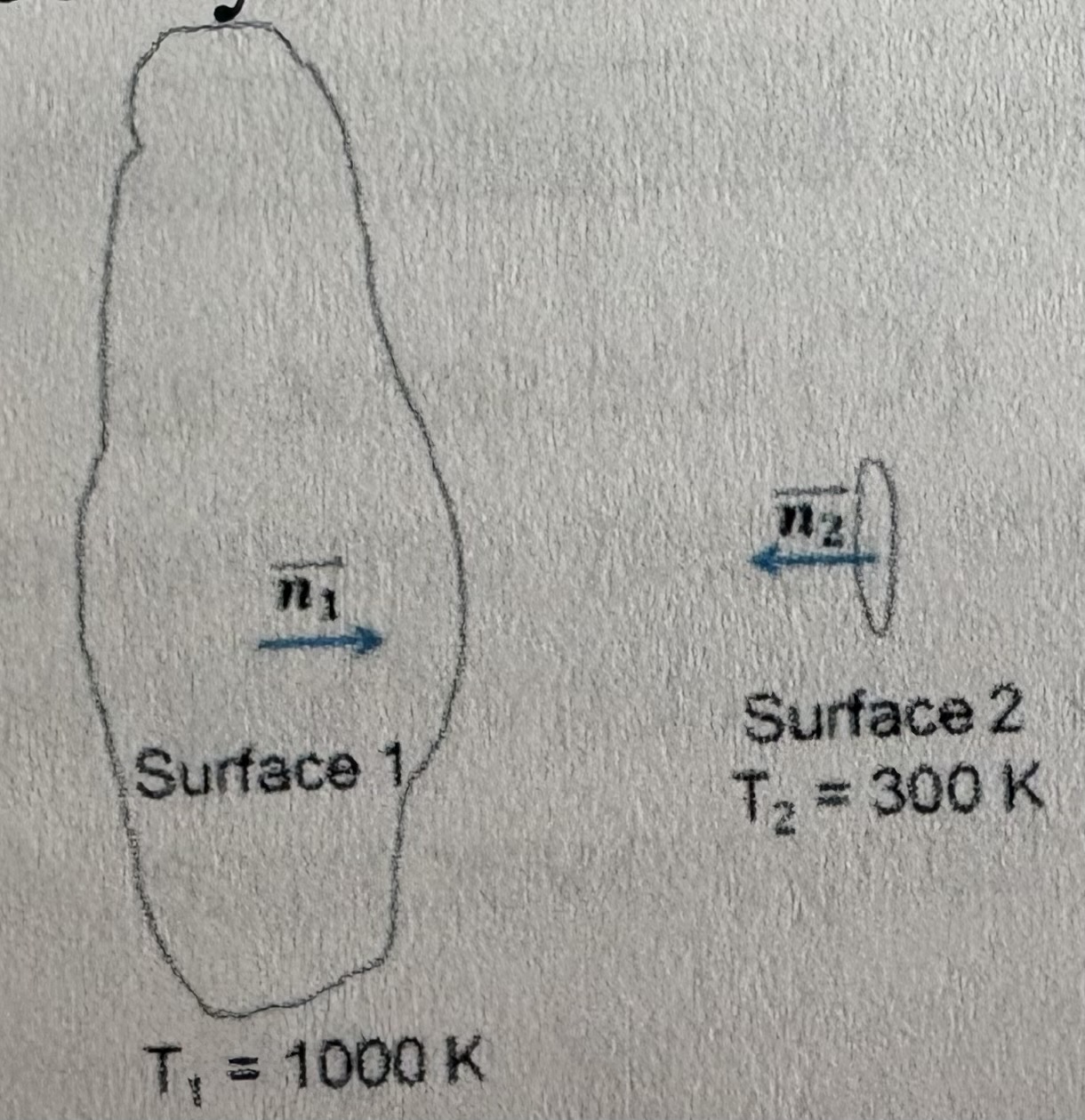
Radiation is exchanged between surface 1 and surface 2. The surface area of 1 is greater than that of 2. The fraction of radiation leaving surface 1 that is intercepted by surface 2 is _____ the fraction of radiation leaving surface 2 that is intercepted by surface 1.
A) greater than
B) less than
C) equal to
D) impossible to tell
B
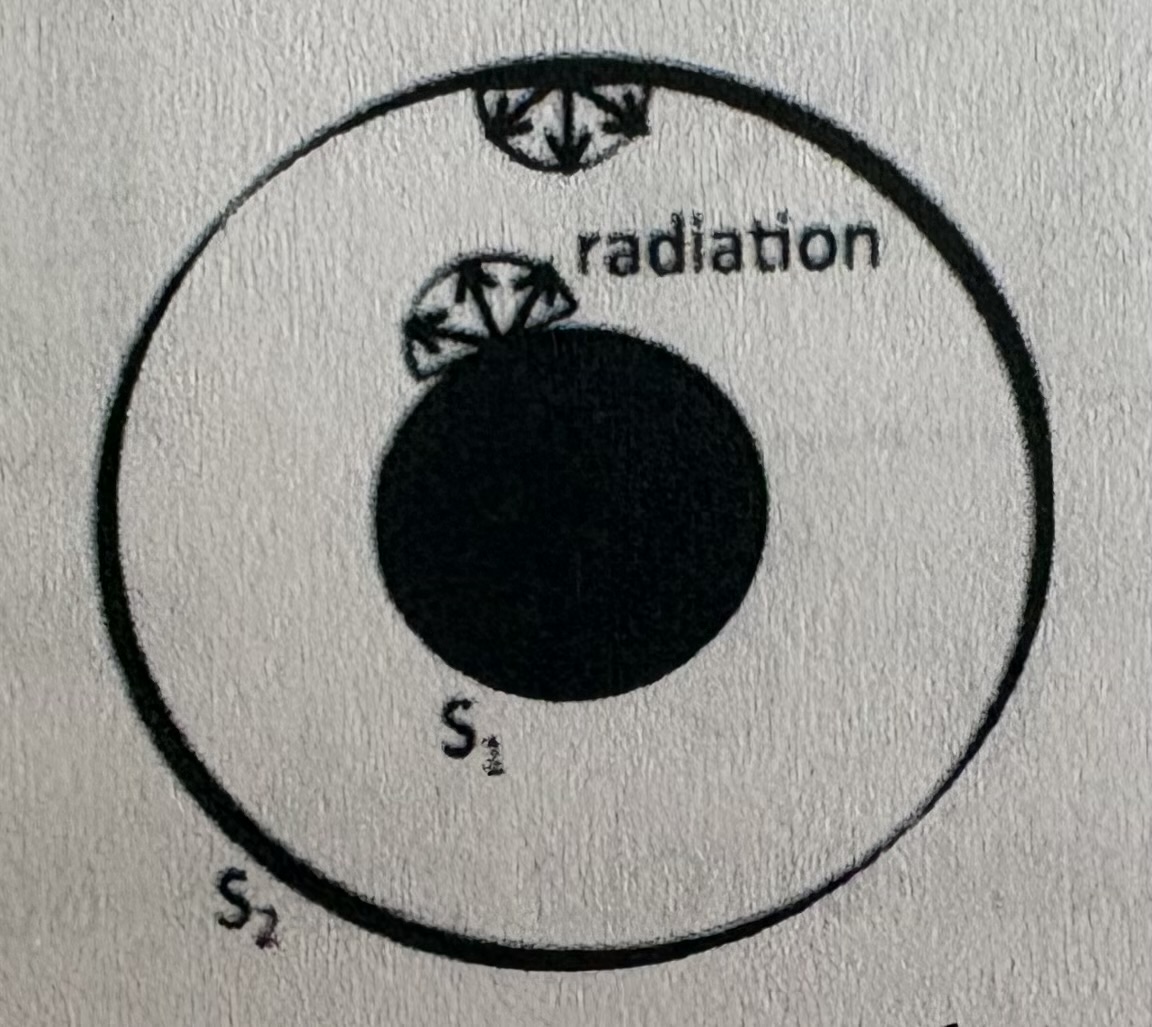
A large hollow tube, S2, encloses a smaller solid tube, S1. Both are at the same temperature and diffuse emitters. Which statement is true?
A) the net radiation leaving S2 will be higher than that reabsorbed into S2
B) the view factor of S2 to itself will be greater than S1 to itself
C) the view factor of S1 to S2 will be greater than S2 to S1
D) All are true
D
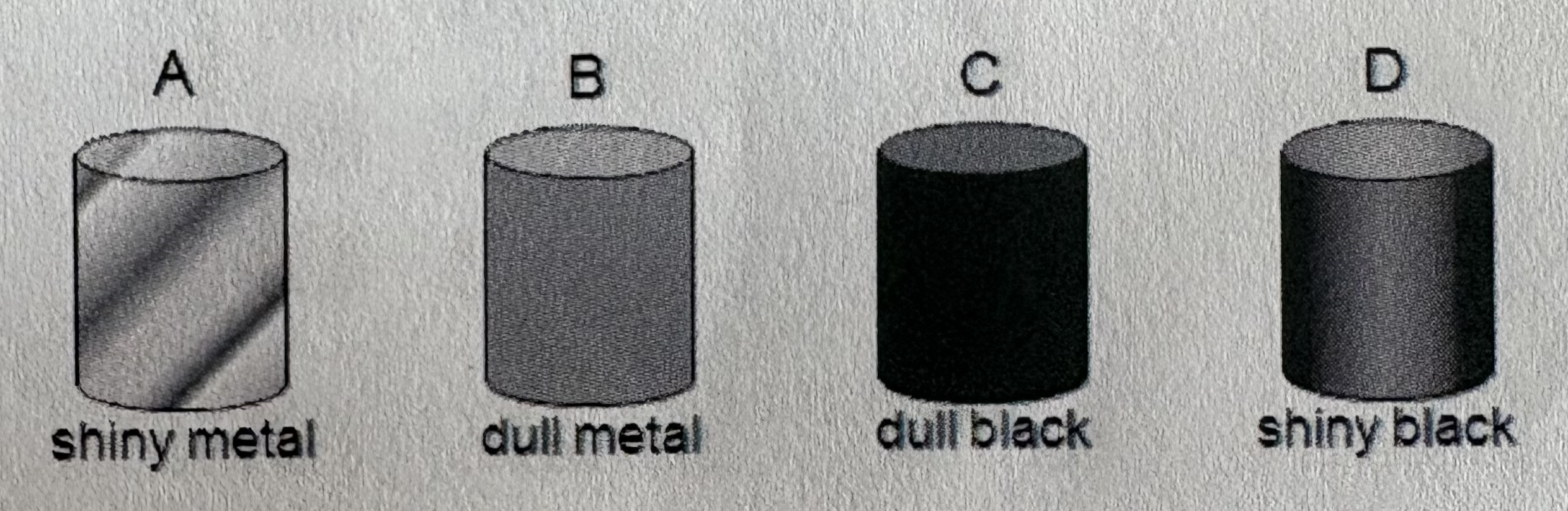
Four containers are filled with warm water and are allowed to cool on the kitchen counter. Heat losses due to conduction through the bottom and due to natural convection are negligible. Which container cools the fastest?
A) A
B) B
C) C
D) D
E) They all cool down at the same rate
C
At the center of a sphere undergoing purely radial transient conduction, the appropriate boundary condition is usually dT/dr = 0 at r = 0. What is the strongest reason?
A) The center is always at the ambient temperature
B) Heat generation is zero at the center
C) Symmetry requires zero radial heat flux through the center
D) The specific heat is largest at the center
C
Three objects have the same volume, material, and initial temperature: a sphere, a cube, and a thin plate. They are exposed to the same fluid, and all satisfy Bi < 0.1. Which object reaches the fluid temperature fastest?
A) The sphere
B) The cube
C) The thin plate
D) All three respond at the same rate because the volume is the same
C
A hot metal sphere is cooled first in still air and then in vigorously stirred water. The solid is the same in both cases. Why can internal temperature gradients become more important in the water bath even though the outside cooling is stronger?
A) Because the water reduces the solid thermal conductivity k
B) Because the water greatly increases h, which raises the Biot number and reduces the relative importance of external resistance
C) Because the water changes the sphere radius
D) Because the Biot number is independent of the surrounding fluid
B
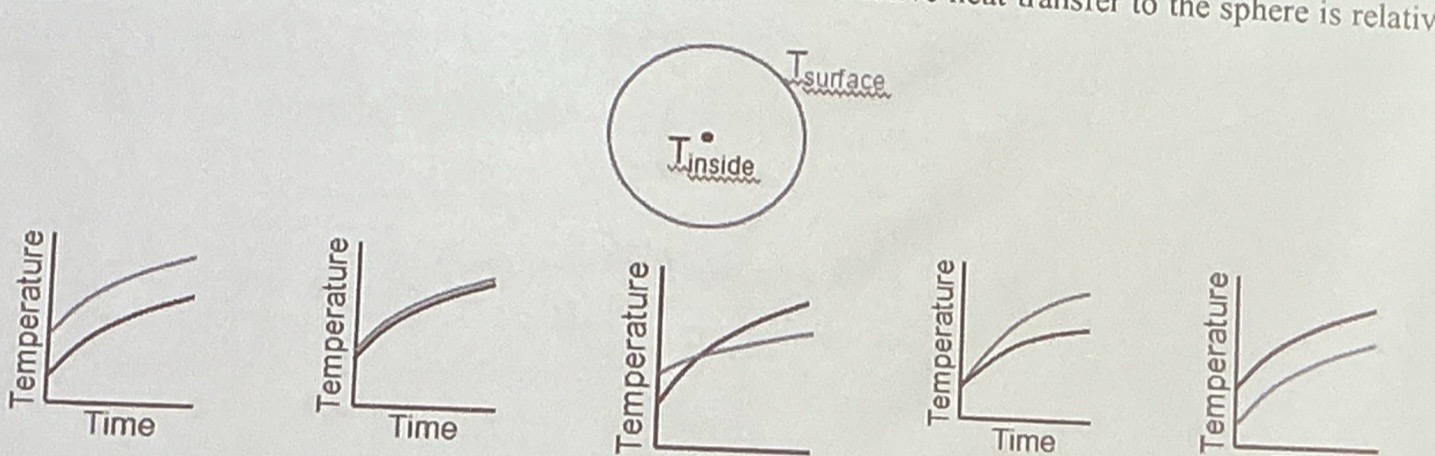
An aluminum sphere, initially at a temperature of 25 C, is placed in a 300 C oven. How do the temperatures of the sphere center (black) and the sphere surface (blue) change over time? Assume that the thermal conductivity of the sphere is large and that the rate of convective heat transfer to the sphere is relatively small.
A) A
B) B
C) C
D) D
E) E
B
Consider two solid copper spheres, 1 and 2. Sphere 1 has twice the diameter of sphere 2. If both spheres are initially at 0 C and placed in quiescent air at 25 C, which sphere will reach air temperature first?
A) Sphere 1
B) Sphere 2
C) Both spheres will reach temperature at the same time
D) Impossible to tell
B
The Biot number can be expressed as the ratio of:
A) The conduction thermal resistance to the convective thermal resistance
B) The convective thermal resistance to the conductive thermal resistance
C) The thermal energy storage capacity to the conduction thermal resistance
D) The thermal energy storage capacity to the convection thermal resistance
E) None of the above
A
Certain unsteady heat conduction problems can be solved using charts, such as the Gurney-Lurie and Heisler plots. This method requires nondimensionalizing the governing equations, yielding four primary dimensionless quantities. Which of the following dimensionless quantities does not result from this process?
A) Biot number
B) Fourier number
C) Dimensionless temperature
D) Dimensionless thermal diffusivity
D
Two different solids are observed at the same Fourier number. Why might the actual elapsed times still be very different?
A) Because Fo depends on alpha and the characteristic length, not just clock time
B) Because the Biot number must also be the same
C) Because equal Fo requires equal convection coefficients
D) Because equal Fo is possible only for the same material
A
Why does the one-dimensional transient heat equation in a cylinder contain the operator (1/r)(d/dr)(r dT/dr) instead of just d2T/dr2?
A) Because the thermal conductivity varies with radius, even when the material is uniform
B) Because the area available for radial conduction changes with radius
C) Because specific heat depends on geometry
D) Because convection is strongest near the centerline
B
Which of the following are correct units for the heat transfer coefficient?
A) BTU/(hr ft2 K4)
B) kg/(s3 K)
C) cal/(cm2 K)
D) kg/(s3 m2 K4)
B
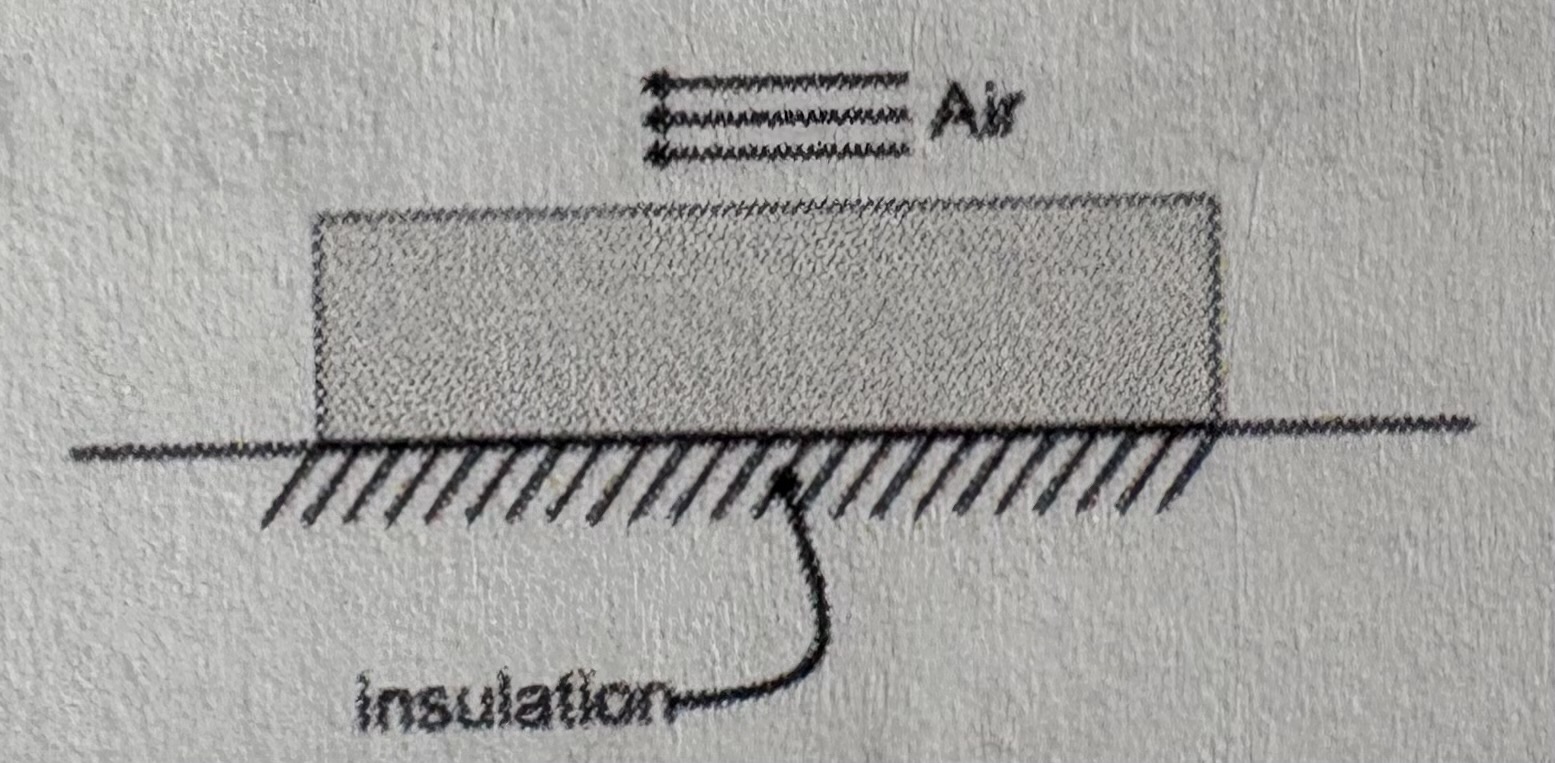
An electronic chip is uniformly generating heat. The top of the chip is being cooled by flowing air while the base is insulated. If the chip has a height of L, the maximum temperature is at height ____.
A) 0
B) L
C) L/2
D) 2L
A
Water enters a circular tube whose walls are maintained at a constant temperature at a specified flow rate and temperature. For fully developed turbulent flow, the Nusselt number can be determined from Nu = 0.023Re0.8Pr0.4. The correct temperature difference to use in the Newton’s Law of cooling in this case is _____.
A) The difference between the inlet and outlet water bulk temperature
B) The difference between the inlet water bulk temperature and the tube wall temperature
C) The log mean temperature difference
D) The difference between the average water bulk temperature and the tube temperature
E) None of the above
D
A cylindrical mixing tank is to be scale up to a larger size such that the volume of the larger tank is 27 times that of the smaller one. If the tanks are geometrically similar, the ratios of diameters and heights between the two is closest to ____.
A) 1.71
B) 2.08
C) 3
D) 4
E) 1.5
C
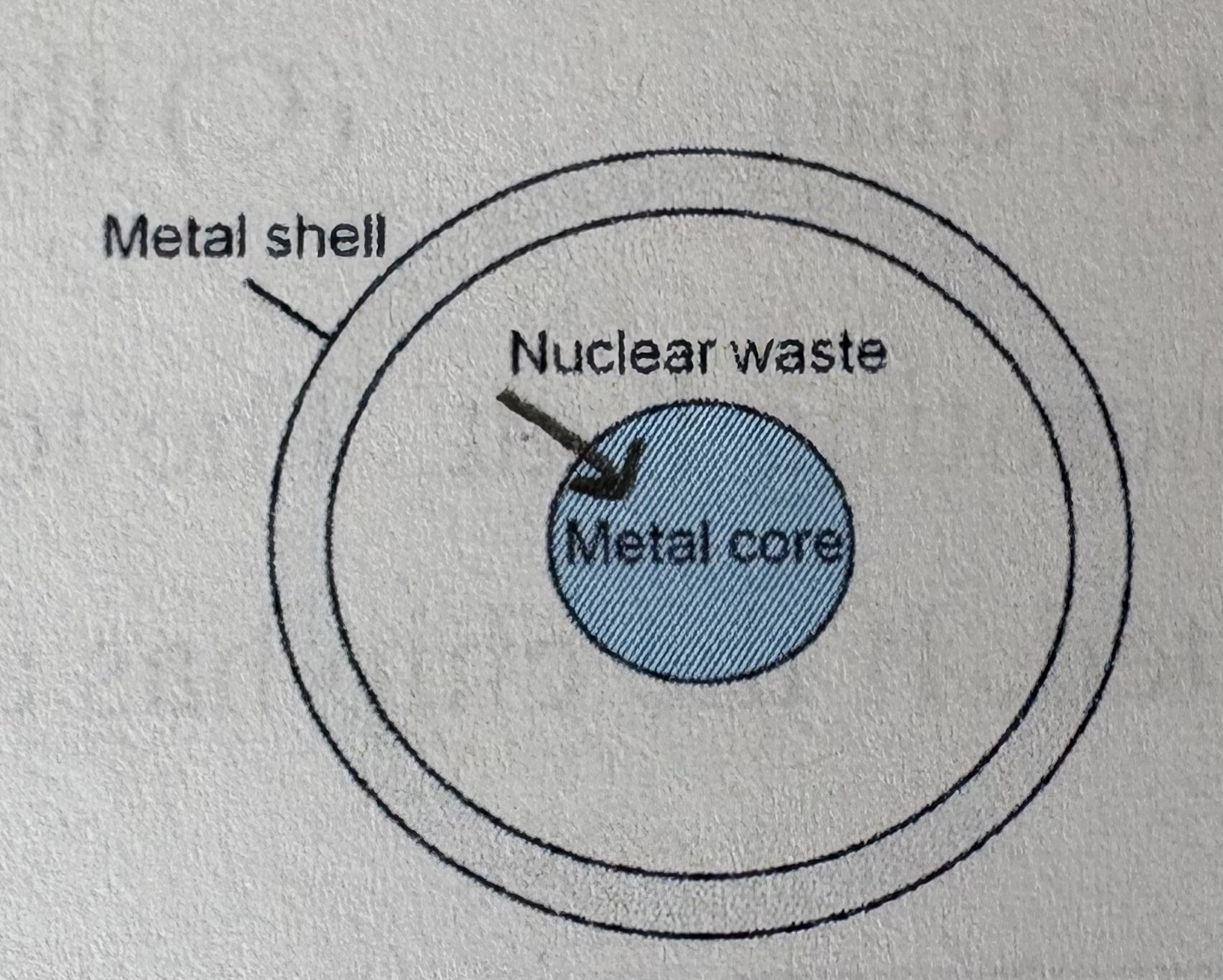
Nuclear waste inside a metal shell generates thermal energy. A metal core is located at the center of the nuclear waste. At steady state, the flux across the surface of the metal core is _____ zero.
A) greater than
B) equal to
C) less than
D) impossible to tell
B
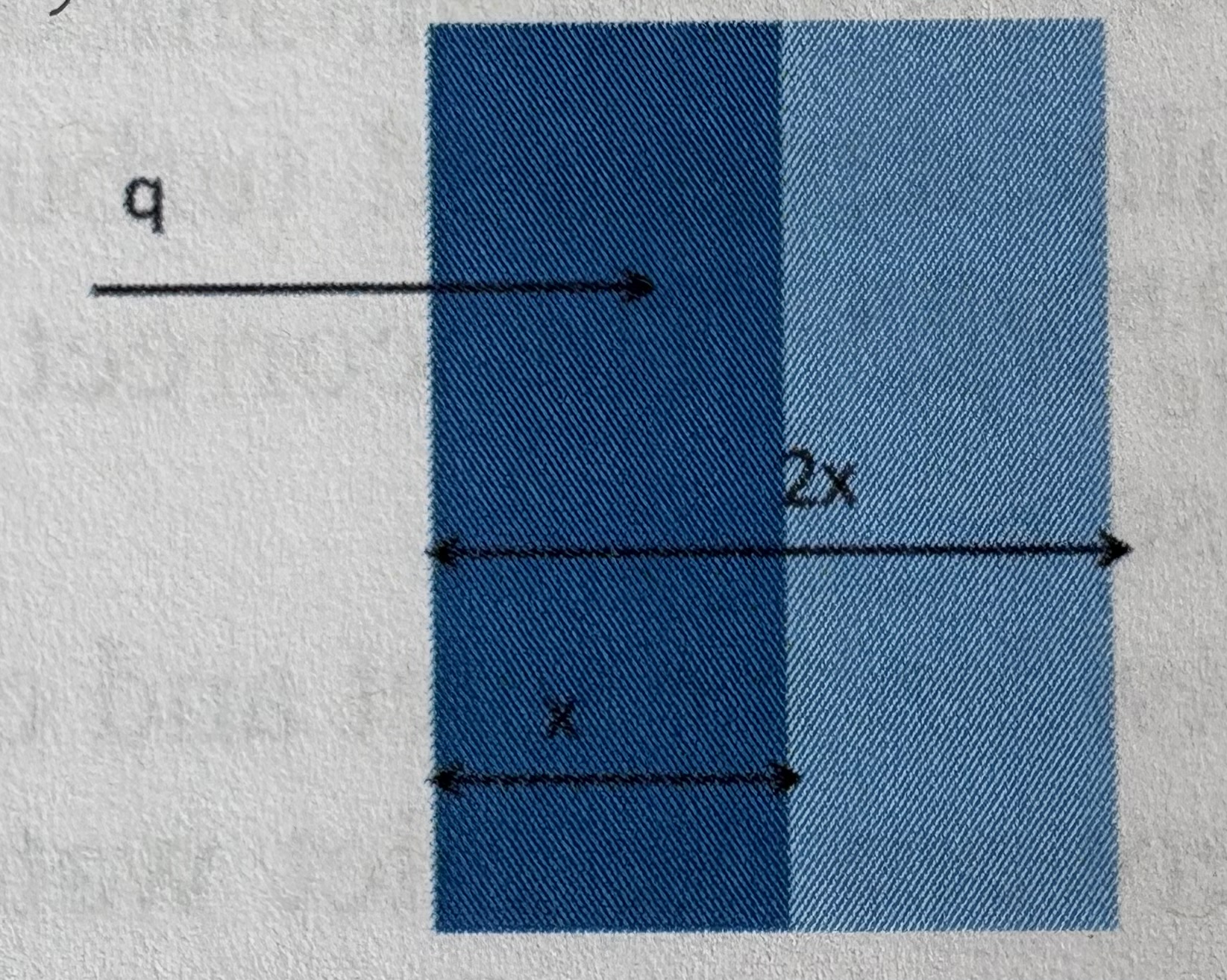
If the thickness of a plane wall is doubled from x to 2x while maintaining the same temperatures on each side of the wall, the conductive heat transfer rate (q) _______.
A) increases
B) decreases
C) stays the same
D) not enough information
B
Consider two walls, A and B, with the same surface areas and the same temperature drops across their thicknesses. The ratio of their thermal conductivities is kA/kB = 2 and the ratio of the wall thickness is LA/LB = 4. The ratio of heat transfer rates through the walls qA/qB is:
A) 0.5
B) 1
C) 2
D) 4
E) 8
A
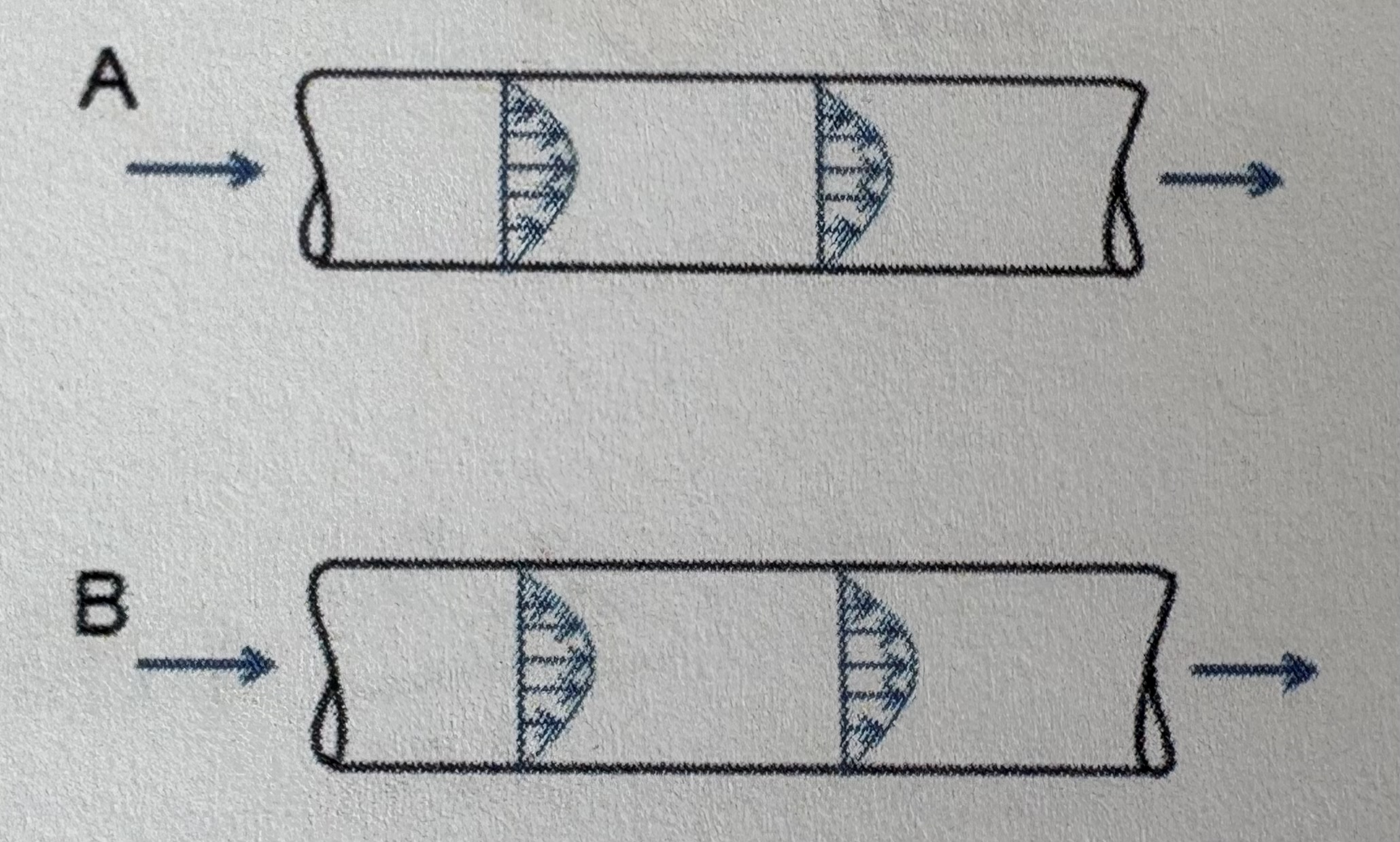
A cold fluid flows through two hot tubes in fully developed flow. The temperature difference between the tubes and the fluid is the same for both tubes at the entrances. Tube A has a constant wall temperature. Tube B has a constant heat transfer rate. Which tube has a higher average thermal flux from the tube to the fluid?
A) A
B) B
C) both tubes are the same
B
Cross-flow, parallel flow, and rotary flow are the main categories of regenerators.
True or False?
False
Fouling introduces additional thermal resistance in heat transfer equipment.
True or False?
True
Cooling towers are examples of direct-contact heat exchangers.
True or False?
True
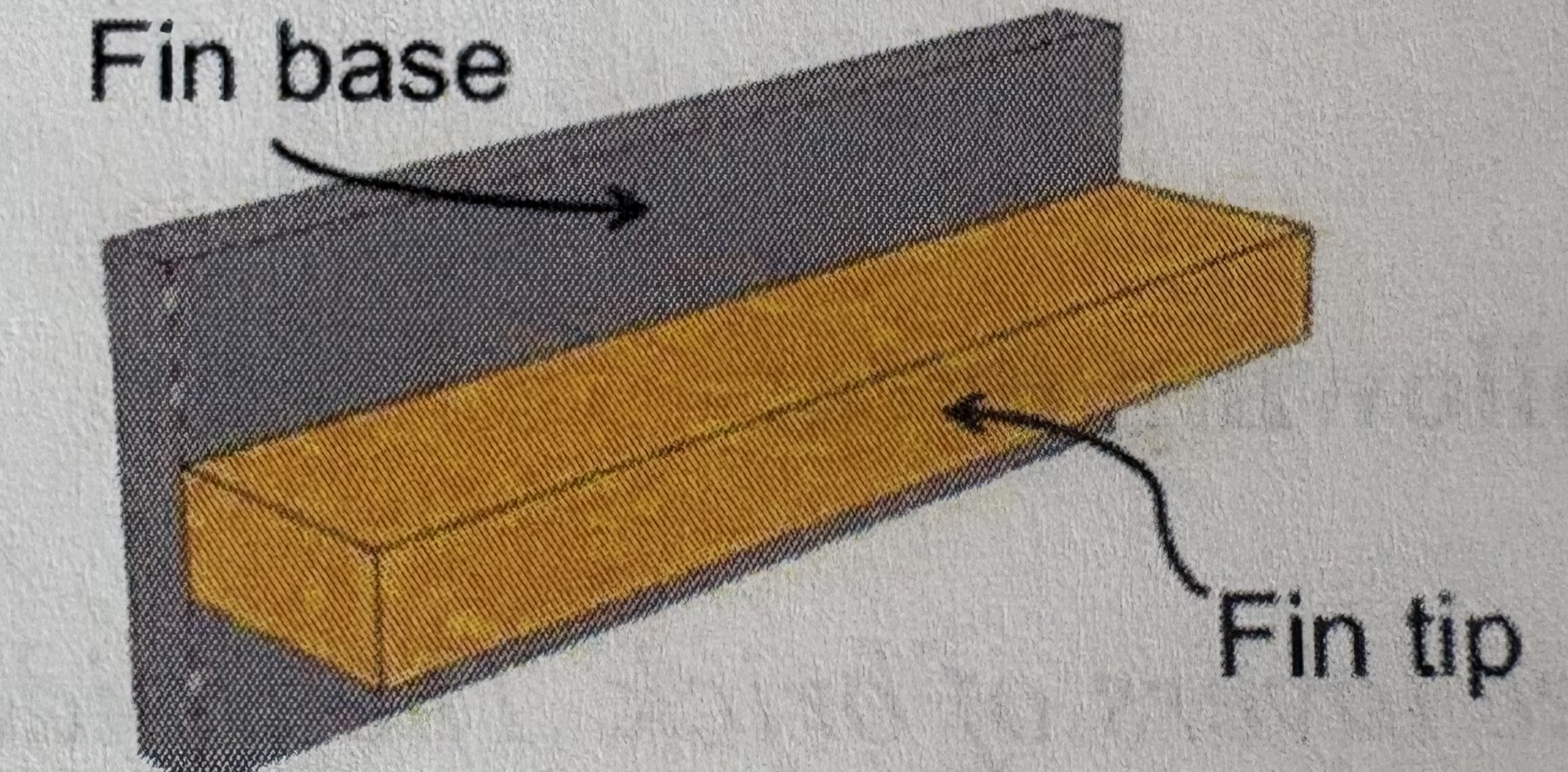
A rectangular fin dissipates heat, with the base temperature Tbase, greater than the ambient temperature, Tsurroundings. The maximum heat transfer from a fin occurs when the temperature at the tip of the fin is equal to ______.
A) Tbase
B) (1/2)Tbase
C) Tsurroundings
D) (1/2)Tsurroundings
C
For a given amount of heat transferred in a heat exchanger, the effectiveness is highest for a heat capacity ratio of ____.
A) 1
B) 0.75
C) 0.5
D) 0.25
E) 0
E
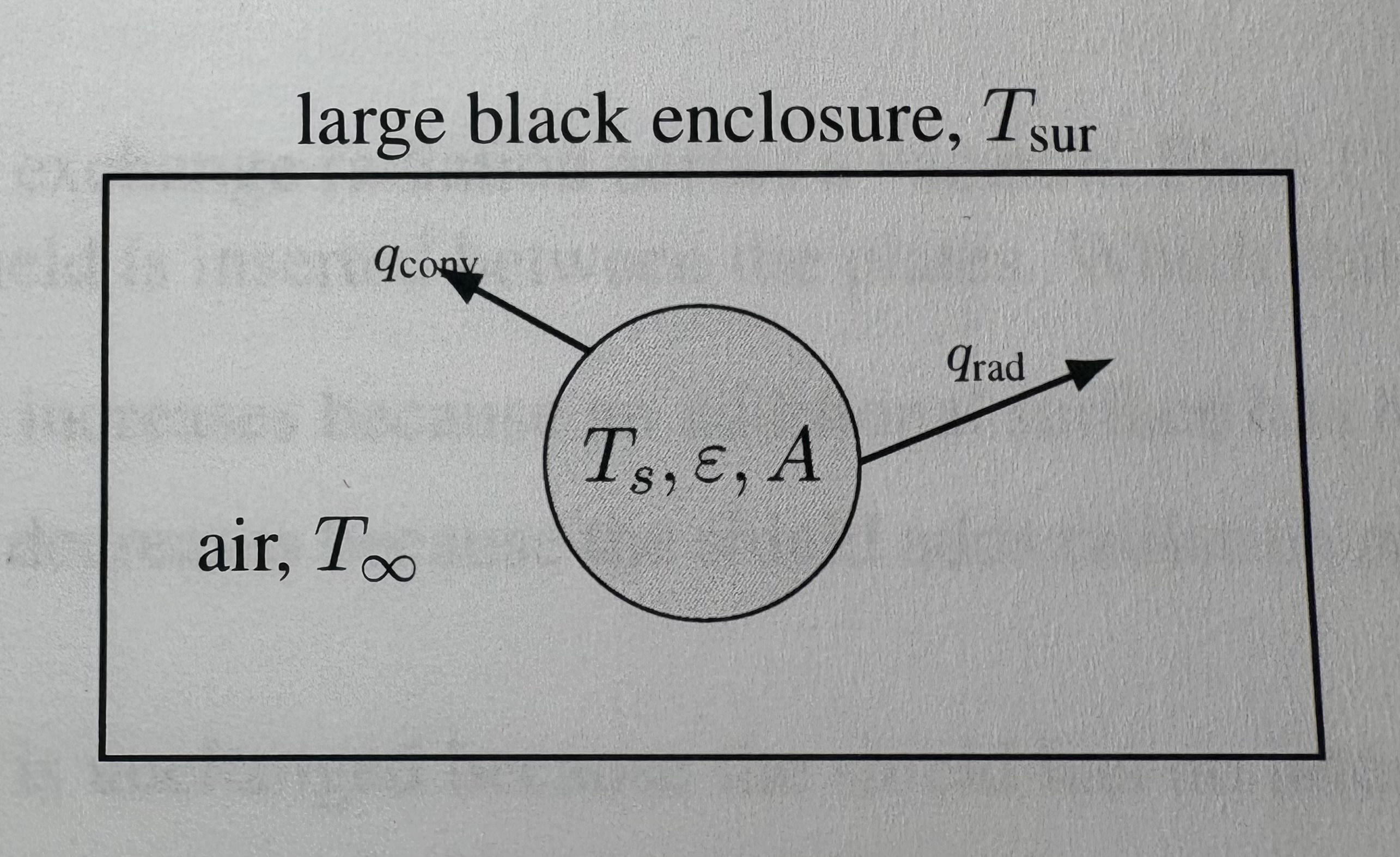
A small gray object is suspended inside a much larger black enclosure. The object has a surface area A, emissivity epsilon, and surface temperature Ts. The enclosure walls are at temperature Tsur, and the air surrounding the object is at temperature Tinfinity. The convection coefficient between the object and the air is h. Assume Ts > Tinfinity and Ts > Tsur. Which expression gives the net rate of heat loss from the object by convection and radiation?
A) q = hA(Ts - Tinfinity) + (epsilon)(sigma)A(Ts4 - Tsur4)
B) q = hA(Tinfinity - Ts) + (epsilon)(sigma)A(Tsur4 - Ts4)
C) q = hA(Ts - Tsur) + (epsilon)(sigma)A(Ts4 - Tinfinity4)
D) q = hA(Ts - Tinfinity) + (epsilon)(sigma)A(Ts - Tsur)4
E) q = h(epsilon)(sigma)A(Ts4 - Tsur4)
A
An opaque gray surface reflects 35% of the thermal radiation incident on it and transmits none of the incident radiation. Under conditions for which Kirchhoff’s law applies, what is the emissivity of the surface?
A) 0.35
B) 0.65
C) 1
D) 0
E) Impossible to determine
B
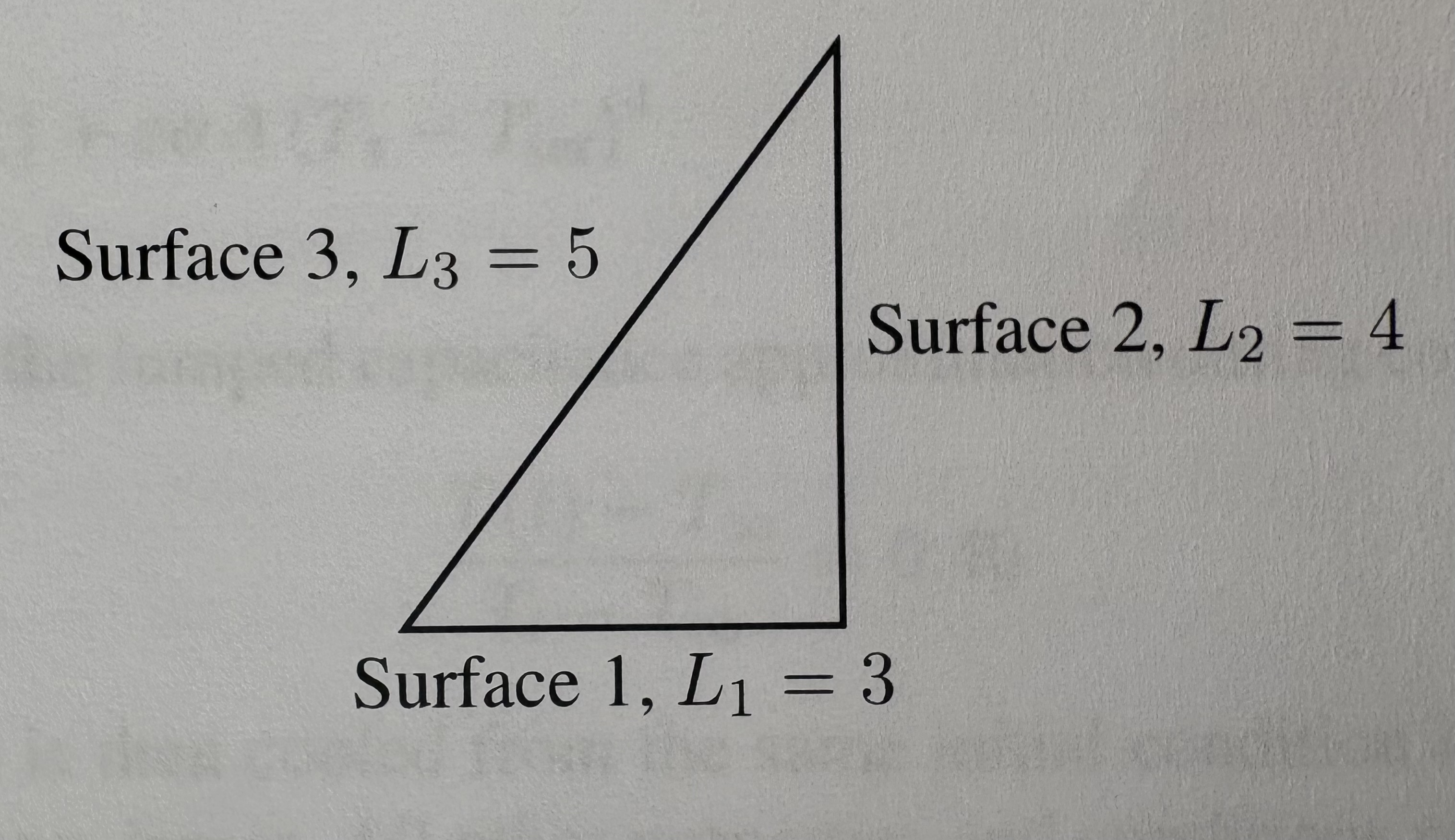
A long triangular duct has a right-triangle cross section. The three inside surfaces are flat and diffuse. End effects may be neglected, and the side lengths shown are proportional to surface areas per unit duct length. What is the view factor F12, from Surface 1 to Surface 2?
A) 0
B) 1/3
C) 1/2 D) 2/3
E) 1
B
Two large parallel gray plates exchange radiation across a vacuum. Plate 1 is hot, plate 2 is cold, so T1 > T2. A thin, low-emissivity radiation shield is inserted between the plates. Which statement is most correct?
A) The net radiation heat transfer increases because an additional surface has been added.
B) The net radiation heat transfer decreases because the shield adds radiation resistance between the hot and cold plates.
C) The net radiation heat transfer is unchanged because the shield has no internal heat generation.
D) The net radiation heat transfer becomes zero because the shield is gray.
E) The radiation heat transfer must be replaced by Newton’s law of cooling.
B
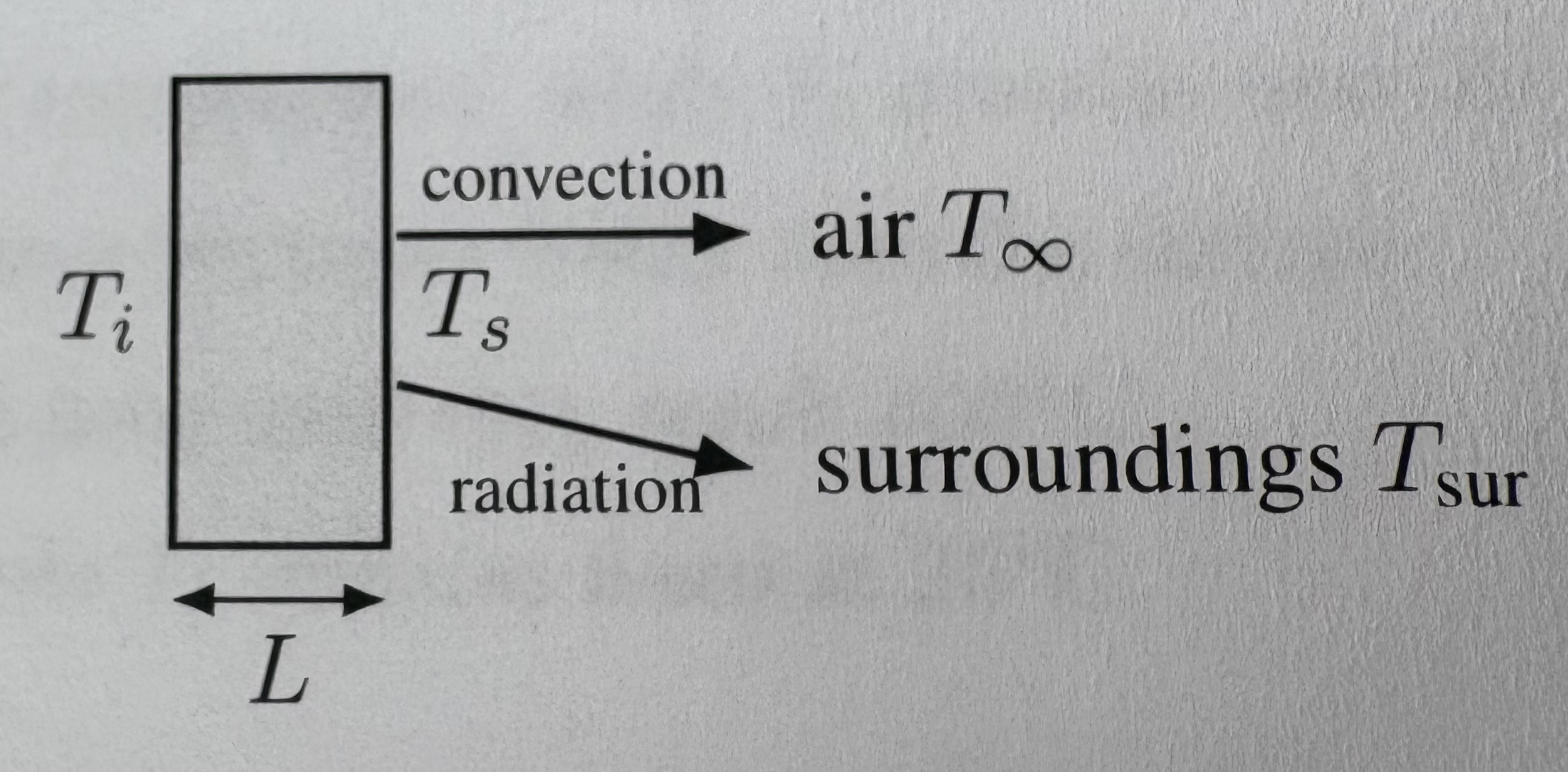
A plane wall has an inner surface temperature Ti. Its outer surface loses heat by convection to air at Tinfinity and by radiation to large surroundings at Tsur. The wall has thickness L, thermal conductivity k, area A, and outer-surface emissivity epsilon. For steady heat transfer with no internal generation, which surface energy balance is correct?
A) kA(Ti - Ts)/L = hA(Ts - Tinfinity) + (epsilon)(sigma)A(Ts4 - Tsur4)
B) kA(Ts - Ti)/L = hA(Ts - Tinfinity) + (epsilon)(sigma)A(Ts4 - Tsur4)
C) kA(Ti - Ts)/L = hA(Tinfinity - Ts) + (epsilon)(sigma)A(Tsur4 - Ts4)
D) kA(Ti - Ts)/L = hA(Ts - Tsur) + (epsilon)(sigma)A(Ts4 - Tinfinity4)
E) kA(Ti - Ts)/L = hA(Ts - Tinfinity) + (epsilon)(sigma)A(Ts - Tsur)4
A
A small metal part satisfies the lumped capacitance approximation during cooling. In still air, the part reaches dimensionless temperature of 0.40 after 18 minutes. The same part is then cooled from the same initial condition in a moving air stream where the convection coefficient is three times larger. All other properties and conditions remain the same. How long will it take the part to reach the same dimensionless temperature ratio of 0.40.
A) 6 min
B) 9 min
C) 18 min
D) 36 min
E) 54 min
A
Two geometrically similar solid metal cubes are initially at the same uniform temperature and are suddenly placed in the same air environment. Cube A has side length L, while Cube B has side length 2L. The same convection coefficient applies to both cubes, and lumped capacitance analysis is valid both. Which cube reaches the halfway point between its initial temperature and the air temperature first?
A) Cube A
B) Cube B
C) Both reach the halfway point at the same time
D) Impossible to determine unless the initial temperature is known
E) Impossible to determine unless the final temperature is known
A
An aluminum sphere initially at 25 C is placed in a 300 C oven. The sphere has high thermal conductivity, and the convection coefficient between the oven air and the sphere is relatively small. Which qualitative description best represents the center temperature TC and surface temperature TS of the sphere as a functions of time?
A) Tc and Ts remain nearly equal and both rise asymptotically toward the oven temperature
B) Ts rises quickly toward the oven temperature, while Tc remains near 25 C for most of the process
C) Tc rises faster than Ts, so the center becomes hotter than the surface
D) Both Tc and Ts rise linearly with time until they reach 300 C
E) Ts instantly becomes 300 C, while Tc remains fixed at 25 C
A
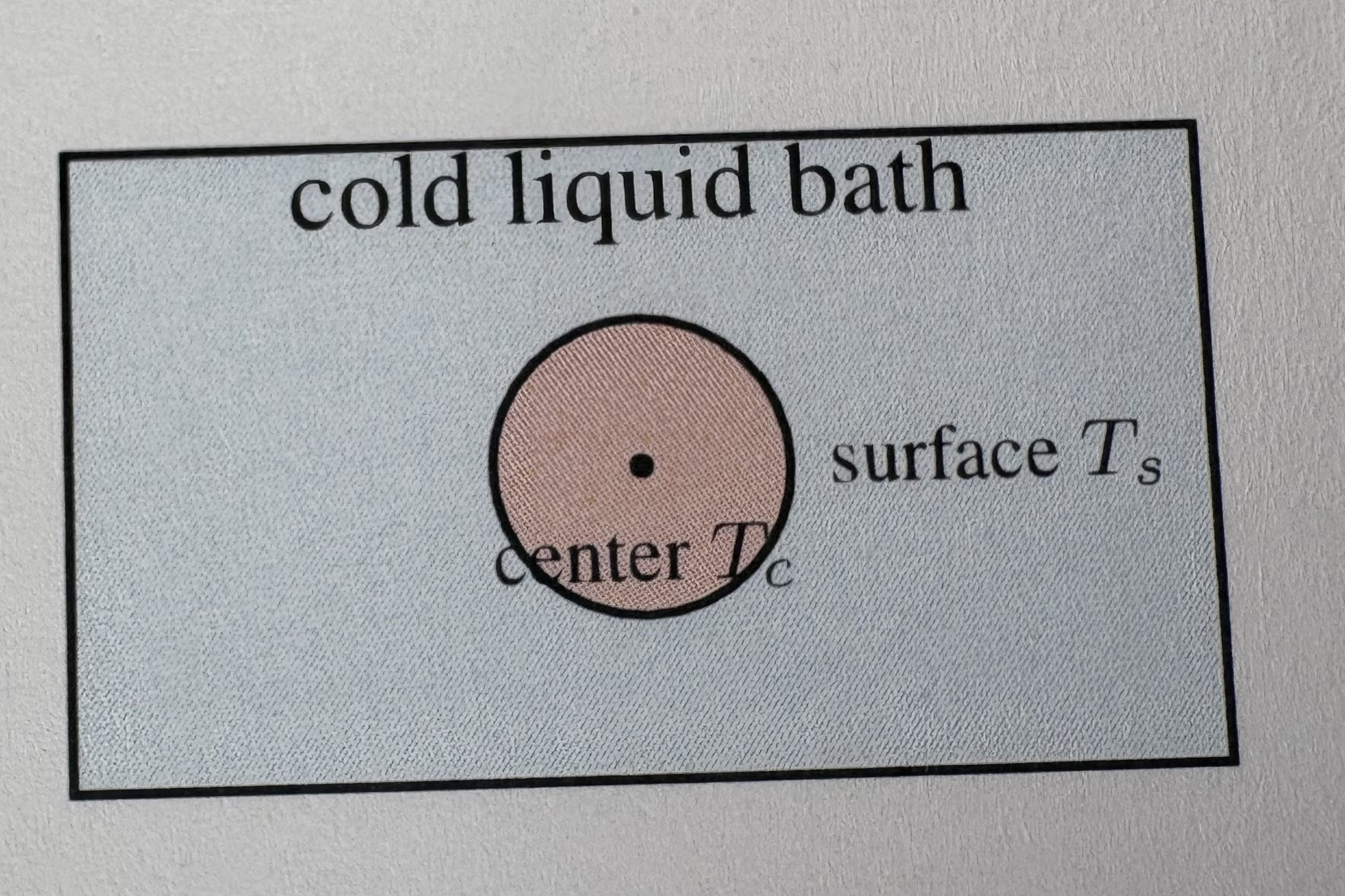
An initially hot solid sphere is suddenly immersed in a cold liquid bath. The Biot number is much larger than 0.1. Which description best represents the temperature behavior?
A) The center and surface temperatures remain essentially identical at all times.
B) The surface temperature decreases rapidly first, while the center temperature remains warmer for some time
C) The center temperature decreases more rapidly than the surface temperature
D) The surface temperature increases because the liquid bath supplies heat
E) No temperature gradients can exist because the object is spherical
B
A steel casting cools to 90 percent of the original temperature difference in 30 minutes in still air. The time it takes to cool this same casting to 90 percent of the original temperature difference in a moving air stream whose convective heat transfer coefficient is 5 times that of still air is:
A) 3 minutes
B) 6 minutes
C) 15 minutes
D) 12 minutes
E) 9 minutes
B