AP Human Unit Vocab Study Resource With Examples (but only for the ones that actually need them not straight forward definitions).
0.0(0)Studied by 19 people
Build your Mastery score
 Multiple Choice & FRQ
 Call Kai
Card Sorting
1/65

Earn XP
Description and Tags
Last updated 10:00 PM on 10/23/22
Name | Mastery | Learn | Test | Matching | Spaced | Call with Kai | Chat |
|---|
No analytics yet
Send a link to your students to track their progress
66 Terms
1
New cards
Population distribution
the pattern of human settlement- the spread of people across the earth. Ex: How crowded, sparsely settled, or even empty.
2
New cards
population density
a measure of the average population per square mile or kilometer of an area. It measures how crowded a place is. Ex: A population of 100 insects that live in an area of 100 square meters has a density of 1 insect per square meter
3
New cards
social stratification
the hierarchical division of people into groups based on factors such as economic status, power, and or ethnicity. Ex: Cities are characterized by regions and neighborhoods where the local population shares a characteristic that distinguishes them from other neighborhoods.
4
New cards
Arithmetic Population Density
the most commonly used population density and is calculated by dividing a region's population by its total area. Ex: In 2019, the US had a population of approximately 328,239,523 in a total area of 3,841,999.
5
New cards
physcological population density
calculated by dividing the population by the amount of arable land. Ex: Recently had a physiological density of 8,078/sq. mile (3156/sq. kilometer0 compared to ab arithmetic density of 226/sq. mile (88/sq. kilometer).
6
New cards
Arable Land
land suitable for growing crops. Ex: Georgia has 9.9 million acres of land devoted to farms, with an average farm size of 235 acres.
7
New cards
Agricultural Population Density
compares the number of farmers to the area of arable land. This value gives an indication of the efficiency of the region's farmers.
8
New cards
infrastructure
facilities and structures that allow people to carry out their typical activities. Ex: transportation systems, communication networks, sewage, water, and school systems.
9
New cards
Carry Capacity
the number of people a region can support without damaging the environment. Ex: China's carrying capacity is 1.66 billion people (assuming 500-550 kg/person/year).
10
New cards
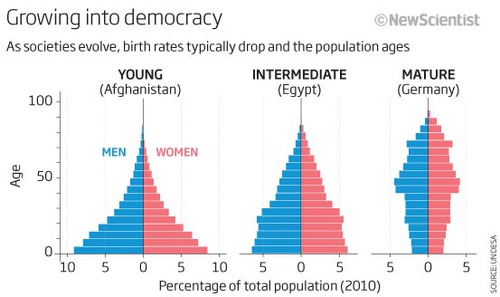
Population Pyramids
a tool used to study populations, also known as age-sex composition graph.
11
New cards
Birth Deficit
the slowdown of births on population pyramid graphs. Ex: When China put out the One Child Policy They entered a birth deficit because they experienced a slowdown in births, which can be shown in the population pyramid graphs.

12
New cards
Baby Boom
A spike in the birth rate. Ex: After WWII, the US baby boom lasted from 1946 to 1965. They are usually associated with the end of the war...
13
New cards
Baby Bust
when a spike in birth rates starts to decline we enter this stage. Period of time during the 1960s and 1970s when fertility rates in the United States dropped as large numbers of women from the baby boom generation sought higher levels of education and more competitive jobs, causing them to marry later in life. As such, the fertility rate dropped considerably, in contrast to the baby boom, in which fertility rates were quite high.
14
New cards
Echo
the birth bulge on a pyramid. As of 2015, children in HS were the last of cohorts, and their parents were the last baby boomers.
15
New cards
Dependent Population
people under the age of 15 or over the age of 64.
16
New cards
Dependency ratio
the comparison between the potential workforce and the dependent population.
17
New cards
Crude Birth Rate
the number of live births per year for each 1,000 people.
18
New cards
crude death rate
the total number of deaths in a year per 1,000 people.d
19
New cards
Total Fertility Rate (TFR)
the average number of children who would be born per woman between the ages of 15-49. Ex:
20
New cards
life expectancy
The average number of years an individual can be expected to live.
21
New cards
Infant Mortality Rate (IMR)
the number of children who die before their first birthday.
22
New cards
Rate of Natural Increase (RNI)
the percentage of which a country's population is growing or declining without the impact of migration.
23
New cards
Population Doubling Time
the amount of time it takes for a population to double.
24
New cards
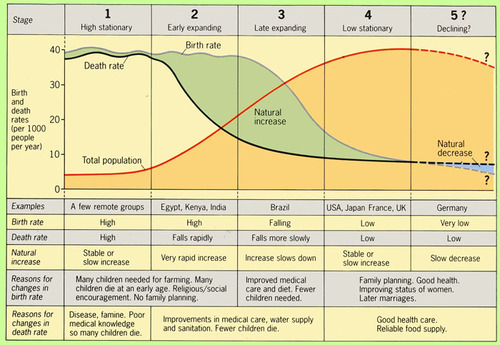
Demographic Transition Model (DTM)
shows five typical stages of population change that countries experience as they modernize.
25
New cards
Stage 1 of DTM: Low Growth
high stationary stage, only a few isolated groups are in this stage and they are typically subsistence farmers or hunters and gathers. The example is in the sentence look closely.
26
New cards
Stage 2 of DTM: High Growth
Niger represents this stage with an expansive population pyramid, one with a high birth rate which produces a wide base and a low life expectancy which leads to narrowing in the upper years. The example is in the sentence look closely.
27
New cards
Stage 3 of DTM: Moderate Growth
Turkey represents this urbanizing stage with a declining birth rate and a more slowly declining death rate. Society is young but the percentage of elderly is increasing as life expectancy goes up. The population is rapidly growing. The example is in the sentence look closely.
28
New cards
Stage 4 of DTM: Low Growth (Stationary)
This stage is known as the stationary population pyramid. It indicates a population that is not significantly growing or shrinking. The birth rate is low but steady. The death rate is also low, indicating a high life expectancy. Ex: China, US, etc.
29
New cards
Stage 5 of the DTM: Declining
This stage has a decreasing birth rate. The population is aging and declining slightly overall. Ex: Japan, Germany, etc.
30
New cards
Demographic Momentum
the tendency for a growing population to continue growing after a fertility decline because of their young age distribution. Ex: For example, when China first introduced the one-child policy, population growth continued regardless.
31
New cards
Epidemiologic Transition Model
This model is an extension of the DTM and explains the changing death rates and more common causes of death within societies.
32
New cards
(Stage 1) Diseases and famine
Affects the population by resulting in a high death rate and low life expectancy. Ex: Cholera, tuberculosis, pandemics, epidemics, animal attacks and accidents, and malnutrition.
33
New cards
(Stage 2) Receding pandemics
Effects the population by resulting in a decreasing death rate and increasing life expectancy due to advancements within society.
34
New cards
Stage 3: Degenerative and Human Created Diseases
Examples are heart diseases and types of cancer, Effects the population by resulting in the death rate stabilizing at a low level and life expectancy increases
35
New cards
Stage 4: Delayed Degenerative Diseases
An extension of stage 3, examples are Alzheimer's and dementia, Effects the population by resulting in death rates reaching lowest levels and life expectancy peaking
36
New cards
(Stage 5) Reemergence of infectious parasitic diseases
diseases increase as bacteria and parasites become resistant to antibiotics and vaccines, life expectancy decreases.
37
New cards
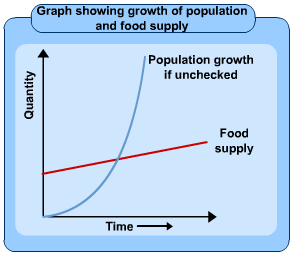
Malthusian Theory
an analysis of natural resource use, particularly agricultural output, and the growing population that concluded that society was on a path toward massive starvation
38
New cards
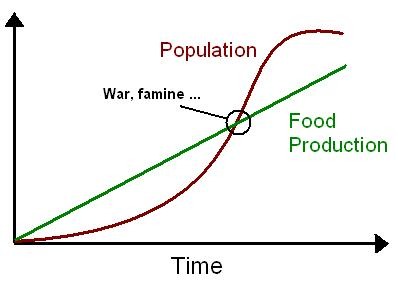
Neo-Malthusians
a group that argued that population growth is a serious problem currently and has an even greater threat to the future
39
New cards
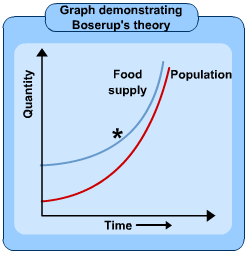
Boserup Theory
suggests that the more people there are, the more hands there are to work, rather than just more mouths to feed. Also argued that population growth is a serious problem.
40
New cards
antinatalist policies
Government policies that attempt to decrease the number of births in a country and are often used by developing countries. Ex: China's One-Child Policy
41
New cards
pronatalist policies
Government programs are designed to increase the fertility rate. Ex: When China eased the restrictions on the One Child Policy.
42
New cards
Migration
the permanent or semi-permanent relocation of people from one place to another.
43
New cards
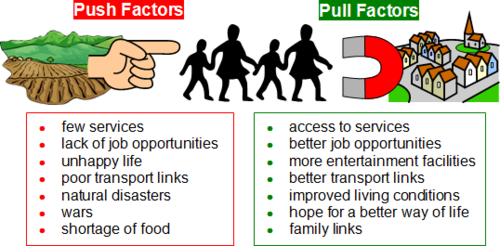
Push Factors
the reasons that people migrate to a specific location, these are typically negative circumstances, events or conditions present where they live that compels a person to leave
44
New cards
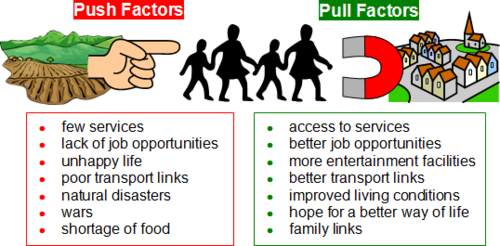
Pull Factors
once migrants decide to leave, they usually choose a destination based on its positive conditions and circumstances.
45
New cards
Immigrant
A person who migrates across an international border with the intention of staying permanently.
46
New cards
Emigrate
when people migrate away from somewhere. Ex: Leaving India for the US.
47
New cards
Migration Transition Model
created by Wilbur Zelinsky that argues that countries in stages 2 and 3 of the DTM experience rapid population growth and overcrowding.
48
New cards
Intervening Obstacles
barriers that make reaching their desired destination more difficult. Ex: political, environmental, or physical barriers (walls and fences). Economic too.
49
New cards
Intervening Opportunities
opportunities migrates might encounter en route that disrupt their original migration plan.
50
New cards
Step Migration
when migrants reach their eventual destination through a series of smaller moves. Ex: migration from a rural area to a city, then a larger city, then finally to a metropolis.
51
New cards
Rural-urban migration
The most typical kind of migration trend, up to 55% of people live in urban areas today. Ex: Economic Pull Factors.
52
New cards
Counter Migration
when migration flows produce a movement in the opposite direction.
53
New cards
Forced Migration
migration that is involuntary, meaning migrants have no choice but to move. Ex: Natural Disasters, wars, political persecution, or ethnic and cultural problems in their homelands. Ex: Syria Civil War.
54
New cards
Internally Displaced Person (IDP)
a term used to classify forced migrants who move to another part of the same country. Ex: Large group of IDPs are located in Columbia, Syria, DRC, and Yemen.
55
New cards
Refugees
a term used to classify forced migrants who move to across international borders. Ex: War and ethnic, tribal and religious violence, environmental disasters.
56
New cards
Asylum
some political refugees apply for this when they arrive in their country of destination.
57
New cards
Voluntary Migration
when people choose to relocate. Ex: Economic Pull Factors (better jobs).
58
New cards
Internal Migration
movement of people within a country. Ex: ATL to NYC.
59
New cards
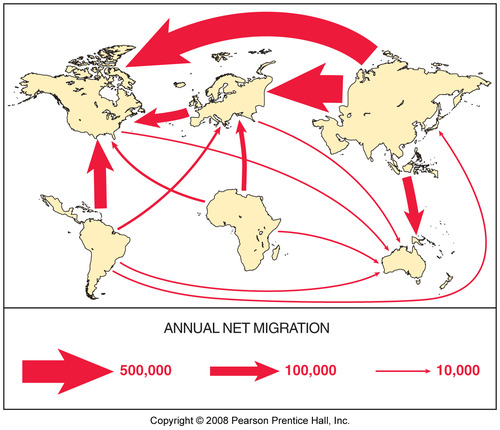
Transnational Migration
when people move from one country to another or internationally, rather than internally.
60
New cards
Chain Migration
when people migrate to and settle in a new country, they often decide to locate in a city or community where others from their home country have previously settled which ultimately contributes to this type of migration.
61
New cards
Guest Workers
Migrants who travel internationally to find work as temporary laborers - typically for a short period of time because the jobs cannot be filled -by a country's own labor force. Ex: Countries in the Persian Gulf are notable for having large percentage of the total population made up of foreign migrants.
62
New cards
Transhumance
the process of herders moving with their animals to different pastures during difference seasons. Ex: Europe and Africa
63
New cards
Xenophobia
a strong dislike of people of another culture. Ex: in the US, economic fears combined to prompt congress to pass the Chinese Exclusion Act.
64
New cards
Remittances
money sent to migrants family and friends in the country they left.
65
New cards
Brain Drain
when migration out of a country is made up of many highly skilled people. Ex: students enter the US and Great Britain to study medicine, engineering, etc.
66
New cards
Ethic Enclaves
neighborhoods filled primarily with people of the same ethnic group. Ex: "Little Italy" or "Chinatown".