Review for Chem Placement test
 Call Kai
 Learn
Learn Practice Test
 Spaced Repetition
 Match
Match Flashcards
 Knowt Play
1/46

There's no tags or description
Looks like no tags are added yet.
Name | Mastery | Learn | Test | Matching | Spaced | Call with Kai |
|---|
No analytics yet
Send a link to your students to track their progress
47 Terms
alpha radiation
large atoms need to decrease in size
split into 1 He & another atom
beta radiation
too many neutrons to protons ratio
a neutron converts itself into a proton and a beta particle
positron radiation
too many protons to neutrons ratio
proton converts itself into a neutron and a positron particle
electron capture
too many protons
a proton and a beta particle turn into a neutron
mole number
6.02 × 10²³
molar mass
how much one mole of something weighs in grams (g/mol)
to find molar mass multiply the number of the atom in the compound by its molar mass for each element and then add them together
percent composition
find molar mass of what you want and divide it by the total molar mass of the compound
empirical formula
the most reduced whole number ratio of atoms in a given sample
convert grams→ moles then divide by smallest mole value
if resulting numbers are not whole numbers multiply by the smallest integer that will give you whole numbers
molecular formula
real formula of a molecule
calculate empirical formula mass
divide the molecules known true molar mass by the empirical formula mass
multiply the subscripts of the empirical formula by the integer found by step 2
molarity =
number of moles of solute over the total volume of the solution (moles/liters)
ionic bond
metals and nonmetals bond together
electrons transfer from one atom to another to meet the octet rule
form ions and the opposite charges form an electrostatic attraction(ionic bond)
electronegativity
atom’s ability to attract a bonding pair of electrons
0-0.4 diff in electronegativity
nonpolar covalent
0.5-1.8 diff in electronegativity
polar covalent
1.9+ diff in electronegativity
ionic
attraction
polar mols attracted to other polar mols
nonpolar & polar and nonpolar & nonpolar are not attracted to eachother
where are s p d and f shapes on periodic table
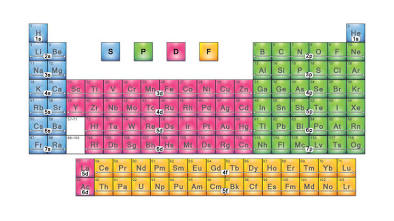
orbital notation
fill in each box per level with one electron then go back & add pairs if possible
Boyle’s Law
P1 x V1 = P2 x V2
kelvins =
C +273
Charles’ Law
V1/T1 = V2/T2
Gay-Lussac’s Law
P1/T1 = P2/T2
Combined Gas Law
(P1 x V1)/T1 = (P2 x V2)/T2
all gas mols have
same kinetic E
lighter gas moles move
faster than heavier ones
@STP
1 mol gas = 22.4L
Ideal Gas Law
PV=nRT
R=
0.0821
temp
av kinetic E of its vibrating molecules
1 atom → no temp
heat
the sum of all the kinetic E of all of the vibrating molecules
everything has heat
specific heat capacity =
q /(mass x change in temp)
q is
joules (energy)
q=
m x change in temp x Cp
Cp is
specific heat capacity
cal
Cp for 1 g water
Cal
food calorie
1 Cal =
1 kcal
1 kcal =
1000 cal
cal =
m x change in temp of H2O
endothermic
break bonds (reactants)
exothermic
make bonds (products)
to find out if reaction is endo or exo thermic
see if the E needed to break the bonds is more or less than the E needed to make the new bonds
to name bases
name of first element + hydroxide
ie NaOH → sodium Hydroxide
naming acids
if H+ not bonded to a polyatomic ion only a singular anion → Hydro__anion__ic acid
If H+ is bonded to a polyatomic ion ending in ate → __root word_ic acid
If H+ is bonded to a polyatomic ion ending in ite → _root_ous acid
Le Chatleier’s Principle
for equilibrium reactions
reactions want to resist change
add/remove chemicals will cause the equilibrium to shift
temp up cold side favored, temp down hot side favored
pressure(gases)
P up side w/ fewer gas molecules favored
P down side w/ more gas molecules favored
equilibrium reactions
the rate of the forward reaction is equal to the rate of the reverse reaction
pH/pOH equations
pH + pOH = 14
pH = -log[H+]
pOH=-log[OH-]
10-pH=[H+]
10-pOH=[OH-]