Somatic Nervous System unit 2 pt.1
 Call Kai
 Learn
Learn Practice Test
 Spaced Repetition
 Match
Match Flashcards
 Knowt Play
1/54

There's no tags or description
Looks like no tags are added yet.
Name | Mastery | Learn | Test | Matching | Spaced | Call with Kai |
|---|
No analytics yet
Send a link to your students to track their progress
55 Terms
Somatic Nervous System (SNS)
1-2
Voluntary Control
This is the part of your nervous system that lets you move your skeletal muscles on purpose .
Examples:
Walking 🚶
Writing ✍
Smiling 😊
Lifting weights 💪
Easy Breakdown 1. Impulses originate in the CNS
CNS = Brain + Spinal Cord
Your brain decides to move.
Example: i want to pick up my phone
The brain sends a message down the spinal cord.
➡ Brain → Spinal Cord → Motor Neuron
2. Somatic Motor Neurons carry the message
These neurons are like electrical wires .
They carry the movement signal from the CNS to the muscle.
➡ Brain → Motor Neuron → Muscle
Somatic Nervous System
3-5
3. Neuromuscular Junction (NMJ)
The neuron cannot directly touch the muscle.
There is a tiny gap called the:
NMJ = Neuromuscular Junction
Think of it as
📞 Nerve calls the muscle
The nerve sends a chemical message across the gap.
4. Acetylcholine (ACh) is released
The nerve releases a neurotransmitter called:
Acetylcholine (ACh)
Think:
📨 ACh = the message
The message says: MUSCLE CONTRACT NOW
5. ACh binds to Nicotinic (Nm) Receptors
On the muscle are special receptors:
Nicotinic Nm receptors
ACh attaches to these receptors like a:
🔑 Key fitting into a lock
ACh (key) + Nm receiver (lock)
↓
Muscle contracts!
💪 Muscle moves
Somatic Nervous System
Brain
↓
Spinal Cord
↓
Somatic Motor Neuron
↓
Neuromuscular Junction (NMJ)
↓
ACh Released
↓
Nm Receptor Activated
↓
Skeletal Muscle Contracts
ACH acts on nicotinic 2/Nm receptors
respirations
contractions of diaphragm and chest muscles
tone for movement
body posture
Respiration (Breathing)
tone for movement
body posture
Somatic Nervous System
Respiration (Breathing)
The somatic nervous system also controls muscles used for breathing.
Diaphragm
Main breathing muscle
Chest Muscles
Help expand the lungs
When the brain sends signals:
➡ Diaphragm contracts
➡ Chest expands
➡ Air moves into lungs
🫁 You breathe
Tone for Movement
Muscle tone = slight muscle tension all the time
Your muscles are never completely relaxed.
This helps:
Be ready to move quickly
Maintain stability
Prevent floppiness
Think:
💪 Muscles stay slightly "on"
Body Posture
The somatic nervous system helps you:
Sit upright
Stand up straight
Keep your balance
Hold your head up
Without muscle tone and somatic control:
😵 You would slump over.
SOMATIC = SKELETAL = VOLUNTARY
Somatic Nervous System
Brain decides
↓
Motor neuron sends signal
↓
ACh released
↓
Nm receptor activated
↓
Skeletal muscle contracts
Remember:
🧠 → ⚡ → ACh → Nm → 💪
Brain → Signal → Acetylcholine → Nicotinic receptor → Muscle movement
Somatic Nervous System
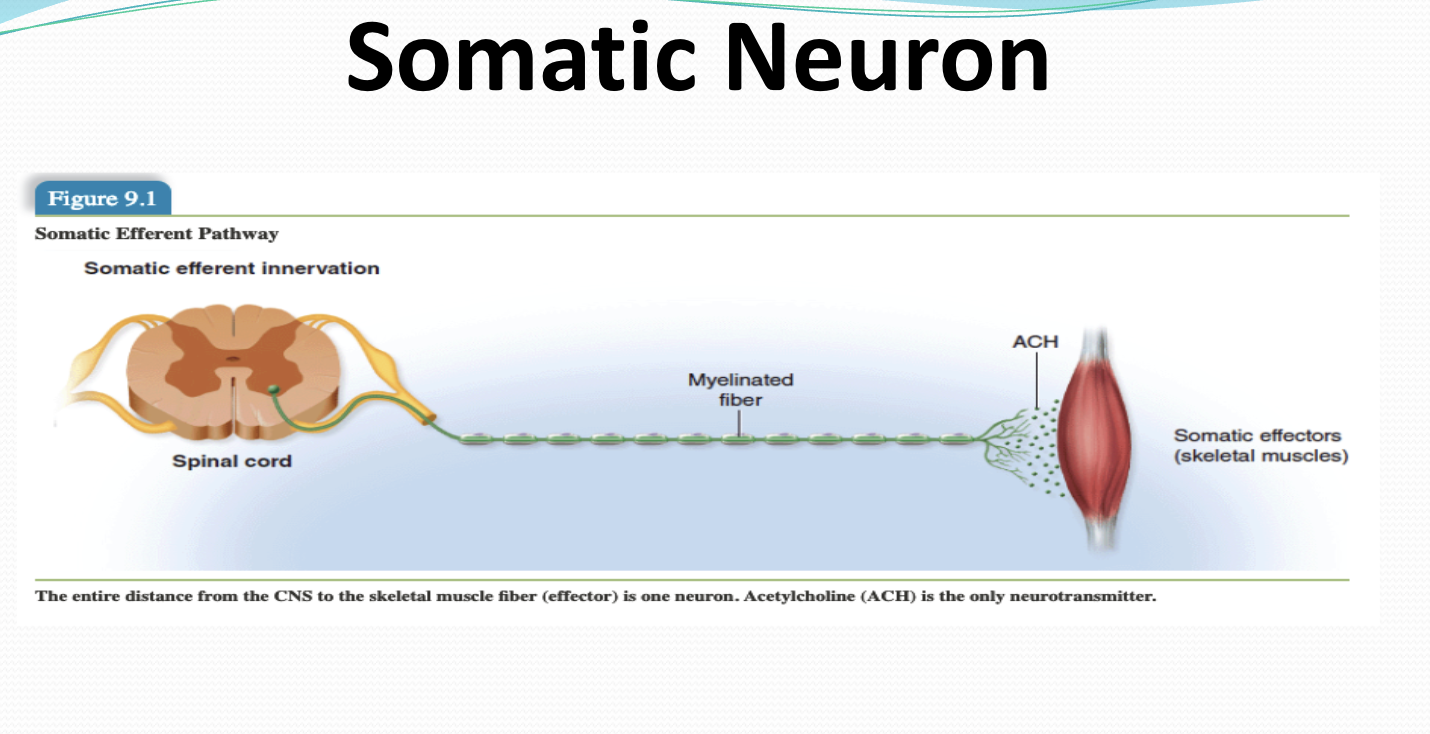
Spinal Cord
↓
One Neuron
↓
ACh
↓
Skeletal Muscle
↓
Movement
✅ Voluntary control
✅ Controls skeletal muscles
✅ One neuron from CNS to muscle
✅ No lymph node
✅ Neurotransmitter = Acetylcholine (ACh)
✅ Causes muscle contraction
CNS → one motor neuron → ACh released → skeletal muscle contracts. ✅
Skeletal Muscle Relaxants 1
What do they do?
Skeletal muscle relaxants = drugs that make muscles relax.
Normally:
🧠 Brain → Nerve → ACh → 💪 Muscle contracts
With a muscle relaxant:
🧠 Brain → Nerve → 🚫 Signal blocked/reduced → 💪 Muscle relaxes
So the muscle does less contracting and less spasming .
MOA = How the drug works
These drugs:
✅ Interferes with neuromuscular function
✅ Reduces muscle contractions
✅ Relax tight muscles
✅ Decrease muscle spasms
Think:
💪 Muscle is squeezing too much
💊 Muscle relaxant says:
"Calm down and relax."
Result:
💪 ➡ 😌
Skeletal Muscle Relaxants
Uses:
painful injuries
Muscles tighten up after injury.
💥 Injury → 💪 Muscle tightens → 😖 Pain
Muscle relaxant:
💥 Injury → 💊 Drug → 😌 Muscle relaxes → Less pain
decrease contraction or spasms from trauma=Spasm = Muscle won't stop squeezing
, overexertion, stress, or tension
spastic diseases
such as cerebral palsy=The brain has trouble controlling muscles.
Result:
💪 Tight muscles
and multiple sclerosis= Nerve damage causes muscles to receive abnormal signals.
pre-op, surgeries
Doctors sometimes want muscles completely relaxed during surgery.
✅ Easier procedure ✅ Prevents muscle movement
Skeletal Muscle Relaxants
Central or Peripheral Acting
Central Acting | Peripheral Acting |
|---|---|
Works in brain/spinal cord | Works on muscle |
Decreases nerve signals | Decreases muscle contraction |
CNS action | Muscle action |
"Control center" | "At the muscle" |
Central-Acting Muscle Relaxants Work in the CNS
(CNS = Brain and Spinal Cord)
🧠 Brain/Spinal Cord
⬇
Drug acts here
⬇
Less signals sent to muscles
⬇
💪 Muscle relaxes
Peripheral-Acting Muscle Relaxants Work at the muscle or neuromuscular junction
The drug acts closer to the muscle itself
Nerve → 🚫 Signal blocked → Muscle can't contract
Example:
Dantrolene
Think:
Peripheral = Out by the muscle
Exam Memory Trick Skeletal Muscle Relaxants
Reduce Excessive Muscle Activity
✅ Relax muscles
✅ Reduces spasms
✅ Help with painful injuries
✅ Used in cerebral palsy
✅ Used in multiple sclerosis
✅ Used before surgery
One-Line Summary
Skeletal muscle relaxants decrease muscle contractions and spasms by blocking signals either in the brain/spinal cord (central acting) or directly at the muscle (peripheral acting). 💪➡😌
Peripheral Skeletal Muscle Relaxants
These drugs work outside the brain and spinal cord , directly at the muscle or neuromuscular junction.
Think:
🧠 Brain sends signal → Nerve → Muscle
Peripheral muscle relaxants block the signal near the muscle .
3 Types to Know
Depolarizing Agents
Non-depolarizing Agents
Direct acting Agents
Peripheral Skeletal Muscle Relaxants
1. Depolarizing Agents
What do they do?
They overstimulate the muscle first, then the muscle becomes unable to contract.
Think of it like:
📞 Phone keeps ringing and ringing and ringing...
Eventually the phone stops responding.
The muscle gets "stuck" and cannot contract normally.
What's happening?
Drug attaches to muscle receptor
Muscle briefly twitches
Receptor stays activated
Muscle becomes relaxed/paralyzed
Easy Memory
Depolarizing = First stimulate, then paralyze
Stimulates first
Causes brief twitching
Then paralysis
Example: Succinylcholine
Peripheral Skeletal Muscle Relaxants
2. Non-Depolarizing Agents
What do they do?
These drugs simply block the signal from the start.
The message never reaches the muscle.
Normal:
🧠 → Nerve → ACh → Muscle contracts
With drug:
🧠 → Nerve → 🚫 ACh blocked → No contraction
Easy Memory
…. = Block the message
ACh blocked
↓
No contraction
↓
Muscle relaxes
Blocks ACh receptors
Prevents contraction
Causes relaxation/paralysis
Examples: Rocuronium, Vecuronium
Peripheral Skeletal Muscle Relaxants 1
. Direct-Acting Agents
What do they do?
These drugs work directly on the muscle fiber itself .
They don't mainly block the nerve signal.
Instead they tell the muscle:
"Don't contract so strongly."
Easy Memory
Think:
💪 Muscle is the problem
💊 Drug goes directly to the muscle
💪 ➜ 😌
Works directly on muscle
Reduces muscle contraction
Example: Dantrolene
Peripheral Skeletal Muscle Relaxants 1
types
Type | What It Does |
|---|---|
Depolarizing | Overstimulates muscle, then paralysis |
Non-depolarizing | Blocks ACh signal to muscle |
Direct-acting | Works directly on muscle fiber |
Peripheral muscle relaxants work near the muscle: depolarizing agents overstimulate then paralyze, non-depolarizing agents block the nerve signal, and direct-acting agents work directly on the muscle fiber. ✅
Depolarizing Agents (Super Easy Version)
💪 "Turn the muscle ON so much that it gets tired and can't move anymore."
What Depolarizing Agents Do Step 1: Stimulate the muscle
The drug attaches to the Nm (Nicotinic 2) receptor just like ACh.
Drug → Nm receptor
↓
Muscle stimulated
↓
Muscle twitching
These little muscle twitches are called:
Fasciculations
Step 2: Muscle becomes unable to contract
The drug stays attached to the receiver.
The receiver becomes "worn out" and stops responding.
Now even when the body releases ACh:
🚫 Receiver won't listen
🚫 Muscle won't contract
Result:
💪 Muscle paralysis/relaxation
Depolarizing Agents (Super Easy Version)
Why are they used?
1. Intubation
Intubation = placing a breathing tube
Doctors want muscles relaxed.
Relaxed muscles
↓
Easier tube placement
2. General Anesthesia
Used during surgery.
Patient asleep
+
Muscles relaxed
↓
Safer surgery
Depolarizing Agents (Super Easy Version)
Side Effects
Fasciculations
Before paralysis, muscles twitch.
Twitching
↓
Soreness
↓
Muscle pain
Jaw Rigidity
Jaw muscles become stiff.
Hypotension Hypo = Low
Hypotension = Low blood pressure
Arrhythmias Arrhythmia = Abnormal heartbeat
Malignant Hyperthermia
A rare but dangerous reaction.
Can cause:
🔥 Very high fever
👨👩👧 Family history
Because it can run in families.
Pediatric Warning
Should only be used in emergencies in children because of serious risks.
Peripheral Skeletal Muscle Relaxants
Depolarizing Agents
No Antidote Antidote
…= Drug that reverses another drug
Depolarizing agents:
🚫 No antidote
Doctors must
✅ Support breathing ✅ Wait for the drug to wear off
How Does the Drug Leave the Body?
An enzyme called:
Cholinesterase
breaks down the drug. Drug in body
↓
Cholinesterase breaks it down
↓
Muscle function returns
No antidote-support respirations until drug is metabolized by cholinesterase in the body
Depolarizing Agents
easy summary
MOA
Bind Nm receiver
Cause fasciculations (twitching)
Receiver stops responding
Muscle paralysis occurs
Uses
✅ Intubation
✅ General anesthesia
Side Effects
✅ Fasciculations
✅ Muscle pain
✅ Jaw rigidity
✅ Hypotension
✅ Arrhythmias
✅ Malignant hyperthermia
Important Facts
✅ No antidote
✅ Support respirations
✅ Metabolized by cholinesterase
✅ Check family history for malignant hyperthermia
One-Sentence Summary
Depolarizing agents first make muscles twitch (fasciculations), then keep the Nm receptor activated so the muscle can no longer respond to ACh, causing temporary paralysis for procedures like intubation and surgery. 💪 → ⚡ → 🚫 → 😌
Peripherally Acting/ I. Skeletal Muscle Relaxants
Depolarizing Agents
DRUG
succinylcholine (no antidote)
Non-Depolarizing Agents (Super Easy Version)
Think of these drugs as:
🚫 "Blocking the muscle's door so ACh can't get in."
Unlike depolarizing agents, these drugs DO NOT stimulate or activate the muscle first.
The drug sits on the Nm (Nicotinic 2) receptor .
Drug sits on receptor
↓
ACh cannot attach
↓
No signal reaches muscle
↓
No contraction
↓
Muscle relaxes
Think of it like:
🔑 ACh = Key
🚪 Nm receiver = Lock
💊 Drug = Gum stuck in the lock
Now the key can't fit!
ACh ❌
Cannot enter receptor
Result
💪 No contraction
😌 Muscle relaxation/paralysis
Non-Depolarizing Agents
Uses
1. Intubation
Intubation = placing a breathing tube.
Doctors want muscles relaxed.
2. General Anesthesia
Used during surgery./ muscle relax/ easier surgeyr
3. Mechanical Ventilation
Mechanical ventilator = breathing machine.
The patient must stay relaxed so the machine can breathe for them.
Non-Depolarizing
NO stimulation
NO twitching first
Just BLOCKS ACh
🚫 "ACh is locked out."
Drug blocks Nm receptor
↓
ACh cannot bind
↓
No contraction
↓
Muscle relaxes
Non-Depolarizing Agents
Side Effects
Fasciculation = Muscle twitching
Muscle Pain
Twitching can cause soreness.
Jaw Rigidity
Jaw becomes stiff.
Hypotension = Low blood pressure
Arrhythmia = Abnormal heartbeat
Respiratory Depression
Respiratory = Breathing
Depression = Slowed down
Because these drugs relax muscles, they can also relax the muscles needed for breathing.
Patients may need:
✅ Oxygen
Non-Depolarizing Agents
QUICK STUDY REVIEW
MOA
✅ Occupy Nm receptors
✅ Block ACh from binding
✅ No depolarization
✅ No muscle contraction
✅ Muscle relaxation/paralysis
Uses
✅ Intubation
✅ General anesthesia
✅ Mechanical ventilation
Side Effects
✅ Fasciculations, ✅ Muscle pain, ✅ Jaw rigidit✅ Hypotension
✅ Arrhythmias ✅ Respiratory depression
Non-depolarizing agents work by blocking the Nm receptor so acetylcholine cannot bind, preventing muscle contraction and causing muscle relaxation for procedures such as intubation, surgery, and mechanical ventilation. ✅💪🚫😌
Non-depolarizing Agents
DRUG
Skeletal Muscle Relaxants
Peripherally Acting
rocuronium bromide - reversed by neostigmine or sugammadex
Direct-Acting Muscle Relaxants (SUPER EASY VERSION)
Think of this drug as:
💊 ➡ 💪 Works directly on the muscle
It does NOT work in the:
🚫 Brain
🚫 Spinal cord
🚫 Nm (Nicotinic 2) receiver
Instead, it goes right to the muscle fiber itself.
These drugs block the release of calcium inside the muscle.
Drug
↓
Blocks Ca++
↓
No calcium released
↓
Muscle cannot contract
↓
Muscle relaxes
Think of Calcium as the "ON Switch"
Normal:
🔘 Calcium ON
↓
💪 Muscle contracts
With drug:
🚫 Calcium blocked
↓
💪 Muscle relaxes
Peripheral Skeletal Muscle Relaxants
BIG DIFFERENCE
Depolarizing Agents
Work at the Nm receptor.
Non-Depolarizing Agents
Block the Nm receptor.
Direct-Acting Agents
Ignore the receiver completely.
Go directly to the muscle.
Depolarizing → Nm receptor
Non-depolarizing → Nm receptor
Direct-acting → Muscle fiber itselfPeripheral Skeletal Muscle Relaxants
Uses
Direct Acting Agents
These drugs are used when muscles are too tight or spastic.
Cerebral Palsy
Brain damage causes muscles to stay tight.
Brain problem
 ↓
Muscles stay tight
 ↓
Drug relaxes muscles
Multiple Sclerosis (MS)
Damaged nerves send abnormal signals.
Spinal Cord Injury
Signals become abnormal.
Malignant Hyperthermia
Direct-acting agents (like dantrolene) help relax the muscles.
Direct Acting Agents
Side Effects
Hepatotoxicity Hepato = Liver Toxicity = Damage
Meaning:
🚨 Can damage the liver
This is the MOST IMPORTANT side effect.
Box Warning
A box warning means
⚠ Serious warning from the FDA
Pay close attention.
vomiting, dizziness, fatigue, weakness
Contraindication
Liver Disease
Because the drug can damage the liver:
🚫Do NOT use in patients with liver disease.
Direct-Acting Muscle Relaxants
easy memory
MOA
✅ Work directly on muscle fibers
✅ Block calcium (Ca++) release
✅ No calcium = No contraction
✅ Do NOT affect Nm receivers
✅ Do NOT affect spinal cord conduction
Uses
✅ Cerebral palsy
✅ Multiple sclerosis
✅ Spinal cord injuries
✅ Malignant hyperthermia
Contraindication
🚫 Liver disease
Direct-acting muscle relaxants work directly on the muscle fiber by blocking calcium release, preventing muscle contraction and relaxing muscles in conditions such as cerebral palsy, multiple sclerosis, spinal cord injuries, and malignant hyperthermia. 💊 → 🚫 Ca++ → 💪 Relaxed Muscle.
Direct Acting Agents
DRUG
dantrolene (Dantrium®)