biological molecules
 Call Kai
 Learn
Learn Practice Test
 Spaced Repetition
 Match
Match Flashcards
 Knowt Play
1/89

There's no tags or description
Looks like no tags are added yet.
Name | Mastery | Learn | Test | Matching | Spaced | Call with Kai |
|---|
No analytics yet
Send a link to your students to track their progress
90 Terms
Monomers and polymers
Monomers -smaller, repeating molecules /units from which larger molecules / polymers are made
●Polymers - molecules made from many (a large number) identical /similar monomer molecules
Condensation
reaction
●2 molecules join together
●Forming a chemical bond
●Releasing awater molecule
Hydrolysis
reaction
●2 molecules separated
●Breaking a chemical bond
●Using awater molecule
What are monosaccharides? Give 3 common examples
●Monomers from which larger carbohydrates are made
●Glucose,fructose,galactose
draw structure of glucose
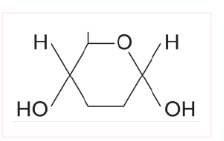
Describe the difference between the structure of α-glucose and β-glucose
●Isomers -same molecular formula but differently arranged atoms
●OH group is below carbon 1 in α-glucose but above carbon 1 in β-glucose
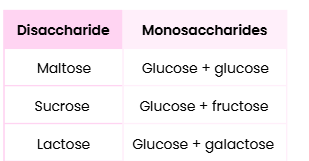
What are disaccharides and how are they formed?
●Two monosaccharides joined together with a glycosidic bond
●Formed by a condensation reaction, releasing a water molecule
List 3 common disaccharides & monosaccharides from which they’re made
What are polysaccharides and how are they formed?
●Many monosaccharides joined together with glycosidic bonds
●Formed by many condensation reactions, releasing many water molecules
Starch Function
Energy storage molecule in plant cells
Starch Structure
Polysaccharide made of α-glucose
Amylose contains α-1,4 glycosidic bonds and forms a long, unbranched, helical/coiled chain
Amylopectin contains α-1,4 and α-1,6 glycosidic bonds and is branched
Glycogen Function
Energy storage molecule in animal cells
Glycogen Structure
Polysaccharide made of α-glucose
Contains α-1,4 and α-1,6 glycosidic bonds
Highly branched (more highly branched than amylopectin)
Starch (amylose and amylopectin) how the structures of starch relate to their functions
Helical/coiled structure of amylose makes it compact, allowing lots to be stored in a small space
Amylopectin is branched, making it compact and allowing more glucose molecules to fit into a small area
Branches provide many ends for enzyme action, allowing faster hydrolysis and quicker release of glucose for respiration and ATP production
Large polysaccharide molecules cannot diffuse out of the cell or cross the cell membrane
Insoluble in water, so they do not affect the water potential of the cell (no osmotic effect)
What is the structure and function of amylose?
Polysaccharide made of α-glucose
Contains α-1,4 glycosidic bonds only
Unbranched chain that coils into a helix
Compact → suitable for energy storage in plants
Fewer ends for enzyme action → slower hydrolysis and glucose release
What is the structure and function of amylopectin?
Polysaccharide made of α-glucose
Contains α-1,4 and α-1,6 glycosidic bonds
Branched structure
Compact → allows lots of glucose to be stored
Many ends for enzyme action → faster hydrolysis and glucose release
Explain how the structures of glycogen relate to their functions
Highly branched structure makes it compact, allowing large amounts of glucose to be stored
More highly branched than amylopectin, so it has more ends for enzyme action and can be hydrolysed more rapidly to release glucose quickly for respiration and ATP production
Large polysaccharide molecule, so it cannot diffuse out of the cell or cross the cell membrane
Insoluble in water, so it does not affect the water potential of the cell (no osmotic effect)
Describe the basic function and structure of cellulose
Function
Provides strength and structural support to plant and algal cell walls
Structure
Polysaccharide made of β-glucose
β-1,4 glycosidic bonds form long, straight, unbranched chains
Every other β-glucose molecule is inverted
Parallel chains are linked by many hydrogen bonds, forming microfibrils
Explain how the structure of cellulose relates to its function
Straight, unbranched chains run parallel to each other
Many hydrogen bonds form between parallel chains, creating strong microfibrils
Large numbers of hydrogen bonds give cellulose high tensile strength
Strong microfibrils provide rigidity and support to the cell wall
Prevents the plant cell from bursting when water enters by osmosis
Describe the test for reducing sugars
1. Add Benedict’s solution (blue) to sample
2. Heat in a boiling water bath
3. Positive result = green / yellow / orange / red precipitate
Reducing sugars
monosaccharides, maltose, lactose
Describe the test for non-reducing sugars
1. Do Benedict’s test (as above) and stays blue / negative
2. Heat in a boiling water bath with acid (to hydrolyse into reducing sugars)
3. Neutralise with alkali (eg. sodium bicarbonate)
4. Heat in a boiling water bath with Benedict’s solution
5. Positive result = green / yellow / orange / red precipitate
Non-reducing sugars
sucrose
Suggest a method to measure the quantity of sugar in a solution
●Carry out Benedict’s test as above, then filter and dry precipitate
●Find mass /weigh
Suggest another method to measure the quantity of sugar in a solution
1. Make sugar solutions of known concentrations
(eg. dilution series)
2. Heat a set volume of each sample with a set
volume of Benedict’s solution for the same time
3. Use colorimeter to measure absorbance (of
light) of each known concentration
4. Plot calibration curve -concentration on xaxis,
absorbance on yaxis and draw line of best fit
5. Repeat Benedict’s test with unknown sample and
measure absorbance
6. Read off calibration curve to find concentration
associated with unknown sample’s absorbance
Describe the biochemical test for starch
1. Add iodine dissolved in potassium iodide (orange / brown) and shake / stir
2. Positive result = blue-black
Name two groups of lipid
Triglycerides and phospholipids
Describe the structure of a fatty acid (RCOOH)
●Variable R-group -hydrocarbon chain (this may be saturated or unsaturated)
●-COOH =carboxyl group
Describe the difference between saturated and unsaturated fatty acid
●Saturated -no C=C double bonds in hydrocarbon chain →all carbons fully saturated with hydrogen
●Unsaturated -one or more C=C double bond in hydrocarbon chain (creating a bend / kink)
Describe how triglycerides form
●1 glycerol molecule and 3 fatty acids
●3 condensation reactions
●Removing 3 water molecules
●Forming 3 ester bonds
Explain how the properties of triglycerides are related to their structure
function: energy storage
●High ratio of C-H bonds to carbon atoms in hydrocarbon chain
○So used in respiration to release more energy than the same mass of carbohydrates
●Hydrophobic / non-polar fatty acids so insoluble in water (clump together as droplets, tails inwards)
○So no effect on water potential of cell (or can be used for waterproofing)
Describe the difference between the structure
of triglycerides and phospholipids
One of the fatty acids of a triglyceride is
substituted by a phosphate-containing group
function of phospholipid
form a bilayer in cell membrane, allowing diffusion of lipid-soluble (non-polar) or very small
substances and restricting movement of water-soluble (polar) or larger substances
Describe how the properties of
phospholipids relate to their structure
●Phosphate heads are hydrophilic
○Attracted to water so point to water (aqueous environment) either side of membrane
●Fatty acid tails are hydrophobic
○Repelled by water so point away from water / to interior of membrane
Describe the test for lipids
1. Add ethanol,shake (to dissolve lipids), then add water
2. Positive result = milky white emulsion
Describe / draw the general
structure of an amino acid
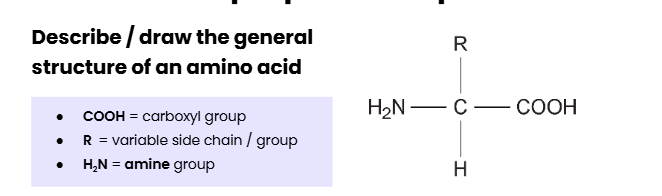
How many amino acids are common in all organisms? How do they vary?
The 20 amino acids that are common in all organisms differ only in their side group (R)
Describe how amino acids join together
●Condensation reaction
●Removing a water molecule
●Between carboxyl group of one
and amine group of another
●Forming a peptide bond
What are dipeptides and polypeptides?
●Dipeptide -2amino acids joined together
●Polypeptide -many amino acids joined together
A functional protein may contain one or more polypeptides
Describe the primary structure of a protein
Sequence of amino acids in a polypeptide chain, joined by peptide bonds
Describe the secondary structure of a protein
●Folding (repeating patterns) of polypeptide chain eg.
alpha helix / beta pleated sheets
●Due to hydrogen bonding between amino acids
●Between NH (group of one amino acid) and C=O (group)
Describe the tertiary structure of a protein
●3D folding of polypeptide chain
●Due to interactions between amino acid R groups
(dependent on sequence of amino acids)
●Forming hydrogen bonds,ionic bonds and disulfide bridges
Describe the quaternary structure of a protein
●More than one polypeptide chain
●Formed by interactions between polypeptides
(hydrogen bonds, ionic bonds, disulfide bridges)
Describe the test for protein
1. Add biuret reagent (sodium hydroxide + copper (II) sulphate)
2. Positive result = purple / lilac colour (indicating presence of peptide bonds)
How do enzymes act as
biological catalysts?
●Each enzyme lowers activation
energy of reaction it catalyses
●To speed up rate of reaction
Enzymes catalyse…?
a wide range of
intracellular and extracellular reactions
that determine structures and functions
from cellular to whole-organism level
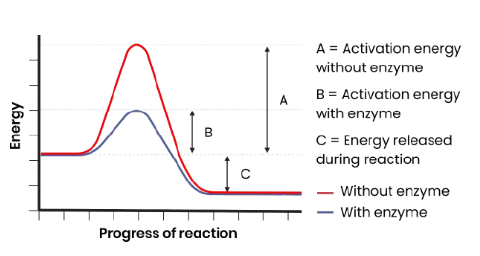
how to identify activation energy with/without enzyme and energy released during a reaction on a graph
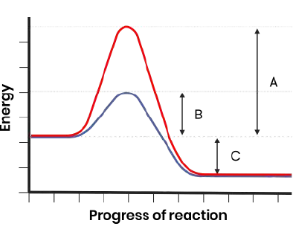
Describe the induced-fit model of enzyme action
1. Substrate binds to (not completely complementary) active site of enzyme
2. Causing active site to change shape (slightly) so it is complementary to its substrate
3. So enzyme-substrate complex forms
4. Causing bonds in substrate to bend / distort, lowering activation energy
Describe how models of enzyme action have changed over time
●Initially lock and key model (now outdated)
○Active site a fixed shape,complementary to one substrate
●Now induced-fit model
Explain the specificity of enzymes
●Specific tertiary structure determines shape of active site
○Dependent on sequence of amino acids (primary structure)
●Active site is complementary to a specific substrate
●Only this substrate can bind to active site, inducing fit and forming an enzyme-substrate complex
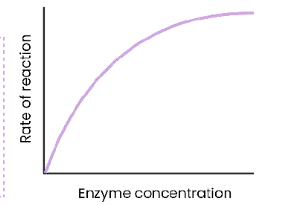
Describe and explain the effect of enzyme concentration on
the rate of enzyme-controlled reactions
●As enzyme concentration increases,rate of reaction increases
○Enzyme concentration =limiting factor (excess substrate)
○More enzymes so more available active sites
○So more enzyme-substrate complexes form
●At a certain point, rate of reaction stops increasing / levels off
○Substrate concentration =limiting factor (all substrates in use
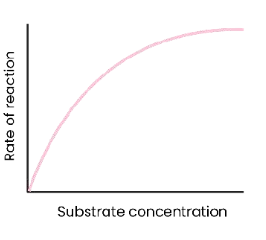
Describe and explain the effect of substrate concentration on
the rate of enzyme-controlled reactions
●As substrate concentration increases,rate of reaction increases
○Substrate concentration =limiting factor (too few substrate
molecules to occupy all active sites)
○More enzyme-substrate complexes form
●At a certain point, rate of reaction stops increasing / levels off
○Enzyme concentration =limiting factor
○As all active sites saturated / occupied (at a given time
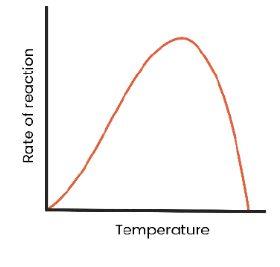
Describe and explain the effect of temperature on
the rate of enzyme-controlled reactions
●As temperature increases to optimum, rate of reaction increases
○More kinetic energy
○So more enzyme-substrate complexes form
●As temperature exceeds optimum, rate of reaction decreases
○Enzymes denature -tertiary structure and active site change
shape
○As hydrogen / ionic bonds break
○So active site no longer complementary
○So fewer enzyme-substrate complexes form
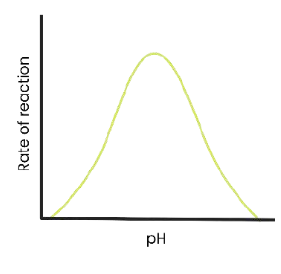
Describe and explain the effect of pH on
the rate of enzyme-controlled reactions
●As pH increases / decreases above / below an optimum, rate of
reaction decreases
○Enzymes denature -tertiary structure and active site
change shape
○As hydrogen / ionic bonds break
○So active site no longer complementary
○So fewer enzyme-substrate complexes form
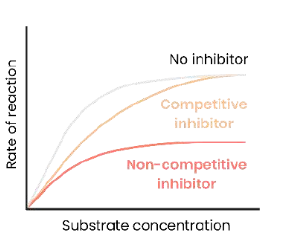
Describe and explain the effect of concentration of competitive inhibitors on
the rate of enzyme-controlled reactions
●As concentration of competitive inhibitor increases, rate of
reaction decreases
○Similar shape to substrate
○Competes for / binds to / blocks active site
○So substrates can’t bind
○So fewer enzyme-substrate complexes form
●Increasing substrate concentration reduces effect of inhibitors
(dependent on relative concentrations of substrate and inhibitor)
Describe and explain the effect of concentration of
non-competitive inhibitors on the rate of enzyme-controlled reactions
●As concentration of non-competitive inhibitor increases, rate of
reaction decreases
○Binds to site other than the active site (allosteric site)
○Changes enzyme tertiary structure /active site shape
○So active site no longer complementary to substrate
○So substrates can’t bind
○So fewer enzyme-substrate complexes form
●Increasing substrate concentration has no effect on rate of
reaction as change to active site is permanent
Describe the basic functions of DNA and RNA in all living cells
DNA
Holds genetic information which codes for polypeptides (proteins)
RNA
Transfers genetic information from DNA to ribosome
Name the two types of molecule from which a ribosome is made
RNA and proteins
Draw and label a DNA nucleotide and an RNA nucleotide
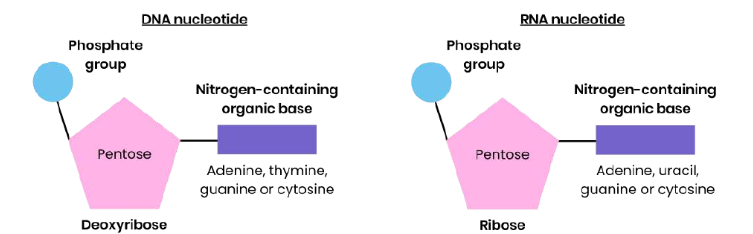
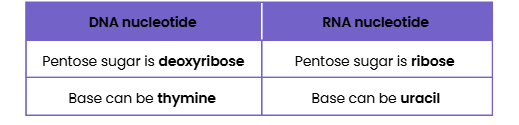
Describe the differences between a DNA nucleotide and an RNA nucleotide
Describe how nucleotides join together to form polynucleotides
●Condensation reactions, removing water molecules
●Between phosphate group of one nucleotide and deoxyribose / ribose of another
●Forming phosphodiester bonds
Why did many scientists initially doubt that DNA carried the genetic code?
The relative simplicity of DNA - chemically simple molecule with few components
Describe the structure of DNA
●Polymer of nucleotides (polynucleotide)
●Each nucleotide formed from
deoxyribose, a phosphate group and a
nitrogen-containing organic base
●Phosphodiester bonds join adjacent
nucleotides
●2polynucleotide chains held together by
hydrogen bonds
●Between specific complementary base
pairs -adenine / thymine and
cytosine / guanine
●Double helix
Describe the structure of (messenger) RNA
●Polymer of nucleotides (polynucleotide)
●Each nucleotide formed from ribose, a phosphate
group and a nitrogen-containing organic base
●Bases - uracil, adenine, cytosine, guanine
●Phosphodiester bonds join adjacent nucleotides
●Single helix
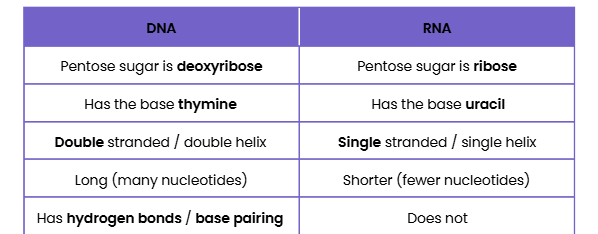
Compare and contrast the structure of DNA and (messenger) RNA
Suggest how the structure of DNA relates to its functions
●Two strands →both can act as templates for semi-conservative replication
●Hydrogen bonds between bases are weak →strands can be separated for replication
●Complementary base pairing →accurate replication
●Many hydrogen bonds between bases →stable / strong molecule
●Double helix with sugar phosphate backbone →protects bases / hydrogen bonds
●Long molecule →store lots of genetic information (that codes for polypeptides)
●Double helix (coiled) →compact
Suggest how you can use incomplete information about the frequency of
bases on DNA strands to find the frequency of other bases
1. % of adenine in strand 1 = % of thymine in strand 2 (and vice versa)
2. % of guanine in strand 1 = % of cytosine in strand 2 (and vice versa)
Because of specific complementary base pairing between 2 strands
Why is semi-conservative replication important?
Ensures genetic continuity between generations of cell?
Describe the process of semi-conservative DNA replication
1. DNA helicase breaks hydrogen bonds between complementary bases, unwinding the double helix
2. Both strands act as templates
3. Free DNA nucleotides attracted to exposed bases and join by specific complementary base pairing
4. Hydrogen bonds form between adenine-thymine and guanine-cytosine
5. DNA polymerase joins adjacent nucleotides on new strand by condensation reactions
6. Forming phosphodiester bonds
Semi-conservative
- each new DNA molecule consists of one original / template strand and one new strand
Use your knowledge of enzyme action to suggest why DNA polymerase
moves in opposite directions along DNA strands
●DNA has antiparallel strands
●So shapes / arrangements of nucleotides on two ends are different
●DNA polymerase is an enzyme with a specific shaped active site
●So can only bind to substrate with complementary shape (phosphate end of developing strand
Name the two scientists who proposed models of the chemical structure of
DNA and of DNA replication
Watson and Crick
Describe the work of Meselson and Stahl in validating the Watson-Crick
model of semi-conservative DNA replication
. Bacteria grown in medium containing heavy nitrogen (15N) so
nitrogen is incorporated into DNA bases
○DNA extracted & centrifuged →settles near bottom, as all
DNA molecules contain 2 ‘heavy’ strands
2. Bacteria transferred to medium containing light nitrogen (14N)
and allowed to divide once
○DNA extracted & centrifuged →settles in middle, as all DNA
molecules contain 1 original ‘heavy’ and 1 new ‘light’ strand
3. Bacteria in light nitrogen (14N) allowed to divide again
○DNA extracted & centrifuged →half settles in middle, as
contains 1 original ‘heavy’ and 1 new ‘light’ strand; half settles
near top, as contains 2 ‘light’ strands
What is ATP?
Adenosine triphosphate
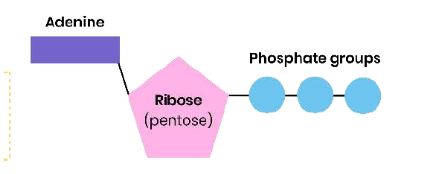
Describe the structure of ATP
●Ribose bound to a molecule of adenine
(base) and 3 phosphate groups
●Nucleotide derivative (modified nucleotide)
Describe how ATP is broken down
●ATP (+ water) →ADP (adenosine diphosphate) + Pi (inorganic phosphate)
●Hydrolysis reaction, using a water molecule
●Catalysed by ATP hydrolase (enzyme)
Give two ways in which the hydrolysis of ATP is used in cells
●Coupled to energy requiring reactions within cells (releases energy)
○eg. active transport, protein synthesis
●Inorganic phosphate released can be used to phosphorylate
(add phosphate to) other compounds, making them more reactive
Describe how ATP is resynthesised in cells
●ADP + Pi →ATP (+ water)
●Condensation reaction, removing a water molecule
●Catalysed by ATP synthase (enzyme)
●During respiration and photosynthesis
Suggest how the properties of ATP make it a suitable immediate source of
energy for cells
●Releases energy in (relatively) small amounts / little energy lost as heat
●Single reaction / one bond hydrolysed to release energy (so immediate release)
●Cannot pass out of cell
Explain how hydrogen bonds occur between water molecule
●Water is polar molecule
●Slightly negatively charged oxygen atoms attract slightly positively
charged hydrogen atoms of other water molecules
a property of water that are important in biology- Metabolite
Used in condensation /hydrolysis /photosynthesis /respiration
a property of water that are important in biology- solvent (Can dissolve solutes)
1. Allows metabolic reactions to occur (faster in solution)
2. Allows transport of substances eg. nitrates in xylem, urea in blood
a property of water that are important in biology - (Relatively) high
specific heat capacity
●Buffers changes in temperature
●As can gain / lose a lot of heat / energy without changing temperature
1. Good habitat for aquatic organisms as temperature more stable than land
2. Helps organisms maintain a constant internal body temperature
a property of water that are important in biology - (Relatively) large
latent heat of
vaporisation
●Allows effective cooling via evaporation of a small volume (eg. sweat)
●So helps organisms maintain a constant internal body temperature
a property of water that are important in biology - Strong cohesion between water molecule
1. Supports columns of water in tube-like transport cells of plants
eg. transpiration stream through xylem in plants
2. Produces surface tension where water meets air, supporting small
organisms (to walk on water
Where are inorganic ions found in the body?
In solution in cytoplasm and body fluid, some in high concentrations and others in very low concentrations
describe the role of hydrogen ions
●Maintain pH levels in the body →high concentration = acidic / low pH
●Affects enzyme rate of reaction as can cause enzymes to denature (topic 1.4.2
describe the role of iron ions
●Component of haem group of haemoglobin
●Allowing oxygen to bind / associate for transport as oxyhaemoglobin (topic 3.4.1
describe the role of phosphate ions
1. Component of nucleotides, allowing phosphodiester bonds to form in DNA / RNA
2. Component of ATP, allowing energy release
3. Phosphorylates other compounds making them more reactive (topic 1.6)
4. Hydrophilic part of phospholipids, allowing a bilayer to form (topic 1.3 / 2.3