individual differences + language interventions
 Call Kai
 Learn
Learn Practice Test
 Spaced Repetition
 Match
Match Flashcards
 Knowt Play
1/32

There's no tags or description
Looks like no tags are added yet.
Name | Mastery | Learn | Test | Matching | Spaced | Call with Kai |
|---|
No analytics yet
Send a link to your students to track their progress
33 Terms
when do most children start producing their first words (Fenson et al., 1994)
within a few months of their first birthday → 10-15 months, though there are enormous individual differences in the rate of learning within this
what did Fenson et al. (1994) find when mapping out individual differences in vocabulary size → number of words understood
by 16 months:
the bottom 10% of children may understand less than 100 words
children within the median will understand around 150 words
those in the 90th percentile may understand around 350 words
shows huge individual differences
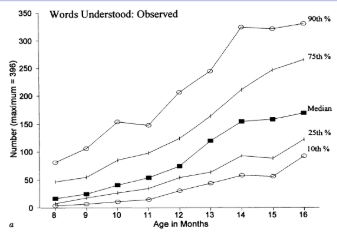
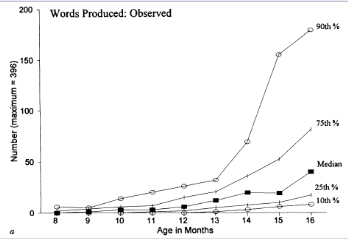
what did Fenson et al. (1994) find when mapping out individual differences in vocabulary size → number of words able to be produced
by 16 months:
bottom 10% of children may produce less than 10 words (though this is not uncommon)
median children would produce around 40 words
those in the 90th percentile may produce around 180 words
once again indicates huge individual differences
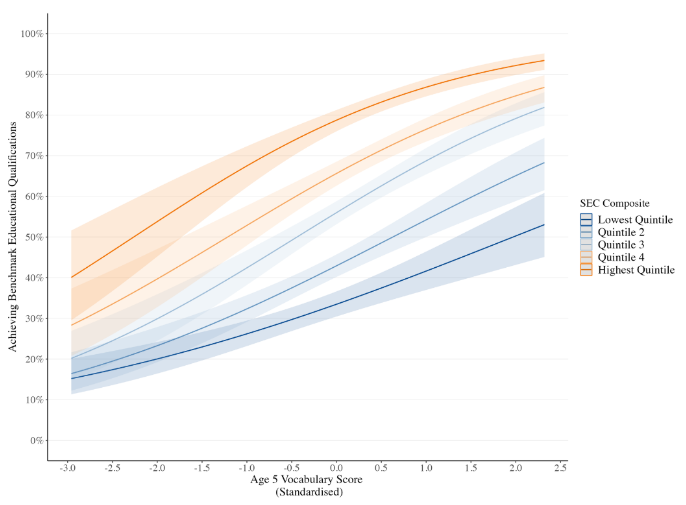
how did Thornton et al. (2026) investigate individual differences in language on later educational outcomes
performed a millenium cohort study with around 15,500 participants → tracked likelihood of passing GCSE maths, English + science at 16 as a function of:
age 5 vocabulary/language ability
socioeconomic quintile (takes into account caregiver educational status, neighbourhood characteristics etc.)
what were Thornton et al. (2026)’s 3 findings in terms of individual language differences on later educational outcomes + what does this suggest
found that when controlling for socioeconomic status, as vocabulary at 5 increases, the percentage of achieving benchmark academic qualifications also increases
as each quintile of SES increases, the likelihood of achieving qualifications increases → even if vocabulary is good quality when they start school, those with lowest SES still only have around 50% chance of achieving benchmark qualifications
there is a slight interaction between vocabulary + outcomes in the middle quintile → suggests SES has less effect on those of middling status on later attainment than those of lower/higher
overall shows that both vocab + SES predict later outcomes → encourages development of language skills to buffer effects of low SES
what 3 factors explain individual differences in language development
infant’s prelinguistic communication predicts transition to language
caregivers’ responsiveness to infants predicts language
socioeconomic circumstances → more distal factor associated with vocabulary developmetn
what is the main idea of Bronfenbrenner (1979)’s ecological systems theory + its 3 layers
based on ecology → the study of interactions among organisms + their environments. posits that human development involves interaction between the person + properties of the immediate settings they grow up in, as well as the larger contexts these systems are embedded in.
doesn’t suggest that humans are ‘blank slates’, but actively move into + restructure the environment they are in → mutual relationship
overall posts that parent-child relationships do not exist in a vacuum → many different environmental factors influence language development
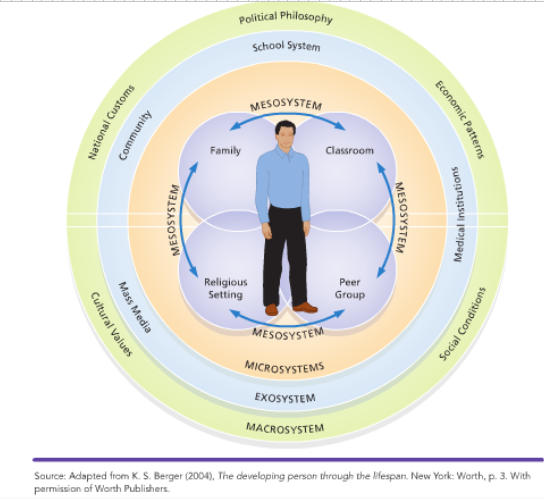
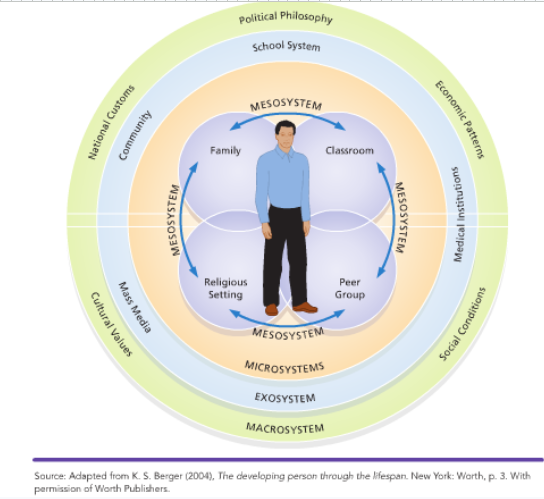
what are the 3 layers involved in Bronfenbrenner (1979)’s ecological systems theory
the model involves different systems of influence nested in one another:
mesosystem → individual’s inner circle, so immediate contacts we interact with everyday e.g. family, peer group, classroom, religious setting
exosystem → wider cultural/environmental factors impacting everyday environments, e.g. school/medical systems, media + community
macrosystem → even wider factors impacting exosystem, e.g. economy, social conditions, political philosophy/customs, cultural values
what 3 main outcomes are socioeconomic circumstances associated with
caregiver language
child language
child life outcomes
what is the social gradient found in language development
the correlation between children’s language skills and the SES they grow up in → the lower their SES, the more challenges with language skills they will typically face
what did Akhtar + Jaswal (2013) state about cultural differences in language development
cultural differences = part of life’s rich tapestry → it is not sensible to say we ‘should’ talk to children in a certain way if we respect cultural diversity, as differences in language development depending on culture are not always deficits
however, within a society where long-term well-being depends on language skill (e.g. stable occupation, academics), social inequality needs to be addressed
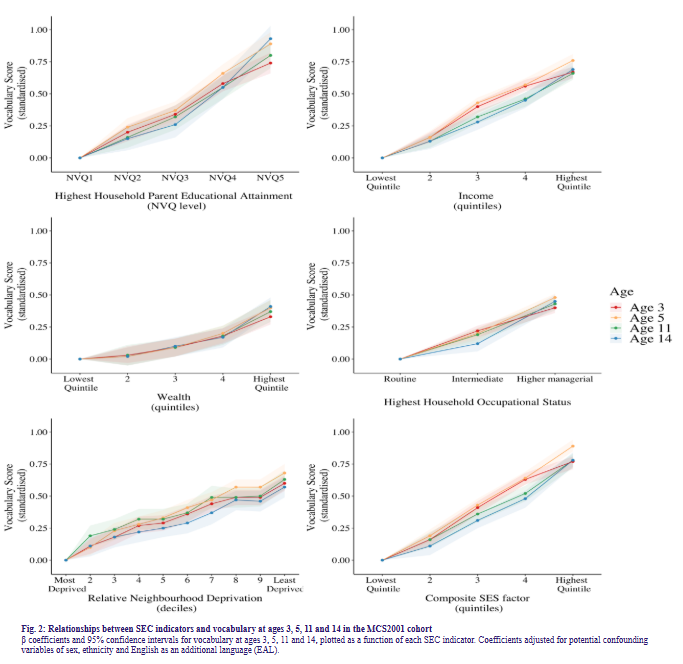
how did Thornton et al. (2026) measure the influence of SEC and vocabulary, what 6 measures of SEC did they use + what was found
same study mentioned previously → children were tested at ages 3, 5, 11 + 14 on measures of SEC including:
parental education
(highest household) income
parental wealth (assets e.g. house value)
parental occupation
index of neighbourhood deprivation by postcode
composite (combination of all 5 measures)
found as measures of SEC increased, vocabulary scores increased linearly, with education, income + neighbourhood deprivation having the largest contributions
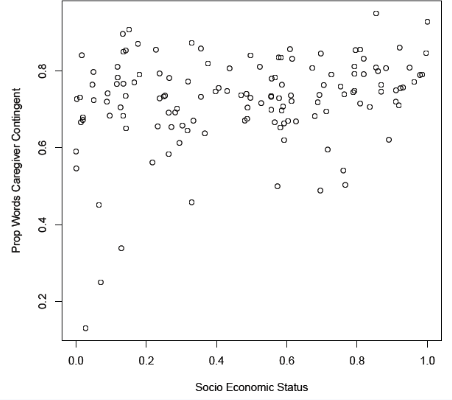
what did McGillion et al. (2017) find the relationship was between SEC and caregiver contingent talk
found a weak positive correlation between SEC and caregiver contingent talk (talk based on what a child is focussing on) → as SEC increased, the more talk increased also
however there were many outliers → not a strong correlation
what are 2 factors proposed to be responsible for why social gradients exist
psychosocial factors → more stress caused by economic tension leads to less time able to be spent aiding children’s language development
cultural factors → some families that are middle class may have more pedagogical sounds (may use more ‘teachy’ tone/language that is easier to comprehend)
what 2 ethical considerations in the BPS code of ethics make it difficult to conduct research on social gradients
respect → dignity of recognising the inherent worth of all human beings regardless of perceived/real differences in social status, ethnic origin or other such group-based characteristics
social responsibility → need to support + reflect respect for the dignity + integrity of social groups, and contribute to the common good
essentially means it is important to not misconstrue findings to compound any stereotypes + apply differences found to promoting child development
why are poor language skills considered a public health problem (Law et al., 2013)
language skills are important to development + wellbeing, and them being poor can cause poor child outcomes due to problems accessing academics, employment, health services + positive social environments
how strong is evidence of efficacy of early parenting interventions on child language development
evidence is currently equivocal (equally for + against) → many plausible interventions have been raised but tests of reliability are not often performed
what is efficacy
how effective an intervention is in ideal circumstances → e.g. outcomes of an early parenting intervention in a lab experiment
what is effectiveness
how effective an intervention is in real-world circumstances → e.g. outcomes of intervention carried out in a nursery + long-term effects
what are 3 main methods of testing interventions + what are they useful for
RCTs + meta-analyses → gold-standard methodological techniques used to assess efficacy + effectiveness of interventions
qualitative work, correlation studies + lab-based experiments → can be used to check what the underlying mechanisms of interventions are
pilot interventions → used to test feasibility + acceptability of interventions (interventions need to be both effective + likely to be used by parents)
what is contingent talk + what did McGillion et al. (2017) find when implementing this as an early-parenting intervention
child-directed speech that is contingent on infant’s focus of attention → found good longitudinal evidence of association with later vocab + experimental evidence to demonstrate how it promotes learning
what is an example of pedagogical language that can be used towards infants
parent using speech to try and teach infant something about the object they are interested in, rather than just conversational speech
how did McGillion assess the effectiveness of a contingent talk intervention on infant vocabulary
sample of 142 socially-diverse Sheffield-based caregivers + 11-month old infants were randomly assigned to either:
contingent talk intervention
dental health intervention → promoting interest in child interaction may have been confounding variable, so no other language intervention was used
intervention measures were assessed at 11, 12, 15, 18 + 24 months
what was McGillion et al. (2017)’s contingency intervention used + what effect did it have on caregiver-contingent talk
showed caregivers a short video identifying ways that infants indicate what they are interested in + examples of contingent talk, and were asked to set aside 15 mins a day to practice contingent talk. found intervention had modest but meaningful effect on the way parents talk:
effect size of word types used = .27,
effect size of % contingent words used = .35
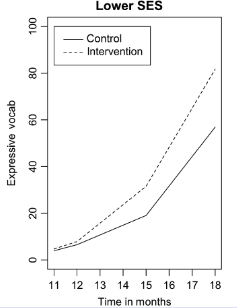
what effects did McGillion et al. (2017)’s intervention have on infant vocabulary from families with lower SES
found when followed up at 18 months, infants in the intervention condition had their vocabulary grow 10.57 words a month, in comparison to 6.64 words/month in control condition
found no effect for higher SES children → shows that contingency talk interventions can possibly close the gap between those with low + high SES
what were the 5 measures of child language used in the follow-up stages of McGillion et al. (2017)’s study
communicative development inventories (CDI) → parent report of vocab
naturalistic vocabulary count → tests knowledge of word types
Reynell → standardised test of vocab
ERB → standardised test of more general academic areas
LENA → measures automatic speech recognition
what effects did McGillion et al. (2017)’s intervention have on child language at 24 months + what does this suggest
found no significant effect of the contingency talk intervention on child language at 24 months using all measures of vocabulary → suggests interventions apply early in childhood, but child eventually returns to individual trajectory based on baseline SES, caregiver contingent talk + infant communication
implies that older child/teenager interventions may benefit from sustained support instead
how do McGillion et al. (2017) define contingency talk + what 3 things has this been previously found to be related to
a style of communication where a caregiver talks about what is in the infant’s current focus of attention → this has been found to:
partially mediate associations with child word learning, especially in infants under 18 months who cannot yet redirect attention to interpret others’ communicative intentions
result in substantially larger vocabularies as toddlers
be less commonly used in less educated mothers, suggesting similar quality of child-directed speech is on a social gradient
what were the 5 inclusion criteria used in McGillion et al. (2017)’s study
infants are:
first-born
singleton (not part of a twin pair)
birth weight over 2.5kg
monolingual
raised as English-speaking
what were the 3 exclusion criteria used in McGillion et al. (2017)’s study
infant was born more than 3 weeks premature
primary caregiver worked more than 24 hours a week
infant/primary caregiver had disability preventing participation
how were SECs measured in McGillion et al. (2017)’s study
using the English Indices of Deprivation → based on neighbourhood employment, income, health provision + housing
sample used in the study spanned all deciles of this measure → socially diverse
this was combined with primary caregiver education + income to collapse onto a single factor → SES
what occurred in the baseline (first) visit in McGillion et al. (2017)’s study
questionnaire pack was given out → audio recorders were given to participants in order for them to make 2 recordings
gaze following test was conducted
caregiver + infant were video-recorded together in free play for 30 minutes to provide measure of quality/quantity of caregiver talk + infant vocalisations
participants were then randomly assigned to intervention or control
when does McGillion et al. (2017)’s study suggest the social gradient in language ability emerges
around 24 months for British infants → when intervention effects drop off