Was Glorious Revolution a Political Revolution
 Call Kai
 Learn
Learn Practice Test
 Spaced Repetition
 Match
Match Flashcards
 Knowt Play
1/107

There's no tags or description
Looks like no tags are added yet.
Name | Mastery | Learn | Test | Matching | Spaced | Call with Kai |
|---|
No analytics yet
Send a link to your students to track their progress
108 Terms
What was the Glorious Revolution?
A political event in England where James II was overthrown and William of Orange took the throne.
Did James II have to be overthrown for the Glorious Revolution to occur?
Some historians argue that James II could have retained his throne if he had not fled.
What factions were involved in inviting William of Orange?
Both Whig and Tory factions were involved in the invitation.
What was the Tories' view on overthrowing a king?
Tories supported the Divine Right monarchy and were uncomfortable with the idea of overthrowing a rightful king.
What philosophical belief did Whig MPs follow?
Whig MPs followed John Locke's philosophy that a ruler could be removed if they broke their contract with the people.
What was the Tories' stance on disobedience to the monarch?
Tories accepted passive disobedience but believed resisting the monarch was a sin against God.
What did James II's voluntary abdication signify?
It made the Glorious Revolution possible and allowed William and Mary to ascend the throne without being seen as usurpers.
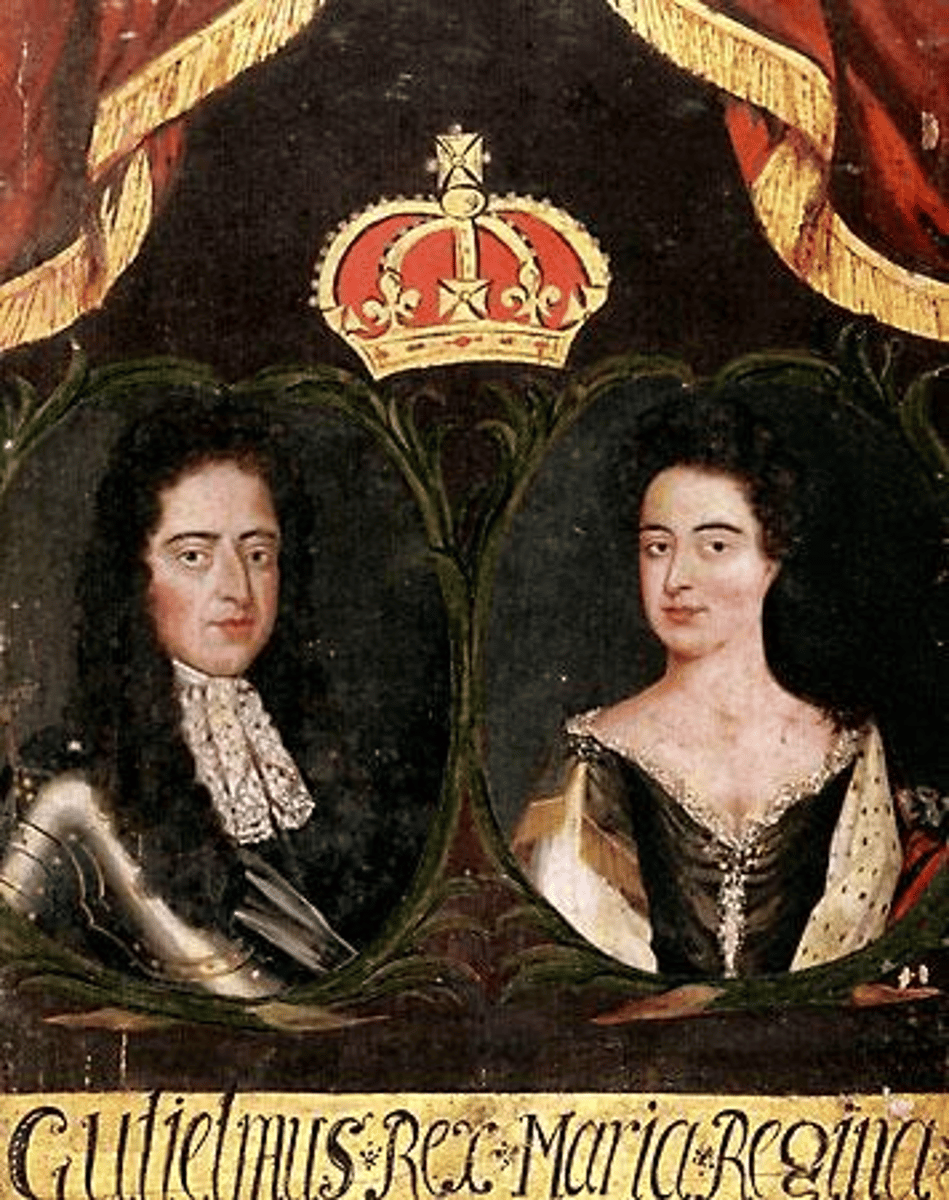
How did historians differ on the violence of the Glorious Revolution?
Macauley viewed it as the least violent revolution, while Vallance noted significant violence in Ireland and Scotland.
What was the Bill of Rights and why was it significant?
The Bill of Rights established limits on the monarchy and outlined rights for Parliament, marking a shift in power.
What were some key provisions of the Bill of Rights?
Regular elections, the right to petition the king, and the illegality of raising taxes without Parliament's consent.
How did some historians view the significance of the Bill of Rights?
Some saw it as significant as the Magna Carta, while others criticized its vagueness and potential for absolutism.
What was the Act of Settlement and its purpose?
The Act of Settlement (1701) ensured the crown would pass to the House of Hanover and barred Catholics from the succession.
What were some key stipulations of the Act of Settlement?
It required royal pardons to be irrelevant in impeachment cases and mandated parliamentary consent for various royal actions.
Did the Bill of Rights and Act of Settlement end Divine Right Monarchy?
Many historians view these acts as a turning point that limited monarchs' claims to power from God.
What was the role of the Convention Parliament after William's arrival?
The Convention Parliament was hastily assembled to determine the future political settlement after James II's escape.
What was the significance of offering the crown to both William and Mary?
It was crucial for Tories to accept the settlement as it acknowledged Mary's hereditary right.
What was the impact of the Declaration of Rights?
It was modified into the Bill of Rights and outlined conditions under which William and Mary accepted the throne.
What was the Tories' reaction to the impeachment clause in the Act of Settlement?
Initially opposed, Tories later supported it to impeach William's Whig advisers.
What was a key criticism of the Bill of Rights by historian Christopher Hill?
He emphasized its vague qualities, particularly regarding the frequency of parliaments and definitions of free elections.
What did the Bill of Rights say about the standing army?
It prohibited raising and keeping a standing army in peacetime without parliamentary consent.
What was the significance of the Triennial Act in relation to the Bill of Rights?
The Triennial Act clarified the vagueness of the Bill of Rights regarding the frequency of elections.
What was the relationship between the House of Hanover and the House of Stuart?
The House of Hanover was linked to the House of Stuart through the marriage of Sophia, James I's granddaughter.
What did the Act of Settlement stipulate about future monarchs' religious affiliation?
All future monarchs must be members of the Church of England.
What was the role of the Privy Council according to the Act of Settlement?
All matters regarding the governance of Britain had to be discussed with the full Privy Council.
What was the consequence of James II's flight for the Tories?
It allowed Tories to accept William and Mary as monarchs due to James's abdication rather than as usurpers.
What was a major consequence of the Glorious Revolution for the monarchy's authority?
Monarchs could no longer claim their power derived solely from divine right, as authority was now approved by Parliament.
What was the significance of the Bill of Rights in relation to monarchs?
It prevented monarchs from claiming their power came from God, establishing that authority was approved by the people through Parliament.
How did Whig historians view the Bill of Rights in the 18th century?
They argued it was not revolutionary but reaffirmed principles from the Magna Carta, asserting that the king ruled within the law.
What was the perspective of Marxist historians on the constitutional monarchy established after the Glorious Revolution?
They believed it was created in the economic interests of the ruling elites, known as the Political Nation.
What did John Morrill argue about the changes brought by the Glorious Revolution?
He claimed that a constitutional monarchy was not fully established and that the monarch remained pre-eminent in the political system.
What was the role of Parliament before the Triennial Act of 1694?
Parliament was primarily an advisory body to the monarch and did not represent the general populace.
What was the Triennial Act of 1694?
It mandated that Parliaments could not sit for more than three years, leading to more frequent elections.
How did the Triennial Act affect the relationship between the Crown and Parliament?
It made the Crown more reliant on Parliament for support, as elections became more regular and competitive.
What was the 'Rage of Party' period?
It was a time of political instability caused by frequent elections and rivalry between Whigs and Tories.
What was the impact of the Triennial Act on political engagement?
It increased interest in politics from those outside the Political Nation and allowed for more political pamphleteering and journalism.
What were the main goals of the Whigs during William's reign?
They favored progressive reform and saw the monarchy as a man-made institution, rather than divinely ordained.
How did William's relationship with the Tories evolve?
Initially suspicious of the Whigs, he favored Tories during his campaign in Ireland but later aligned with Whigs due to their support for the war.
What was the significance of the Civil List established in 1698?
It provided the Crown with £700,000 per year from taxpayers, allowing Parliament to scrutinize royal spending.
What evidence suggests Parliament became a partner in government post-Glorious Revolution?
Parliament forced the king to reduce the army size and required approval for peacetime armies and taxation.
What limitations remained on Parliament's power after the Glorious Revolution?
Many aspects of the Royal Prerogative remained intact, including the right to declare war and dissolve Parliament.
What was the relationship between the king and Parliament regarding the Civil List?
It represented a collaboration, showing the king's need for parliamentary approval while still holding significant power.
What was the outcome of the inquiries set up by Parliament in 1695?
They investigated corruption in government, reflecting increased parliamentary confidence.
What was the effect of regular elections on the political landscape?
They led to increased competition and rivalry between political parties, particularly the Whigs and Tories.
How did the Bill of Rights restrict royal power?
It limited royal interference in the law and established that taxation without Parliament's consent was illegal.
What was the role of William's Privy Council?
William chose a balanced council of Whigs and Tories, but they struggled to command respect in the House of Commons.
What was the significance of the 'Williamite War' in Ireland?
It shifted parliamentary concerns towards the costs of war and influenced William's political alliances.
What did the term 'Political Nation' refer to?
It referred to the ruling elites who benefited from the economic interests of the constitutional monarchy.
What was the relationship between the Whigs and the City of London?
The Whig Junto had strong ties to the City and supported the war as it allowed them to profit through loans to the Crown.
What was the impact of the Act of Settlement?
It further established the foundations of a constitutional monarchy alongside the Bill of Rights.
What was the significance of the Magna Carta in the context of the Bill of Rights?
It was an earlier document that first put the power of the monarch within the rule of law, influencing later constitutional developments.
When did King James II lose control of the government?
December 1688
How did the Stuart monarchy lose control of government?
December 1688, King James II fled the country and took refuge with Louis XIV of France due to overwhelming opposition to his rule
What shows there was demand for William of Orange as head of government?
Group of around 60 lords and 300 former MPs (bipartisan) asked William of Orange to take over the government
What date did the Convention Parliament meet to decide how to deal with James' flight?
22 January 1689
What was the Whigs' take on James II's flight?
-Believed social contract exists between king and his people both have to uphold
-Assertion James II broke this contract and exceeded his powers by attempting to establish Catholicism in England
-James' actions meant he lost the right to rule as king
-Therefore, the throne was vacant
What was the Tories' take on James II's flight?
-Believed in hereditary succession and divine right of kings to rule over their subjects
-Tories had sworn an oath of allegiance to James, and felt they couldn't break this as long as the King lived
-They needed justification for the replacement of James by William of Orange
What was the result of the 1689 Convention Parliament?
Formulated a resolution on the monarchy whose wording satisfied most Whigs and Tories
Convention Parliament, 1689, resolution:
-James II had broken the contract between king and people - Whig
-He had violated the country's fundamental laws - Whig
-His flight meant he had abdicated the throne - Tory
Why was the resolution of the Convention Parliament 1689 not fully accepted?
-Tories in the Lords objected to the statement
Did William of Orange and Mary have popular support?
-anti-Tory crowds demonstrated outside parliament in late January 1689 after their opposition
-one petition supporting William and Mary attracted around 15,000 signatures and was backed by large street demonstrations
What quelled the Tory opposition to William and Mary?
-3 February 1689, William in a secret meeting with peers warned them he 'would go back to Holland' unless he were made king
-a powerful ultimatum that forced the hesitant Tories in the Lords to back down quickly
-allowed William and Mary to be offered the crown jointly as full monarchs rather than a weaker, unstable regency arrangement
What was the eventual regency arrangement William and the political elite agreed?
-His wife, Mary, would share title of monarch with William, without the power
-If Mary died and William married again, any children from the second marriage would follow Anne, Mary's sister, in the line of succession
-Throne offered to William and Mary unconditionally
When was William and the political elite's regency arrangement settled?
-6 February 1689 formally accepted by the Lords
-8 February 1689 confirmed by the Commons
What year was the Declaration of Rights?
1689
What did the Declaration of Rights encompass?
Listing all the errors James II had committed, asserting some traditional liberties of the people
Give examples of some traditional liberties:
-Laws could not be suspended without parliament's consent
-Parliament had to approve all forms of taxation
-Parliaments should meet frequently
How was the Declaration a compromise document?
-No statement James had been resisted, deposed, or had broken a contract
-William and Mary weren't referred to as 'rightful' or 'lawful' heirs
-Left ambiguous in the constitutional implications of James' removal
-Those who wished to regard William and Mary as de facto monarchs could recognise them as rulers without denying James was de jure king
How did the Declaration of Rights change?
A diluted version called the Bill of Rights passed later in 1689
When and where was the crown offered to William and Mary?
13 February 1689, at a formal ceremony where the Declaration of Rights was read
When was William and Mary's coronation?
11 April 1689
What was distinct about William and Mary's coronation?
Different coronation oath from that sworn by other monarchs, indicating their different position and that of parliament
How did William and Mary's coronation oath differ?
-Previous oath: to 'confirm to the people of England the laws and customs to them granted by the Kings of England'
-New oath: 'to govern the people of this kingdom of England, and the dominions thereunto belonging, according to the statutes in Parliament agreed on, and the laws and customs of the same'
Whig historians' Interpretation of events of 1688-89
-Fundamental change
-Led to the establishment of a constitutional monarchy
-Monarchs were expected to get the agreement of parliament for their actions
Revisionist historians' Interpretation of events of 1688-89
-A conservative reformation
-A conservative event where key aim for political elite was to bring stability, did this by change of monarch.
-They simply removed James II because he threatened the existing order.
-Then they quickly restored the traditional ruling structures with minor adjustments
-Little changed for ordinary people
Marxist / radical historians' Interpretation of events of 1688-89
-A political elite coup (confirming their power)
-The glorious Rev and constitutional changes = not about liberty for the people, but about the ruling class protecting its own economic and political dominance by replacing one king with another who would safeguard their interests and property.
-William's need to finance his wars against Louis XIV led to the Financial Revolution after 1688, which gradually ironically increased the power of Parliament at the expense of the monarchy. The ruling class (landed and commercial elites in Parliament) increasing their control over the state.
What was William III's religion?
Calvinist
What was William III's view on an ideal religious settlement?
-Wanted to secure support of all British Protestants for his war against France, as Calvinist
-Wanted to extend toleration to Catholics as was done in the Netherlands
What was William III's first religious policy move and when?
16 March 1689, the king asked the Commons to abandon the religious tests that kept dissenters out of public office
What was the new religious settlement act after the Glorious Revolution and when?
Toleration Act, May 1689
Why was the Toleration Act put in place by parliament?
The predominantly Anglican parliament wanted to extend toleration while maintaining the political supremacy of the Church of England
Terms of the Toleration Act May 1689
-Dissenters exempt from penal laws if they took oath of allegiance and declared against transubstantiation
-Could worship freely in licensed meeting houses which had to keep their doors open
-Could set up their own schools to educate their children
Who was religious toleration not extended to with the Toleration Act, 1689?
Catholics, Jews, Unitarians
What caused divisions within Anglicanism after 1689?
-Key divide: To broaden the Church to include dissenters/maintain strict Anglican uniformity
-William III supported broader inclusion, appointing Latitudinarians as bishops, like John Tillotson as Archbishop of Canterbury in 1691
-Tories opposed this, fearing it encouraged the growth of dissent
Why were Tories concerned about dissent?
-Feared rapid expansion of groups like Quakers
-Concern increased after Toleration Act 1689
-Believed Latitudinarian churchmen were too lenient in defending Anglican dominance
How did religion change in practice between 1689-1701?
-Gradual acceptance of Protestant diversity, not mainly through law but changing attitude
-Rise of science and reason reduced dominance of purely religious thinking
-Shift from religious uniformity -> religious diversity, but religion still shaped political attitudes
Why had Anglican supremacy ended by 1701?
-Growth in number and size of Protestant denominations after 1689
-Regional diversity, e.g. Catholic strength in North, dissent strong in East Anglia
-Church of England no longer the sole religious authority
Why was Catholicism remaining a political issue after 1689?
-Catholics remained a small, mistrusted minority, still facing prejudice
-Strong anti-Catholicism linked them to Louis XIV and foreign threat
-Continued to be a major political concern up to 1701 and the Act of Settlement
How did the 1689 Bill of Rights affect Catholics?
-Excluded Catholics from throne
-Removed James II and his heirs from succession
-BUT left uncertainty about succession after Anne
Why did the succession issue become urgent in the 1690s?
-Mary II died childless in 1694
-Anne lost her only surviving child, the Duke of Gloucester, in 1700
-Fear grew that James II's Catholic heirs might reclaim the throne
What was put in place to solve the succession issue?
Act of Settlement, 1701
What did the Act of Settlement 1701 do?
-Excluded 57 Catholic heirs from succession
-Required monarch to be a committed Anglican and active member of Protestant Church of England, attending services
-Granddaughter of James I, Protestant Sophia of Hanover, made next in line to throne
Why was the Act of Settlement a Whig victory?
-Extended earlier Whig aims from the Exclusion Crisis
-Not just James II but all Catholics permanently barred from the throne
-Secured a Protestant succession long-term
When was the Nine Years' War?
1688-97
Why did William join the Nine Years' War?
-William II joined the League of Augsburg, a coalition of European powers against Louis XIV's France
-Drew England into major European war with significant domestic consequences
How did the Nine Years' War affect domestic politics?
-William absent, campaigning in Europe from spring - autumn each year -> rule left to Queen Mary II
-Increase in royal patronage as more MPs given military roles
-Seen as King's growing power over the Commons + ability to corrupt MPs. Fear of a 'Court Party' where MPs were controlled by the King
-Annual taxation needs meant frequent parliaments, but no requirement to dissolve Parliament -> no need for elections, King can buy loyalty, risking parliament becoming subservient to the Crown and not represent the people
How did Parliament respond to the threat of William III's Nine Years' War?
-1692, Lords agreed Triennial Bill = establish regular elections every 3 years
-Passed by the Commons but vetoed by the king
-1693, other measures vetoed
-Reminiscent of the anti-parliamentary stance taken by Charles II and James II
How did Parliament respond to William III's vetoes?
1694, powerful campaign for a Triennial Act = no future parliament could last longer than 3 years
Immediate effect of the Triennial Act 1694
-Parliament must be held every 3 years
-Removed key royal prerogative of control over parliament's lifespan, dissolution/extension
-Major increase in parliamentary power
-Royal influence continued via patronage and pensions
What were the long-term political effects of the Triennial Act 1694?
-More frequent elections -> stronger party rivalry and divisions between Whigs and Tories
-Tensions peaked under Anne who didn't have a living heir.
-On her death, Act of Settlement 1701 -> throne to House of Hanover
-Many pro-Stuart Tories tried to oppose Hanoverian succession
When was the last time Britain had been involved in European conflict, before William III plunged Britain and the Dutch Republic into the Nine Years' War?
Hundred Years' War, ended in 1543