Biology - Cells
 Call Kai
 Learn
Learn Practice Test
 Spaced Repetition
 Match
Match Flashcards
 Knowt Play
1/39

There's no tags or description
Looks like no tags are added yet.
Name | Mastery | Learn | Test | Matching | Spaced | Call with Kai |
|---|
No analytics yet
Send a link to your students to track their progress
40 Terms
A cell is an open system
True
Cell membrane
Protective barrier; controls what goes in and out of a cell.
Cytoplasm
Gel like substance that suspends all the organells; it sustains nutrients.
Nucleus
Contains the cell’s DNA, and controls all the cell activity.
Mitochondria
Known as the powerhouse of the cell; it is where cellular respiration happens (sugar to energy).
Ribosomes
Makes proteins out of amino acids
Rough Endoplasmic Reticulum
Rough from ribosones → protein synthesis. Its primary function is synthesizing, folding, and quality-controlling proteins
Smooth Endoplasmic Reticulum
Manufactures lipids; creates fats in animals and oils in plants.
Golgi Apparatus/Body
Gets substances from the Smooth ER and makes vesicles around them to transport them around and out of the cell.
Lysosomes
Digestive enzymes that defends cell against antigens like viruses and bacteria.
Centrioles
Involved in cell division; organizes microtubules to form centrosomes. Before a cell divides, they duplicate and migrate to opposite sides of the cell
Cell Wall
Rigid frame around cell to provide strength/support (Has small holes so things can still come in/out))
Chloroplast
Has chlorophyll which traps sunlight, also is a site of photosynthesis (uses sunlight to make sugar)
Large central vacuole
Stores water and nutrients (Animal cells have many small ones instead)
Channel Protein
Tunnel in the cell membrane to let big molecules pass through
Carrier Protein
Opens and closes to let big molecules through, designed for specific molecules.
Lipids (Heads)
Fats or oils that are hydrophilic (likes water), and is next to the ICF and ECF (contains water)
Phosphates
They are hydrophobic, and away from the ECF and ICF.
Phospholipid Bilayer
The two layers of the phospholipids
The Particle Model of Matter
All matter is made up of particles | Particles are always moving | Particles are attracted to each other | Particles have spaces between them
Concentration
The ratio of solute to solvent in a solution.
Concentration Gradient
Exists when there is a different concentration on either side of a membrane (like a high concentration seperated by a semi-permeable from low concentration)
Impermeable
Allows nothing through
Semi-permeable
Allows some things through
Permeable
Allows fluids, gases, or specific molecules to pass through it
Passive Transport
Does not require energy, goes along the concentration gradient (high to low) and includes diffusion, facilitated diffusion, and osmosis
Active Transport
Active requires energy, and goes against the concentration gradient (low to high). Includes exocytosis and endocytosis.
Diffusion
Molecules are able to pass right through the membrane, so they move from an area of high to low concentration.
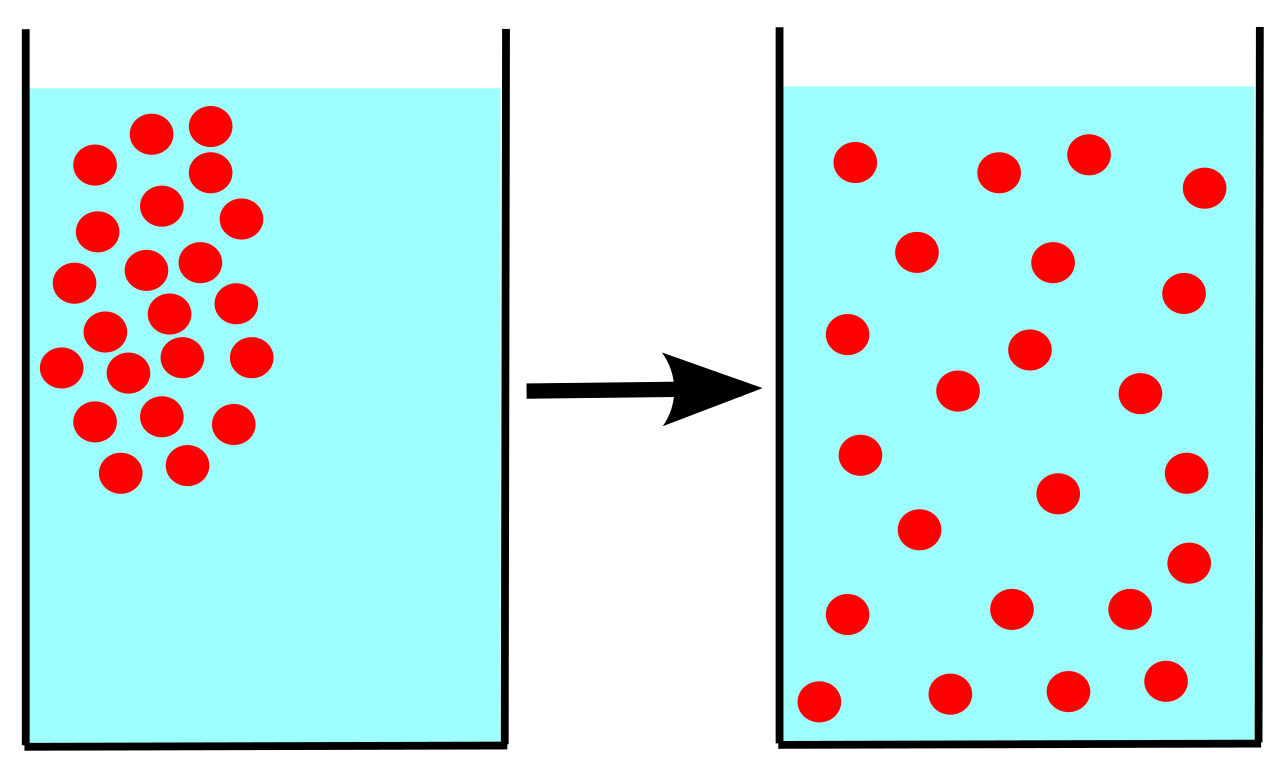
What does diffusion happen with?
Molecules that are small enough to fit through the membrane, and molecules that are fat soluble (can get through fat/lipids of the cell membrane)
Facilitated Diffusion
Diffusion with the help of proteins that are embedded in the membrane for molecules that otherwise could not get through.
What does faciliatated diffusion happen with?
Molecules that are too big to fit through the membrane, and molecules that are not fat soluble (cannot get through fat/lipids of membrane)
Osmosis
The movement of water molecules through a semi-permeable membrane from a place of low solute concentration (high water potential) to a place of high solute concentration (low water potential). Like diffusion but specifically for the movement of water.
What will happen if you place a cell that is made up of 20% salt and 80% water in a solution that is 10% salt and 90% water?
The cell will swell up with water and burst. Because the water concentration inside the cell (80%) is lower than the water concentration in the surrounding solution (90%), water will move into the cell through osmosis.
What will happen if you place a cell that is made up of 20% salt and 80% water in a solution that is 30% salt and 70% water?
The cell will shrink and shrivel as the water molecules naturally move across the cell membrane from areas of higher water concentration to lower water concentration through osmosis.
Hypertonic
The solution has a higher concentration of solutes than the cell. Therefore it has a lower concentration of water. Water will move out of the cell.
Isotonic
The concentrations of the cell and the solution are equal and there will be no movement of water.
Hypotonic
The solution has a lower concentration of solutes than the cell. Therefore it has a higher concentration of water. Water will move into the cell.
Active Transport
Uses proteins (carrier) to pump molecules from low to high concentration
Exocytosis
A type of active transport where it moves things out of the cell. The golgi body forms a vesicle around large waste products which then merges with the cell membrane, releasing the waste to the outside of the cell.
Endocytosis
A type of active transport where it moves things into the cell. A vesicle forms around the solute. Since it has the same phospholipid structure as the cell membrane, the membrane folds inward and pinches off to form the vesicle around the solute.