Organic compounds
 Call Kai
 Learn
Learn Practice Test
 Spaced Repetition
 Match
Match Flashcards
 Knowt Play
1/10

Earn XP
Description and Tags
b1.1-b1.1.3
Name | Mastery | Learn | Test | Matching | Spaced | Call with Kai |
|---|
No analytics yet
Send a link to your students to track their progress
11 Terms
organic compound
compound that contains carbon and is found in living things
Exceptions includes carbides (cac2), carbonates (co3²-), oxides of carbon (c02) and cyanides (CN^-)
Carbon
forms the basis of all organic compounds due to its ability to form large and complex molecules via covalent bonding
carbona toms can form four covalent bonds, with bonds between carbon atoms being particularly stable
this allows carbon to form a wide variety of structures, including compounds consisting of branched or unbranched chains and single or multiples rings
Types of carbon compounds
carbohydrates, lipids, nucleic acids, proteins
Carbohydrates
Molecules consisting of carbon ( c ), hydrogen, (h), and oxygen( 0) typically in a consistent ration of (ch20)n
the monomeric subunit of carbohydrate will commonly adopt a closed ring structure that can form different seteroisomers
Carbohydrates are commonly used in nutrition as an enery source, but can also be used in cell recognition (glycoproteins) and structure (cellulose)
the monomeric subunits are also used as componenets in a range of different molecules, including DNA and coenzymes (ATP and NADH)
Lipids
Lipids are non polar hydrophobic molecules that typically consist of either unbranched chains (fatty acids or ringged structures (steroids)
lipids serve as the main structural component of cell memebranes (phospholipids and cholestrol) and may also be utilised for energy storages (triglycerides)
certain lipids may also function as signaling molecules (steroid hormones)
nucleid acids
consist of monomeric subunits (nucleotides) containing a pentose sugar, a phosphate group and a nitrogenous base
nucleic acids function as the genetic material of the cell and determin the inherited features of an organism
there are tow main types of nucleic acids-DNA function as a master copy, while RNA is responsible for protein assembly
Protein
proteins are composed of one of more chains of amino acids residues and comprise over 50% of the dry weight of the cell
they preform a vast array of fucntions within the cell- including catalysis (enzymes) structure , signlaing and transport.
some proteins can have non peptide groups attached (cofactos.prosthetic groups) which contribute to the overall functions of the molecule
1.1.2 Monomers****
organic compounds are typically composed of recurring subunits (monomers) which are covalently joined to form polymers
the monomeric subunit of carbohydrates of repeating nucletoides
protein consist
polymerisation
polymers can be formed from monomeric subunits ia CONDENSATION reactions
a hydroxyl group (-OH) on one monomer is combined with a hydrogen atoms (-h) on another monomer
the two monomers become covalently bonded and a water molecule is produced as a by product
Digestion
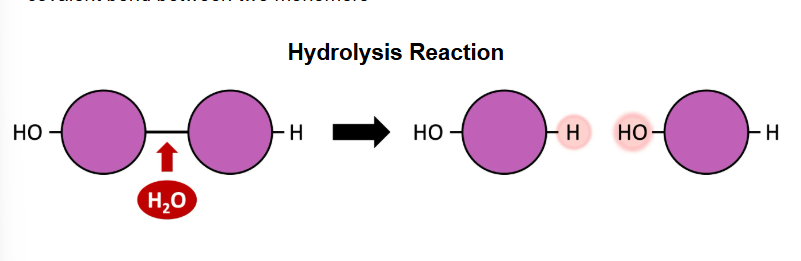
polymers can be broken down into their monomeric subunits via HYDROLYSIS reactions
a water molecule is split to provide the -h and -oh groups requires to break the covalent bond between two monomers
Polymers
large macromolecules composed of smaller repeating subunits (called monomers) via condensation reactions