ch 7-6 geologic time
 Call Kai
 Learn
Learn Practice Test
 Spaced Repetition
 Match
Match Flashcards
 Knowt Play
1/37

There's no tags or description
Looks like no tags are added yet.
Name | Mastery | Learn | Test | Matching | Spaced | Call with Kai |
|---|
No analytics yet
Send a link to your students to track their progress
38 Terms
what are the two ways of dating geological materials (age)
qualitatively and quantitatively
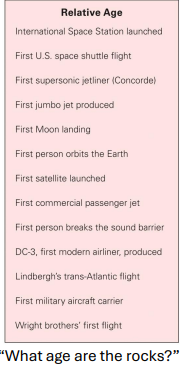
which are older and younger?
what are relative ages based on?
upon the order of formation and permit determination of older vs younger relationships
doesn’t provide specific age
number of geological principles to order rocks
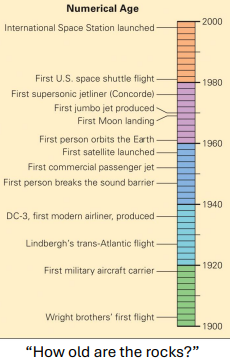
what are numerical (absolute) ages?
actual number of years since an event occurred
using radioactive decay of isotopes in rocks
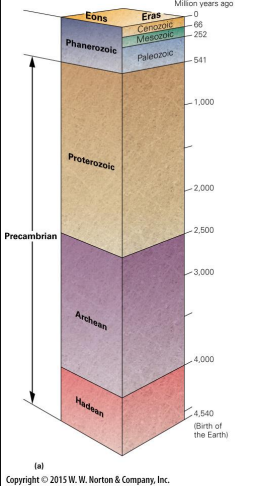
how old is Earth?
4.5 billion years old (4.5 Ga)
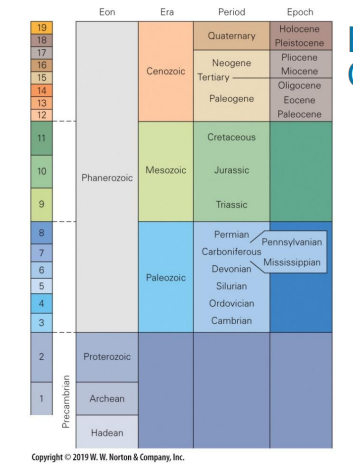
eons and eras
one thousand years
=Ka (kilo-annum)
one million years
=Ma (mega-annum)
one billion years
=Ga (giga-annum)
what eon is the vast majority of the Earth’s past in?
Precambrian
Proterozoic
Archean
hadean
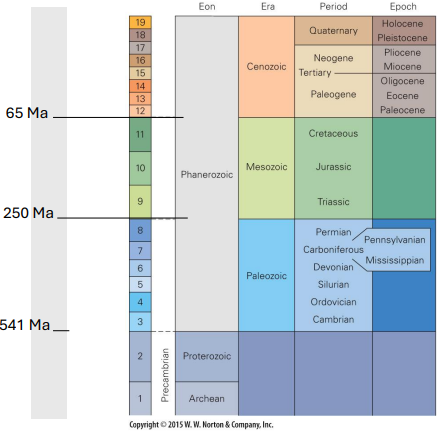
how is Earth’s geologic time scale divided into?
Eons
eras
periods
epochs
each division is smaller and smaller
more recent we have more rocks to create more categories
What major events occurred during the Hadean Eon?
Formation of Earth and Moon, accretion of planetesimals, differentiation of Earth, formation of a molten iron core, and development of the first crust.
What does it mean that Earth differentiated during the Hadean Eon?
Dense materials such as iron sank toward the center, forming the core, while lighter materials rose toward the surface.
How did Earth's first atmosphere and oceans form?
Volcanic degassing released gases (N₂, CO₂, SO₂, H₂O), leading to the formation of the atmosphere and oceans by about 3.8 billion years ago.
high heat flow during Hadean Eon (4.5-4.0 Ga)
radioactive decay, bombardment by meteorites
Earth differentiated
molten iron core developed
end of Hadean: crust
rocks mostly not preserved
some minerals (zircon) as old as 4.4 Ga
oldest known rocks on Earth 4.03 Ga (NWT)
what did volcanic gegassing led to?
development of oceans by 3.7 Ga
development of atmosphere
N2, CO2, SO,2, H2O-rich
denser than present day, not oxygenated
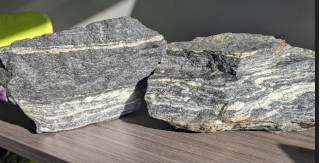
The Acasta Gneiss
oldest rocks found in the Northwest territories
gives us clues about what life on Earth was like at that time
Isotopic age dating as 4.03 billion years ago (formed when Earth was 5y/o)
rocks define boundary between Hadean and Archean eons
What major developments occurred during the Archean Eon 4.0 to 2.5 Ga?
Formation of continental nuclei, development of oceans, appearance of the first life, and the establishment of Earth's magnetic field ~3.5 Ga.
What is the earliest evidence of life during the Archean Eon?
Stromatolites produced by cyanobacteria, dating to at least 3.5 billion years ago.
led to oxygenated atmosphere
may have begun in Hadean
How did cyanobacteria change Earth's atmosphere?
Through photosynthesis, they released oxygen, eventually leading to an oxygenated atmosphere.
well developed hydrosphere during Archean
large erosive rives
weathering of rocks made oceans salty
atmosphere: outgassing rom volcanoes → reducing atmosphere
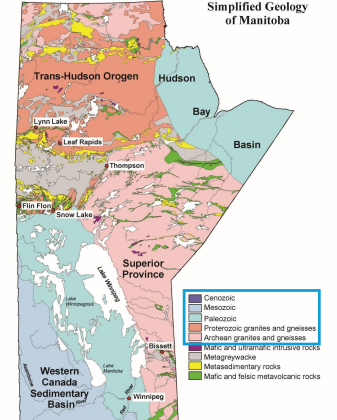
distribution of rocks
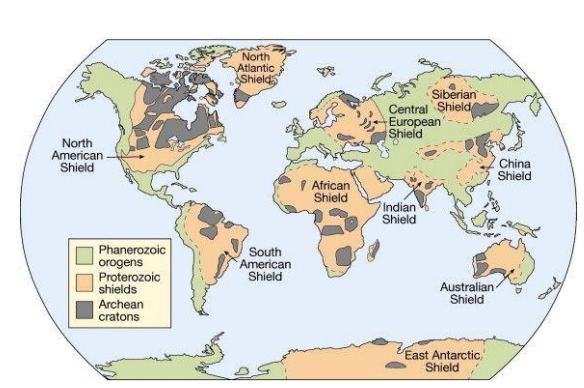
superior province of Manitoba
most significant deposits of Gold, Nickle, and Cooper, and potential to host diamonds
What major atmospheric change occurred during the Proterozoic Eon (2.3 to 0.541 Ga)?
The atmosphere became increasingly oxygenated.
stabilization of continental platforms
What type of organisms became abundant by the end of the Proterozoic Eon?
Multicellular organisms.
evolution from bacteria
level of O2 rose significantly
What were the Ediacaran Fauna?
The earliest known soft-bodied multicellular animals that lived near the end of the Proterozoic Eon.
Ediacaran Fauna fossils
earliest known, soft complex, multicellular
first animals, soft bodied
multicellular
required oxygen
precursors to animals with skeletons
first evidence of simple ecological interactions
pioneers of complex life
What are the major characteristics of the Phanerozoic Eon 541 (Ma to present)?
Modern plate tectonics, modern atmosphere, diverse life, and the transition of life from the oceans onto land.
What major biological transition occurred during the Phanerozoic Eon?
Life expanded from marine environments onto land.
How does the atmosphere of the Phanerozoic compare to today?
It is essentially the modern oxygen-rich atmosphere.
hydrosphere during Phanerozoic eon
shallow seas through much of time
atmosphere during Phanerozoic eon
The atmosphere contained abundant oxygen and supported diverse plant and animal life.
biosphere during Phanerozoic eon
diversity of life
transition from marine to terrestrial
what are eons divided into?
eras
eras of the Phanerozoic
Paleozoic (“old life”)
←——— >90% of species extinct
Mesozoic (“middle life”)
←——— ~75% of species extinct
Cenozoic (“new life”)
when did the “Great Dying” happen?
Paleozoic era
believed to be from massive volcanic events that caused rapid global warming, ocean acidification, and widespread monomial → ocean depletion of O2
90-96% of marine species died
~70% of land vertebrate species died
what era did the dinosaurs die?
Mesozoic era
asteroid impact in Mexico that caused dust and ash to block the atmosphere for months to years
halted photosynthesis and causes collapse of food chain
period are divided into?
epochs
smaller time frame
more rock preserved to make distinguishing between time period