STRAT 390 MIDTERM
 View linked note
 Call Kai
 Learn
Learn Practice Test
 Spaced Repetition
 Match
Match Flashcards
 Knowt Play
1/144

There's no tags or description
Looks like no tags are added yet.
Name | Mastery | Learn | Test | Matching | Spaced | Call with Kai |
|---|
No analytics yet
Send a link to your students to track their progress
145 Terms
mission
why we exist
firm’s motivation for being in the business
should guide the company for decades
vision
where we are going
what future do we want to create?
articulates future direction and impact
values
how we go about our work
a “code of conduct” that guides employees’ actions, choices, and behaviors
why have stated aspirations
ease of coordination and minimize disputes
guide decisions
motivate and inspire
characteristics of effective aspirations
motivational, strategic, coherent
motivational aspirations
provides an important connection between the individual’s motivation and behavior and the organization’s strategy
inspires and motivates employees to seek a common goal
authentic
strategic aspirations
help guide the development of a strategy
focus on value creation, not just value capture
focus on needs or problems, not just products or services
coherent aspirations
most useful
shared by employees (motivational)
complement a carefully developed strategy (strategic)
purpose of mission, vision, values
to guide and inform strategy
purpose of mission, vision, values ≠ strategy
8/28 lecture (strategy and its role in business) key takeaways
Know what questions mission, vision, and values answer
Be able to tell the difference between them
Know what makes aspirations effective
Be able to tell the difference between aspirations and strategy
We care about real aspirations not stated ones
Compelling mission, vision, and values often enhance the likelihood of success
As the environment changes, the firm must modify its aspirations
9/4 lecture (ryanair case) key takeaways
The airline industry is unattractive (Porter’s 5 forces)
If the structure of the industry is not likely to lead to profits, strategy becomes more important
External consistency: exploiting opportunities in the industry
Internal consistency: works well with other company policies
Dynamic consistency: anticipates and adjusts to competitors’ activities
The airline industry has high fixed costs, low marginal costs
Ryanair is a classic example of a focused low-cost competitor
Entrants need to consider how rivals will respond to their entry
Price wars with low-MC competitors and deep pockets is dangerous!
business strategy
competitive advantage within an industry
How do we compete in this market?
What choices will grant us a competitive advantage?
How will we compete in this market in the future?
corporate strategy
doing business strategy across several businesses
In which markets should we compete today and in the future? (diversification)
How does our ownership of business ensure its competitive today and in the future? (vertical/global integration and horizontal diversification)
How do we organize to maximize corporate advantage?
horizontal diversification
expand into other products and services
vertical integration
expanding into other parts of the supply chain
backward / upstream vertical integration
expansion into supplier industries
forward / downstream vertical integration
expansion into buyer industries
global integration
expand firm location
objective of corporate strategy
three single businesses are not as strong as a single entity as combined businesses
advantage a + advantage b + advantage c > advantage 1
how can a multi-business firm improve overall performance?
a better portfolio management and resource allocation
improving individual business performance through firm restructuring
improving portfolio performance by exploiting linkages across businesses (synergies)
reduce costs at the corporate center
challenge of corporate strategy
costs incurred by ownership of multiple businesses
costs of headquarters facilities and personnel
costs of coordination
costs of distractions
costs of social comparison
how to choose scope?
better-off test
ownership test
better-off test
Does the presence of the firm in a given market improve the total competitive advantage of business units over and above what they could achieve on their own?
i.e. adding or dropping a business creates value
cost advantages through economies of scope
willingness-to-pay advantage through cross-selling benefits
economies of scope
When the total cost of producing two products jointly is less than the combined cost of producing each product separately
𝐶 (𝑌1, 𝑌2) < 𝐶 (𝑌1, 0) + 𝐶 (0, 𝑌2)
can arise when a corporation owns a multi-purpose asset which can be used to produce more than one product
cross-selling benefits
can arise when reputation is important
exploit reputation as a high-quality brand and sell different products
ownership test
Should there be a joint ownership to exploit economies of scope or cross-selling benefits?
Does ownership of business unit produce a greater competitive advantage than an alternative agreement would produce?
how do we decide if business belong together?
economies of scope: there are cost reduction benefits (𝐶1 > 𝐶2 while 𝑅1 = 𝑅2 )
cross-selling: there exist revenue benefits through synergies (𝑅1 < 𝑅2 while 𝐶1 = 𝐶2)
AND managers can realize these conditions at a lower cost than equity holders can
attractiveness test
diversification must be directed towards attractive (or with the potential of becoming attractive) industries
cost of entry test
cost of entry cannot capitalize all future profits
9/9 lecture (corporate strategy / amgen) key takeaways
Know the definition of corporate strategy and how it differs from business strategy
A corporate strategy drives decisions on the scope of businesses the multi-business firm should operate in and the organization of these businesses
Be able to apply the better-off and ownership tests (be specific)
As well as the attractiveness and cost of entry tests
Understand economies of scope and cross-selling benefits
Know when to horizontally diversify
related diversification
occurs when the firm expands into industries that share similarities with the industry the firm already operates in
i.e. volkswagen acquiring audi
firms can leverage and exploit relationships between different businesses to become more successful
through demand side and supply side economies of scope
demand side economies of scope
greater revenue through cross-selling
customers can buy or use multiple products from the same firm
reduces search cost
reduces customer acquisition costs
increases revenu
supply side economies of scope
reducing costs through exploiting current assets for many activities
tangible and intangible resources
economies of scale
using a resource many times for the same activity is cheaper than using it fewer times (i.e. lululemon producing more tights)
tangible resources
offer economies of scope by eliminating duplications (e.g. IT systems, sales force, shared services, et.c)
intangible resources
offer economies of scope based on the ability to apply them to additional businesses at a low marginal cost (e.g. brand name, corporate repuation, technology, etc.)
operationalizing relatedness
mechanisms used for exploiting relatedness in diversification to increase economies of scope
employing slack
shared knowledge
similar business models
allocating capital/personnel
entry to new industries
employing slack
utilizing unused resources capacity
shared knowledge
enhance corporate learning by sharing experiences
similar business models
gaining expertise through similar “dominant logic” or methods of creating and capturing value
allocating capital/personnel
creating value through more efficient allocations
entry to new industries
exploiting existing resources and capabilities to allow the firm to acquire more and enter new industries
unrelated diversification
occurs when a firm enters a business that has little horizontal interaction with the other businesses in the firm (i.e. Amazon acquiring Whole Foods)
can result in a conglomerate where:
acquire firms to get businesses they have no standing in
managers’ goal is to increase their own status, rather than shareholders’ values
but they do not create further economic value
and therefore, should be dismantled
benefits of unrelated diversification
allows the firms to spread risk
might offer the firm enhanced profitability and flexibility
can offer a use for the firm’s underutilized resources
offers a way to grow the firm (especially important in stagnating markets)
challenges of unrelated diversification
failure in one business may negatively affect other businesses
lack of common identity may lead to a clash of interests
coordination is costly
9/11 lecture (horizontal diversification / disney case) key takeaways
Know the difference between related and unrelated diversification
Know the essence of the demand and supply sides of the economies of scope
Understand how they can lead to cost reduction or higher revenue
Know which kind of diversification is most often successful (related)
The corporation must add value over and above what the businesses earn by themselves
By diversifying into TV, movies, toys, and parks, Disney was able to deploy their resources (their characters) and to realize economies of scope
vertical integration
combination of 2+ stages of the value into one company
value chain
sequence of activities that transform raw materials into finished products
example value chain for steel can

efficient market hypothesis
“market” is more efficient than any individual firm
information
the “market” aggregates information from many participants
prices on the market tend to reflect all the available information
firms are bound to the information they are exposed to, which may be incomplete
efficiency
“market” can achieve economies of scale in ways individual firms cannot
firms are bound to internal inefficiencies, and even when efficient, that only benefits the “market”
market prices adjust quickly to new information, making it hard for any single entity to consistently exploit market inefficiencies
when should a firm vertically integrate?
better-off test: for a specific set of transactions, is the firm better off conducting transactions in the market or using the hierarchy of the firm?
can it enjoy technical economies integrating the processes?
what are the comparative costs of transacting in the market vs internalizing the same set of transactions?
ownership test: for a specific set of transactions, will the firm realize the benefits only through integration?
can a contract be written cost effectively?
is coordination needed between the transacting parties?
what determines when a firm should vertically integrate?
when internal transaction costs < external transaction costs, otherwise “buy”
transaction costs
costs associated with an economic exchange
internal transaction / administrative costs
costs associated with the in-house production of a good or service and need to coordinate production among different parties in the transaction
associated with activities that are not directly productive
lower-powered incentives
exist when a person’s pay is not closely tied to their effort (i.e. fixed salaried employees (low-powered incentives) generally work less hard than rate-based salaried employees (high-powered incentives)
salaried managers and workers are more likely to shirk, and administrative controls are needed to deter that
Internal suppliers can lose incentives to compete (lower quality and higher prices)
Less exposure to the market can slow learning and experience effects
external transaction / market transaction costs
costs of using the market to purchase a food or service
search and information costs
costs of finding the right company/good/service
bargaining costs
costs of writing a contract, negotiating, etc.
monitoring and enforcement costs
costs of making sure that the other party sticks to the terms of the contract, and taking appropriate actions (e.g., arbitration, legal battles, etc.) if the agreement is broken
when do external TC arise?
opportunism
bounded rationality
performance uncertainity
“hold" up” problem
opportunism
the presence of asymmetric information that allows one party to take advantage of another, sometimes involves dishonesty
bounded rationality
limited access to knowledge and a limited ability to process the knowledge they have access to
performance uncertainty
either because of lack of coherent measures or due to specifying the goals
when do external transaction costs > internal transaction costs?
high asset specificity
significant coordination across the value chain is needed
asset specificity
degree to which an asset of a certain value can be adapted for other purposes
high level of specificity: useful only for certain tasks or in a certain context (transaction) (e.g., customized computer software)
low level of specificity: more flexible resource and has multiple uses and purposes (e.g., managerial skills)
high asset specificity increases transaction costs and leads to vertical integration
low asset specificity stimulates market solutions
coordination of flows through the value chain
workers at different stages of the vertical chain make complementary decisions
with incomplete contracts the problem is bigger
firms cannot ensure adequate coordination of design attributes
might be better to integrate and bear the administrative costs to achieve appropriate coordination
vertical integration as a solution to the “hold up” problem
incentives usually change once the contract is signed
one party may have an incentive to “hold up” the other
foreseeing such scenarios, parties will not want to cooperate
or to invest in a specialized, but very specific, technology
results in inefficiencies
vertical integration solves this problem
both parties own both assets
incentives are properly aligned
9/16 lecture (vertical integration / fisker case) key takeaways
know how to apply the better-off and ownership test (and be specific)
know difference between forwards vs backwards integration
know and identify components of internal and external transaction costs
know when external TC are expected to be higher
know when to vertically integrate (internal TC < External TC)
loss of flexibility
costly when a firm operates in a highly uncertain or changing industry
rapid changes are needed to respond to changes in technology and demand
compound risk
costly when the firm operates in uncertain industries
For a vertically integrated firm, the risk compounds across its businesses
9/18 lecture (amc case) key takeaways
Know and identify the components of external (market) and internal (administrative) transaction costs
Be able to identify type of diversification
Know when to vertically integrate
Remember that internal transaction costs are also called
Costs of hierarchy/Administrative costs
Remember that external transaction costs are also called costs of market transactions
Know the advantages and disadvantages of market solutions vs. vertical integration
The case emphasizes some examples of when studios/theaters would want to engage in vertical integration
execution/implementation of diversification
can the firm organize its businesses in a way that allows it to realize the value creation potential from their common ownership?
how should the firm organize its business in a way that allows it to capture value?
what is the right power structure between the different owners?
what is the organizational challenge?
to design a structure and systems that:
permit specialization
create incentives to align individual and firm goals
facilitate coordination by grouping individuals and link groups with systems of communication, decision making, and control

organizational structure
a formal reporting structure, which is a description of who in the organization reports to whom
management of control systems
formal or informal mechanisms to ensure that managers behave consistently with firm’s strategies
compensation policies
ways that firms pay employees, which is used to create incentives for employees to behave in certain ways
key questions in the process of implementing a strategy
how should the information flow within the organization?
when and by whom should decisions be made?
how to influence individuals’ behavior?
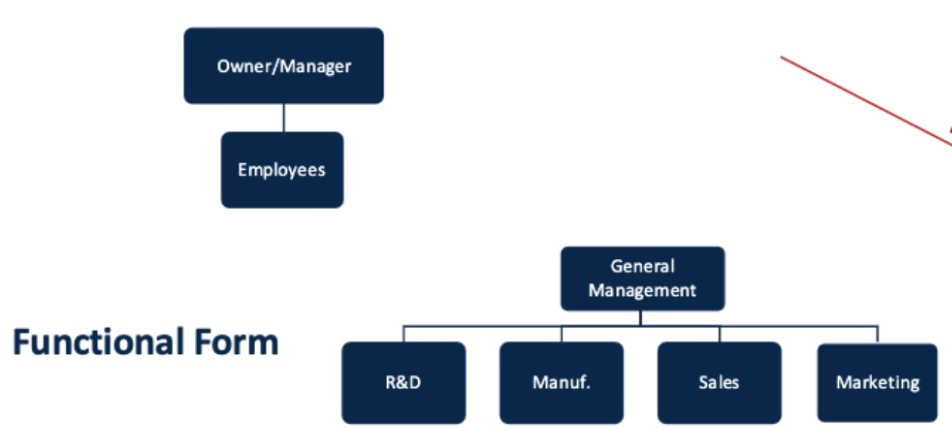
functional structure
division of labor: by inputs
coordination mechanisms: hierarchical supervision, plans and procedures
decision rights: highly centralized
boundaries: core/periphery
importance of informal structure: low
politics: inter-functional
basis of authority: positional and functional expertise
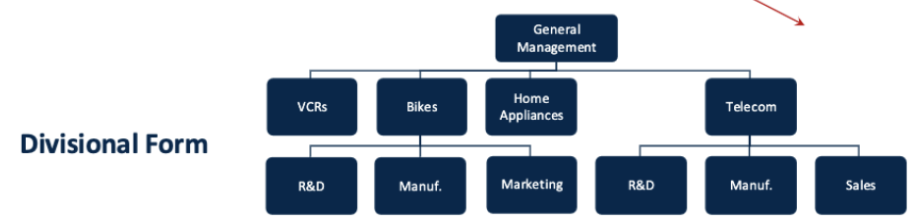
divisional structure
division of labor: by outputs
coordination mechanisms: division general manager and corporate staff
decision rights: separation of strategy and execution
boundaries: internal/external markets
importance of informal structure: modest
politics: corporate division and inter division
basis of authority: general management responsibility and resources
matrix structure
division of labor: by inputs and outputs
coordination mechanisms: dual reporting relationship
decision rights: shared
boundaries: multiple interfaces
importance of informal structure: considerable
politics: along matrix dimensions
basis of authority: negotiation skills and resources

network structure / holocracy
division of labor: by knowledge
coordination mechanisms: cross functional teams
decision rights: highly decentralized
boundaries: porous and changing
importance of informal structure: high
politics: shifting coalitions
basis of authority: knowledge and resources

different organizational structures: dis/advantages

strategic control and reward systems
plays an important role in the firm’s ability to determine the strategy and to influence performance in the different businesses
internal governance mechanisms
input controls (what has to be done and how)
output controls (results not actions lead decisions)
internal governance mechanisms
culture: how you should behave
sanctions: what happens if you don’t follow the rules
input controls (what has to be done and how)
rules and standard operating procedures
budgets: how much you can spend
behavior guidelines: what is allowed in the organization and what not
output controls (results not actions lead decisions)
results-oriented
ROWE (results only work environment)
what is an incentive system?
framework that rewards people or groups for achieving desired goals, behaviors, or outcomes
includes 3 parts:
authority/decision rights: who should make the decision?
performance measurement: are we using objective or subjective measures?
accountability/rewards and punishments: can be monetary or non-monetary
the incentive system links and aligns authority and accountability
the trade-off funnel (objective performance measurement)

mckinsey’s 7s of strategy implementation
skills: the employees’ skills and competenies
strategy: the plan to build and maintain competitive advantage
structure: how the firm is designed and who reports to whom
shared values: the core values in the culture and work ethic
systems: the activities and procedures staff members engage in
staff: the employees and their general capabilities
style: the style of leadership adopted
9/23 lecture (organizational structure / norland case) key takeaways
organizational structure needs to be aligned with the strategy
no one structure fits all: the best structure is the one that fits the strategy the firm tries to achieve
simple structures are easier to manage, but might be inefficient to acheive the strategic goal
social networks can substitute for formal structure
puts emphasis on encouraging the appropriate social relationships
requires changes in the organization
corporate strategy for a multi-business firm drives decisions about…
the scope of the business it operates in
whether and how to structure the relationship between these businesses
specifically, it includes:
the search for operating synergies and other value-enhancing opportunities among businesses in the corporation
the activities of the firm’s corporate headquarters which support the individual businesses and grant them a greater competitive advantage compared to the scenario of not being part of the corporation
what is the primary goal of the structure in diversified firms
to create mechanisms for exploiting economies of scope while minimizing conflict
driven by decisions on which businesses a diversified firm should operate
gives rise to economies of scope among current and potential businesses
where is there tension in a firm?
there is tension between managers at different levels
senior corporate executives have a broad view that allows them to discover, develop, and nurture valuable economies of scope
divisional/functional managers have a narrower view, and they focus on the divisional/functional outcomes
functions of organizational structure in corporate strategy
coordinated capabilities
coordinated activities
coordinated goals
coordinated boundaires
what are the organizational and individual needs of coordinated capabilities?
org: enables divison of labor
ind: helps developing specific skills and capabilities
what are the organizational and individual needs of coordinated activities?
org: provides integrating mechanisms
ind: enables independent work
what are the organizational and individual needs of coordinated goals?
org: distributes decision making authorities
ind: enables independent work
what are the organizational and individual needs of coordinated boundaries?
org: defines the work they do and do not
ind: helps members identifying with the organization
performance goals
specific, measurable targets that an organization sets to evaluate the effectiveness and productivity of its employees, teams, departments, or the overall business
what are the purposes of performance goals?
communicating strategy and motivation
planning coordination
early warnings of potential problems
ex-post evaluation of managers and businesses