Myth in Art Week 1: Introduction, narration in ancient art:
 Call Kai
 Learn
Learn Practice Test
 Spaced Repetition
 Match
Match Flashcards
 Knowt Play
1/52

There's no tags or description
Looks like no tags are added yet.
Name | Mastery | Learn | Test | Matching | Spaced | Call with Kai |
|---|
No analytics yet
Send a link to your students to track their progress
53 Terms
How do we recognise myths?
Through inscriptions/labels
Through the context of what is going on around the figures
Through the figures themselves being so distinct, e.g. Heracles
Close visual analysis
Attributes (Heracles)
Odd situations/juxtapositions of figures
Reference to literary texts
Note: sometimes the narrative order is manipulated, in order to make the sense/identification clear- Actaeon statue (from villa at Lanuvium)
What are the problems with telling stories in images and how does this differ from telling stories verbally?
Oral tradition precedes written narratives- this meant narratives could change and evolve over time so we may see an image of a version of a story we don’t have anymore
Variations and versions, forms and traditions
Artists created images inspired by different versions of narratives
Not always direct representation of specific texts/plays
Encapsulation of story into a static image
Choice of focus in image pivotal figures or key moments
Limitations of space, not always enough space on a vase to fit an entire myth
What are the different types of narrative in art?
Monoscenic narrative
Synoptic narrative
Cyclical narrative
Progressive narrative
Panoramic narrative
Continuous narrative
What is monoscenic narrative?
snapshot view of a single moment in time and place.
What is synoptic narrative?
combines different elements of a story into a single picture (no unity of time or place; no single figure appears more than once).
What is cyclical narrative?
different episodes in multiple scenes, placed next to each other but physically separated (can be selected from a longer narrative; protagonist appears more than once).
What is progressive narrative?
shows more of a story with time progressing sequentially, no repetition of characters.
What is panoramic narrative?
different events taking place in different places but shown together as if simultaneous.
What is continuous narrative?
different episodes in time placed next to one another, within single composition, creating a continuous narrative.
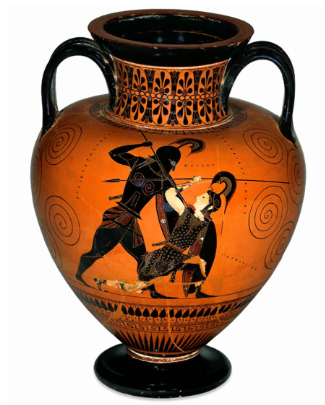
Identify and describe this vase
Black-figure amphora, signed by Exekias, ca.530 BCE
Heracle is plunging the spear into the Amazon. The Amazon is looking up at him, falling, although she is holding her spear it is clear that she has been defeated- this is the precis moment in time that he killed her. Without the inscriptions how easy would it be to work out who these people were. Scholarship has pointed out that their eyes were meeting and there is a myth about the two falling in love as he kills her
What type of narrative is the former vase displaying?
A monoscenic narrative: snapshot view of a single moment
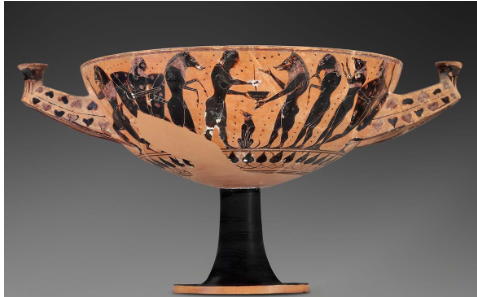
Describe this vase
Story in the Odyssey about Circe turning the men into pigs. Lots of detail on the cup- it essentially compresses the story. Circe is in the centre stirring and offering a cup to a companion who is already transforming into an animal (boar head, human hands). The other half human half animal figures are around them. The second figure from the left is Odysseus rushing in with a sword to save his companions. These parts of narrative are combined together despite the inconsistencies of the timings.
What type of narrative is the former vase displaying?
Synoptic narrative: combination of episodes/time/place
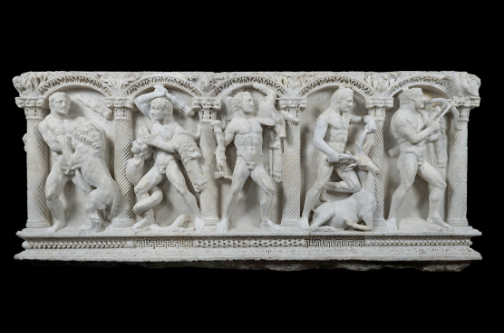
Identify and describe this object
Roman sarcophagus, second century CE.
Essentially there is a number of labours of Heracles, the nymean lion, the linen hydra, the erymanthion boar, hind and stymphalion birds. On other objects the labours don’t always appear in order.
What type of narrative is the former object displaying?
Cyclical narrative: different episodes, multiple separated scenes, same protagonist:
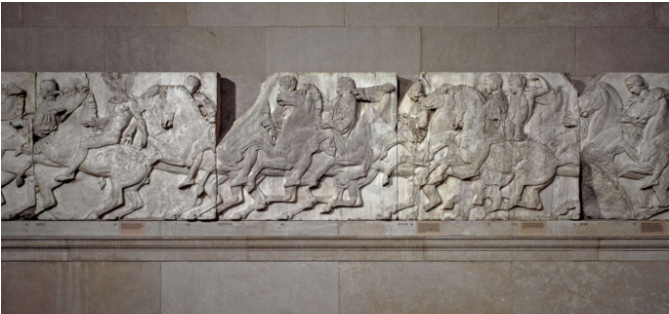
Identify and describe this image
North frieze of the Parthenon. 438-432 BCE.
Panathanaea Procession
What type of narrative is the former image displaying?
Progressive narratives: sequential images, longer story, no repetition of same characters
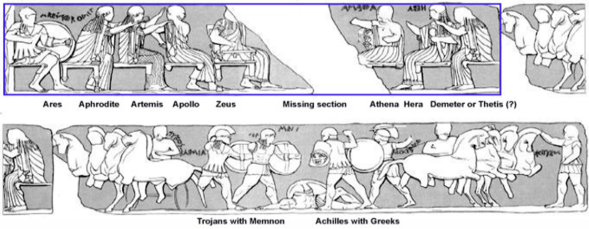
Identify this image
Frieze (east) from Siphnian Treasury, Delphi, ca. 525/4 BCE.
Scene related to the Trojan war, an assembly of the gods who are weighing up the fates of the men, so this is taking place on Mt Olympus but there are also chariots and a battle taking place
What type of narrative is the former image displaying?
Panoramic narrative: different events in different places simultaneously, shown together:
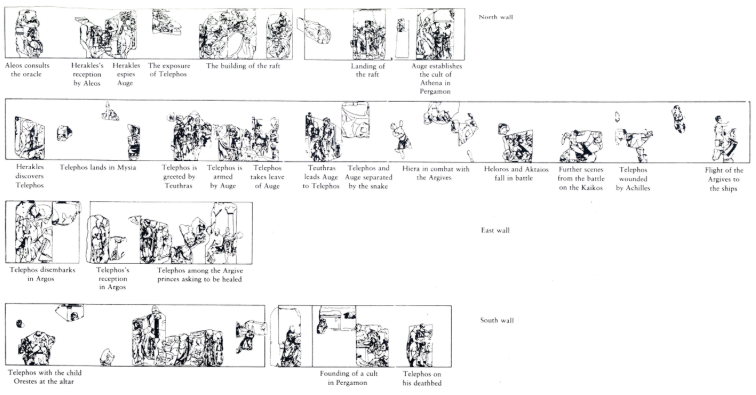
Identify and describe this image
Telephos frieze, Great Altar of Pergamon, 180-160 BCE.
The frieze tells a story of Telephos, the mythical founding father of Pergamon, he was also the song of Hercules, and was also connected to the Trojan war
What type of narrative is the former image displaying?
Continuous narration: multiple episodes in time, placed next to each other
List the theoretical approaches
Iconographical
Iconological
Chronological/historical
Form (tracing myth on specific genres of artworks).
Modern visual theories
Associative-philological approach
Multifaceted
What is the iconographical approach?
Iconographical (symbols, attributes = visual shorthand, communicate to the viewer specifics of representation in an image – object-centred).
What is the iconological approach?
Iconological (significance of visual subject matter within the society/culture that produced it – object oriented). We use these images to access wider information about the society that produced it
What is the chronological approach?
Chronological/historical (tracing myth through time).
What is the form approach?
Form (tracing myth on specific genres of artworks).
What is the modern visual theories approach?
Modern visual theories (physicality of image and location/spatiality of it, comparison to other similar examples, sensory experience of image, film theory – viewers).
What is the associative-philological approach?
Associative-philological approach (literary version of myth central; one of the problems with this approach is that any discrepancy in visual representation considered wrong).
What is the multifaceted approach?
Multifaceted approach can combine these to give a more nuanced understanding.
What are the problems of identification?
Source material – fragmentary, damaged, faded or restored:
Possible to sometimes use imaginative questioning and comparison with other imagery/literary sources.
Might be able to identify characters but scene is abnormal or doesn’t correlate with other imagery:
Different versions of myth.
Limited extant literary sources for comparison.
Artistic choice.
Attributes can sometimes be misleading.
Not always possible to definitively identify mythical imagery:
Different interpretations possible – Portland Vase a good example of this.
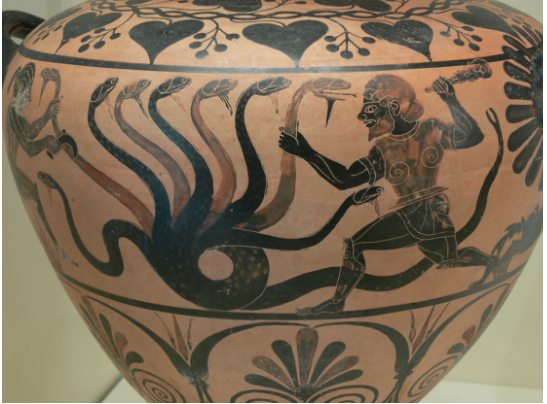
What time period is this vase from?
Late 6th century BCE
What type of decoration does it show?
Black figure (6th-5th century BC)
Centred image, unusual combination of red and black colours.
Ivy around the shoulder of vase above the image - decorative.
Who does it show and what are they doing?
Who? Attributes?
Hercules (armed, bearded) and the 9 headed Hydra (labour 2)
Attributes
Club or torch?)
Hydra
Iolas, his loyal servant
Crab- came to aid of hydra
What are they doing?
Figure on left: using a sickle to cut off a head?
Hercules- grab head and beat with club
What type of narration is it?
monoscenic
Anything else to identify on the vase?
He’s not wearing his lion cloak unlike usual
Bacchic decoration?
Not seeing the actual defeated monster but the implication that it will be.
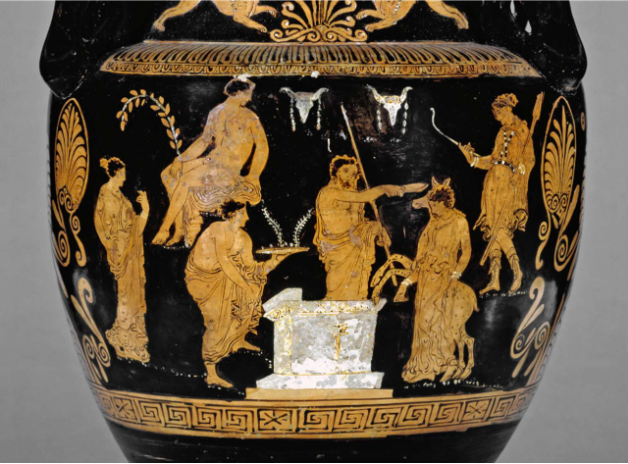
When is this vase from?
4th century – proportional accuracy and detail
Later due to intricacy of decoration.
What type of decoration does the vase show?
Red figure, unusual as female figures aren’t painted white.
Some dogs at the top
panoramic
Identify the myths/characters:
Sacrificial altar
God at the top watching the sacrifice??
Agamemnon (bearded and carrying a sceptre)
Artemis with silver bow (and carrying 2 spears; she wears laced boots, short chiton with embroidered edge, jewellery)
Maybe apollo
Agamemnon sacrificing his daughter (Iphigenia) to Artemis
She becomes a deer by it being behind her?
^ trying to show her transformation into it Innovation by the painter
Iphigenia - dishevelled hair, barefoot, long chiton, looks downwards.
What type of narration does the vase use?
Synoptic
Anything else about the vase?
Relationship to dramatic version by Euripides - Iphigenia at Aulis? Maybe but there are inconsistencies - the female figure to the right may represent Clytemnestra but uncertain. If so, then this would be inconsistent with the ending we have from Euripides (although this was finished after his death). Also Apollo doesn’t appear in this version.
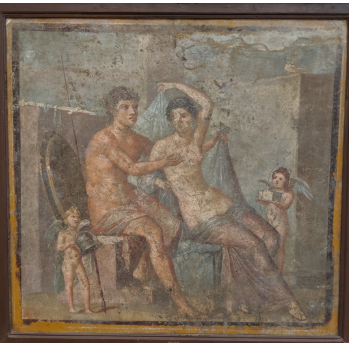
What time period is this painting from?
40AD onwards (4th intricate style)
roman
Who are the characters shown?
Mars and Venus
Cupids - Winged
Dove (sacred bird) also an attribute of Venus
Anything else of note about the painting?
Shield, spear, and helmet of Mars carried by Cupid (?)
Venus depicted naked (almost), diaphonous drapery
Cupid’s bringing Mars his armour
Looks like a military camp
Fourth Style (intricate style) (more square)
House of Meleager
It’s a fresco
Domestic scene possibly indicated by the walls behind them
It’s a monoscenic narrative
Also note that Mars helmet is the size to fit the cupid not Mars.
Are they covering or uncovering Venus? Hand on breast - sexual? Or possession?
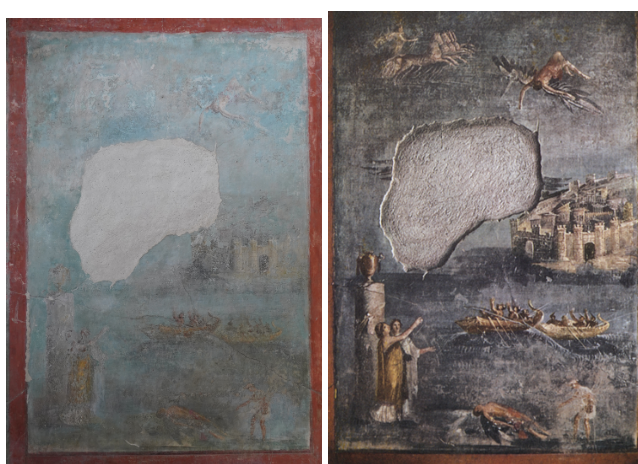
What is the story being told in this painting?
Icarus flying close to the sun (Helios)
Icarus and Daedelus
Helios in the top?
Walled city in background = Crete
What sort of narrative does the painting show?
Usually described as continuous because of Icarus appearing twice, synoptic narrative does not have repeating characters.
Good digital reconstruction (yes but be careful of these as they may not be true to the original)
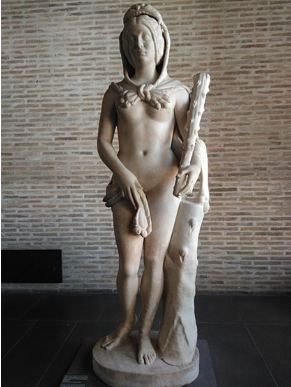
What time period is this statue?
Roman? Marble with support
^^ and contrapposto position
2nd/3rd century ce (indicated by face and hair)
What attributes are seen on this statue?
Lion cloak, club
Herculean attributes
Who is the character?
Omphale (queen of Lydia)- bought Hercules
Anything else of note about the statue?
Contraposto pose
Somewhat paradoxical Heroic nudity, would be naked save for the iconography belonging to another figure
Evocative of the Farnese Heracles statue, except actively wearing the cloak and using it to mask genitalia
Possibly a portrait face.
Reminder that attributes alone can’t be relied on to identify characters.
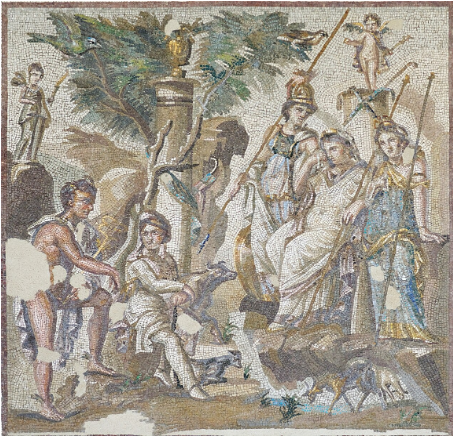
What is the time period of this mosaic?
Roman
From Antioch
2nd century
Which characters/deities can be identified in this mosaic?
Three female deities: Aphrodite, Athena, hera
Cupid (column on the right hand side) and Psyche
Hermes with his wingèd slippers (also has wings on his head and carries his caduceus).
A couple of little birds in the trees
What is the scene in this mosaic?
Judgement of Paris
What else stands out in the mosaic?
Gold of Troy Gold elaborate clothing, conflicting with shepherd clothing - difference in rank, divinity
Paris has lighter skin despite being a man and a shepherd (in comparison with Hermes) Referencing his perceived cowardice and femininity as a foreign archer, or likening his beauty to Aphrodite, his future patron?