Sponges, cnidiarins, roundworms, earthwprms, flatworms
 Call Kai
 Learn
Learn Practice Test
 Spaced Repetition
 Match
Match Flashcards
 Knowt Play
1/35

There's no tags or description
Looks like no tags are added yet.
Name | Mastery | Learn | Test | Matching | Spaced | Call with Kai | Chat |
|---|
No analytics yet
Send a link to your students to track their progress
36 Terms
Sponges belong to what phylum
Phylum prorifera
Sponges features
No true tissues. Although sponges have several types of cells, the cells do not show the level of tissue organization seen in other animals.
No symmetry. Other animals show radial symmetry (cnidarians, for example) or bilateral symmetry (humans). Sponges have variable and irregular body forms.
Intracellular digestion. Unlike other animals, sponge cells take in small food particles by phagocytosis.
Spicules: hard, crystalline structures secreted outside the cells; see the description
In sponges, Currents of water are drawn through small pores,
ostia, in the sponge body and leave by way of larger openings called oscula.
In sponges what maintains the water current
he beating of flagella on collar cells or choanocytes, localized in chambers on the interior of the sponge, maintains the water current.
Support for the sponge tissues is provided
calcareous or siliceous spicules, or by organic fibers, or by a combination of organic fibers and siliceous spicules. Some species have a compound skeleton of organic fibers, siliceous spicules, and a basal mass of aragonite or calcite
Because of their primitive organization, sponges are of interest to
zoologists as an aid in understanding the origin of multicellular animals
what is scypha in sponges
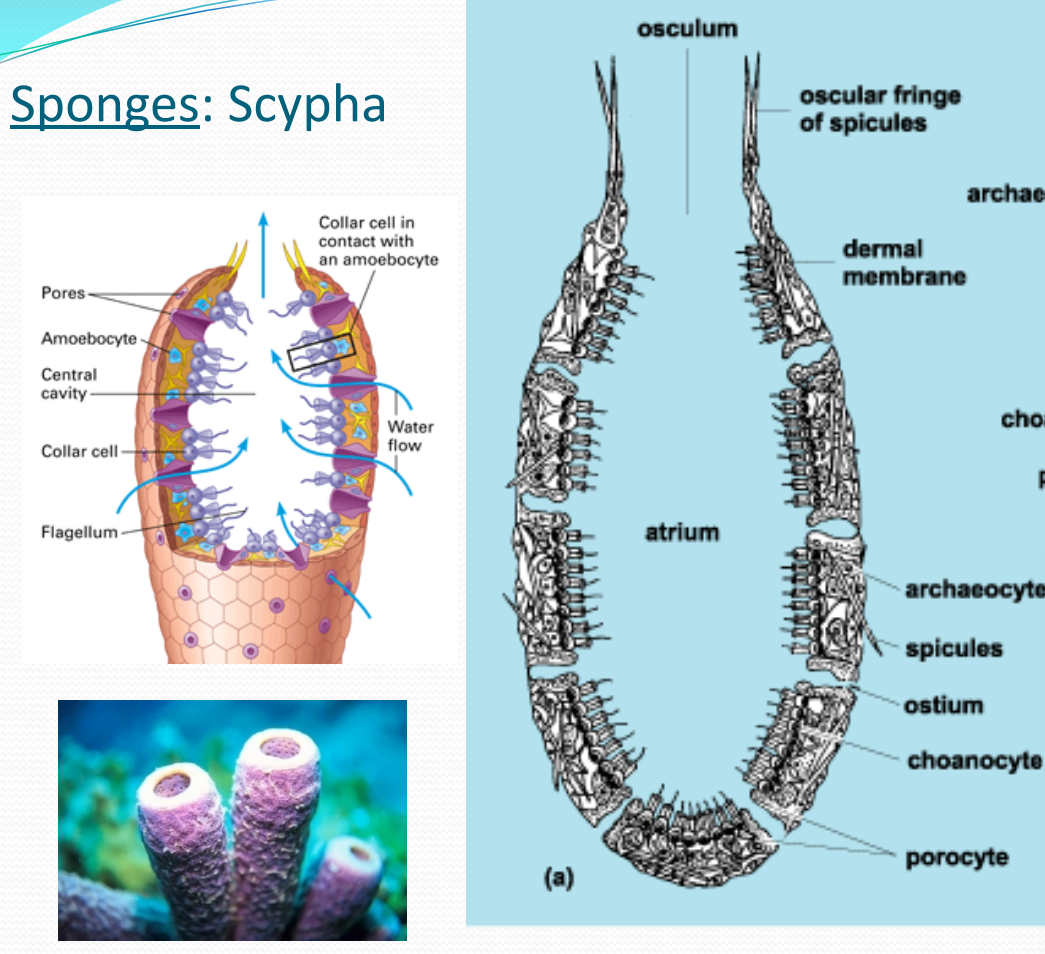
Scypha is a small, tube-shaped sponge. We have two microscope slides of Scypha: a cross section and a longitudinal section
Cross section of scypha
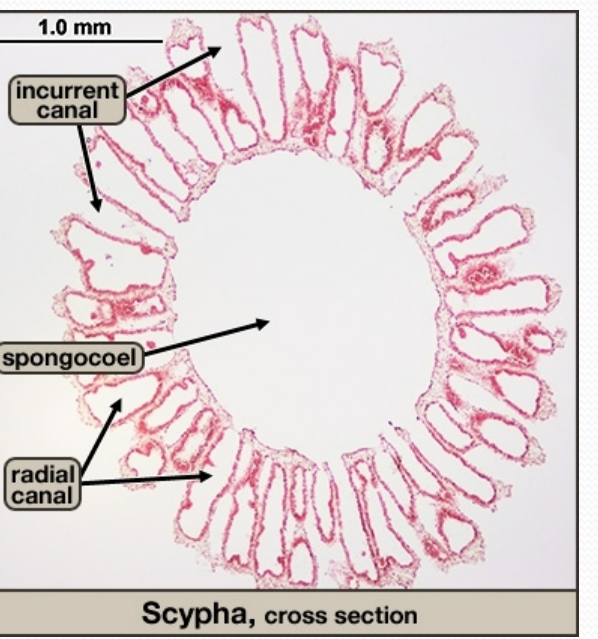
Scypha uses the flagella on its choanocytes to draw water through its body so it can capture small suspended particles of food. The water is drawn in through the incurrent canals, passes through the radial canals, and finally out through the spongocoel.
The spongocoel is an empty space in the middle of the body. It is not comparable to the coelom of other animals, because there are no organs in it; it's just an empty tube through which water is expelled.
Longitudinal section:
At higher magnification, you will be able to make out several types of cells. The choanocytes, or collar cells, perform the essential functions of pumping water by flagellar action and capturing food particles with their collar of microvilli. The incurrent and radial canals are lined with choanocytes
. Amoebocytes are cells with an amoeboid, or irregular, shape. They perform various functions and can differentiate to become other cell types. The amoebocytes are surrounded by a layer of extracellular matrix material called mesohyl.
Pinacocytes are flattened cells that form the outer layer of the sponge.
Tedania ignis is what type of sponge
Fire Sponge
The spicules in sponges are what
The spicules are sharp, crystalline structures made of calcium carbonate, the same material that makes up the shells of many other marine animals. The spicules reinforce the body and make it more resistant to attack by other animals.
Calcium carbonate is formed by many marine animals. However, it also dissolves fairly easily if the water's pH decreases even slightly (acid);
Phylum cnidaria feautures and the examples
examples nemones, jellyfish or corals, they play important ecological roles i
Cnidarians have radial symmetry and only rudimentary organs.
All are aquatic and are found in both fresh and salt water
Food is taken into a central gastrovascular cavity, often with branches into the tentacles. Digestion is extracelluar followed by intracellular absorption of nutrients.
Hydra is sessile and is an ex of cinidaria
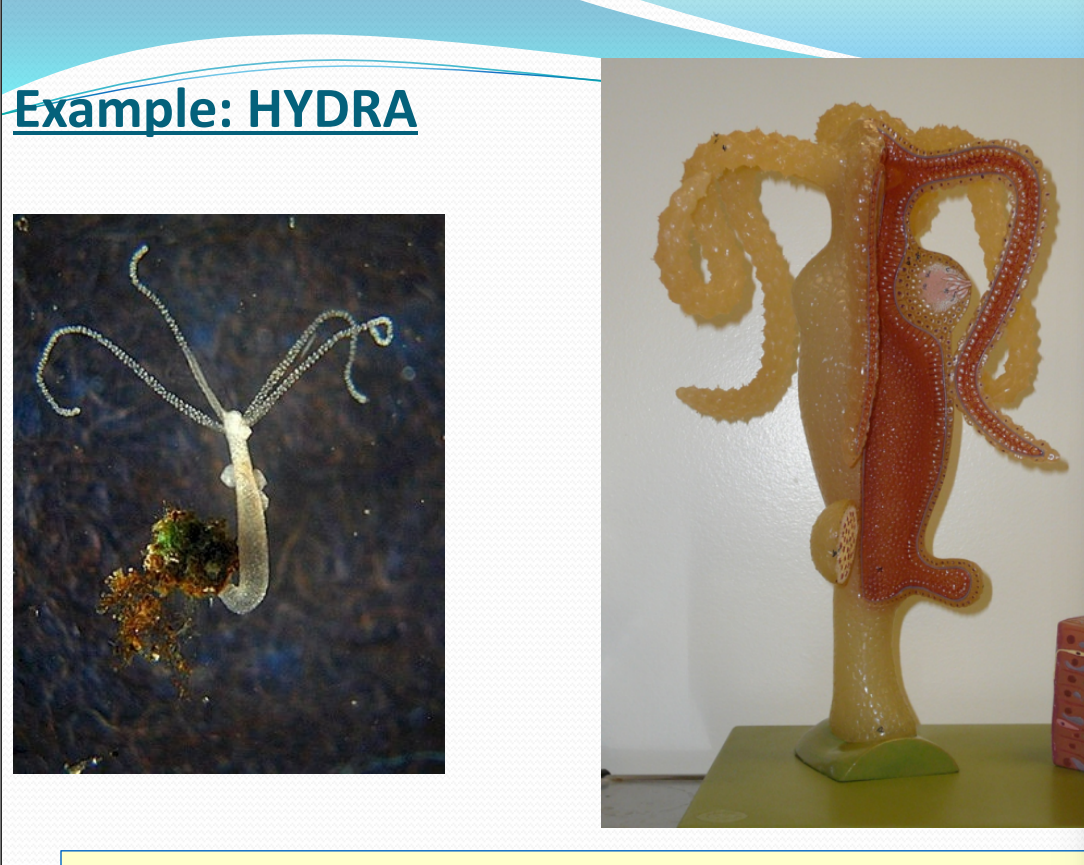
hydra has serveral elognate moving
tentacles which are used to capture food
in hydra At the centre of this circle of tentacles, is the
mouth
When the tentacles of the Hydra come into contact with its prey, the prey
jerk for several minutes before becoming still. The food organism reacts in this way because it is being stung by numerous wart-like nematocysts on the tentacles.
in hydra Once the food organism has been ingested,
it will be degraded within the gastrovascular cavity and the small particles engulfed by the gastrodermal cells by phagocytosi
In hydra which two body systems can they live without
special respiratory nor circulatory system.
in hydra , no cell is ever far enough from the source
of either nutrient materials or gases to necessitate any more elaborate transport than either direct diffusion from cell to cell or diffusion through the very watery mesoglea that exists between the two cell layers (the epidermis and the gastrodermis).
how do hydra reproduce asexually
y simple budding and sexually by the production of sperm and ova. Budding consists of a simple outgrowth from the body wall. The gastrovascular cavity of the bud is initially continuous with that of the parent. The bud will separate from the parent at maturity.
in hydra
The gametes for sexual reproduction are produced in organs called spermaries (testes) and ovaries, which are protuberances along the body wall (Figure 3). Both sex organs may be present in a single organism or in two separate organisms
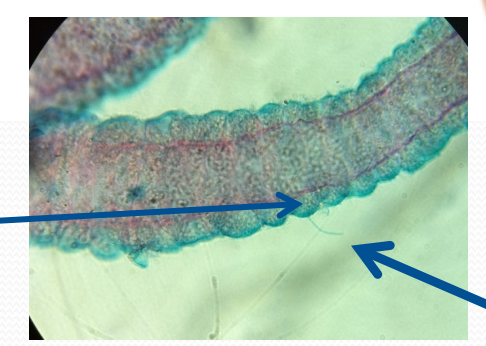
nematocysts
hair-like trigger in the nematocyst .
immortal jellyfish
he Benjamin Button
, the immortal jellyfish transforms from an adult back into a baby, but with an added bonus: Unlike Benjamin Button, the jellyfish can do it over and over again—though apparently only as an emergency measure.
how did the jellyfish benny become immortal
Turritopsis typically reproduces the old-fashioned way, by the meeting of free-floating sperm and eggs. And most of the time they die the old-fashioned way too. But when starvation, physical damage, or other crises arise, "instead of sure death, [Turritopsis] transforms all of its existing cells into a younger state,
Through asexual reproduction, the resulting polyp colony can spawn hundreds of genetically identical jellyfish—near perfect copies of the original adult
![<p>Turritopsis typically reproduces the old-fashioned way, by the meeting of free-floating sperm and eggs. And most of the time they die the old-fashioned way too. But when starvation, physical damage, or other crises arise, "instead of sure death, [Turritopsis] transforms all of its existing cells into a younger state,</p><p>Through asexual reproduction, the resulting polyp colony can spawn hundreds of genetically identical jellyfish—near perfect copies of the original adult</p>](https://assets.knowt.com/user-attachments/b86a70e2-6684-429e-af4a-b5be41b22039.png)
Free living flatworms such as Planaria Flatworms are the simplest
bilateral animals
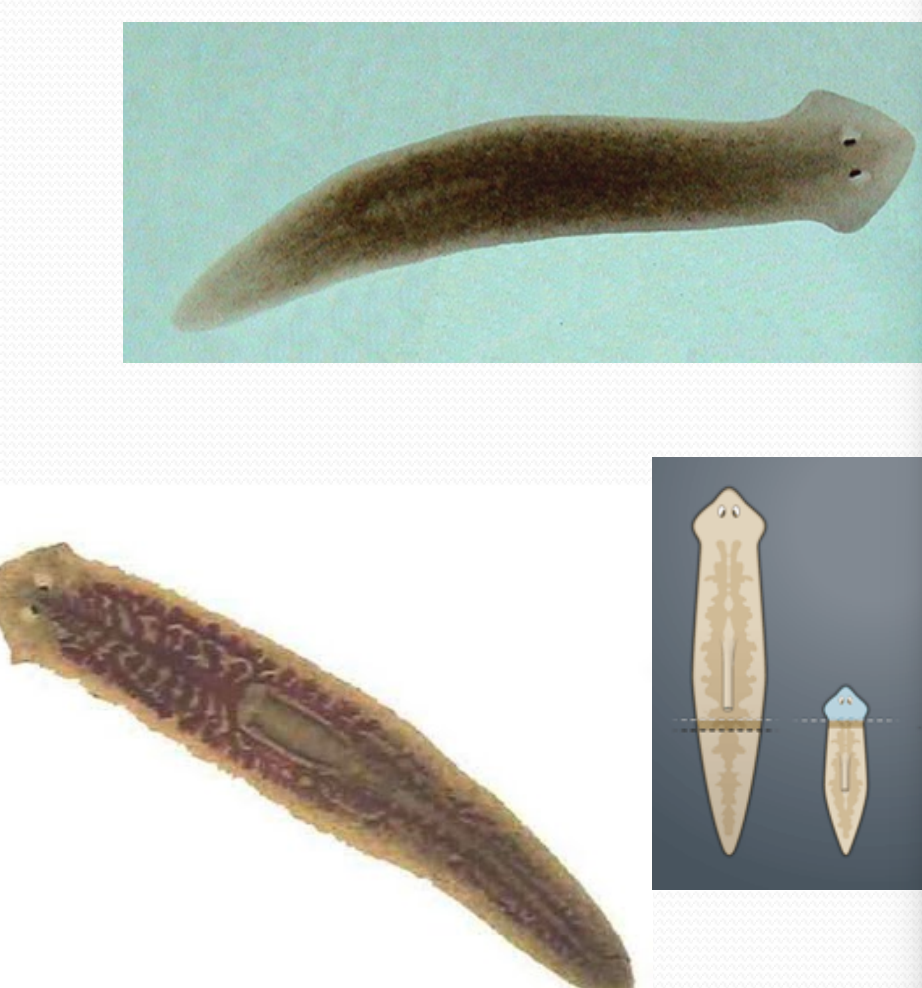
Planeria feautures
NEMATODA
entrally flattened with bilateral symmetry and with a hint of cephalization. Distinct tissues and organ systems are found, but the organs are not located in a body cavity
acoelomate.
These animals are said to be triplpoblastic
. Two nerve ganglia and sensory receptors
Individuals may have both male and female sex organs, producing sperm and eggs. Fertilization is internal. Microscopic fertilized eggs are released.
as parasites of animals they have impacts on ecosystems
Planeria with shrimp
Planaria can harm shrimp and their offspring.
If your shrimplets always disappear after a few days, planaria may be the reason.
They even attack full grown shrimp: The tiger shrimp showed on the pics below was jumping like crazy trough the tank.
A closer look showed that a planaria had been creeping inside the body. The shrimp died later on
roundworm such as ascaris feautures
They have a complete digestive tract running as a tube from the mouth to the anus
They have a nervous system that coordinates movement but shows little cepahalization.
Nematodes lack a distinct circulatory and respiratory system.
Nematodes are found in aquatic habitats, moist soils, and as internal parasites of plants and animals.
adults have these worms in their small intestine
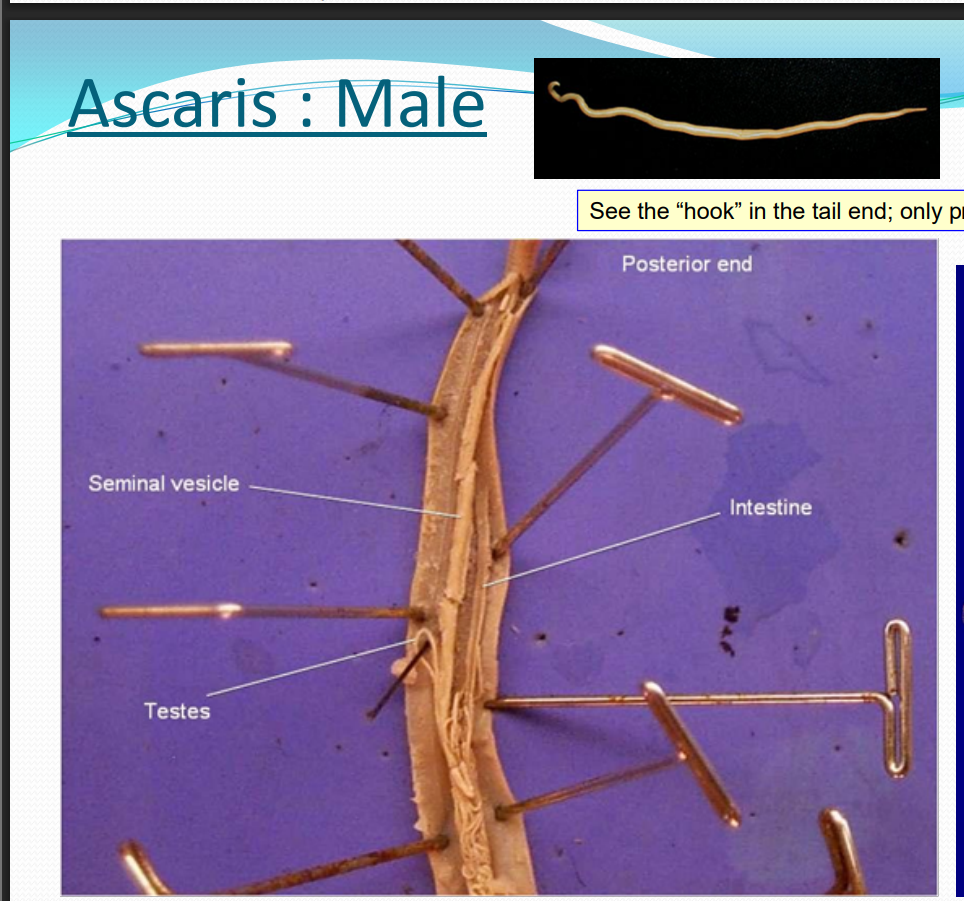
Ascaris male
they have thhat hook in the tail end
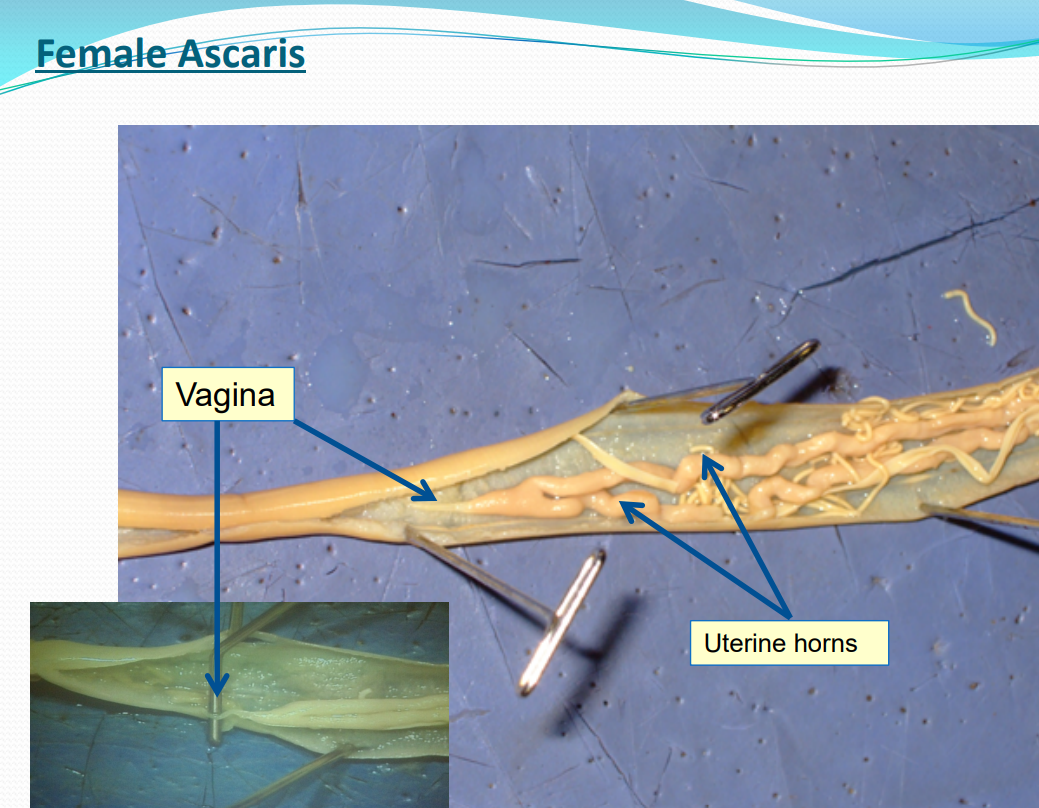
Female ascaris
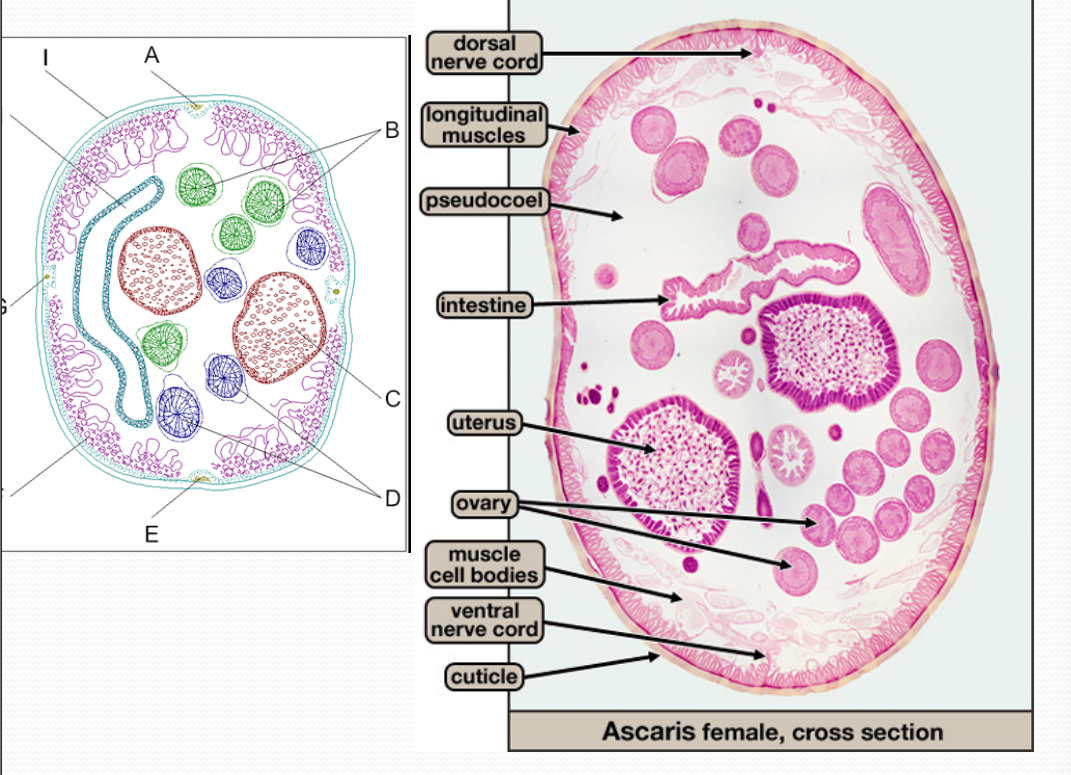
Female ascaris: cross section
the big circles are uters full of eggs
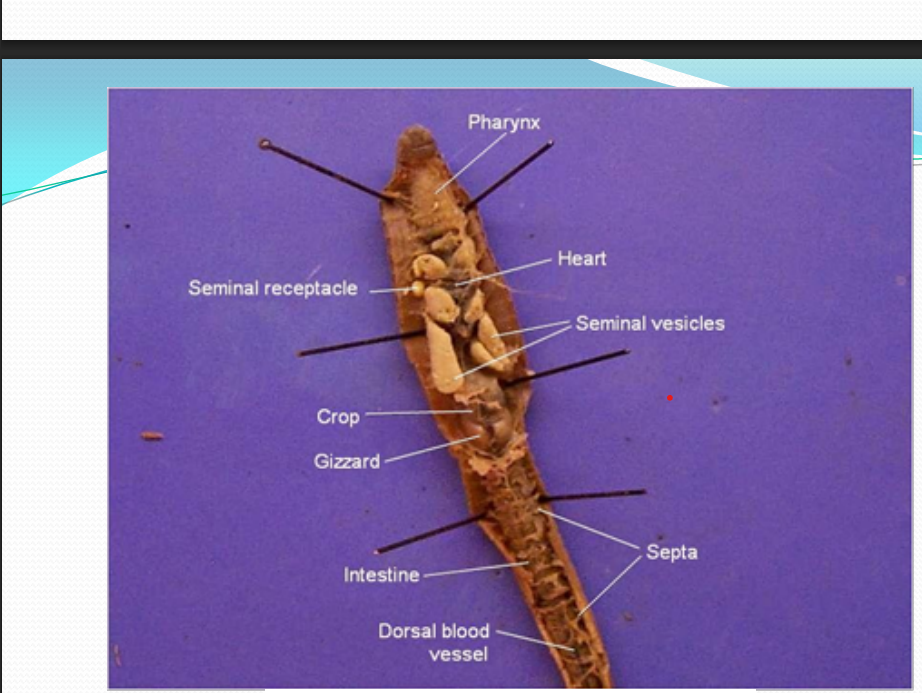
Earthworms phylum annelida feautures
Annelid features:
Three tissue layers in embryo. Almost all animals share this basic feature; the sponges and cnidarians are exceptions.
Segmented body. Contrast this with nematodes, which have unsegmented bodies.
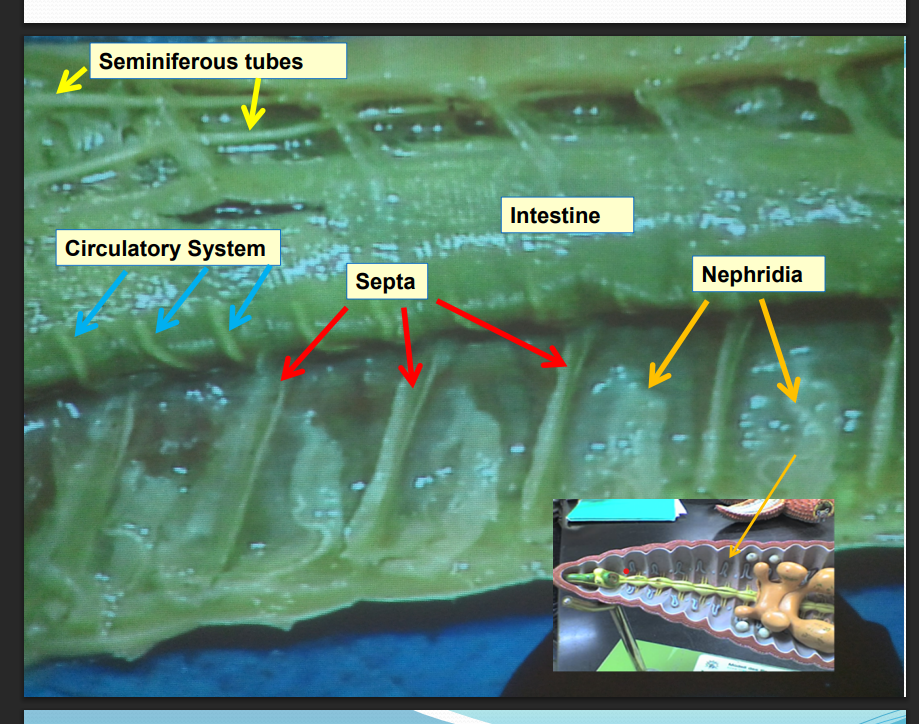
True coelom: The coelom of an annelid is a large space in which the internal organs form. Since the body is segmented, the coelom is segmented, too.
Complete digestive tract: The digestive tract run througout the length of the body, and different regions show a significant degree of specialization (unlike flatworms or nematodes).
Closed circulatory system: Blood is contained within the circulatory system. This is particularly important given that the segmented body prevents coelomic fluid from cirulating througout the body (as it does in nematodes).
Earthworms mating
Earthworms are simultaneous hermaphrodites -- each individual produces both eggs and sperm at the same time. When a pair of earthworms mates, each individual gives sperm to the other. Sperm is released through a male genital pore and received by the female genital pore on the other individual
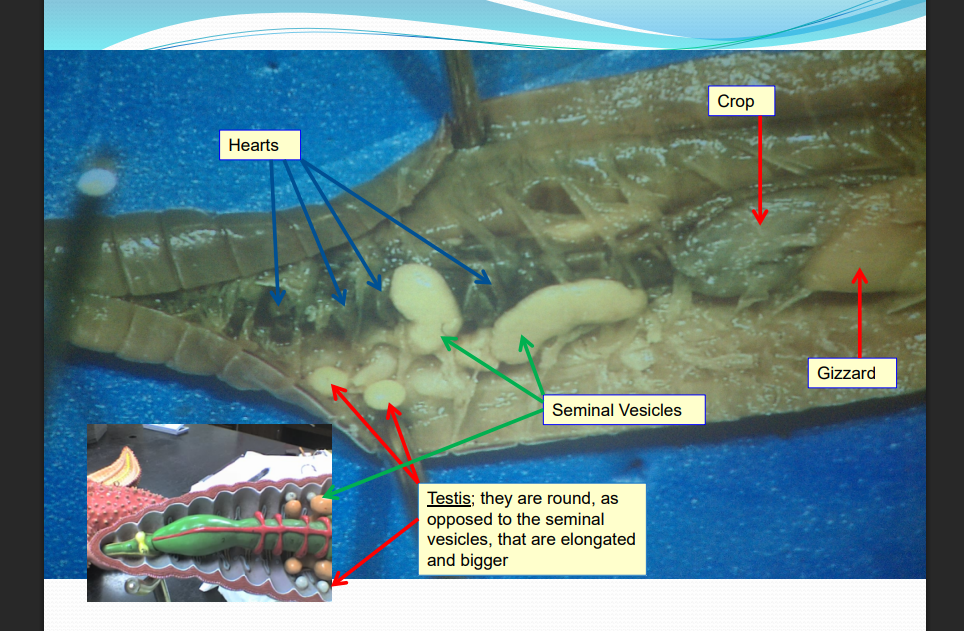
Earthworms dissection