all chemical reactions
 Call Kai
 Learn
Learn Practice Test
 Spaced Repetition
 Match
Match Flashcards
 Knowt Play
1/16

There's no tags or description
Looks like no tags are added yet.
Name | Mastery | Learn | Test | Matching | Spaced | Call with Kai |
|---|
No analytics yet
Send a link to your students to track their progress
17 Terms
reaction of an alkane with bromine
alkane (gas) + bromine (liquid) → haloalkane (gas) + hydrogen halide (gas)
requires UV light
conditions for reaction of alkanes with halogens
UV light
what type of reaction is the reaction of methane with bromine?
free radical substitution
homolytic fission
propagation for the reaction of methane with bromine
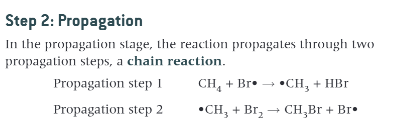
initiation for the reaction of methane with bromine
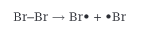
termination for the reaction of methane with bromine
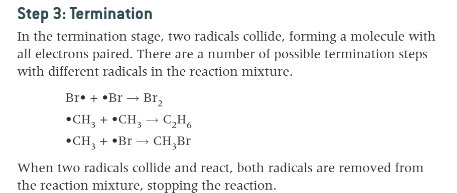
limitations of radical substitution in organic synthesis
further substitution
substitution at different positions on a carbon chain
why do alkenes react more readily than alkanes?
the pi bond is weaker than the sigma bond, and is therefore broken more readily
reactions of an alkene with hydrogen
alkene + hydrogen → alkane
must be passed over a nickel catalyst at 423K
hydrogenation
reaction of an alkene with bromine
alkene + bromine → haloalkane (1,2- dibromo…)
room temperature
reaction of an alkene with hydrogen halide
alkene + hydrogen halide (gas) → haloalkane
if the alkene is a gas, the reaction takes place when the two gases are mixed together
if the alkene is liquid, then the hydrogen halide is bubbled through it
reaction of an alkene with steam
alkene + steam → alcohol
in the presence of a phosphoric acid catalyst
reaction of a primary alcohol when distilled
alcohol + acidified potassium dichromate → aldehyde + water
reaction of a primary alcohol when refluxed
alcohol + excess acidified potassium dichromate → carboxylic acid + water
reaction of a secondary alcohol when refluxed
alcohol + acidified potassium dichromate → ketone + water
dehydration of alcohols
alcohol → alkene
heated under reflux
in the presence of an acid catalyst, such as conc. H3PO4