PHYS 0220 Practice Questions
 Call Kai
 Learn
Learn Practice Test
 Spaced Repetition
 Match
Match Flashcards
 Knowt Play
1/50

There's no tags or description
Looks like no tags are added yet.
Name | Mastery | Learn | Test | Matching | Spaced | Call with Kai |
|---|
No analytics yet
Send a link to your students to track their progress
51 Terms

When a celestial object recedes from an observer:
D
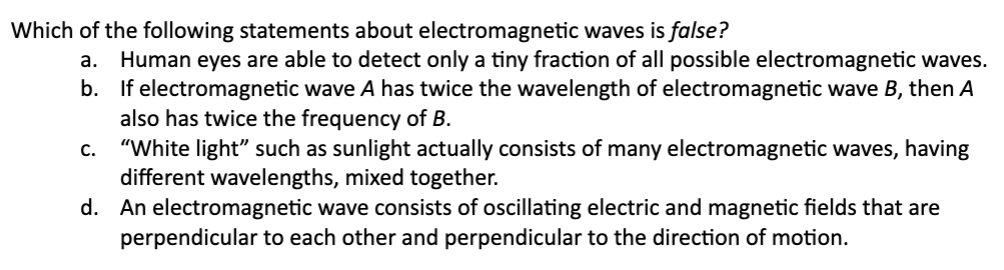
Which of the following statements about electromagnetic waves is false?
B
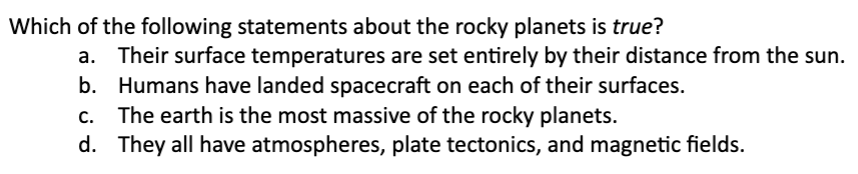
Which of the following statements about the rocky planets is true?
C
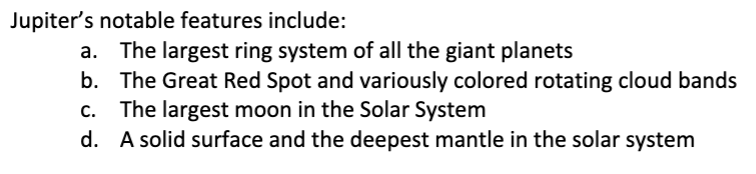
Jupiter’s notable features include: 2 answers
B, C

Blackbodies:
A
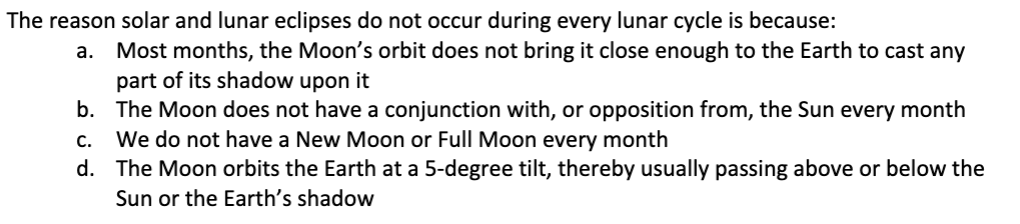
The reason solar and lunar eclipses do not occur during every lunar cycle is because:
D
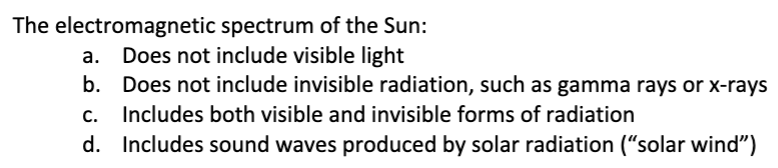
The electromagnetic spectrum of the Sun:
C
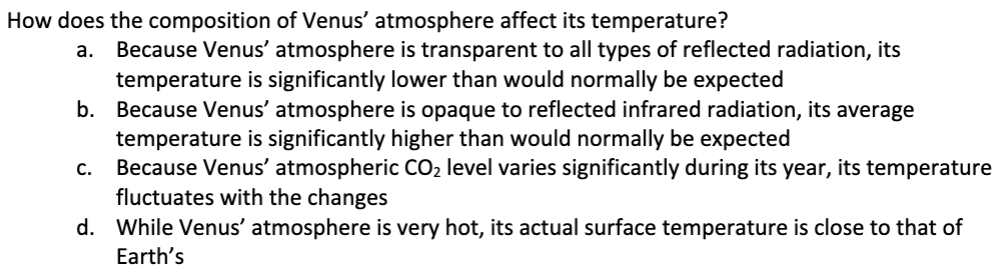
How does the composition of Venus’ atmosphere affect its temperature?
B
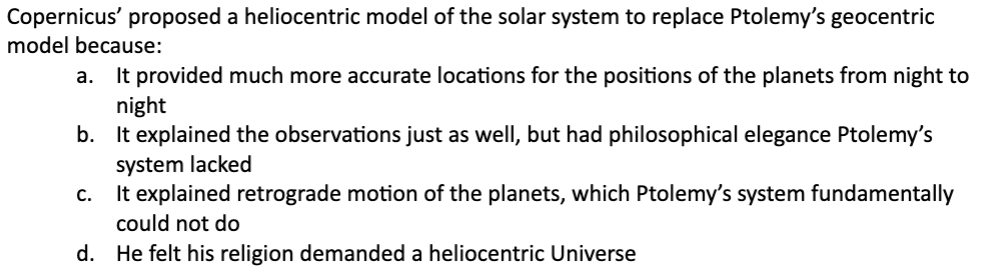
Copernicus proposed a heliocentric model of the solar system to replace Ptolemy’s geocentric model because:
B
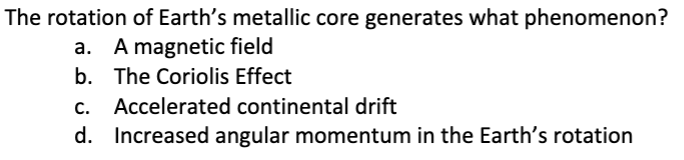
The rotation of Earth’s metallic core generates what phenomenon?
A

The low average densities of Jupiter and Saturn compared with the Earth suggest that:
B

When a photon is given off by an atom:
A
Does the human body emit light? If so, what part(s) of the electromagnetic spectrum is the emission in? If not, how does matter in the human body interact with light?
The human body emits primarily infrared radiation, although, like a blackbody, this is where its spectrum peaks. Other wavelengths can also be emitted, but in insignificant amounts.
Explain why we never observe a full moon during the day.
The full moon is visible when the moon is on the opposite side of the Earth from the sun. Therefore, the full moon is only visible from the side of the Earth opposite the sun, where it is night.
If you could send a spacecraft to search for life anywhere in our solar system, where would you send it and why?
Europa and Titan are great answers, and Mars would get full credit too if the existence of flowing liquid water were discussed.
How does light emission from the 4 → 2 hydrogen transition compare to emission from the 3 → 2 transition? Light from the 4 → 2 transition
a. is higher frequency.
b. is longer wavelength.
c. is less energetic.
d. travels faster in vacuum.
A
A perfect blackbody
a. emits no light.
b. reflects all incident light.
c. absorbs all incident light.
d. transmits all incident light.
C
To improve the light collecting power of a telescope by a factor of 16, the diameter of the telescope would need to
a. increase by a factor of 2.
b. increase by a factor of 4.
c. decrease by a factor of 2.
d. The diameter of a telescope does not affect its light collecting power.
B
Earth experiences seasons because
a. its rotation axis is inclined relative to its orbital plane.
b. its orbit is elliptical.
c. solar activity varies over time.
d. all of the above.
A
According to Kepler’s third law, a planet’s orbital period depends on the
a. inclination of the planet’s orbit.
b. semimajor axis of the planet’s orbit.
c. eccentricity of the planet’s orbit.
d. planet’s radius.
B
In terms of size and composition, which planet is most like Uranus?
a. Venus
b. Jupiter
c. Saturn
d. Neptune
D
During which phase(s) of the Moon do we experience spring tides (the largest variation between high and low tides)?
a. quarter moon and third quarter moon
b. quarter moon
c. new moon and full moon
d. new moon
C
Which terrestrial planet(s) exhibit(s) a greenhouse effect?
a. Mars
b. Venus
c. Earth
d. all of the above
D
You are measuring spectral lines from Saturn’s rings and find that a line measured from the left side of the rings has a slightly shorter wavelength than the same line measured from the right side of the rings. What does this mean about the movement of the rings? Explain your answer.
The lines from the left side of the rings have a shorter wavelength, which means they are blue-shifted, and the lines from the right side of the rings have a longer wavelength and are red-shifted. From the Doppler effect, light is blue-shifted if the source is moving toward you and red-shifted if the source is moving away from you. The rings must be rotating across Saturn from left to right from the observer’s perspective.
Describe the role that Earth’s magnetic field plays in the planet’s ability to sustain life.
Earth’s magnetic field shields the planet from the solar wind and from other high-energy particles that would be harmful to life. Without Earth’s magnetic field, the solar wind could erode Earth’s atmosphere. Earth’s atmosphere regulates temperature variations, keeps Earth comfortably warm, protects it from solar radiation, and contains gases that humans and other animals need to breathe.
Which moon should be the target of the next mission to the outer Solar System?
Saturn’s moon, named Titan, generally has lots going on, such as its dunes on the surface, storms with so much rain volume that it makes Earth hurricanes seem minor, and its large methane seas. Also, there are rivers, gravel, and lakes, and flowing water is the primary requirement for life, making Titan a possible habitat for simple life.
Sunspots appear dark because:
a. The changing magnetic polarity of the Sun causes gas in the sunspot to cool down substantially
b. They are regions where strong magnetic fields make it difficult for fresh supplies of hot, ionized gas to reach the photosphere
c. They are much hotter than the surrounding area, so their emission peaks at ultraviolet wavelengths, which our eyes cannot see
d. They are holes in the photosphere through which the cooler interior of the Sun is visible
B
Which of the following statements about star formation is false?
a. Stars form from collapsing “clouds” of dust and gas
b. Before nuclear fusion begins, forming stars are completely unobservable due to the large amounts of gas and dust surrounding them
c. Stars often form in clusters, not as isolated objects
d. Before nuclear fusion begins, forming stars glow through energy released by gravitational contraction
B
The blindingly bright “surface” of the Sun is also known as its:
a. Chromosphere
b. Corona
c. Crust
d. Photosphere
D
The basic fusion process within a main sequence star:
a. Fuses four hydrogen nuclei into one helium nucleus
b. Separates one helium nucleus into four individual hydrogen nuclei
c. Is an endothermic reaction common to all stars
d. Stops when iron is created in the core
A
When an ordinary star collapses into a neutron star, releasing tremendous amounts of energy and producing cosmic rays, it has become a:
a. Main Sequence star
b. Red Giant
c. Blue Giant
d. Supernova
D
What is the principal explanation for the size of the giant planets?
a. They are brown dwarfs that formed outside the solar system and were later gravitationally captured
b. They formed beyond the snow line, which allowed them to accumulate both ices and rocky materials
c. There is less space in the inner solar system, so terrestrial planets collided frequently, reducing their size
d. The circumference of a planetary orbit is larger further from the Sun, meaning there was more material for them to accumulate
B
During its total lifespan, for how long will the Sun have existed as a Main Sequence star?
a. 5 million years
b. 10 million years
c. 5 billion years
d. 10 billion years
D
What is the difference between a star and a brown dwarf?
a. A brown dwarf forms differently from a star by gradually accreting smaller particles.
b. A brown dwarf has already burned through its hydrogen.
c. A brown dwarf cannot fuse hydrogen in its core.
d. A brown dwarf cannot have any planets.
C
What is parallax and how is it used in astronomy?
Parallax is a geometric measurement of the angular movement of a star compared with very distant (and hence effectively unmoving) stars. By observing the star’s position 6 months apart (so that the Earth is on the opposite side of the sun), a trigonometry problem can be set up that allows for the determination of the star’s distance from the Earth.
Describe two features of the long period comet population that led to the hypothesized existence of the Oort Cloud.
The long period comet (LPC) population is isotropic, i.e. LPC orbits don’t show a preference for the ecliptic plane. This is difficult to explain if all comets come from the Kuiper belt, which is mostly aligned with the ecliptic plane. The long period comet population also has a lot of comets with extremely large semimajor axes, upwards of 10,000 AU. This is also difficult to explain by scattering objects from the Kuiper belt, which falls off around 50 AU.
Which of the following features has not been observed on Pluto?
a. Nitrogen glaciers
b. Methane lakes
c. Impact craters
d. An atmosphere
B
Which of the following Solar System reservoirs is an important source of long period comets?
a. The Kuiper Belt
b. The Asteroid Belt
c. The Oort Cloud
d. All of the above
C
Most meteor showers are caused by debris from
a. Mars
b. The Moon
c. Comets and asteroids
d. Interstellar objects
C
On average, the temperature of the solar corona is
a. A few million Kelvins
b. A few thousand Kelvins
c. Hundreds of millions of Kelvins
d. Tens of thousands of Kelvins
A
Which of the following is a sign that the solar cycle is near its maximum?
a. Frequent solar flares
b. Numerous sunspots
c. Low-latitude auroras on Earth
d. All of the above
D
Astronomers can study the atmosphere of an exoplanet by examining the spectrum of the starlight that passes through the planet’s atmosphere when the planet is in front of the star. What is this type of spectrum called?
a. A transmission spectrum
b. An emission spectrum
c. A blackbody spectrum
d. An eclipse spectrum
A
Which type of exoplanet is the easiest to detect with the transit method?
a. A super-Earth
b. A hot Neptune
c. A hot Jupiter
d. A cold Jupiter
C
In the transit method, astronomers look for a dip in a star's brightness as a planet passes in front of it. Hot Jupiters are the easiest to detect for two primary reasons:
Size: They are large, gas-giant planets (Jupiter-sized or larger), which means they block a significant amount of the host star's light. This creates a deep, easily measurable dip in the light curve.
Proximity: The term "hot" refers to their very close orbit to their host star. Because they are close, they have short orbital periods, meaning they transit frequently. This allows astronomers to observe multiple transit events in a short timeframe to confirm the planet's existence.
The radial velocity detection technique for exoplanets can provide a lower bound on the mass of the planet. This method cannot determine the exact mass of the planet because it is impossible to distinguish between the signals from
a. a higher-mass planet in an eccentric orbit and a lower-mass planet in a circular orbit.
b. a higher-mass single planet system and a lower-mass planet with companions.
c. a higher-mass planet in an inclined orbit and a lower-mass planet in an edge-on orbit.
d. a higher-mass planet around a quiet star and a lower-mass planet around a very active
star.
C
The phrase “habitable zone” describes the distance from a star where
a. a planet with an Earth-like composition can form
b. a planet can sustain an atmosphere
c. a global ocean can exist within the planet
d. liquid water can exist on the surface of a planet
D
What is the power source of a G-type star, such as our Sun, that is on the main sequence?
a. Gravitational collapse
b. Hydrogen fusion via the pp-chain
c. Hydrogen fusion via the CNO cycle
d. Helium fusion via the triple-alpha process
B
What type of pressure supports a white dwarf against gravitational collapse?
a. Electron degeneracy pressure
b. Thermal pressure
c. Radiation pressure
d. Neutron degeneracy pressure
A
Pulsars pulse in which wavelength range?
a. Gamma-Ray
b. X-ray
c. Infrared
d. Radio
D
Describe the steps of bottom-up planet formation for a giant planet starting with the protoplanetary disk. Be sure to mention where we expect these planets to form within the disk and why.
Dust in the protoplanetary disk clumps into larger pebbles. These collide and form larger particles called planetesimals, which grow into a protoplanet either through collisions with other planetesimals or through accretion of pebbles. Giant planets form beyond the snow line, where there is more rocky material available to quickly build up a protoplanet. The rocky protoplanet core then accretes a gas envelope.
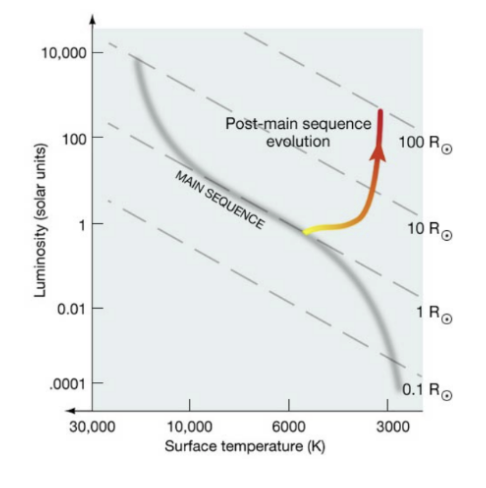
The image on the right shows the first stage of the evolution of a solar mass star when it leaves the main sequence. Explain how the structure of the star changes as it moves along this post-main sequence path. Be sure to mention why the star leaves the main sequence and how changes inside of the star affect its observed luminosity and temperature.
The star leaves the main sequence when it runs out of hydrogen in the core. At this point, the core contracts, which brings more hydrogen into the hot interior of star where it can ignite. A hydrogen-burning shell develops around the core. The thermal energy from nuclear burning causes the outer layers of the star to expand. As these layers expand, they cool, resulting in a redder star. However, due to the increase in stellar radius, the star becomes more luminous.
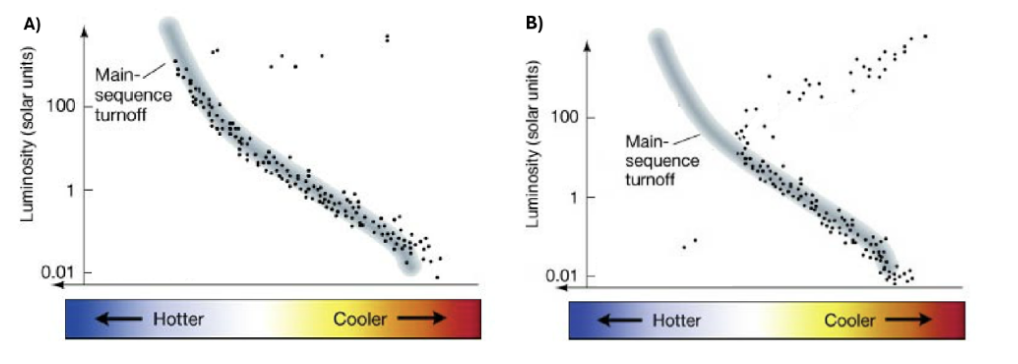
Two stellar clusters with the same metallicity are shown in the HR diagrams on the right. Is cluster A or B younger?
Cluster (A) is younger. It has a higher-luminosity turn-off from the main-sequence than cluster (B). This means that only the most massive stars in the cluster have evolved off of the main-sequence. In cluster (B), lower-mass stars with longer lifetimes have also started to move off the main-sequence, so cluster (B) must be have been around longer. There are also white dwarfs in the lower left corner of cluster (B) but not in cluster (A), which indicates that cluster (A) is younger.