Anatomy & Physiology The Ear and Hearing (Test 1)
 Call Kai
 Learn
Learn Practice Test
 Spaced Repetition
 Match
Match Flashcards
 Knowt Play
1/99

There's no tags or description
Looks like no tags are added yet.
Name | Mastery | Learn | Test | Matching | Spaced | Call with Kai |
|---|
No analytics yet
Send a link to your students to track their progress
100 Terms
What is the ear?
An energy transducer where sound is converted from acoustic to mechanical to electrical energy
Physical processing of acoustic information occurs in 4 groups of what structures?
1. Outer
2. Middle
3. Inner
4. Cochlear Nerve (8th cranial)
What are the two main components of the outer ear?
- Pinna (auricle)
- External Auditory Canal (ear canal)
What are the characteristics of the Pinna?
- designed to enhance high frequency sounds
- first 1/3 cartilage
---- numerous hair cells and a modified sebaceous gland
- remaining 2/3 bone
What are the characteristics of the External Auditory Canal/Meatus?
- connects the outer and middle ear together
- adult size is 2.5 cm on average
- Largest part of the EAC is the opening
- The smallest part is the Isthmus
What are both the Pinna and EAC lined with?
both lined with skin and has ceruminous glands
What do the glands produce?
cerumen (ear wax)
- dead skin and oil
How many decibels of hearing would we lose without the pinna?
The outer ear is a natural hearing aid or amplifier and 60dB would be lost without it
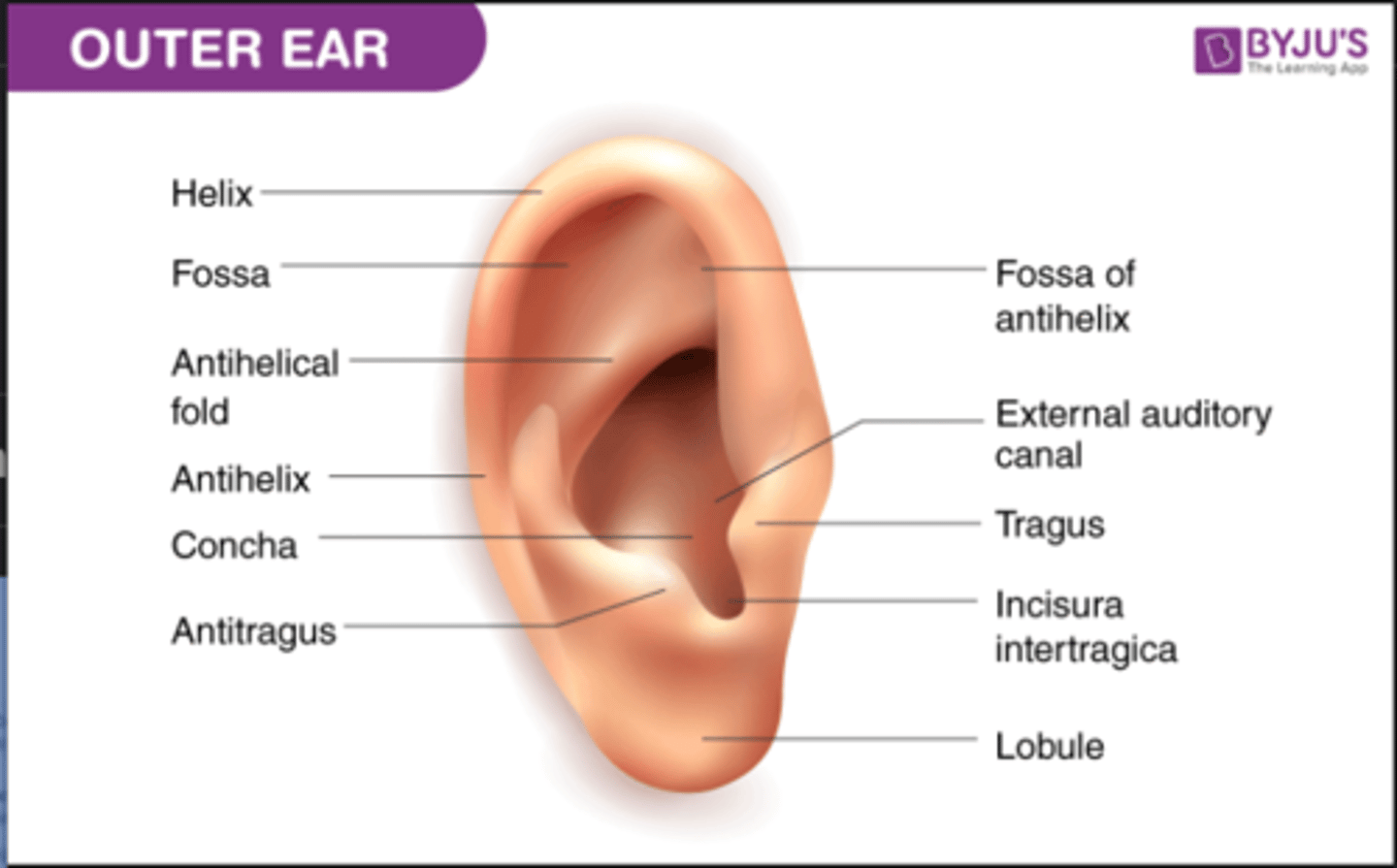
What are the parts of the pinna?
- Helix
- Antihelix
- Concha (bowl area)
- Tragus
- Antitragus
- Lobule
How many layers does the tympanic membrane have?
3
What is the first layer of the tympanic membrane?
Epithelial layer: lining of the ear canal
What is the middle layer of the tympanic membrane?
- fibrous, providing strength and support
--- there are three layers within this portion
What is the inner layer of the tympanic membrane?
- mucosa, located behind the eardrum and completely lined with mucous membrane
What are the characteristics of tympanic membrane?
slightly coned shaped, pearl grey in color and semi-translucent
What are the two main sections of the tympanic membrane?
- Pars Flaccida
- Pars Tensa
What are the characteristics of the Pars Flaccida?
- smaller more compliant portion of the tympanic membrane
- located superiorly and contains two layers of tissue
What are the characteristics of the Pars Tensa?
- larger portion
- located inferiorly and contains 4 membranous layers and is stiffer than the pars flaccida
What is the manubrium?
the arm of the malleus
What does the umbo do?
attaches the tympanic membrane to the manubrium
What is the cone of light?
- shaped like a triangle
- should reflect light back
- signifies a healthy tympanic membrane
What are the characteristics of the middle ear?
small air-filled cavity located within the temporal bone of the skull
What are the structures of the middle ear?
- Tympanic membrane
- Ossicles (Ossicular Chain)
- Tympanic muscle
- Eustachian tube
What makes up the ossicular chain?
the malleus, incus, stapes
Mallues
- consists of a long process called the manubrium (handle) attached to the TM
- The head is attached to the body of the incus
Incus
- articulates with the head of the malleus and the stapes
Stapes
- head articulates with the incus
- footplate rests in the oval window of the inner ear
The ossicular chain is held together by what?
several ligaments
Impedance
the opposition to the flow of energy through a system
There is an impedance mismatch between what?
the air-filled ear canal and the fluid filled inner ear
The difference in the size of the TM and the oval window produces an area ration hydraulic effect providing....
25dB of pressure gain
The difference between the length of the malleus and the stapes cause a lever action adding...
2-3dB of pressure gain
The buckling of the TM adds...
4-6dB of pressure gain
What is the function of the middle ear with regards to impedance mismatch?
Middle ear transfers the vibration from the large, low impedance at TM to the smaller, high impedance at the oval window of inner ear
What is the function of the ossicular chain?
conduct sound from the air outside to the fluid of the inner ear and this is called the impedance mismatching transformer
What are the tympanic muscles?
stapedius and tensor tympani
What are the characteristics of the stapedius muscle?
- attached to the neck of the stapes
- innervated by the VII (facial) cranial nerve
--- This muscle pulls on the stapes in response to loud sounds
What are the characteristics of the tensor tympani muscle?
- originates from the eustachian tube
- attached to the manubrium of the malleus
- innervated by the motor branch of the V (trigeminal) cranial nerve
--- pulls on the malleus and runs parallel to the eustachian tube
--- contacts and pulls on the malleus
What is the acoustic reflex?
o These muscles contract and tighten the ossicular chain and provide protection against loud sounds
Both muscles pull on opposite ends of the ossicular chain protecting the inner ear from loud sounds
-- occurs in both ears
What is the Eustachian tube?
- Cartilaginous tube from the ME space to the nasopharynx
- Serves as the passageway from the nasopharynx to the anterior wall of the ME to bring oxygen to the ME space
What can happen in mastoid air cells?
o On the floor of the middle ear cavity where infection may result
What is the job of the eustachian tube?
- Normally closed but can be readily opened when we yawn, or swallow and a rush of air enters the middle ear space and provides an equalization of air pressure on both sides of the ear drum
What are the two purposes of the eustachian tube?
o Ventilation of middle ear cavity
o Facilitates drainage of fluids from the middle ear to the nasopharynx
The middle ear is kept at what by the eustachian tube?
atmospheric pressure
Infants and children are prone to what?
- prone to frequent ear infection because tube not fully developed (short and horizontal)
What is eustachian dysfunction?
- when the tube fails to open to equalize pressure (seasonal allergies, Flu, Cold, Sinus Infection, smokers)
What is within the inner ear?
houses the sensors for balance (semicircular canals) and hearing (cochlea)
What is the osseous (bony) labyrinth?
cavity that houses the membranous labyrinth
What is the membranous labyrinth?
- soft-tissue fluid-filled channels housing the inner ear structures
What does the balance portion include?
- Semicircular canals
- Utricle
- Saccule
Semicircular canals
sense organs for movement of the body in space
vestibule
entry way to the cochlea
Cochlear Labyrinth
sensory organ for hearing
What is the bony labyrinth filled with?
perilymph and endolymph
Characteristics of the membranous labyrinth?
o Sac filled with endolymph that rests in the cavity of the bony labyrinth
o Structure parallels the osseous labyrinth
o Houses the vestibular organs and cochlear duct
What are the characteristics of the cochlea?
- most medial part of the labyrinth
- 35 mm coil around the modiolus (core made of finely perforated bone)
What is the modiolus?
- Central core of the cochlea where sensory cells of the cochlea come together and form the auditory portion of the VIII cranial nerve
What two membranes divide the labyrinth lengthwise into 3 parallel chambers?
- Reisner's membrane
- Basilar membrane
What are the three parallel chambers?
- Scala Vestibuli
- Scala tympani
- Scala media
Which chambers contain perilymph?
scala vestibuli and scala tympani
Which chambers contain endolymph?
scala media
What are the three prominent openings?
- round window
- oval window
- cochlear aqueduct
Round window
- Communicates between the scala tympani and the middle ear
Oval window
- Permits communication between the scala vestibuli and the middle ear
Cochlear Aqueduct
- Opening between the scala tympani near the round window and the subarachnoid space
- Allows perilymph to pass through
What are the characteristics of the cochlear duct?
o Resides in the scala media
o Reissner's membrane separates the perilymph from endolymph
o Basilar membrane forms the floor of the scala media where the organ of Corti (organ of hearing) is found
Where is the organ of corti located?
- rides the basilar membrane; contains sensory cells of hearing
The organ of corti has how many rows of hair cells?
4
What are the two types of hair cells?
- outer hair cells
- inner hair cells
What are the characteristics of outer hair cells?
- Form three rows toward outer edge of cochlea; connected to tectorial membrane
- Elongated, small cilia, innervated by efferent (motor) fibers of the nervous system
- Each shares a single VIII nerve fiber innervation with ten other OHC
· More outer hair cells than inner hair cells
What are the characteristics of inner hair cells?
- Single row
- Elongated with an array of cilia on top
- Innervated by afferent (Sensory) fibers of the nervous system
- Stimulated by the motion of fluid movement
Each innervates as many as 10 VIII nerve fibers
Orientation of the canals help the brain differentiate between what?
left and right
Superior canal
- Responsive to tilting left or right
Posterior canal
- Responsive to forward/backward and tilting left or right
Horizontal Canal (Lateral)
- Responsive to rotation of the head left and right
What is the purpose of vestibular structures?
o Job is to sense head movement in three dimensions, there is a gelatinous substance that cilia hairs protrude into where movement can be sensed
Ampula
houses crista ampularis (receptor organ for movement) sense angular acceleration and deceleration
Steriocilia
embedded in the cupula inside the crista ampularis; senses movement in fluid, stimulates SCC (semi-circular canal)
What is the Utricle and Saccule?
lie within the vestibule; house the otolithic organs (crystals)
What is the purpose of the crystals?
- stimulate the utricle and saccule to help the body maintain its orientation in gravity
- important because if dislodged can cause a specific inner ear condition called benign paroxysmal positional vertigo (BPPV)
What treatment can be used to help with vertigo?
o moving head in certain positions to attempt to move crystals in correct position
What causes the traveling wave?
- Vibration of the stapes in and out of the oval window creates fluid, wavelike motion in the cochlea
What does the traveling wave do?
- As different sounds occur, the traveling wave proceeds down the cochlear partition until it reaches its point of maximum displacement
High frequencies
base, close to the oval window
Low frequencies
apex
Inner hair cells are stimulated sending neural impulses to what?
the cochlear branch of the VIII never
Outer hair cells
codes intensity of sounds
Inner hair cells
codes the frequency of sounds
VIII Cranial Nerve
Vestibulocochlear Nerve
Where does the VIII cranial nerve exit?
exits through the petrous part of the temporal bone through the internal auditory canal
- leads to the auditory and vestibular nervous system pathways
VIII connected to what?
pons affecting hearing, taste, and balance
Information is functionally crossed
right ear --> left auditory
Auditory Nervous System Pathways
- Afferent neurons transmit neural signals from the cochlea to the brainstem
- Efferent neurons regulate the outer hair cells and general inhibitory action throughout the central auditory nervous system
- Information is functionally crossed
Vestibular Nervous System Pathways
o Many afferent and a few efferent neurons communicate with hair cells of vestibular organs
o Afferent neurons carry sensory information up the central pathway to the vestibular nuclei on brainstem
o Helps control eye muscles (oculo-motor reflexes) and skeletal muscles
Central Auditory Pathways encompass what?
o Cochlear nucleus (CN)
o Reticular Formation (RF)
o Superior Olivary Complex (SOC)
o Inferior Colliculus (IF)
o Medial Geniculate Body (MGB)
Cerebral Cortex (CC)
Cochlear Nucleus
o Receives and modifies the neural responses from the VIII nerve
Reticular Formation
o Communicates with the brain
o Responsible for alertness, reflexes, habituation, selective attention and our ability to hear in noisy surroundings
Superior Olivary Complex
o Relay station
o Aids in binaural listening and sound localization
Inferior Colliculus
o Receives input from both SOCs
o Core portion of all auditory fibers
Medial Geniculate Body
o Direct connection to the auditory cortex
o Responsible for auditory attention
Cerebral (Auditory) Cortex
o Areas of auditory reception located in the temporal lobes on both sides
o Tonotopic
o Neurons use the ipsi and contra temporal and spectral information for the identification of the features of speech
o Aids in fine discrimination and speech understanding