MAN4504 Exam 2
 Call Kai
 Learn
Learn Practice Test
 Spaced Repetition
 Match
Match Flashcards
 Knowt Play
1/58

There's no tags or description
Looks like no tags are added yet.
Name | Mastery | Learn | Test | Matching | Spaced | Call with Kai |
|---|
No analytics yet
Send a link to your students to track their progress
59 Terms
Repetitive Manufacturing + Example
Allows for high volume, emphasizes quality, many variation possible, highly skilled Harley Davidson
Which process strategy offers the greatest product flexibility?
Process Focus
Production process steps
Sourcing the parts
Make the product
Deliver the products (e-commerce)
Made-To-Stock
Customer goes to a retail location to buy a finished product. The lead time is short. Inventory investment is high.
Assemble To Order
The customer asks a manufacturer for a specific type of product. The manufacturer has unassembled goods that are put together for a customer. This may take several weeks. Lower investor cost
Make to Order
Raw materials exist in the facotry but must be processed and assembled. Customer clothing, for example.
Engineer to Order
Can be direct to customer, such as custom cabinets, custom potato friers. Usually the longest to do.
Lead time
Time order is placed until it is received by the customer
Lean manucturing
A means of achieving high high levels of customer service with minimal inventory.
Mass Customiaztion
High variety, high volume (dell), low variable costs
Process Focus
Low Volume, High variety (service)
Repetitive
Medium volume, changes in modules lead to some differentiation, skilled labor (autos, motorcycles)
Product Focus
High volume, low variety (Frito-Lay)
Four Strategies
Process
Repetitive
Product focus
Mass customization
Describe characteristics of Process Focus
Facilities are organized around specific activities or processes.
General purpose equip. and skilled personnel.
High degree of flexibility
Procut flows may vary and scheduling may be challenging
Describe characteristics of Repetitive Focus
Assembly line
Characterized by modules with parts and assemblies
Modules may be combined
Less flex than process focus, but more efficient
Harley Davidson
Describe characteristics of Product Focus
Facilities are organized by product
High volume but low variety
Long, continuous production runs enable efficient processes
Typically high fixed cost but low variable costs
Less skilled labor
Frito Lay (Various facilities are dedicated to making Doritos, Lays, etc)
Describe characteristics of Mass Customization
Rapid, low cost production of goods
Combines the flex of a process focus with the efficiency of a product focus
Invisalign, Dell
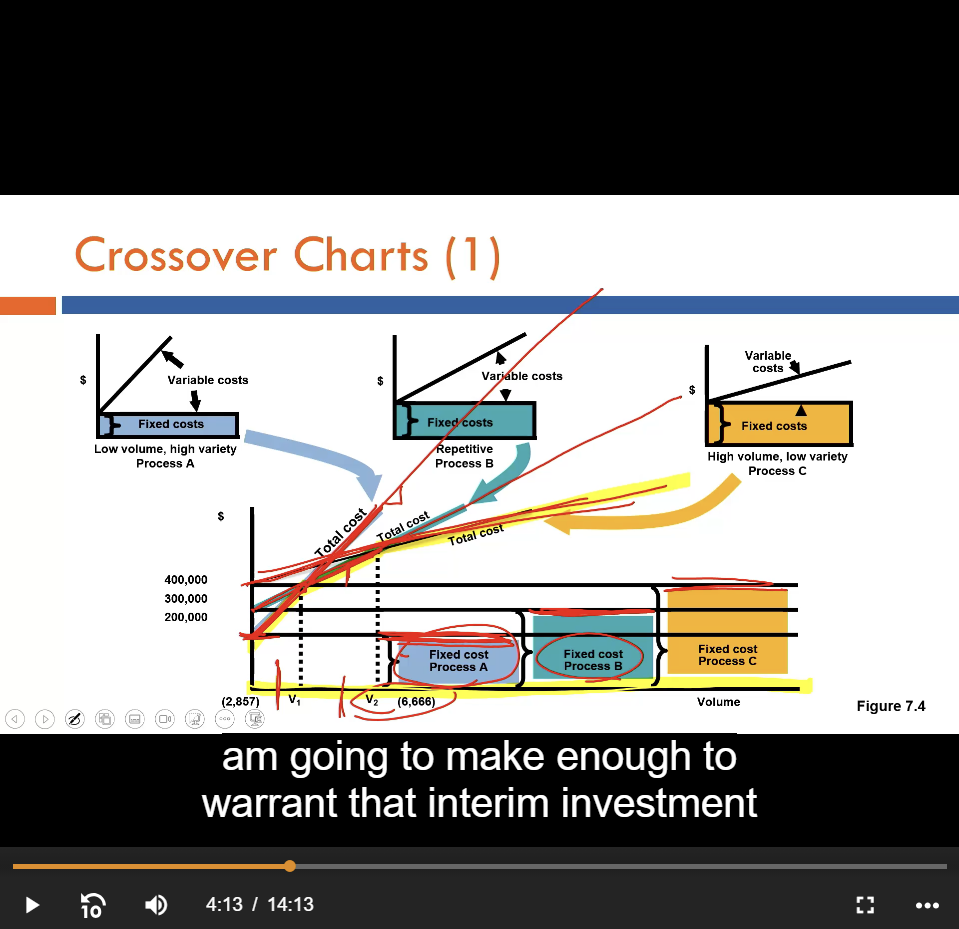
Crossover chart
Y-intercept is defined by the fixed cost of the process and the slope is defined by variable costs. The x-axis represents volume. The ideal volume is determined by the intersection with the lowest cost (y-axis).
Value Added Time vs Stall Time
Value time is time used for essential processes such as operations — though not all necessary time has value. Transportation and inspection are necessary but do not add value.
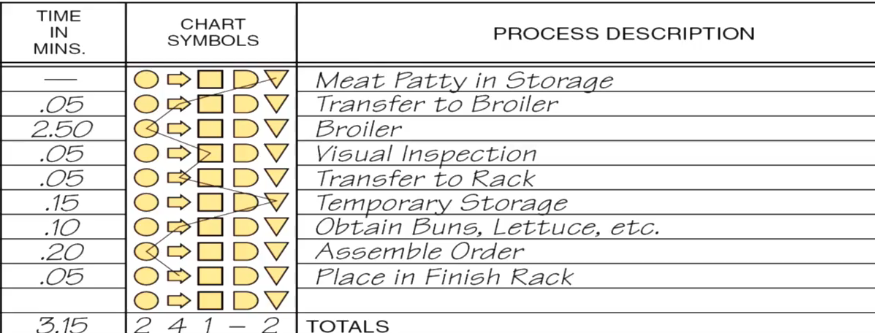
What percent of this process is value added time?
85.7%, 2.5/3.15
Describe the service blueprint
There are multiple levels, with the customer interacting only with customer service.
Value Stream Mapping
examines the supply chain to determine where value is added
Volume Stream Mapping
extends from customer to supplier
Is a variation on time function mapping
examines the supply chain to determine where value is added
extends time function mapping back to the supplier
Capacity
The limit to production
Throughput
The number of units a facility can hold, receive, store, or produce
Long Term PLanning
Add facilities, long leat time equipment
Intermediate time planning (3 months - 1 year)
Modify Capacity: Subcontract, add equipment, add shifts
Use Capacity: add personnel, build or use inventory
Short term planning (Within 3 months)
Use Capacity: Scheduling, allocating resources
Design Capacity
Theoretical output, usually a rate
Effective capacity
The capacity a firm expects to achieve given current operating constraint (usually lower than design capacity)
What is the design capacity of a machine that produces 1,000 bags of chips/ hr in a plant that runs for 16 hours?
16,000 bags/ day
What is the effective capacity of a machine that produces 1,000 bags of chips/ hr in a plant that runs for 16 hours, but loses 3 hours of output a day on preventative maintenances.
Effective: 16,000/day
Lost in output:( 3)1,000
Design capacity = 13,000/day
Actual output: the machines are not running for .25 hrs a day due to late parts and machine breakdowns.
The actual output:
Design capacity: 13,000
Breakdowsn: -250 bags/ day
Actual: 12750/ day
Utilization
Actual output/ design capacity
If demand exceeds capacity
raise prices, schedule longer lead time, increase capacity
Capacity exceeds demand
Stimulate market, product changes
Adjusting to seasonal demands
Produce products with complementary demand patterns
Examples of seasonal and complementary demand
Jet ski manufacturing increasing during summer months; we can also produce snowmobiles to offset low demand months in the winter.
How to match capacity to demand
Staffing changes
Adjust equipment
Improve processes to increase throughput
Redesign products to facilitate more throughput
Adding process flexibility to meet changing preferences
Closing facilities
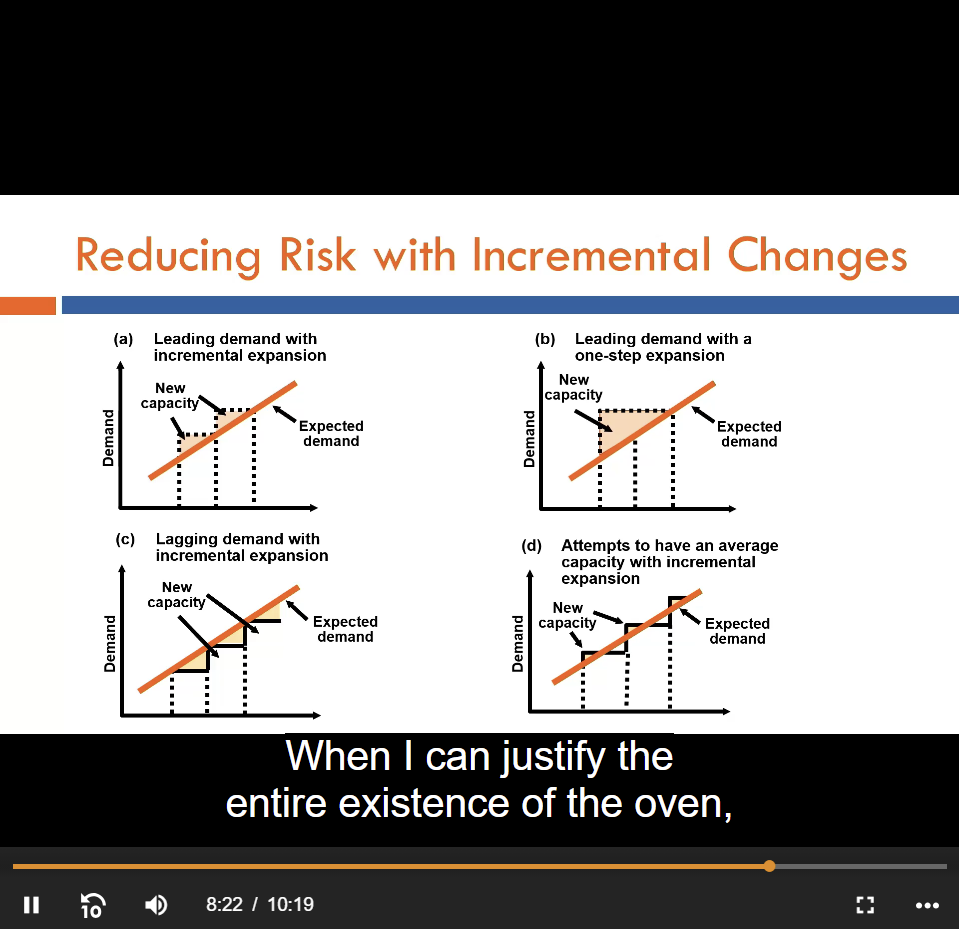
How to reduce risk
Leading demand with incremental expansion
Leading demand with one-step expansion
Lagging demand with incremental expansion
Have average capacity with incremental expansion (up and down)
Bottleneck time
the time of th slowest workstationT
Throughput time
The time it takes a unit to go through production from start to end, with no waiting
A (2 min) → B(4 min) → C (3 min)
If the actual time is 48 minutes.
Throughput time: 9 minutes
Cycle time efficiency: 9/48 = 0.1875
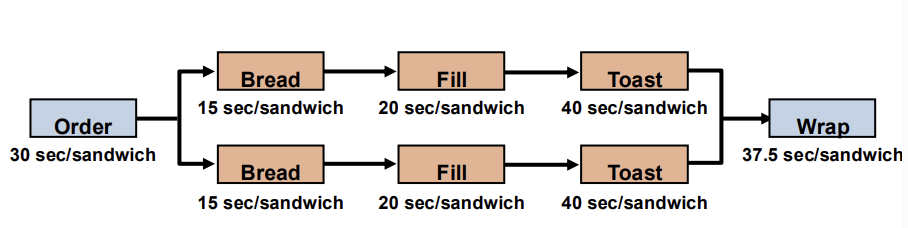
Given this line, calculate the bottleneck time and throughput time.
Bottleneck: Wrapping (37.5)
Throughput Time: 142.5 seconds
Capacity per hour: 3,600 seconds/ 37.5 seconds per sandwich = 96
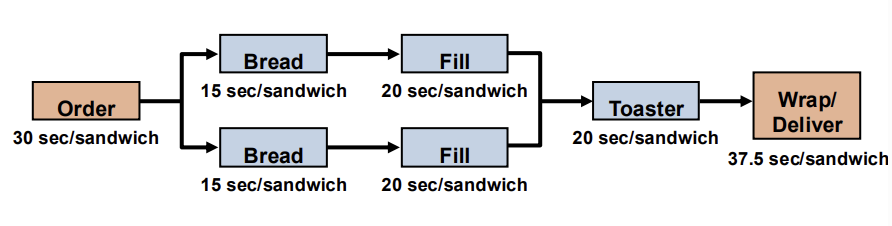
What if we replaced two toasters with one toaster that could toast twice as fast?
Throughput: 122.5
Bottleneck: Wrapping 37.5
Capacity per hour: 3600/37.5 sandwiches per hour
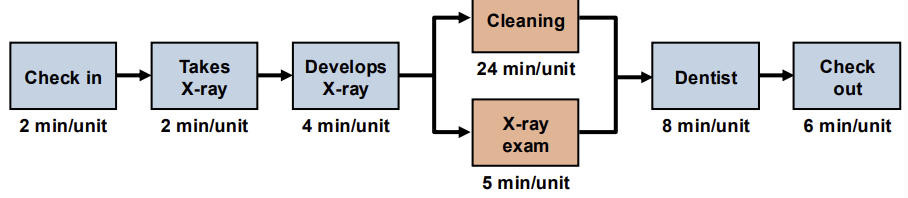
Find the throughput, capacity per hour, and bottleneck for the following process.
Throughput: 46 minutes
Bottleneck: Cleaning, 24 minutes
Capacity per hour: 60 minutes/ 24 minutes = 2.4 patients
Break-even assumptions
Cost and revenue are linear functions
We know all the costs associated with production
Time value of money is ignored
Break Even in Units
Price−VariableCostsFixedCosts
Break Even in Dollars
Price−VariableFixed
BEPxPrice
Price(Price−Variable)Fixed
Price(1−Variable)Fixed
Cycle Time
BottleneckTime
Quality tools found in a hospital
Continuous improvement
Empowerment
Benchmarking
just-in-time
Quality tools (pareto charts)
Goals of an operations manager
built a atotal quiality management system that identifies and satisfied customers’ needs
How does improved quality lead to sales gains?
Improved response
Flex pricing
Improved reputation
How does quality reduce costs?
Increased productivity
Lower rework and scrap costs
Lower warranty costs
What example was given in the lecture regarding quality?
Memory chips. Samsung gets to charge more for chips due to slighter better quality. Commodities are not very differentiated.
What is the flow of activity in terms of quality management?
Organizational practices → Quality principles (quantified/ measured) → Employee fulfillment (empowerment) → Customer satisfaction
What are the three main implications of Quality?
Company reputation
Product Liability
Global Implications