ANTA02 Vocabulary MT+FINAL
 Call Kai
 Learn
Learn Practice Test
 Spaced Repetition
 Match
Match Flashcards
 Knowt Play
1/77

There's no tags or description
Looks like no tags are added yet.
Name | Mastery | Learn | Test | Matching | Spaced | Call with Kai |
|---|
No analytics yet
Send a link to your students to track their progress
78 Terms
why is anthropology generous
must pay attention to and listen to what people say, believe, value.
why is anthropology open ended
research not based on solutions but instead insights, accept that more knowledge may lead to more questions.
why is anthropology comparative
acknowledges how there are many different ways to be human
why is anthropology critical
“because we can’t be content with the way things are”
describe anthropology in four words (G, O, C, C)
Generous, openminded, comparative, critical.
What does it mean to “think
like an anthropologist?"
• An anthropological sensibility
• “Being there” (“there” not necessarily being about geography, doing
participant observation)
• A commitment to paying attention to the context(s) in which people do
what they do, believe what they believe, etc.
what does ethnography accomplish
understanding culture from natives’ POV
Malinowski came up with what idea (and a little bit of Boas too)
Participant observation (evolution away from armchair anthropology)
Historical Particularism
each society
has its own unique historical development
and must be understood based on its own
specific cultural and environmental context,
especially its historical process.
Cultural Relativism versus
Ethnocentrism
cultural realism is methodology of being impartial, not judging cultures directly. suspending moral judgement temporarily. bias is inevitable, but this helps!
ethnocentric: judging off stereotypes. opposite of romanticizing which is also bad btw.
Salvage Ethnography
gathering info with the goal of rescuing a culture (bad mindset)
Anténor Firmin
“On the Equality of
Human Races” (1885); a comparative “armchair”
anthropology that argued against racial hierarchy
Franz Boas saw culture as a
lens for experience
Clifford Geertz saw culture as a
common sense
Culture is:
shared patterns of learned behaviour, a concept
critical cultural relativism
cultural relativism with some ethics involved, most optimal.
5 consensus of culture definition
is taught
symbolic and material
shared yet contested
not pristine (always affected by other cultures)
just bc a culture is exposed to globalization deosn’t mean it’ll extinct.
2 important takeaways from Balinese cockfights
tells story of status
culture integrated into text/vocabulary ( he scored!) Canada&hockey
Sapir-Whorf hypothesis
different language patterns yield different patterns of thought. "learning a language is learning a culture”
Lakoff and Johnson’s metaphors:
Perhaps it is not the structures of
language, but culturally significant
key metaphors, that shape and
reflect worldview and culture ( he scored!) Canada&hockey.
if you understand a place’s metaphors you understand their culture.
Sapir-Whorf time analysis in a place, compared with our own views on time.
them, “in the time where the snow melts” instead of numerical values
significance of hunger among the kwakwaka’wakw
controlling hunger. reincarnation as salmon. also have the Hamatsa(key metaphor for hunger) dance ritual.
think about how we think of time as something to ration. “running out of time”, when some other cultures see it as something to share
interesting!
how do the Dene tha people see resources, compared to us.
we exploit resources, while they practice stewardship instead.
what makes a ritual
Ritual is patterned, repetitive, and
symbolic
Rituals are set off from everyday life
and recognized as significant
Religious rituals attempt to gain
influence or sympathy of a particular
cosmic being
Asceticism— Benjamin Franklin, 1748
. the practice of strict
self-denial as a measure of personal
and especially spiritual discipline. related to the time thing
three phases of a ritual (STI)
Separation
Transition/liminality
Integration
One result of participating in a rite of
passage with others
communities
what is an etic POV
from outsider
what is emic POV
from insider
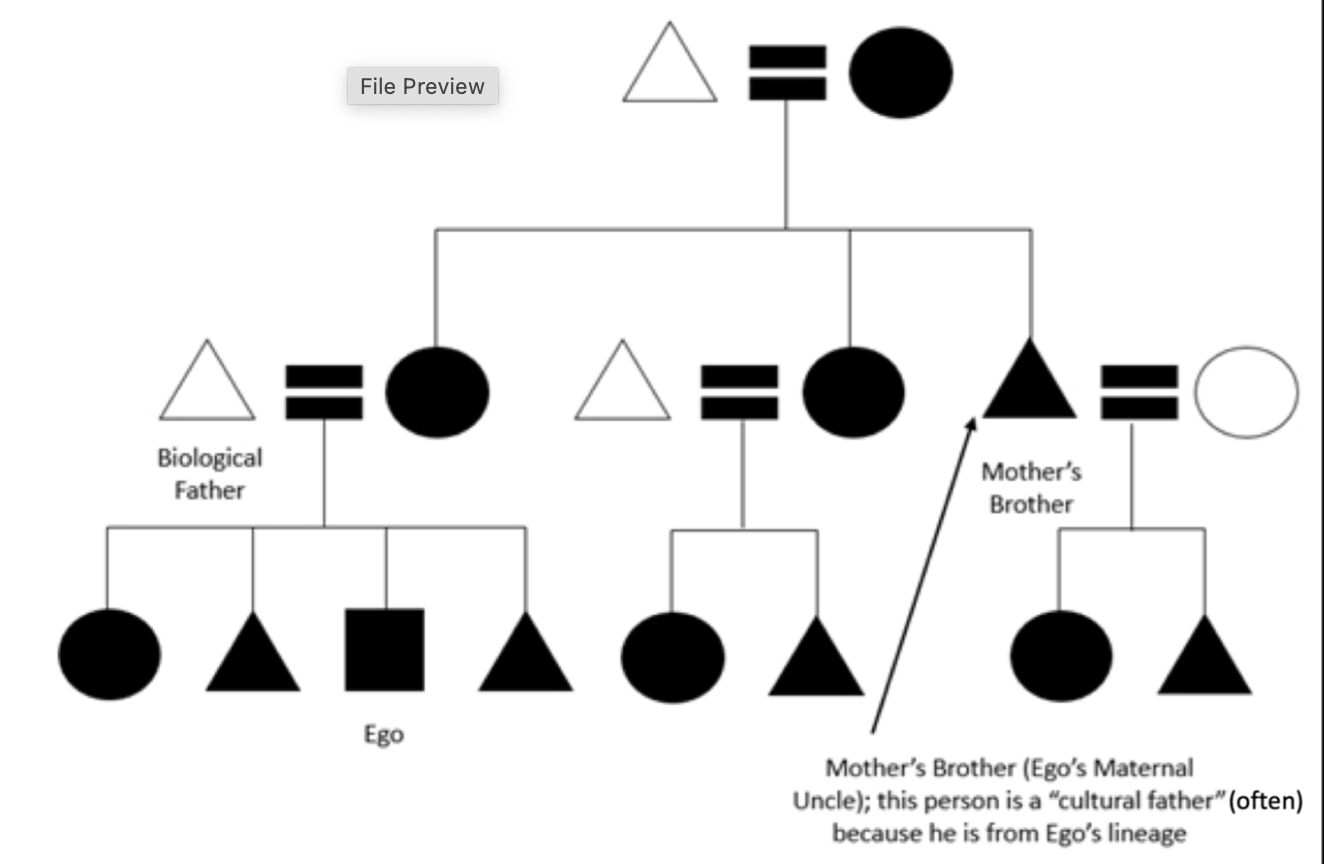
triangle kinship symbol?
man circle
circle kinship symbol
woman
dot in the middle kinship symbol
adopted
which stage of a ritual is likely to be the most dangerous
liminal/transition
communitas definition
collective feeling of investment into a community
Bilateral kinship class
‘normal’ white ppl one
Bifurcate Merging
father’s bro= father, and kids=siblings
mothers sis=mother, and kids=siblings
can be duallinal!
square kinship symbol
ego, no gender

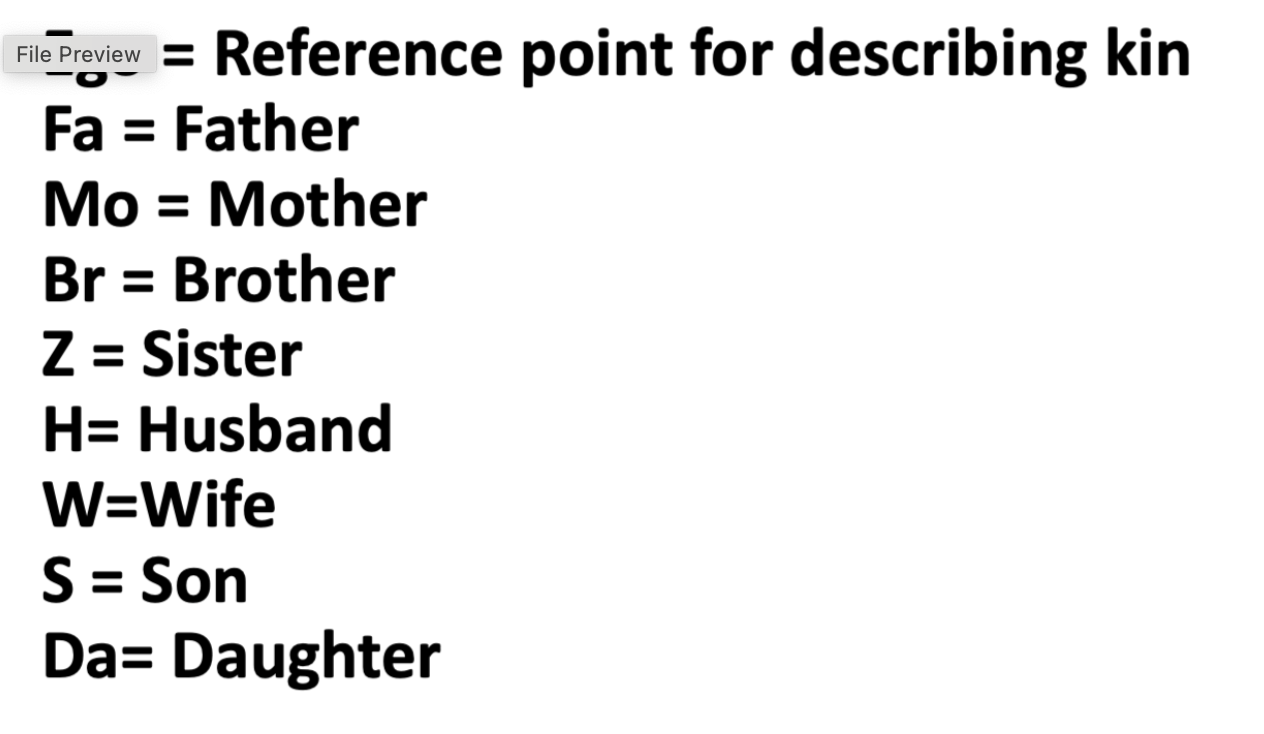

matri, patri, or dualinial
dualiial
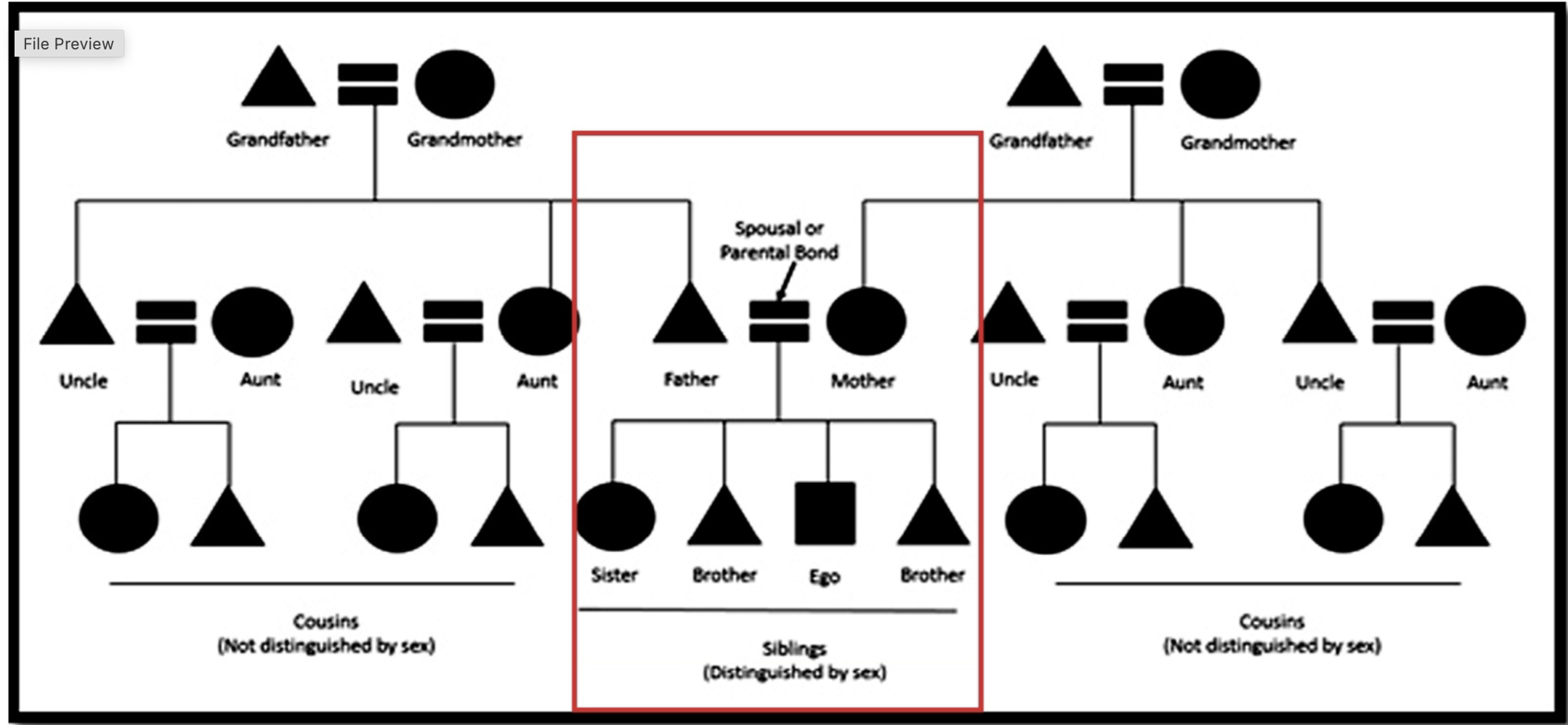
bilateral kinship
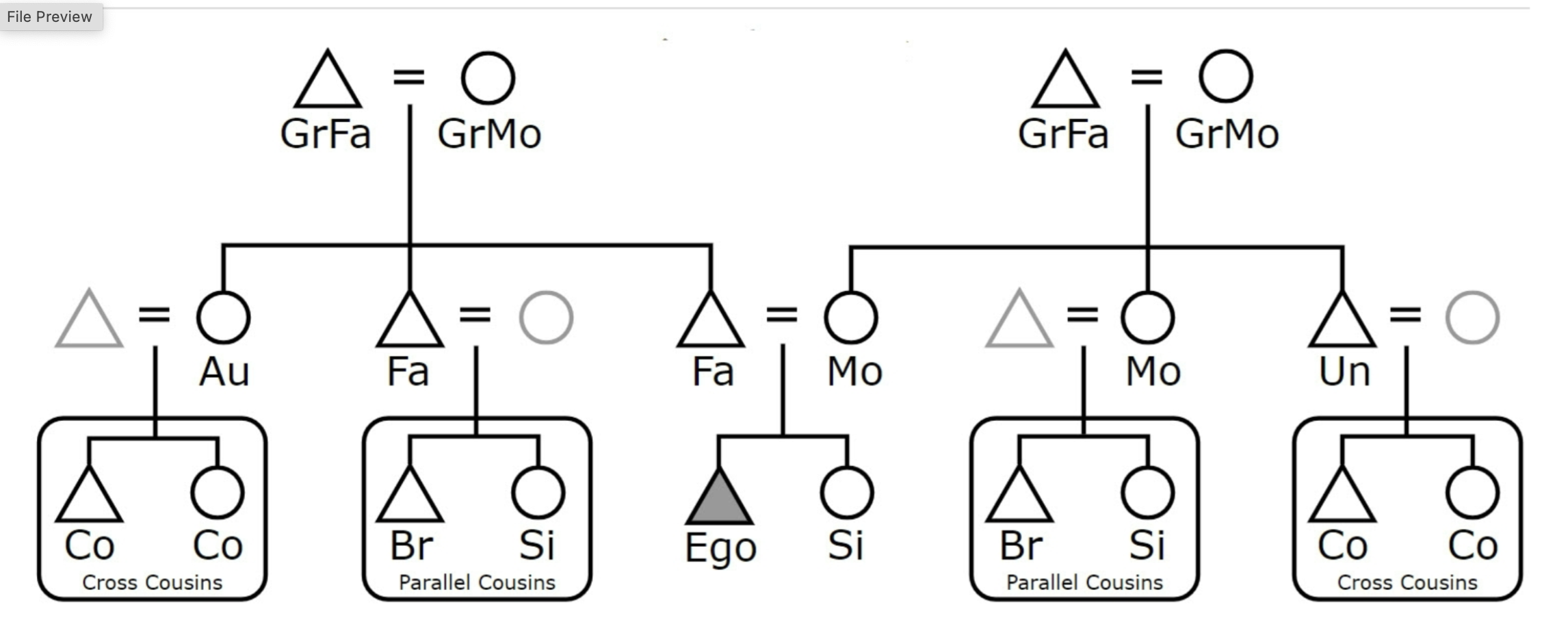
bifurcate merging
patriarchal society means patriarchy? true or false
false!
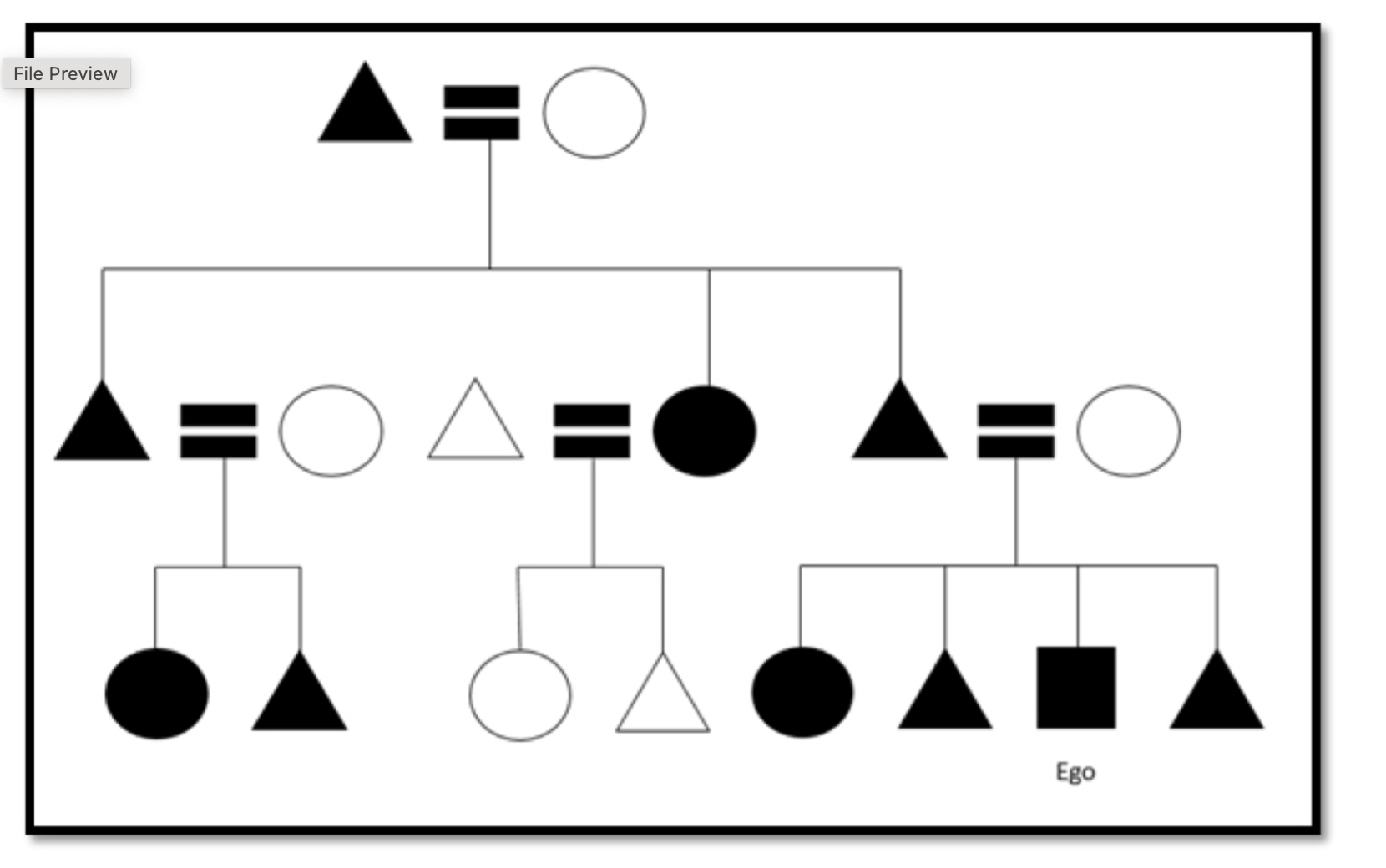
____lineal
patrilineal
______lineal
matrilineal
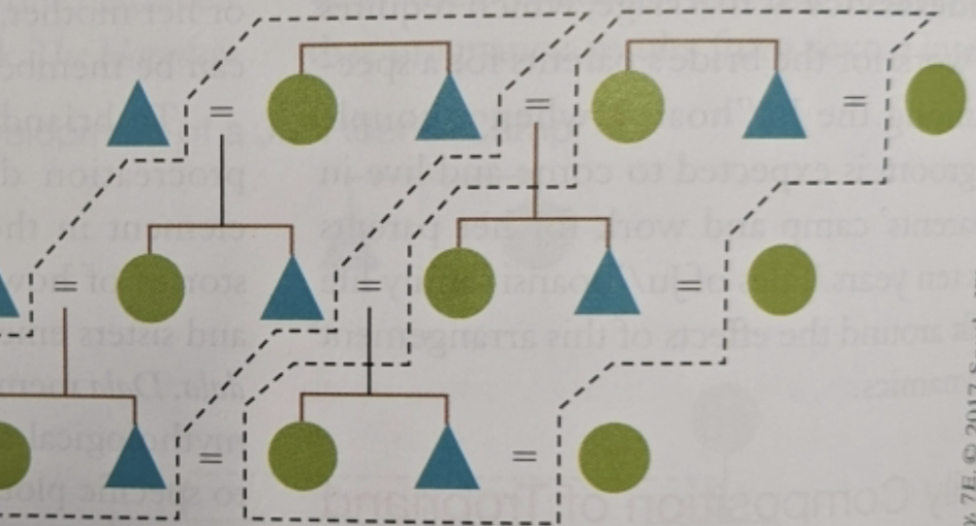
______lineal
matrilineal
parallel cousins vs cross cousins
parallel: parent’s same sex sibling’s kinds
Cross: parents opposite sex sibling’s kids
Affinal kin
related through marriage
endogamy vs exogamy
endoga,y within ones of group, exo: out of
Consanguinal kin
related through “blood” ties
an example of fictive kin
milk kin in azawagh Arabs
things risked from exogamy vs endogamy
exogamy? Depending on context: Wealth,
sentiment, trust, residence, other aspects of health, personhood itself
endo: health slightly
what are the two forms of unilinial descent
matrilineal and patrilineal
Gender
is one aspect of identity, selfhood, and personhood
egocentric vs sociocentric selfhood
you know, its a spectrum!
Egocentric selfhood: each person is perceived to be capable of acting
independently of others, and as the locus of internal motivations and drives (“He
is a generous person”)
• Sociocentric selfhood: a context-dependent view of the self; The self exists only
within the concrete situations or roles occupied by the person (“He shares what
he has with others”)
Cultural constructionism:
human behaviour and ideas are best explained as the
result of culturally-shaped learning
Biological determinism:
biological features such as genes or hormones are used
to explain behaviour and ideas
what’s the happy medium between biological determinism and cultural constructionism?
Biocultural approach
Social constructs are learned and shared
through ____
enculturation
3 examples of 3rd genders
two spirit, Albania sworn virgins, fa’afafine
explain how sperm and egg portray western stereotypes
sperm’s journey, egg is passive and stuff
what is reciprocity?
giving and getting in return or something
Traditional society is (not primitive!!)
held together by solidarity based on the
basic similarity of its members; custom
Modern society
is held together by the interdependence of its
parts; rationality. DOES NOT MEAN TODAY→ use contemporary for today
The Lubicon Cree of northern Alberta
The Cherokee Removal (aka The Trail of
Tears)
and in 19th-century USA
are examples of:
AB: no legal treaty , lots of resources and land taken. gov’t “youre in our way”\\\.
The Cherokee Removal (aka The Trail of Tears): machines in indu.revo need more land, cherokee forcibly removed from their land.
The detrimental effects of narratives of progress and development
percieving time as linear, teleogical, time means progress. so those living in same ways as earlier societies misunderstood as ‘stuck in the past’, in need of saving, in the way of progress.
this thinking does not alow us to see cultures objectively.
What explanations can anthropology offer for
thinking inequality between different types of
societies, other than linear narratives of
progress, or stereotypes about primitives who
need to become modern?
every different culture has its own lifestyle. all valid. we need to understand. approaching with an open mind allows us to learn objectively.
Modes of livelihood
Political Organization
Social Organization
Population Density
How are these things interrelated as we look at the shift from foraging to swidden agriculture to plough/irrigation/industrial agriculture?
more stratified, increased inequality, increase in population density, stronger nuclear family sense,
Why did most human societies shift away from foraging according to Morgan and White? but what’s the problem? what about Sahlins’ alternate explanation?
PROGRESS
Henry Lewis Morgan (<3 darwin)—societies easier/productive way, “evolved” from savagery to civilization
Leslie White—technology=energy-efficient, all human=capacity, societies evolved accordingly
but progress doesnt explain how some societies are still foragers, wealth differentials,
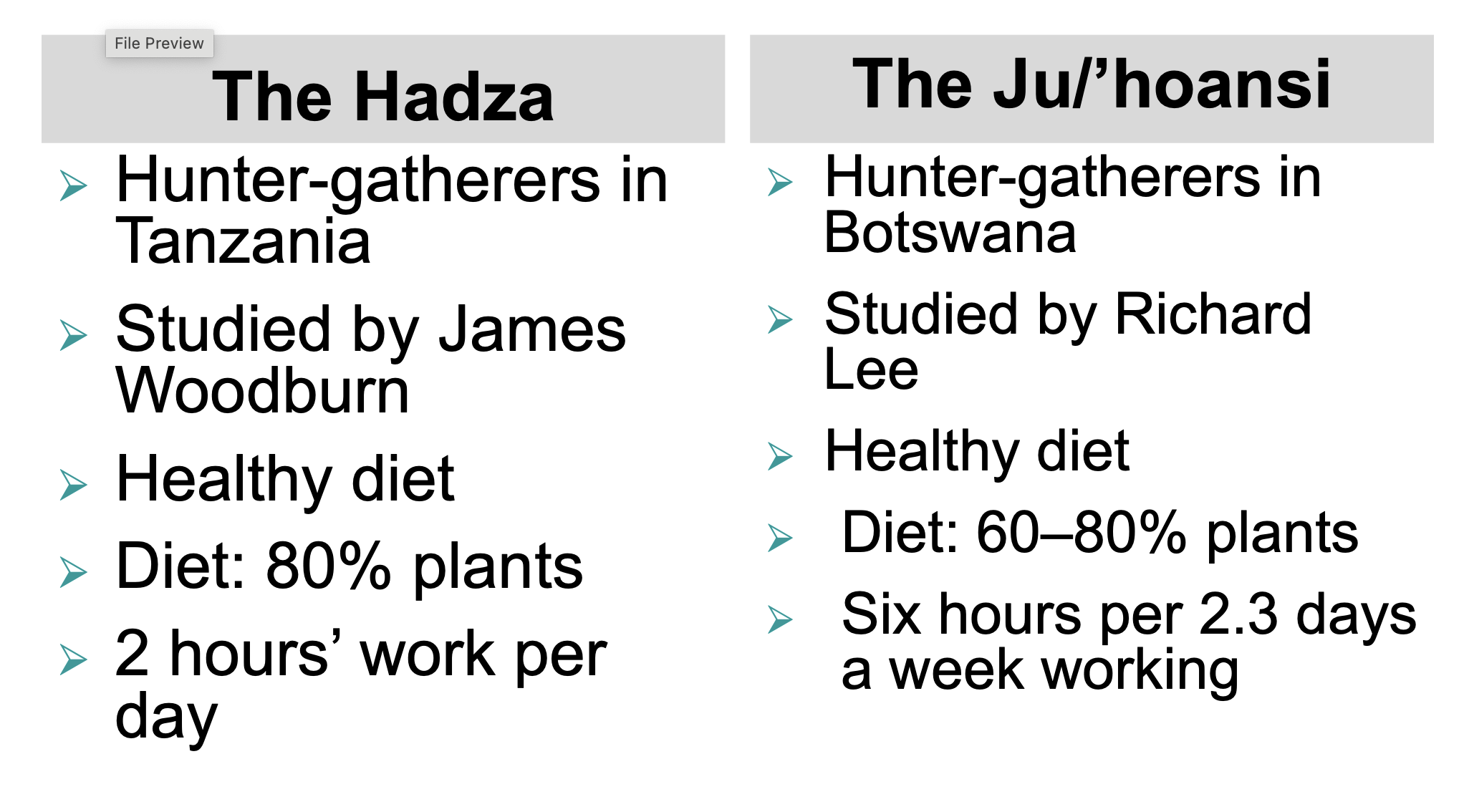
Marshall Sahlins, “the original affluent society”: omanticiizing hunter gatherer life, have lots of leisure time, a good life.
two examples of original affluent societies?
Progress for who? popular narratives of progress and development benefits and consequences?
benefits:
Colonialism and the Industrial Revolution produced great wealth for some.(and not)
Colonies produced stimulants (e.g., sugar, tea, coffee) and other goods to satisfy the consumer demands of the colonial countries.
Cons:
• Local industries in the colonies were destroyed (e.g., textile).
• Women’s livelihoods/status declined (India).
indigenous peoples in the Americas and elsewhere forced from their ancestral lands to make way for progress
How can we explain the vast inequality
between the rich and the poor?
?? social stratification and racism?
the mindset of ‘thats just the way things are” and “its just natural” is used to justify"_____
race, and race is the reason for a lot of social stratification.
3 ways anthros think about race
its recent human invention
cultural category not biology.
race and racism are i\embedded in everyday life and institutions
Working definition of race:
the culturally constructed
categorization of people into groups based on physical
characteristics
Race versus ethnicity
Race—insists on “natural” or biological explanations
Ethnicity—based on a shared sense of identity, and a relationship
to other groups
Ex: race: settlers are white
ethnicity: there are differnces between anglo and franco canadians.
describe how reactions to Samoans in the NFL are an example of Racial thinking
Racial thinking explain Samoan football prowess with reference to breeding, genetics, innate strength and size
This is usually accompanied by “cultural” explanations that verge on
primitivism (warriorhood, etc.)
This takes away from the actual hard work, cultural, personal motivstions these athletes put in, saying its “just natural”.
why arent Races discrete biological categories?
There is more genetic
difference within “races” than
between them
(prolly dont need to know actual numbers.. its in mod.9 tho
Problems with using race as classification system
Racial categories as subjective, but historically
situated (Your racial identity might shift depending where (and when) you
live:)
Using phenotype to put people into discrete categories
requires arbitrary decisions