Soft Sediment Adaptations Flashcards
 Call Kai
 Learn
Learn Practice Test
 Spaced Repetition
 Match
Match Flashcards
 Knowt Play
1/67

Earn XP
Description and Tags
This set of 30 flashcards covers the lecture content on adaptations in soft sediment marine environments, including physiological, morphological, and behavioral traits across sandy and muddy shores.
Name | Mastery | Learn | Test | Matching | Spaced | Call with Kai |
|---|
No analytics yet
Send a link to your students to track their progress
68 Terms
What sediment types are the most representative habitats of the benthos
Cohesive and non-cohesive
What four reasons may species adjust to their environment over short and longer timescales
To respond to changes in ecological or environmental context
To exploit and derive sufficient resources, such as food, shelter/camouflage
To defend or protect themselves and their resources
To maximise the chances of reproductive success
What is adaptation
The structural, behavioural or physiological/functional change in which a species gains an advantage, including the development pf special body parts, behavioural traits or physiological processes
This change is not reversible
What are the two types of adaptation
Ecological adaptation and evolutionary adaptation
How is ecological adaptation distinguished from evolutionary adaptation?
Ecological adaptation involves phenotypic change within an individual's lifetime; results from repeated exposure to a naturally occurring challenge (acclimatisation) or a lab/field setting induced challenge (acclimation).
Evolutionary adaptation involves genotypic change over several generations within a population and is the product of natural selection or artificial selection.
How does the sabellid polychaete Amphiglena mediterranea exhibit ecological adaptation to naturally occurring CO2 vents?
This species lives in carbon dioxide vents, which lower the pH of the water, and exhibit high rates of metabolism to compensate for pCO2-induced hypoxaemia
These rates return to normal once the organism is removed from the vents, indicating it is acclimated rather than adapted.
What characterizes the physiological state of Playnereis dumerilii living in CO2 vents?
It is genotypically adapted to elevated pCO2
Its metabolic rate remains high even after being removed from the vents.
What is the primary difference between acclimation and acclimatisation?
Acclimation is the non-heritable reversible modification that occurs over the lifetime of an individual. Generally, a phenotypic response to a specific stressor
Acclimatisation is the process by which as individual adjusts to a challenge in order to maintain performance across a range of changing conditions. Generally a coordinated response to several stressors experienced simultaneously
What is a significant energetic cost associated with metabolic phenotypic plasticity?
It requires the reallocation of energy away from other critical processes such as growth and reproduction.
What are the physical characteristics of grains in non-cohesive sediments?
They are typically coarse grains with large pore/interstitial spaces that are regularly flushed.
What are the physical characteristics of grains in cohesive sediments?
They are usually fine-grained, compact, and have smaller pore spaces that retain water.
Are non-cohesive sediments high or low energy environments
High energy environments
Are cohesive sediments high or low energy environments
Low energy environments (sheltered from wave influence but still tidally influenced)
Are non-cohesive sediments stable or unstable
Unstable
Are cohesive sediments stable or unstable
Stable
What kind of organisms are in non-cohesive sediments and what is their motility
Mobile infauna and epifauna
What kind of organisms are in cohesive sediments and what is their motility
Sessile and discretely sessile infauna
Do non-cohesive sediments have a low or high oxygen content
High oxygen content
Do cohesive sediments have a low or high oxygen content
Low oxygen content
Do cohesive sediments have a low or high organic matter content
High
Do non-cohesive sediments have a low or high organic matter content
Low organic ma
What grain size threshold defines the fine sediments in cohesive muddy shores?
<63μm.
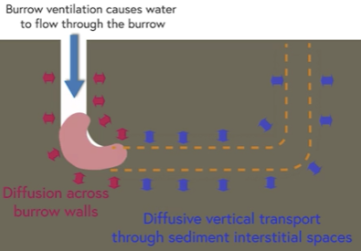
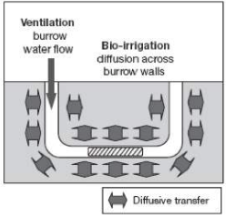
Describe the burrowing technique in cohesive sediments
Burrow ventilation causes water to flow through the burrow
Diffusion across burrow walls
Diffuse vertical transport through sediment interstitial space
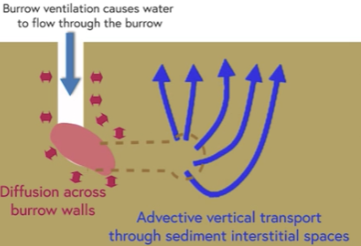
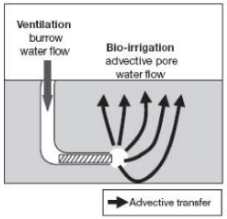
Describe the burrowing technique in cohesive sediments
Burrow ventilation causes water to flow through the burrow
Diffusion across burrow walls
Advective vertical transport through sediment interstitial spaces
Why is vertical zonation typical of rocky shores not clearly visible in soft sediment systems?
Because soft sediments are 3-dimensional habitats where species distributions overlap and many animals live beneath the surface or move cyclically.
What do the microphytobenthos inhabit
The sediment-water interface and uppermost few millimetres of the sediment profile in the photic zone
What organisms comprise the microphytobenthos community?
Unicellular eukaryotic algae, cyanobacteria, foraminifera, and euglenids.
Are the microphytobenthos motile
Yes, they are motile
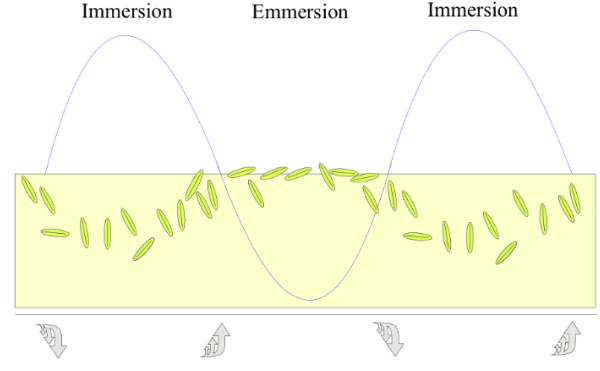
How do microphytobenthos respond when the sediment surface is inundated with water?
They migrate downwards into the sediment (as little as 4mm) to avoid being washed away.
How does the primary productivity of microphytobenthos compare to terrestrial plants?
They convert solar energy into biomass at a rate around 10 times greater than terrestrial plants.
How much CO2 can be fixed per 1kg of microalgae biomass?
Up to 1.83kg.
How do diatoms founds in found in sheltered beaches move
Move in a cycle between the sediment and the water surface within the surf zone
What migration do some surf-zone diatoms undertake
An endogenously controlled vertical migration between the water surface during the day and the sediment at night and a horizontal movement between the surf zone during medium to high energy conditions and the nearshore during calm periods
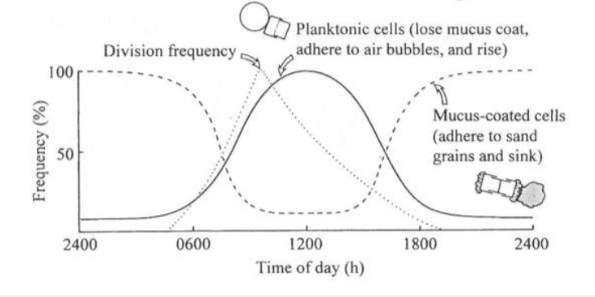
How do mucus coated individual diatoms move in the surface-zone
Individuals divide to loose their mucus coat and float to the surface waters
Once they are carried to the outer surf zone by the currents, they secrete a mucus coat that enable adherence to sediment grains and they sink.
The process is repeated so the diatoms ride the incoming and outgoing tides to maintain their position
Why is migration important for the microphytobenthos
It provides then protection from grazers and maximises the period over which photosynthesis can take place
This allows them to store sufficient energy in order to survive the extended period in the dark and to grow
What morphological adaptation helps the plough snail Bullia transit towards food scents?
An enlarged foot that acts as an underwater sail in the surf.
Why do plough snails migrate with the tides
They risk desiccation if they are stranded above the waterline
How long can a plough snail Bullia survive without food while remaining buried?
120days.
How do clams from the cold province (Benguela current) and warm province (Agulhas current) differ
Clams from the cold province are rounder, flatter and less wedge-shaped than clams from the warm province
How does the shell shape of bivalves from dissipative (high energy) beaches compare to those from reflective (low energy) beaches?
Dissipative species range from blade-shaped to almost spherical, whereas reflective species tend to be wedge-shaped.
Where can mole crabs be found
They occupy unstable sediments within the swash zone
What unique respiratory adaptation is found in mole crabs of the genus Emerita?
The respiratory current of water flows from anterior to posterior, which is different from other decapods.
Their first 4 pairs of walking legs and the uropods are modified for burrowing
The antennae are are adapted for filtering food
Shorter reproductive cycle and recruitment period, and lower abundance of recruits in reflective beaches to dissipative beaches
What is the endogenous rhythm period of the European beach amphipod Talitrus saltator?
24.5hrs.
When is the activity of Talitrus saltor limited to
The period during which it would be dark in their natural environment
Where can Philine aperta be found
It occupies the surficial sediment layer of many offshore subtidal molecules where they primarily predate bivalve molluscs
How does Philine aperta bury into sediments
By using hydrostatic adjustments
When does the brittle star Amphiura filiformis exhibit maximal arm emergence for particle capture?
During mid-tides when tidal currents are sufficient to support filter feeding.
What rhythm of swimming does the mud shrimp, Corophium volutator exhibit
An endogenous circa-tidal rhythm of swimming activity which varies seasonally, and also over the spring to neap tide cycle
This semi-lunar variation in phase is not significant during the winter when the rhythm is generally less distinct
What is the reproductive cycle of Corophium volutator
Shows a semi-lunar reproductive cycle in the summer, but the rhythmicity becomes obscure in early spring and autumn, and shifts to a lunar cycle in the cooler season
This change matches changes in the duration of egg development, which is prolonged by lower temperature and reduced food availability.
At what temperature threshold does the reproductive rhythm of Japanese Corophium volutator shift from semi-lunar to lunar?
Below 17.5∘C.
What is thixotropic sand?
Sand that liquefies when saturated with water, as occurs in the surf zone during an incoming flood tide.
Why are burrows in cohesive sediments typically U-shaped or multi-opening?
Because the small particle size prevents water from penetrating the burrow wall, meaning volume must be actively removed via the burrow lumen to the surface.
What is the common burrow architecture in non-cohesive sandy sediments?
I- or J- shaped burrows, because ventilation flows can penetrate the surrounding porous sediment matrix.
Why do some burrowers construct mucus lined burrows or rubes made either from membranous secretions or calcareous materials, or by cementing sand-grains or selected fragments together
They tubes serve to protect the occupant, act as a lair for catching passing prey, facilitate attachment to various substrata, and/or provide a stable and regulated environment in sandy or muddy substrates
What are the four cyclical behaviours
Diurnal, lunar, tidal and seasonal
When do innate behavioural responses occur
When the modification of behaviour is the result of evolution at the population scale over multiple generations; that is, a predetermined phenotypic trait is produced in response to a predetermined environmental stimulus
When do learning behaviours responses occur
When the modification of behaviour is refined through experience within the lifetime of an individual
What are the three species with flexible feeding strategies
Pseudopolydora kempi (deposit/suspension switch)
Hediste diversicolor (omnivory/scavenging)
Streblospio benedicti (resource tracking)
How does Calianassa subterranea handle the toxicity of rising sulphide levels?
It oxidises toxic sulphide to less toxic thiosulphate.
What is competitive displacement
The removal of a formerly established species from its position or standing as a result of direct or indirect competitive interactions with another species
Which bivalve hosts symbiotic bacteria in its gills to detoxify sulphide?
Solemya reidi.
In the Mugu Lagoon study, which haustoriid amphipod was the competitive dominant?
Acanthohaustorius.
Define character displacement in the context of soft sediment systems.
A phenomenon where differences among similar species are accentuated in regions where they co-occur to reduce resource competition.
How do the body sizes of Hydrobia ulvae and Hydrobia ventrosa change when they co-occur?
H. ulvae becomes larger (>3.5mm) and H. ventrosa becomes smaller (<3mm) to avoid competing for the same food resource.
How does Macoma balthica alter its behavior in the presence of the predator Crangon crangon?
It buries deeper in the sediment and switches from surficial feeding to deposit feeding.
What agent in the blood of the echiuran worm Urechis caupo is used for sulfide-detoxification?
Haematin.
What specialized defenses does the scale worm Harmothoe imbricata use against predators?
It uses bright green luminescence from its elytra and autotomization (voluntary loss of body parts).