Lecture 9 - group cognition
 Call Kai
 Learn
Learn Practice Test
 Spaced Repetition
 Match
Match Flashcards
 Knowt Play
1/36

There's no tags or description
Looks like no tags are added yet.
Name | Mastery | Learn | Test | Matching | Spaced | Call with Kai |
|---|
No analytics yet
Send a link to your students to track their progress
37 Terms
madness of crowds
-stock market activity and economic bubbles
-investors buy cheap shares and this snowballs increasing the price of shares until they no longer reflect the value of the company
wisdom of crowds
-individuals asked to guess weight of an ox
-guesses made individually but the mean of the guesses was very close to the actual weight of the ox
small group decision making
-typical paradigm to test group cognition:
3-6 people
short tasks
common aims
decision tasks
-individuals more likely to get answer wrong
-in groups can discuss and see improvement in cognition
wasons selection task
-four cards all have letter on one side and number on other side: E, X, 1, 6
-rule is all cards with a vowel on one side have an even number on the other side
-75% get wrong when doing it alone → not difficult and most understand it when explained to them
-in a group 75% get it right → talk through options, argue case and reason
confirmation bias
-preference for seeking information that can only confirm existing beliefs, rather than contradict it
-about active search for information, not just whether you believe information when you encounter it
wason selection task in groups
-can be used as small group decision task
-75% groups arrive at correct answer, complete opposite for individual level
-few minutes of discussion can change the wrong answer to correct response
-allows researchers to look at the process of reasoning in groups
wason task controls
-things which don’t help:
motivation/reward
changing the wording
university education
-things that help:
making the task less abstract
working within a group
wason selection task - social rule version
-making it less abstract but same rules
-people perform better on this
-group cognition can improve on individual reasoning
process loss (groups vs individuals)
-group decisions are worse than individual
process gain (groups vs individuals)
-group decisions are better than individual
groups vs individuals
-most of the time groups performed at the accuracy of second best member of the group
-group cognition tends to avoid the individual worst answer but also the best answer
difficulty comparing groups
-need to define four factors
task type
standards of comparison
coordination methods
individual differences
task types (difficulty comparing groups)
-intellective tasks vs judgement tasks
-well-defined vs ill-defined
-does the task depend on insight, background knowledge or intuition?
individual vs group task type (difficulty comparing groups)
-given time and discussion groups perform as well as best individual on intellective tasks
-best members outperform groups in judgements tasks
-when the task does not have a clear answer, then groups tend to perform at the level of the average members
standard of comparison (difficulty comparing groups)
-how well we do within groups and how groups compare to individuals
-synergy → performing at higher level than the capacity of individuals within the group
coordination methods (difficulty comparing groups)
-refers to how the group functions
-no discussion → averaging individual’s answers
-iterative, anonymous, answers, no discussion → delphi method revises answers to reach consensus
-discussion group chooses the best individual to answer → dictator method
-discussion and come to group agreement → consensus method
-discussion with revision, given collective mean, discuss and revise → dialectic methods
evidence for different coordination methods (difficulty comparing groups)
best improvement with dictator group
delphi method
dialectic method
least improvement was consensus group
-none outperformed the best individual members
individual differences (difficulty comparing groups)
-sources of information
-ability
-other capacities e.g., willingness to coordinate
achieving group consensus
-consensus is achieved through revision and weighting
-revision occurs within the individual
-weighting (combination of multiple judgements) occurs within the group
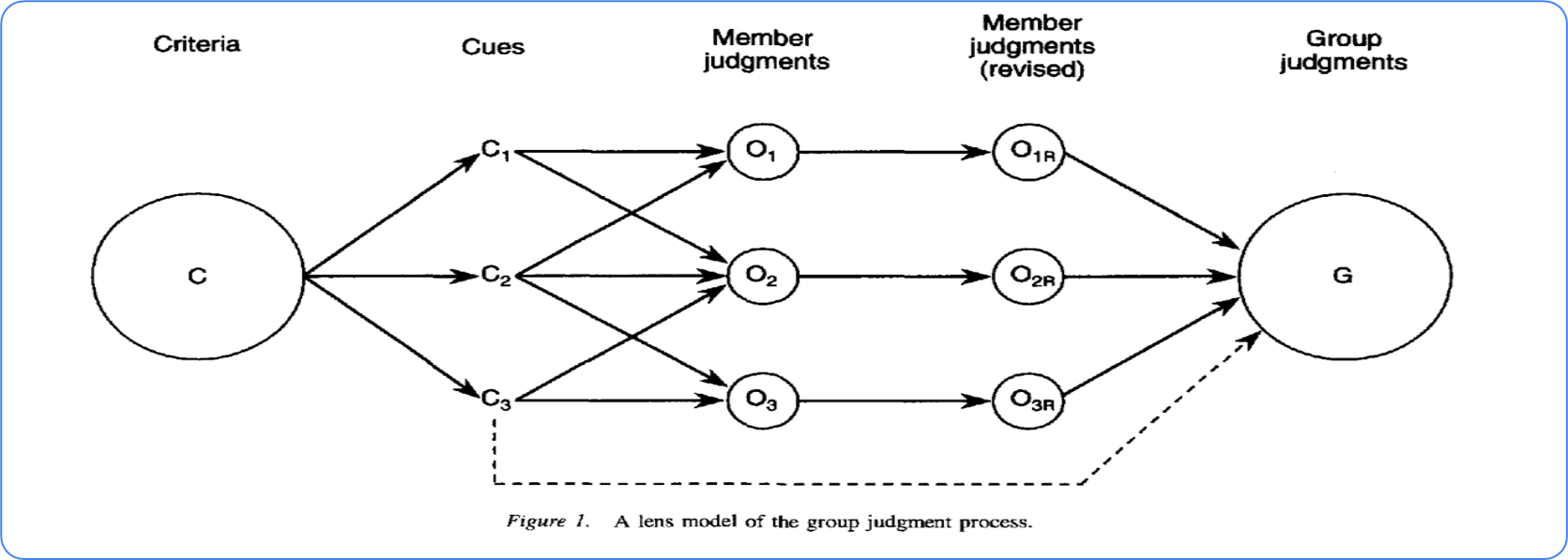
lens model of group decision making and consensus
-revision at an individual level and weighting at a group level
-C = environment containing the to be judged element/criteria
-O = judgements and revised judgements
-accuracy of group decision making relies on accuracy of individual judgements - weighting towards individuals and information can affect accuracy of the group judgement
-group judgements that are highly related to the criteria in the environment then this would be an accurate decision
-can be influenced by systematic bias or persuasive individuals
when averaging works
-uncorrelated errors → independent estimates
-no systematic biases
-no coordination between group members
uncorrelated errors
-most people guess around middle
-so group estimate averages out to be near true value (if true value near middle)
correlated errors
-there is bias within space so shift in answers
-still have an average but this has shifted due to systematic bias and not near true value
-due to:
limited information
shared biases
group conformity
influences on group cognition
groupthink
diversity
groupthink
-attitudes in group move from average of individuals to more polarised extreme position
-highly cohesive groups exhibit premature consensus seeking that leads to poor decision making
overconfidence
blindness to errors
conformity
criticisms of groupthink
-not a distinct phenomenon
-hasn’t added anything to literature of group reasoning
-lack of empirical evidence for all of the constructs
-focus on when group decisions have led to negative outcomes → restricts the understanding of group decision making process
diversity
-antidote to bias
-more diverse teams produce better outcomes
-e.g., diverse wikipedia editing teams produce better articles and spend longer in complex discussion
interactionist account (social accounts of reason)
-reason evolved to produce and evaluate arguments
-not for individuals to solve problems
argumentative theory of reasoning
-exchange of arguments is key to better reasoning
-confirmation bias is an individual failing but in a group is a collective strength
how groups reason
-exchange arguments → groups typically co-constructed a structure of arguments qualitatively more sophisticated than that from individuals
-arguments change people’s problem representation
collective intelligence
-ability of a group to perform a wide variety of tasks
woolley (collective intelligence)
-general ability of a particular group to perform well across a wide range of different tasks
-people who do well on one task tend to do well on most others
general intelligence
-collective intelligence is not strongly correlated with the average or maximum individual intelligence of group members
-collective intelligence is correlated with:
average social sensitivity of group members
equality in distribution of conversation turn-taking
proportion of women in the group
diversity within the group
cognitive diversity
engel - method (collective intelligence)
-68 groups online and offline - 34 groups in each condition
-ToM task → measure of social cognition and ability
-intelligence task → sudoku conducted online or face-to-face
-raven’s advanced progressive matrices test
-generating task → intelligence task
engel - results (collective intelligence)
-one factor accounting for most variance seen across different tasks seen as collective intelligence
-online and offline RMET scores predicted average → social sensitivity is important to group functioning
predictors of group intelligence
-average social sensitivity
-amount of communication
-distribution of communication
-strongly suggests the coordination problem of group work often overweighs the intellectual challenges