NURS 222 Exam 4
0.0(0)
Studied by 2 people Call Kai
 Learn
Learn Practice Test
 Spaced Repetition
 Match
Match Flashcards
 Knowt Play
Card Sorting
1/69

Earn XP
Description and Tags
Last updated 10:43 PM on 12/3/22
Name | Mastery | Learn | Test | Matching | Spaced | Call with Kai | Chat |
|---|
No analytics yet
Send a link to your students to track their progress
70 Terms
1
New cards
What is the correct order of completing abdominal assessment?
1. Health History
2. Inspection
3. auscultation
4. Percussion
5. Palpation
2. Inspection
3. auscultation
4. Percussion
5. Palpation
2
New cards
Light Palpation
Light touch in a circular motion. Assess for tenderness, enlarged organs, masses. Avoid designated pain areas until last.
3
New cards
Deep Palpation
Press down 2/3 inches. May need to use biannual technique. Asses for Pain, tenderness, masses, enlarged organs.
4
New cards
Percussion
Percuss all 4 quadrants
Predominant Sound is tympany
Air in intestines to rise to surface when patient is supine
May hear dullness due to distended bladder, adipose tissue, fluid, mass, organs
Percuss up to lower level of liver
Predominant Sound is tympany
Air in intestines to rise to surface when patient is supine
May hear dullness due to distended bladder, adipose tissue, fluid, mass, organs
Percuss up to lower level of liver
5
New cards
Inspection
Usually none, if you do see any they would be over artery areas (aorta, iliac, renal)
Hair distribution-should be even
Facial expression, position-watch for guarding, signs of pain or discomfort, curled up or fetal position
Hydration and nutrition-malnourished/undernourished
Hair distribution-should be even
Facial expression, position-watch for guarding, signs of pain or discomfort, curled up or fetal position
Hydration and nutrition-malnourished/undernourished
6
New cards
Auscultation
Use diaphragm of stethoscope to auscultation bowel sounds
Hold it lightly against skin
Start in RLQ - ileocecal valve
Note any vascular sounds none should be present
Hold it lightly against skin
Start in RLQ - ileocecal valve
Note any vascular sounds none should be present
7
New cards
How do you assess for kidney inflammation
CVA tenderness (Flat and and thud)
-First percussion on back
-Thumb that hand with other hand
-should feel thud but not pain
-First percussion on back
-Thumb that hand with other hand
-should feel thud but not pain
8
New cards
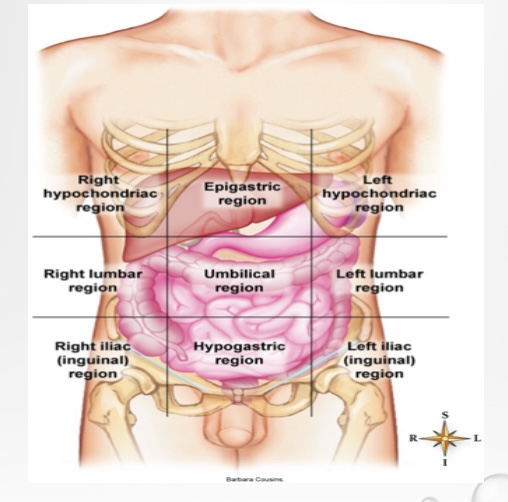
Regions of the abdomen
Right hypochondriac region
Right lumbar region
Right iliac region
Epigastric region
Umbilical region
Hypogastric region
Left hypochondriac region
Left lumbar region
Left iliac region
Right lumbar region
Right iliac region
Epigastric region
Umbilical region
Hypogastric region
Left hypochondriac region
Left lumbar region
Left iliac region
9
New cards
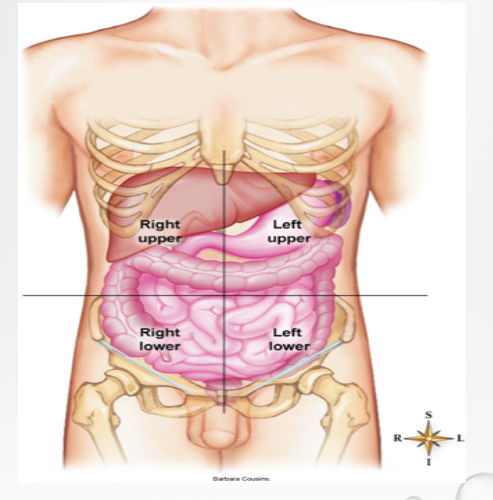
Quadrants of the abdomen
RUQ
LUQ
RLQ
LLQ
LUQ
RLQ
LLQ
10
New cards
Aging adult considerations (GI)
salivation decreases
Esophageal emptying delayed
Gastric acid secretion decreases
Incidence of gallstones increases
Liver size decreases (25%)
Constipation
Esophageal emptying delayed
Gastric acid secretion decreases
Incidence of gallstones increases
Liver size decreases (25%)
Constipation
11
New cards
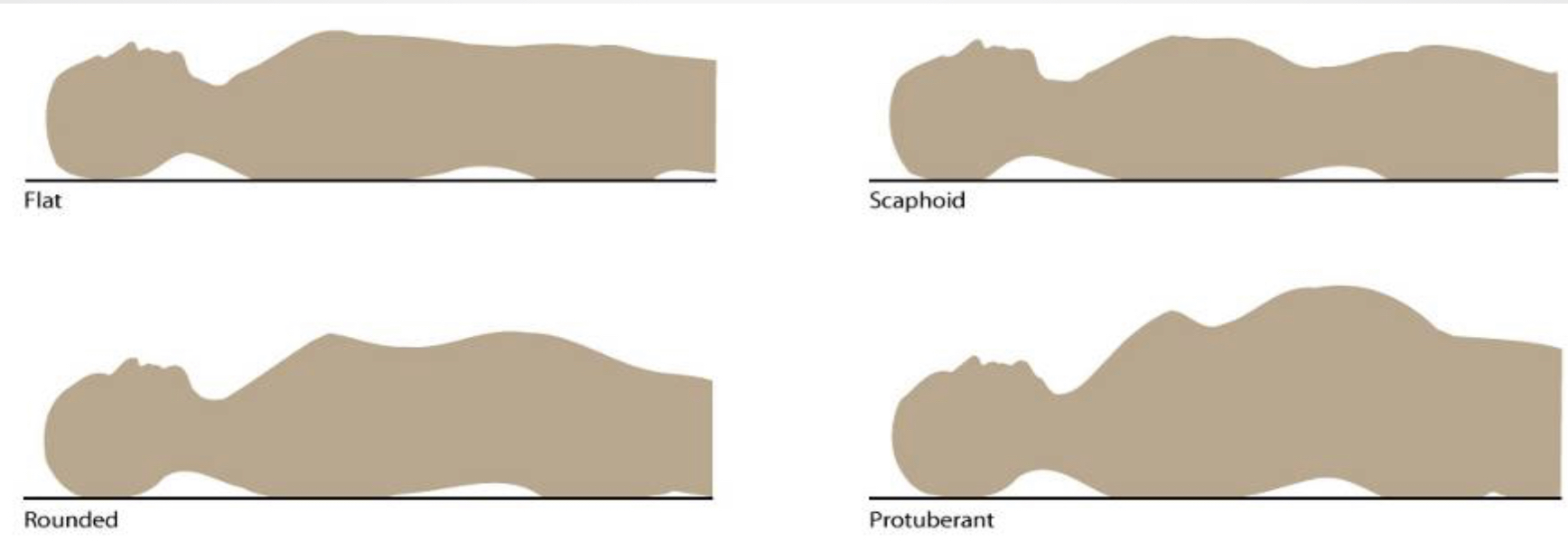
Contours of the abdomen
Flat
Scaphoid
Rounded
Protuberant
Scaphoid
Rounded
Protuberant
12
New cards
Considerations while palpating the spleen
Mono makes spleen enlarged and palpable
13
New cards
Why should women perform breast self-examinations?
To assess for any abnormal lumps which could indicate breast cancer.
14
New cards
When is the best time to perform a self breast exam for women who still have their periods?
Right after a menstrual period, Day 4-7 of the cycle. Breasts are the smallest and least congested. If a women is in menopause/no longer has period, encourage her to pick a day of the month to always do the exam (ex: 1st of the month)
15
New cards
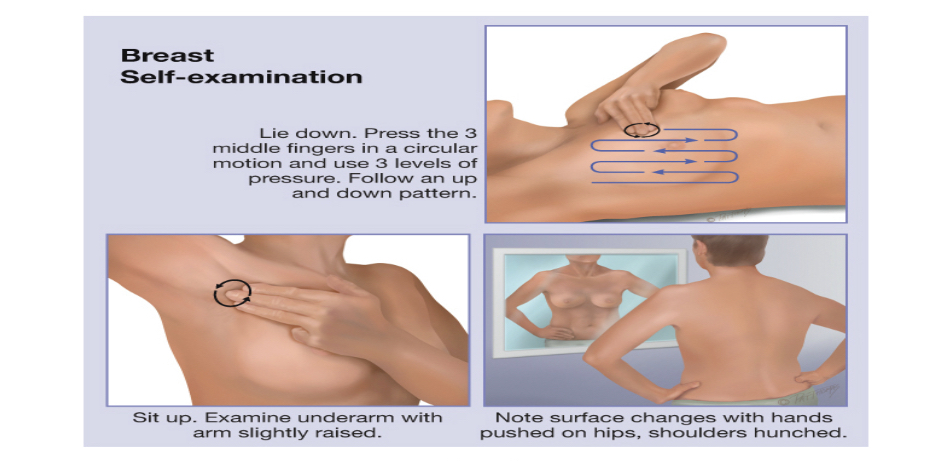
How should a women perform a breast self exam?
16
New cards
Incidence of breast cancer
30% (1 in 3) of all new female cancers/ year
17
New cards
Racial differences and breast cancer
-White women have higher incidence starting at age 45
-African American women have higher incidence before age 40
-Asian American, Hispanic, American Indian have lower incidence and lower death rates
-African American women have higher incidence before age 40
-Asian American, Hispanic, American Indian have lower incidence and lower death rates
18
New cards
Mortality of breast cancer
Decreasing, especially after age 50
—decreases thought to be the result of treatment advances, earlier detection thru screening and increased awareness
—women in the US: breast cancer death rates are higher than those for any other cancer, besides lung
—decreases thought to be the result of treatment advances, earlier detection thru screening and increased awareness
—women in the US: breast cancer death rates are higher than those for any other cancer, besides lung
19
New cards
What conditions can the male develop in relation to the breast?
Gynecomastia
20
New cards
Gynecomastia
Condition of breast tissue enlargement
Common in adolescence
Can reappear in aging male due to declining testosterone levels
Can appear w/ certain medications
Common in adolescence
Can reappear in aging male due to declining testosterone levels
Can appear w/ certain medications
21
New cards
Testicular Abnormalities
Cryptorchidism
Small Testis
Testicular Torsion
Epididymitis
Varicocele
Spermatocele
Hydro electric
Scrotal Hernia
Orchid is
Scrotal Edema
Small Testis
Testicular Torsion
Epididymitis
Varicocele
Spermatocele
Hydro electric
Scrotal Hernia
Orchid is
Scrotal Edema
22
New cards
Cryptorchidism
Undescended testicles
Can have testicular cancer
Infertility in adulthood
Treatable w/ surgery
Can have testicular cancer
Infertility in adulthood
Treatable w/ surgery
23
New cards
small testis
Possible infertility
Estrogen therapy in the transgendered
Possible hormone therapy
Estrogen therapy in the transgendered
Possible hormone therapy
24
New cards
Testicular torsion
Sudden twisting of spermatic cord
Very painful (excruciating)
Infertility (if untreated)
Requires surgery
Very painful (excruciating)
Infertility (if untreated)
Requires surgery
25
New cards
Epididymitis
Sudden onset, painful
Does not cause infertility directly
Treatable w/ antibiotics
Does not cause infertility directly
Treatable w/ antibiotics
26
New cards
varicocele
May require surgery depending on severity
May affect fertility
May affect fertility
27
New cards
spermatocele
Should not affect fertility
Generally no treatment required unless there’s growth
Generally no treatment required unless there’s growth
28
New cards
Hydrocele
differs from Spermatocele (fluid collection in the tunica vaginalis)
Should not affect fertility or require treatment
Should not affect fertility or require treatment
29
New cards
Scrotal Hernia
May need treatment if hernia becomes incarcerated
Does not affect fertility
Does not affect fertility
30
New cards
Orchitis
Acute inflammation of testis
Cause is infection (most common is mumps)
Medication for treatment
Should not affect fertility directly
Cause is infection (most common is mumps)
Medication for treatment
Should not affect fertility directly
31
New cards
Scrotal Edema
Treatment is of underlying causes of edema
32
New cards
tumor
Early-painless, found on examination
-most all are malignant (18-35 at most risk)
More common in white men
Most important risk factor is undescended testicle
Will require surgery
Will cause infertility
Diffuse-enlarged testis
-tumor maintains shape of testis
Takes up most of the testicle
Will cause infertility
-most all are malignant (18-35 at most risk)
More common in white men
Most important risk factor is undescended testicle
Will require surgery
Will cause infertility
Diffuse-enlarged testis
-tumor maintains shape of testis
Takes up most of the testicle
Will cause infertility
33
New cards
Testicular cancer statistics
~8000-10000 men develop cancer each year
Chance of developing testicular cancer is about 1/270
Cure rate greater than 95%
400 men die each year (1/5000)
White men are 4-5 times more likely to have testicular cancer than black men and 3x more likely than Asian American men
Chance of developing testicular cancer is about 1/270
Cure rate greater than 95%
400 men die each year (1/5000)
White men are 4-5 times more likely to have testicular cancer than black men and 3x more likely than Asian American men
34
New cards
What are some possible responses while performing reflexes?
0= no response
+1= Diminished, low normal, or occurs w/ reinforcement
+2= Average, normal
+3= brisker than average, may indicate disease
+4= very brisk, hyperactive with clonus, indicative of disease
+1= Diminished, low normal, or occurs w/ reinforcement
+2= Average, normal
+3= brisker than average, may indicate disease
+4= very brisk, hyperactive with clonus, indicative of disease
35
New cards
Frontal lobe
Descion making, voluntary movement
36
New cards
Parietal lobe
Sensation, touch, proprioception, stereognosis
37
New cards
Cerebellum
Responsible for coordination of movement, equilibrium, proprioception, and maintaining of muscle tone
38
New cards
Occipital lobe
Vision
39
New cards
Temporal lobe
Hearing, taste, smell
40
New cards
Wernicke’s area
Language comprehension
41
New cards
Brock’s area
Motor speech
42
New cards
Afferent
Carries sensory messages to CNS
43
New cards
Efferent
Carries motor message from CNS
44
New cards
Kinesthesia
Awareness of the position and movement of the parts of the body by means of sensory organs (proprioception)
45
New cards
stereognosis
Mental perception of depth or 3 dimensionality
46
New cards
Graphesthesia
Recognition of movements drawn on the skin
47
New cards
Romberg test
Ask person to stand up, with feet together and arms at sides; when in stable position, ask person to close eyes and to hold position for about 20 seconds
—normally person can maintain posture and balance even with visual orienting information blocked
Shallow knee bend
—demonstrates normal position sense, muscle strength, and cerebella function
—normally person can maintain posture and balance even with visual orienting information blocked
Shallow knee bend
—demonstrates normal position sense, muscle strength, and cerebella function
48
New cards
rapid alternating movements
Supination/pronation (quick pace)
Finger to finger
Finger to nose
Heel to shin
Finger to finger
Finger to nose
Heel to shin
49
New cards
CN I
Olfactory nerve
Smell
Present familiar aromatic substance and ask to identify
Smell
Present familiar aromatic substance and ask to identify
50
New cards
CN II
Optic nerve
Snellen and Jaeger test
Snellen and Jaeger test
51
New cards
CN III, IV, VI
Oculomotor, Trochlear, Abducens Nerves
Pupil size w/ light reaction and accommodation (III and IV)
Assess extraocular movement by diagnostic positions tests (6 cardinal positions of gaze) CN VI
Pupil size w/ light reaction and accommodation (III and IV)
Assess extraocular movement by diagnostic positions tests (6 cardinal positions of gaze) CN VI
52
New cards
CN V
Trigeminal nerve
Motor function: muscles of mastication
Clench jaw and try to open
Sensory: feel cotton ball on sides of face
Motor function: muscles of mastication
Clench jaw and try to open
Sensory: feel cotton ball on sides of face
53
New cards
CN VII
Facial nerve
Smile, frown, close eyes tightly
Puff cheeks in, to see that air escape equally from both sides
Smile, frown, close eyes tightly
Puff cheeks in, to see that air escape equally from both sides
54
New cards
CN VIII
Acoustic (Vestibulocochlear)
Test hearing by doing whispered voice test
Test hearing by doing whispered voice test
55
New cards
CN IX and X
Glossopharygeal and vagus nerves
Depress tongue with tongue blade and note pharyngeal movement as person says “ahh”, uvula and soft palate rise in midline
Gag reflex
Depress tongue with tongue blade and note pharyngeal movement as person says “ahh”, uvula and soft palate rise in midline
Gag reflex
56
New cards
CN XI
Spinal accessory nerve
Rotate head against resistance applied to side chin and lateral bending to left and right against resistance
Shrug against resistance
Rotate head against resistance applied to side chin and lateral bending to left and right against resistance
Shrug against resistance
57
New cards
CN XII
Hypoglossal nerve
Inspect tongue: no wasting or tremor should be present
Light, tight, dynamite
Inspect tongue: no wasting or tremor should be present
Light, tight, dynamite
58
New cards
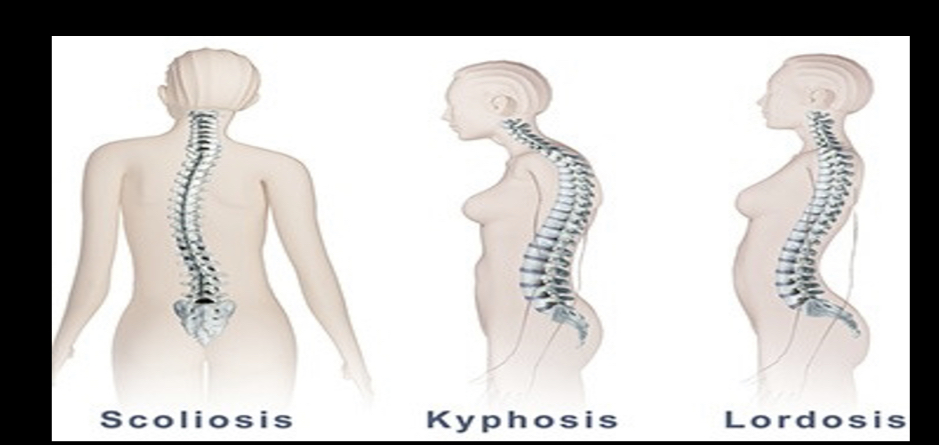
Abnormal contours of the spine
kyphosis
Scoliosis
Lordosis
Scoliosis
Lordosis
59
New cards
ROM Shoulders
Flexion
Extension
Abduction
Addiction
Internal rotation
External rotation
Extension
Abduction
Addiction
Internal rotation
External rotation
60
New cards
ROM Elbows
Flexion, extension, pronation, supination
61
New cards
Knees ROM
Flexion, extension, walk, shallow knee bend, butt kick
62
New cards
Hips ROM
Flexion, extension, knee bent Flexion, external rotation, internal rotation, abduction, adduction
63
New cards
Ankle ROM
Doris Flexion, plantar Flexion, inversion, eversion
64
New cards
Wrists/Finger ROM
Wrist Flexion/extension, ulnar deviation, radial deviation, finger Flexion/extension, spread fingers (abduction, adduction), make fist (Flexion, extension), touch thumb to each finger (opposition)
65
New cards
Neck ROM
Flexion, extension, lateral bending (R/L), rotation (r/L)
66
New cards
Contours of the cervical spine
Concave
67
New cards
Contours of the thoracic spine
convex
68
New cards
Contours of the lumbar spine
Concave
69
New cards
contours of the sacral spine
Convex
70
New cards
Osteoporosis
reduced bone mass