BIMM 100 Midterm 2
 Call Kai
 Learn
Learn Practice Test
 Spaced Repetition
 Match
Match Flashcards
 Knowt Play
1/92

There's no tags or description
Looks like no tags are added yet.
Name | Mastery | Learn | Test | Matching | Spaced | Call with Kai |
|---|
No analytics yet
Send a link to your students to track their progress
93 Terms
Primer
DNA or RNA complementary sequence that attaches to template DNA (acting as a starting point)
Allows DNA polymerase to add nucleotides/not required in Transcription
Polymerase Chain Reaction (PCR)
Purpose is to copy and amplify specific region of double strand DNA
Dependent on DNA polymerization in a test tube, single strand template, primer, dNTPs.
Simple sequence repeats
Non-functional
Location of repeats in genome are fixed (same location in genome for all humans)
Number of repeats at each location are variable among individuals
How to amplify Simple sequence repeats
Through PCR and Electrophoresis
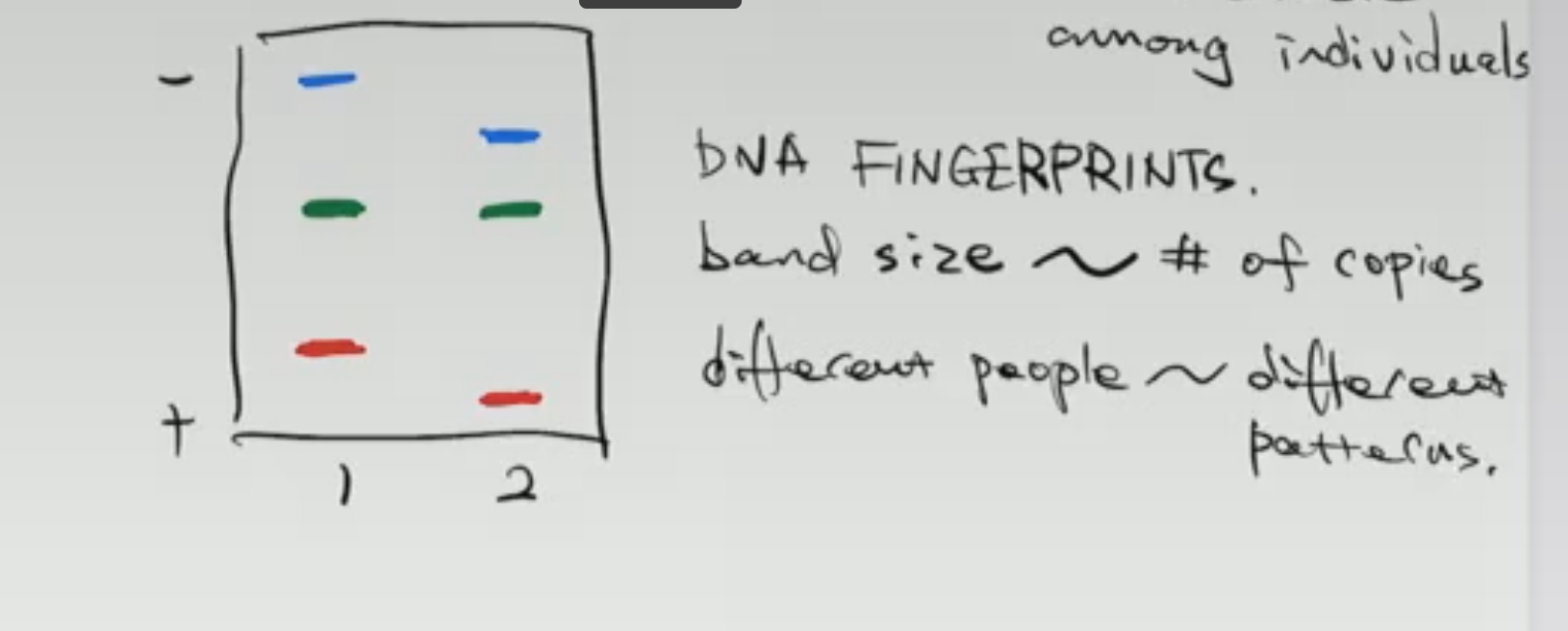
Application for Paternity and Criminal cases
Reverse transcription
Scenario: RetroVirus infects human and will inject viral RNA
Complementary DNA strand generated from viral RNA (RNA dependent and DNA polymerase),
viral RNA is digested/only DNA in cell (RNA nuclease),
cell will make double stranded DNA (DNA dependent and DNA polymerase),
DNA integrated into human genome
This is possible due to enzyme Reverse transcriptase (single strand of RNA into double strand DNA)
Step 4 uses enzyme Integrase
What happens once viral RNA to DNA is inserted into human genome?
Is silenced, however double stranded DNA will be transcribed back into RNA and will be translated to create more enzymes (Reverse transcriptase, Integrase, Protein coat, Protease)
Do you need a primer for DNA polymerization or RNA polymerization (transcription)?
For any DNA polymerization you do, however RNA polymerization you don’t
Reverse transcription in Eukaryotes
DNA fragments called mobile elements (DNA fragments move within and between chromosome location) in Eukaryotic cells
Mobile elements considered non-functional
Types of Mobile elements
DNA transposons (Cut and paste) Original site loses DNA material
Retro transposons (Copy and paste) Original site maintains DNA material since DNA fragment uses RNA intermediate (undergoes reverse transcription)
Mechanism for DNA transposon
DNA site undergoes transcription generating RNA, translated into enzyme called Transposase (cuts out DNA transposon site and integrates to target region)
Mechanism for Retrotransposition
Retrotransposon DNA transcribed to RNA, translated into protein Reverse transcriptase, this enzyme will reverse transcribe RNA into double stranded DNA, Integrase inserts retrotransposon DNA to target region
Autonomous transposition
Mobile DNA element encodes the enzymes needed for transposition
Although have genetic material, they need host gene expression machinery to express these enzymes
Telomere
DNA repeats found at the ends of chromosomes
1.Prevents fusion of chromosomes by double strand break repair
Replication at the ends of linear chromosomes (Lagging strand utilizes multiple primers, primers must be removed for DNA pol to fill in gaps, however Primer found at end of lagging strand unable to fill in gap since 3’ → 5’, meaning during Replication will always lose genetic material on lagging strand, this is solved by adding Telomere at end of Chromosome
What is the function of enzyme Telomerase
When ends of Telomere have been “eaten away” Telomerase is able to make copies to prevent loss of genetic material
Telomerase (reverse transcriptase) recruits telomerase RNA, Telomerase will use telomerase RNA as template to add complementary nucleotides
Distinction with Telomerase is that it’s not autonomous, instead two different genes encode for telomerase RNA and telomerase
Transcription
DNA-dependent RNA polymerization '“meaning using DNA as template to make RNA”
Distinctions between DNA and RNA polymerization
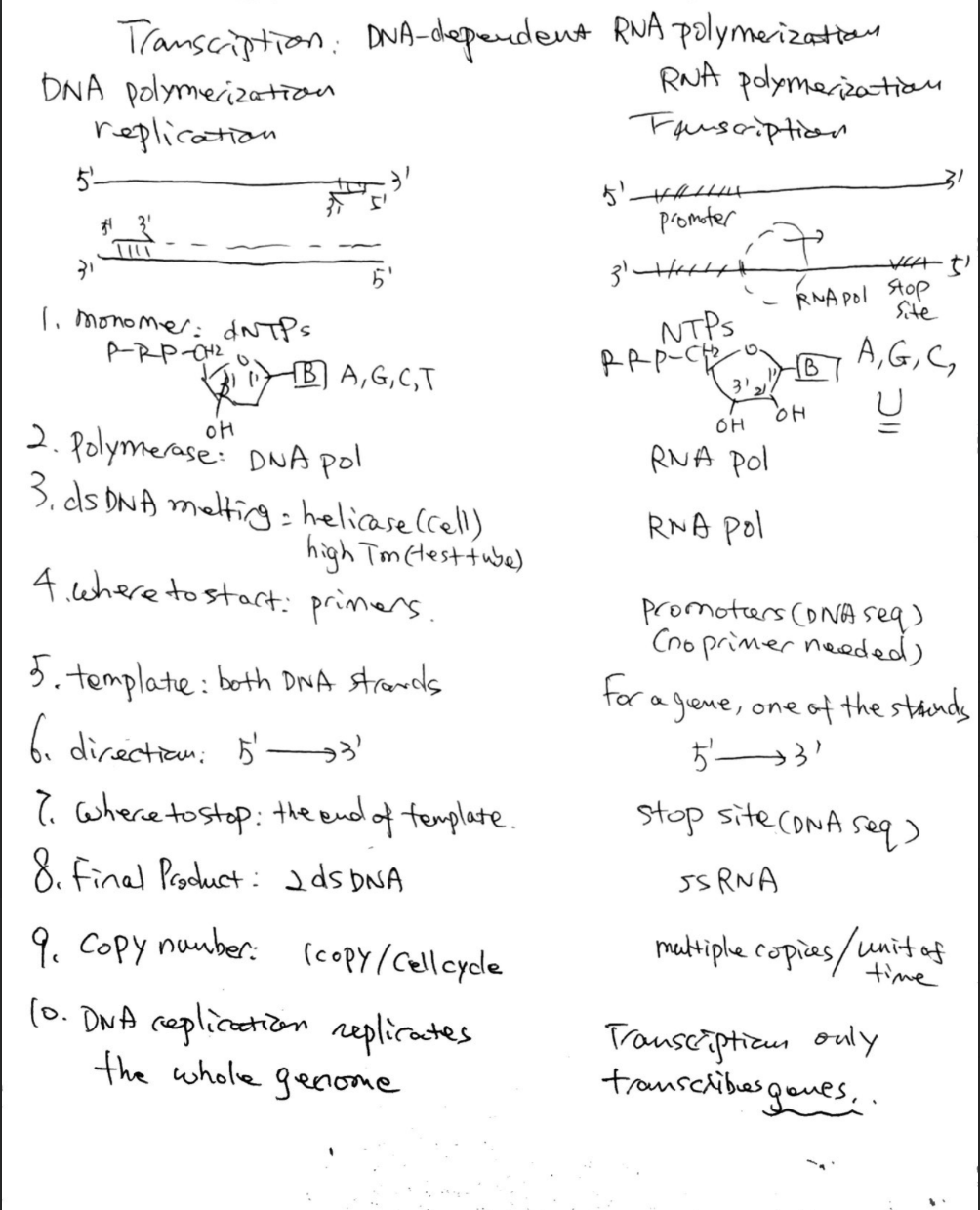
Promoter is apart of the gene (acts as binding site for transcription of only genes, not the entire genome), not apart of mRNA or RNA being transcribed from gene tho
What is the function of a promoter in transcription?
Promoter (piece of DNA seq, apart of gene) determines direction where to start transcription, which DNA strand is template, how many copies of RNA made
How is the Promoter region recognized?
Recognized by a transcription factor, binds to template strand. RNA polymerase recruited/binds to transcription factor, RNA polymerase initial nucleotide marks the Transcription start site (TSS) with +1 (numerical values assigned both sides)
Promoter determines orientation/direction of transcription
Consensus seq in E.Coli Promoters
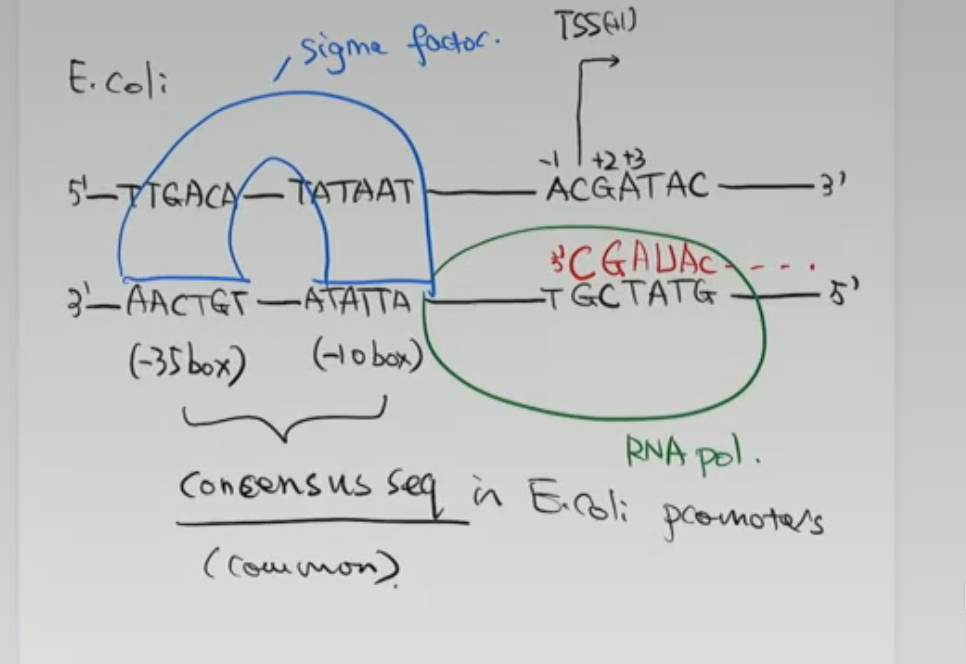
Mutation in (-35box) and (-10 box) results in
Functional elements in a promoter
1000 bp upstream of the transcription start site recognized as the Promoter, however within Promoter find functional elements (short DNA seq recognized by transcription factors)
Types of Functional elements
Common consensus (Ecoli -10 and -35, Eukaryotes TATA box)
Gene specific elements
CDNA Library, How to determine which genomic regions are protein-coding genes?
Extract many RNAs, will take all mRNA into single test tube (every single mRNA has 5’ cap and 3’ end has poly A tail)
Add RNA oligos (short piece of RNA single strand) to 5’ end with Ligase
Add poly-T primer (DNA primer) and Reverse Transcriptase (use RNA as template to make DNA)
Add RNase to digest RNA and left with single stranded DNA called cDNA (complementary to RNA)
Design primer thats complimentary to cDNA and DNA pol
Single stranded DNA into double stranded DNA (ds cDNA)
All ds cDNA corresponding to RNA from cell
Undergo PCR (Denature, Anneal, Amplification), since know both ends, can introduce restriction sites to two ends, digestion, and ligation, introducing cDNA fragment into a vector
Transform vectors into E.coli, transform into plate, forming many colonies
Sequence each colony, getting cDNA seq matches mRNA seq
Able to determine Transcription start site
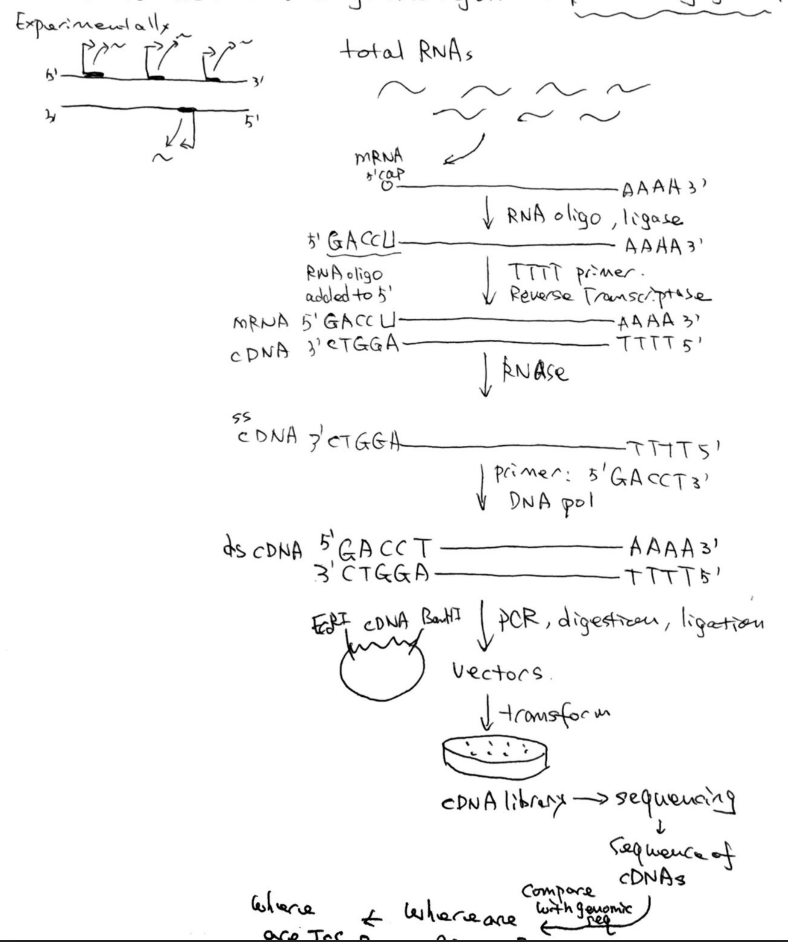
For a specific gene, we know its cDNA/RNA seq.
Want to know how much RNA produced (transcriptional activity of a promoter/ promoter strength) in different cell types under different conditions (more RNA produced more proteins produced)?
Northern blot
Transcriptional Reporter Assay
Northern blot experiment
Detect a specific RNA and its relative level
Given known mRNA sequence, make RNA or DNA probe (complementary sequence to small region of specific RNA, that is radioactively labeled at 5’ end)
Extract many RNA, undergo Gel electrophoresis (separated based on size)
RNA found inside the gel, however want to transfer to surface, do so by using Nylon membrane, incubate in solution of probe
Probe binds to RNA (hybridization), able to detect RNA due to radioactive label to determine size of mRNA (based on position), relative mRNA level (intensity of band)
Transcriptional Reporter Assay
PCR promoter region ONLY, clone into plasmid, immediately upstream of the coding region of a reporter gene, if promoter activated in cell (transcription factor bound and recruits Poly), coding region will be transcribed into report mRNA, reporter mRNA will be transcribed into reporter protein (easy to detect) able to determine transcriptional activity
How to identify functional elements (short DNA pieces in promoter that determine transcriptional activity)?
Deletion series or Linker Scan
Deletion series
Take promoter, using report assay clone into plasmid or Northern blot, look at activity of promoter (should be 100%), make promoter shorter (if transcriptional activity still 100%, that specific region of promoter not important, make shorter and if activity decreased to 50% determine this region is a functional unit, and continue…until 0%)
Linker Scan
Clone out promoter into a reporter, instead of removing part of promoter, mutate reporter portion of reporter and continue…
Difference in experimental results between Deletion series and Linker Scan
With deletion series always compare to fragment before, not the original full length reporter. Whereas with Linker scan each mutant compare to wild type or original promoter
Goal To identify transcription factors that bind to a specific promoter?
EMSA (Electrophoretic mobility shift assay)
DNase footprinting
,
EMSA (Electrophoretic mobility shift assay)
Know before experiment is gene of interest
PCR out promoter region, introduce radioactive p32 label
Fractionate proteins from cell lysate (separate proteins), put into test tube
Mix radioactive gene with test tube
Run Gel electrophoresis (this gel is non-denaturing or native gel), will notice one band at the bottom which corresponds to promoter (not bound to protein migrates fast), if you notice two bands (one corresponds to promoter bound to protein and a lighter band being just promoter)
DNase footprinting
Before experiment know promoter region and transcription factor. However, want to identify specific binding site of transcription factor
Radioactive label one end of sDNA strand, achieved by designing primer (one has label, other does not)
Get shiz ton of copies, split into two test tubes
One test tube mix with transcription factor, every single copy of DNA will be bound with TS
Other test tube do not add TS
Will add little DNAse (this specific DNAse cuts at multiple random sites of DNA) treatment to both test tubes. Find that in test tube with TS the DNAse cannot cut where TS is bound
Run Gel electrophoresis (denaturing gel, removes protein and unlabeled DNA fragment)
How to determine exactly where the transcription factor binds? Will need to be told labeled DNA end (# away from TSS) as well as DNA fragment size marker(means distance from labeled end)
How do we know whether DNA binding proteins activate transcription?
Some proteins activate, inhibit, or have no effect, thus have to test through In vitro Run-off transcription assay
In Vitro Run-off transcription assay
What’s needed in a test tube?
dsDNA (template) gene which contains promoter
NTPS (p32 labeled)
RNA pol
Two test tubes one with (+) and one without (-) transcription factor of interest
Prokaryotic transcription
only 1 RNA pol (makes all RNAs)
Eukaryotic transcription polymerase
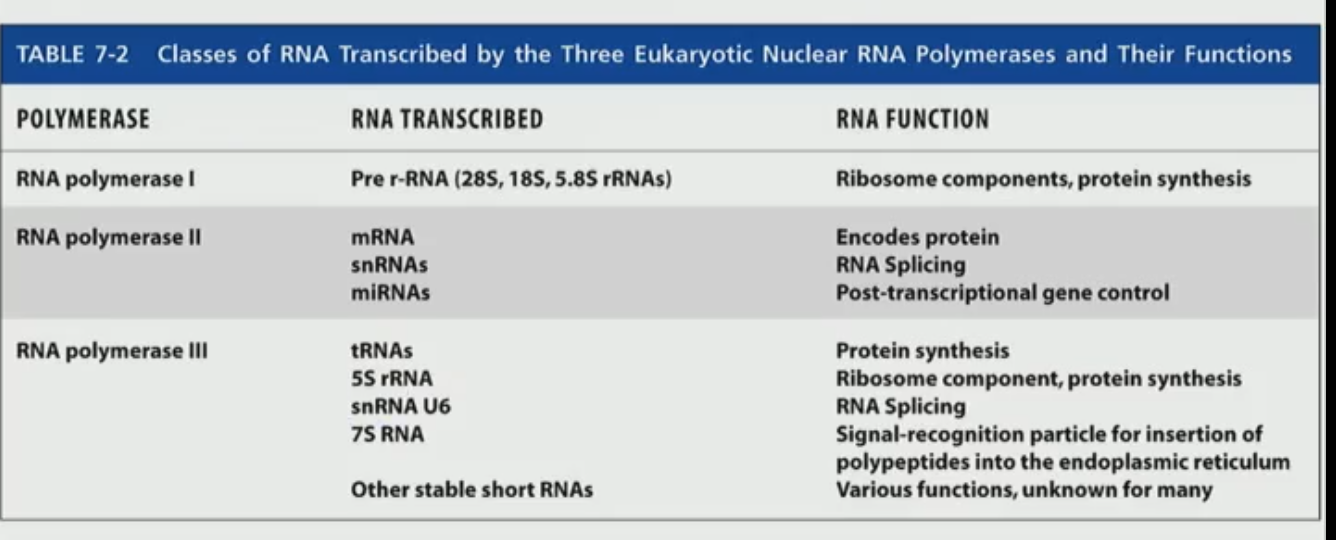
Which RNA pol contains CTD and what is the function?
ONLY RNA pol II contains a large subunit C-terminal domain end (CTD), CTD phosphorylation is critical for transcription initiation, Phospho-CTD is critical for co-transcriptional mRNA processing
What is the function of RNA pol I?
Responsible for pre r-RNA (ribosomal RNA, consists of 18s, 5.8s, 28s) → major components of ribosomes (however, is not an information carrier instead functions more like enzymes)
Find r-RNA cluster gene repeats throughout specific regions of chromosomes
Structure of rRNA gene (this is DNA, not RNA since has not been transcribed)
Consists of promoter region, transcription start site, coding region
Promoter region (CORE element (binds to transcription factor called CF) and Upstream element (binds to transcription factor called UAF) both transcription factors linked by TBP (TATA box binding protein)
What happens when TBP is linked to CF and UAF transcription factors?
Will activate transcription, will transcribe coding region called pre-rRNA (pre since not processed yet), Will find snoRNA/small nucleolar RNA (form bp to specific region of pre-rRNA)
What is the purpose of snoRNA?
Recruits enzymes to modify pre-rRNA by making nucleotide modifications (add chemical marks), if do not have these modifications wont be able to assemble ribosomes
What is the role of RNase?
RNase cuts pre-rRNA into different fragments, will continue to do so until isolate 18s, 5.8s, and 28s segments
What happens to the 18s pre-rRNA?
Will be associated/bind with ribosomal proteins forming small subunits of ribosome
What happens to the 5.8s and 28s pre-rRNA?
Will form bp with one another and associated with 5sRNA (only RNA made with Pol III) and ribosomal proteins forming large subunit of ribosome
Important to know that modifications of rRNA occur co-transcriptionally in the nucleolus
co-transcriptionally (transcription of pre-rRNA DNA is accompanied by modifications as well)
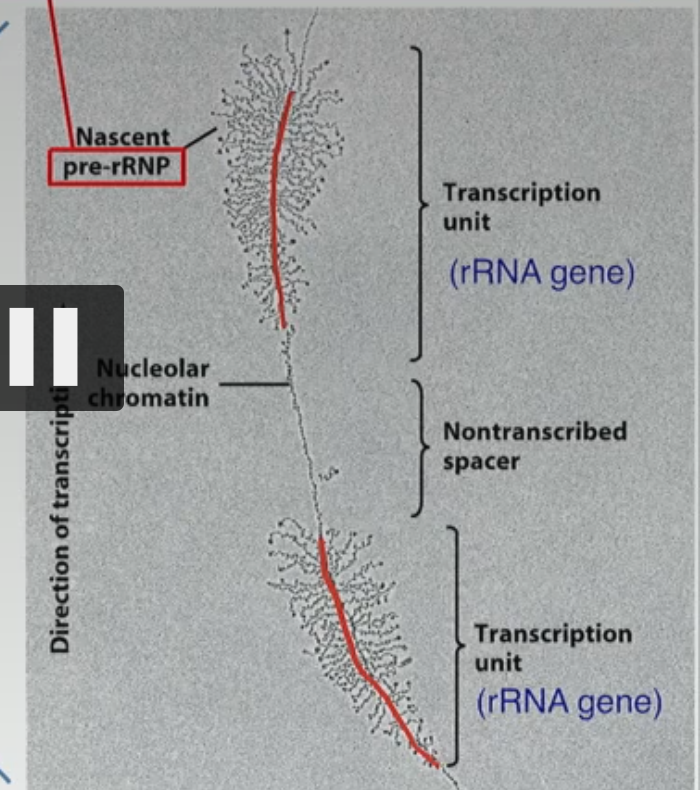
All these steps occur in Nucleolus (region of Nucleus)
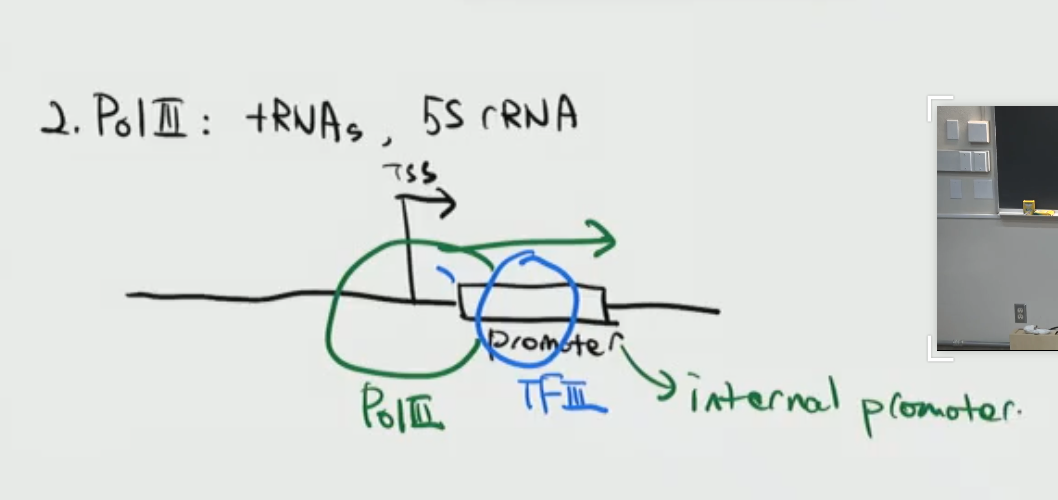
What is the structure of RNA Pol III
Makes tRNAs, 5s rRNA (important distinction between these two structures is that promoter is encoded in the RNA being transcribed since is downstream of transcription start site
What is the structure and function of RNA pol II?
Pol II makes all the mRNA,
TFIID binds the TATA box promoter and helps recruit RNA polymerase II.
TFIIH then unwinds the DNA and phosphorylates the Pol II CTD domain, which activates RNA Pol II and allows transcription to begin.
They are called general transcription factors (GTFs) because they are required for transcription of most Pol II genes.
(TFIID (consists sof TATA box binding protein + TAFs) and TFIIH (consists of DNA helicase and Pol II CTD kinase protein))
mRNA processing
5’-capping and after 3’-polyadenylation
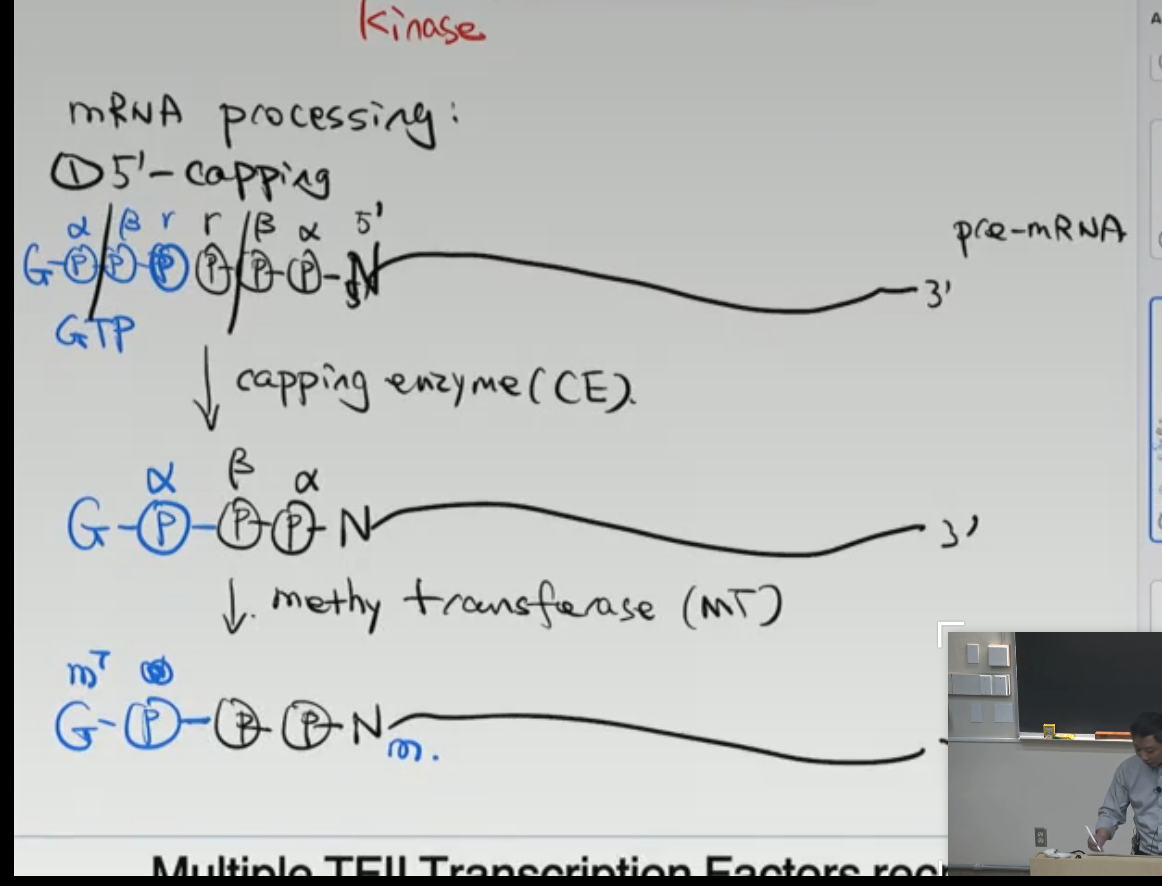
5’ capping
Once the RNA polymerase II CTD is phosphorylated, it recruits:
Capping enzyme (CE) → adds a GTP cap to the 5′ end of the pre-mRNA
Methyltransferase (MT) → adds methyl groups to form the 5′ methyl cap
Function is to mark mRNA for translation by ribosomes
3’polyadenylation
5’ has undergone 5’-capping, find that Specificity factor (SF) binds to AAUAAA sequence and Cleavage stimulatory factor (CSTF) binds to G/U 3’ end.
Pol-II CTD phosporylation once again allows for 3’-polyadenylation, however requires AAUAAA sequence and G/U as well to form poly A tail
What happens when both SF and CSTF are bound to specific cite?
Another protein will bind in between both called Cleavage factor (CF), which causes a cut in between. Find that CSTF is gone, only SF remains attached.
What happens after CF has made a cut in between?
SF recruits another protein at 3’ end called poly A polymerase (PAP), which is activated by SF and add many A nucleotides to 3’ end
What happens after the PAP has added many A nucleotides to the 3’ end?
Another factor called Poly-A binding protein II (PABPII) will further activate PAP to add a total of 300 A nucleotides
What is the function of the addition of A nucleotides at 3’ end?
Marks mRNA for nuclear export and translation
Protects mRNA from degradation
Only Pol II transcribed genes can have 5’ capping since Pol-II CTD domain recruits enzymes, all other RNA such as r-RNA, t-RNA does not have 5’ capping
How come snRNA (small nuclear RNA) are transcribed by Pol-II, however only contain 5’ capping, but not poly A tail?
If has Pol II promoter, will be transcribed by Pol II which is ONLY needed for 5’ capping, however snRNA is missing AAUAAA and G/U sequence thus will have no poly A tail
Recap of mRNA processing through Pol II Promoter
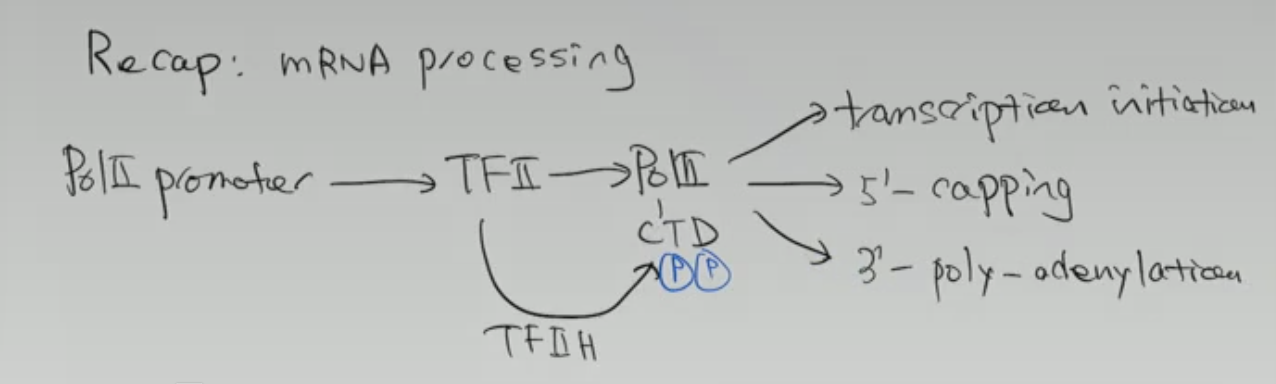
Say you PCR rRNA gene and put it under Pol II promoter, which Pol will be used to transcribe gene?
Will use Pol II since contains Pol II promoter gene sequence thus will have 5’-capping also but not 3’-poly-adenylation
mRNA splicing
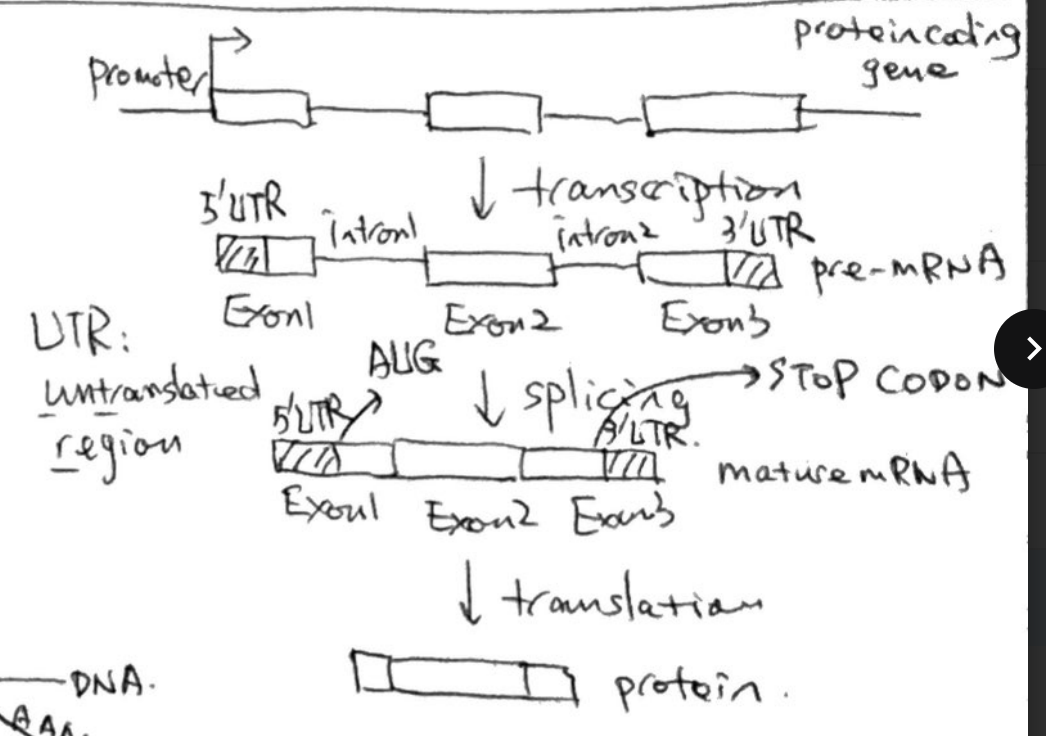
Note that mature mRNA (doesnt have introns)
5’UTR and 3’UTRare transcribed and kept in mRNA however are not translated
What is a UTR? Are UTR found in the introns or exons? Are UTR translated?
UTR is an untranslated region, they are found in exons, and they cannot be translated
Experiments to understand splicing of mRNA
Take single DNA template strand and mix in test tube with mature mRNAs that are transcribed by this DNA and look at EM. Able to understand direction based on poly A tail
In Vitro splicing analysis to determine biochemical steps of splicing (substrate/precursor (pre-mRNA) → intermediate(?)→ product (mature mRNA)). Goal to determine intemediate
DNA template/ P32 labeled pre mRNA generated by in vitro transcription, pre-mRNA transcribed from DNA (don’t get mature mRNA since this occurs in the test tube not in a cell, dont have the machinery), pre-mRNA incubated with nuclear extract (enzymes needed for splicing), perform reaction under different time points, and run through Gel electrophoresis (mobility dependent on size of fragment but also structure of molecule)
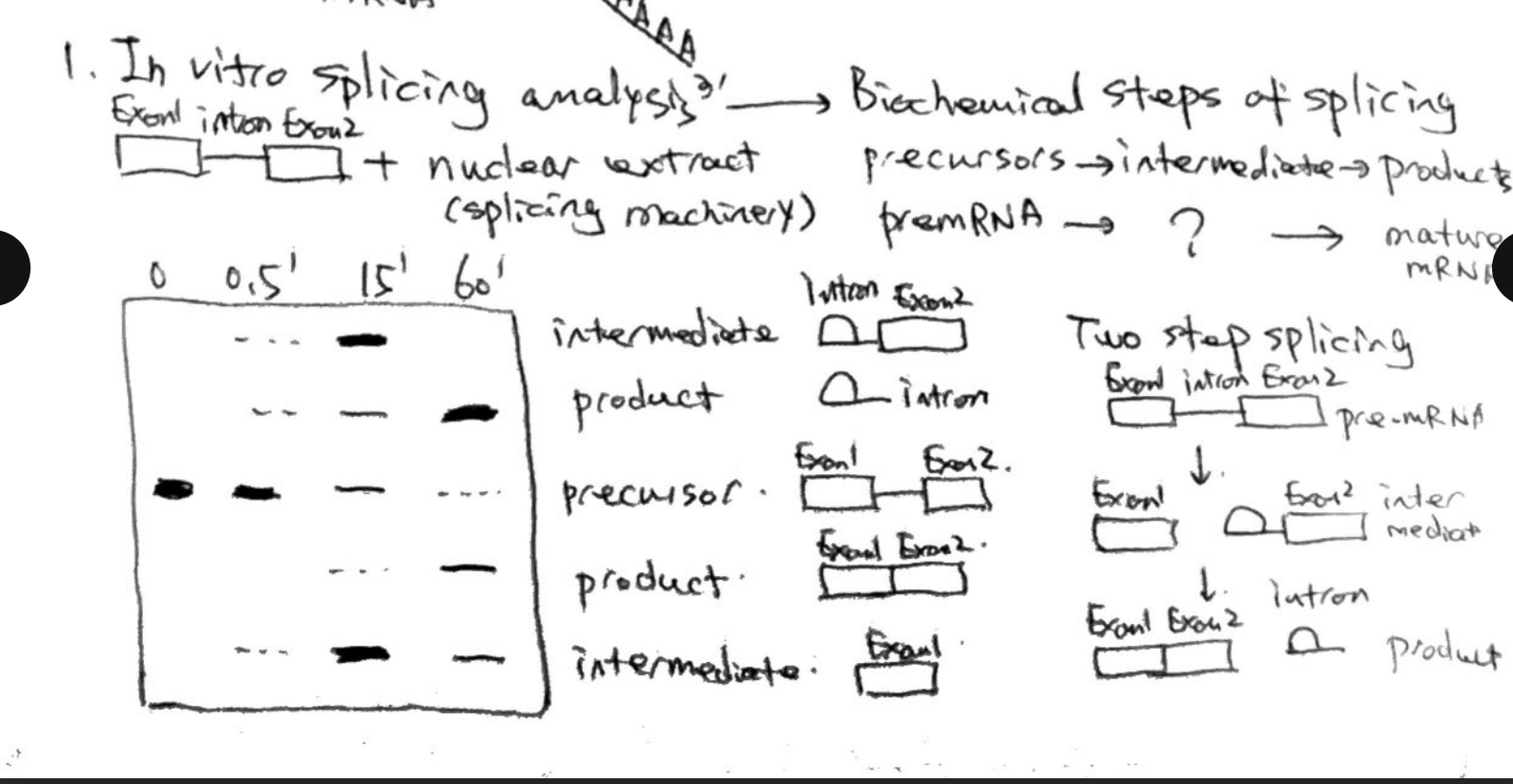
Biochemistry of In-Vitro splicing
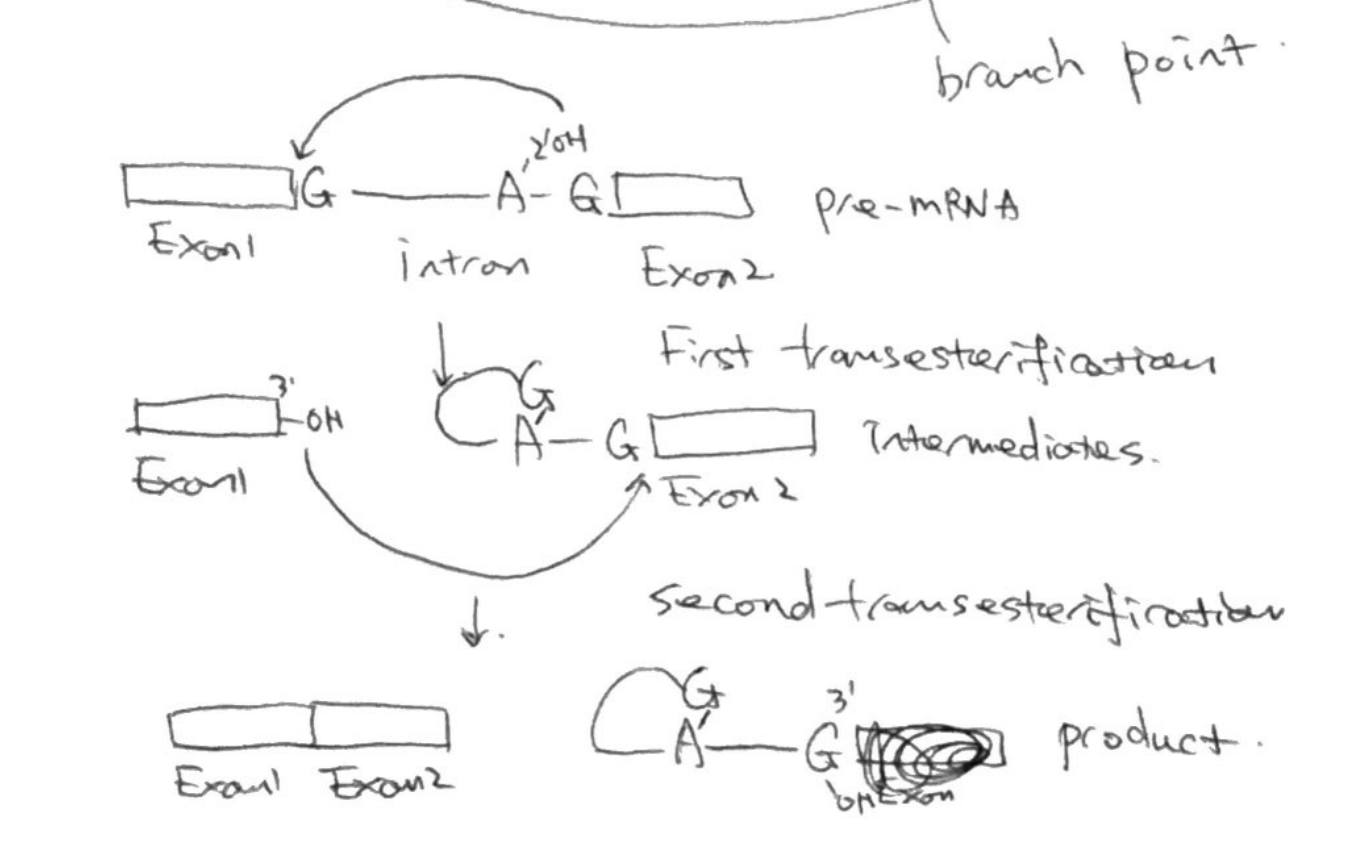
What role does spliceosome play in Intron recognition?
Spliceosome (composed of snRNAs (majority produced by Pol II besides U6 snRNA produced by Pol III) + proteins) → Form ribonucleoprotein (RNPs)
What recognizes and removes the intron?
U1 and U2 snRNAs of Spliceosome
What role does U1 play in intron recognition
Will recognize consensus sequence found in boundary between exon and intron, form complementary sequence
What role does U2 play in intron recognition
Will recognize and form bp around the branch point (but avoid the A)), U2 snRNA will bind to U2AF which required to recognize ending point of the intron
Splicing will occur once U1 and U2 snRNA identify introns and find …
5’ splice site at U1 snRNA and 3’ splice site at U2 snRNA
Steps of splicing pre-mRNA
RNA helicase (utilizes ATP, to break H bonds allowing for conformational change of spliceosome subunits) → assembly/disassembly/remodeling of spliceosome subunits → splicing
Once 5’ splice site and branch point/3’ splice site recognized, more snRNPs and will bind to these sites to form Spliceosome
Will undergo conformation change allowing branch point (A nucleotide 2’ OH group attacks phosphate sugar bond between exon and intron triggering first transesterificatrion)
Will undergo further conformational change, regenerating introns 3’ hydroxy group, this OH group will attack phosphate sugar bond between end of intron and beginning of Exon 2, triggering second transesterifcation. Cutting intron
Splicing occurs co-transcriptionally
As Pol II is transcribing mRNA, splicing is occurring as well.
Pol II CTD domain recruits Spliceosome and cuts off intron
Pol II-CTD → spliceosome (must recognize 5’splice site/3’ splice site/branch point) → Splicing
Which step in the splicing reaction would be inhibited if you generate a pre-mRNA containing a 2’ deoxy adenosine (dA) at the branch point A?
First transesterification
Functions of some Pol-III transcripts
5S rRNA → 60s subunit (large) role in translation
tRNA undergoes aminoacylated → tRNA-aa plays role in translation
U6 snRNA → Spliceosome (with snRNAs generated by Pol II) plays a role in pre-mRNA splicing
For both tRNA gene and 5s-rRNA gene the promoter is downstream of TSS, meaning transcribed during translation
Not all Pol-III downstream
What processes does pre-tRNA undergo?
5’ cleavage triggered by RNase P (Ribozyme:RNAs with enzymatic activity), splicing of introns, 3’ trimming, and base modifications
Not all ribonucleoprotein complex (RNPs) are ribozymes, which are tho…?
Spliceosomes and Ribosomes
Nuclear export
Pol I transcribed rRNA and ribosomal subunit synthesis both occurring in Nucleolus, after Ribosomes are formed are exported out of the Nucleus because function is translation and that occurs in cytoplasm
Pol II synthesize mRNA, undergoes 5’ capping, splicing, 3’ polyadenylation all occurs in Nucleus and exported out nucleus (mRNA triggers translation in cytosol and meet with ribosomes). Pol II also makes snRNAs (subunions of spliceosome, but not exported out of nucleus since splicing occurs in Nucleus. Pol II makes snoRNA which will stay in the Nucleolus and make modifications
Pol III make tRNA also apart of translation machinery thus exported to Cytosol
Nuclear export of mRNA
mRNA in the nucleus is bound to many proteins which stabilize it and export it to Cytoplasm, these proteins go back to the Nucleus and once mRNA in the cytoplasm different proteins bound to stabilize and facilitate recognition of mRNA for translation
Steps to determine amino acid sequence of protein translated
Start 5’ end at look for AUG(start codon)
Everything after considered triplet codon
Once reach UAG or UGA have reached stop codon
Genetic code
Universal across all living organisms
Reading frames
The way you analyze the RNA sequence into triplets
In vitro translation
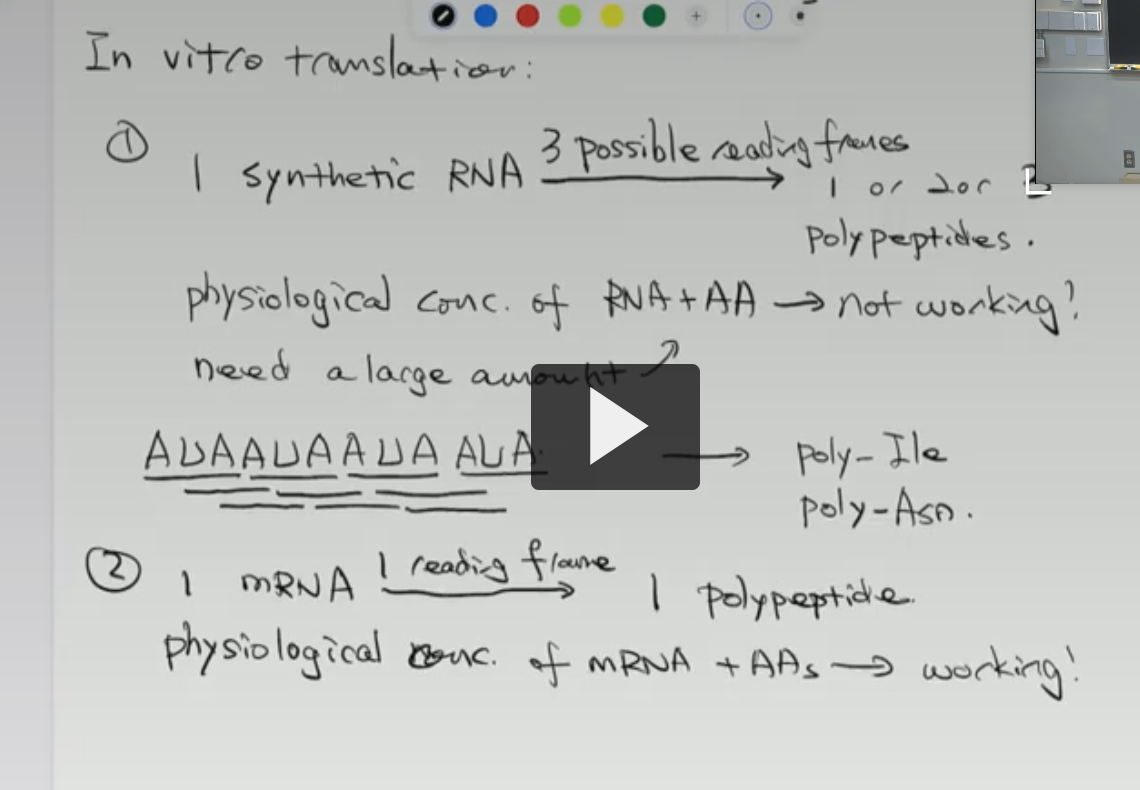
In test tube one synthetic RNA that does not have AUG, may be three possible reading frames (only possible since add abundant concentration allowing for energetically unfavorable reaction to occur)
However, under physiological conc of RNA + amino acids does not work
1 mRNA only have one reading frame (ORF) thus one polypeptide, this is energetically favorable due to 5’cap + AUG (start codon) + 3’ poly A tail
How does the cell match AA to codons?
tRNA molecule (one side nucleic acid with complementary sequence (anti-codon) and other side connect with amino acid)
tRNA transcribed by Pol III
What connects tRNA with amino acid?
Enzyme called Aminoacyl tRNA synthetase (one pocket match with amino acid and other pocket with tRNA)
Amino acid is connected at 3’ end of tRNA
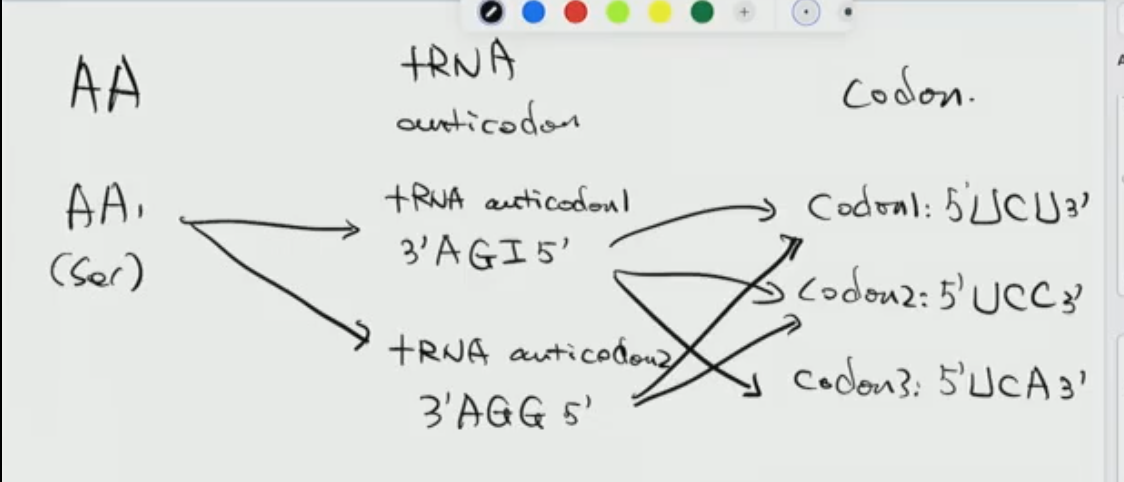
Interesting thing about tRNA anti-codon is that third bp doesn’t need to be complementary (wobble position allows G-U, I-C, I-A, I-U) (I is modified A)
There are 30-50 anti-codons tRNAs, for amino acids have 61 (64 codons in total, but 3 are stop codons)
1 tRNA synthetase → multiple different tRNAs
1 anticodon → different codons
1 codon → different anti-codonds
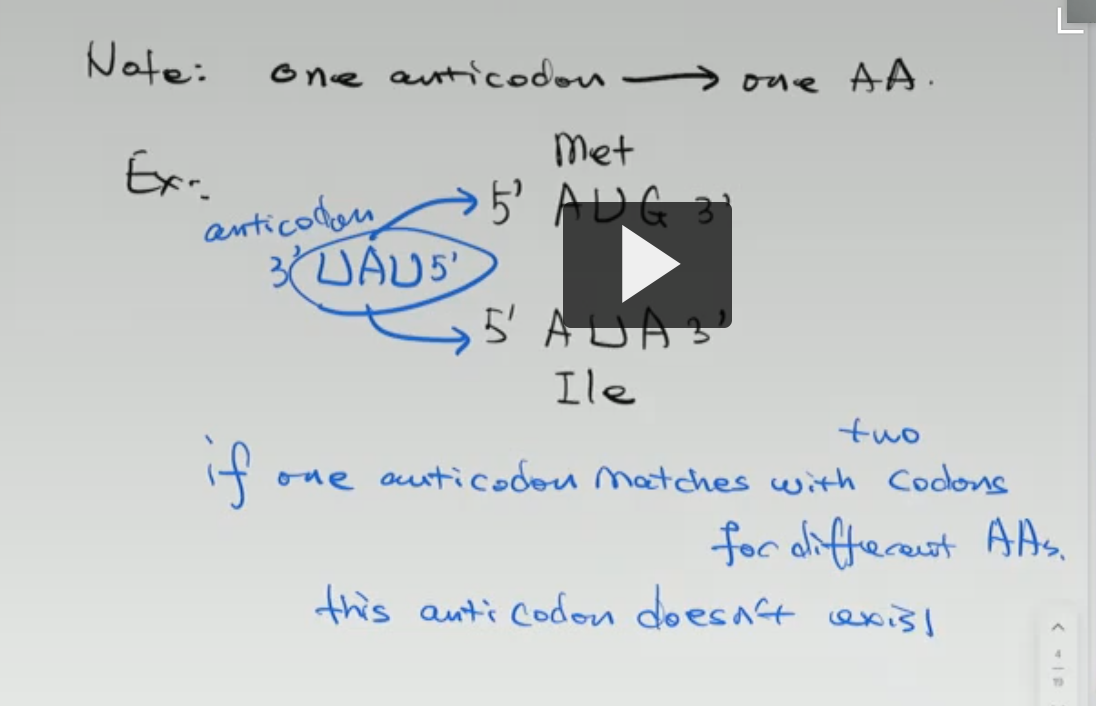
However, one anticodon can only match with one amino acid
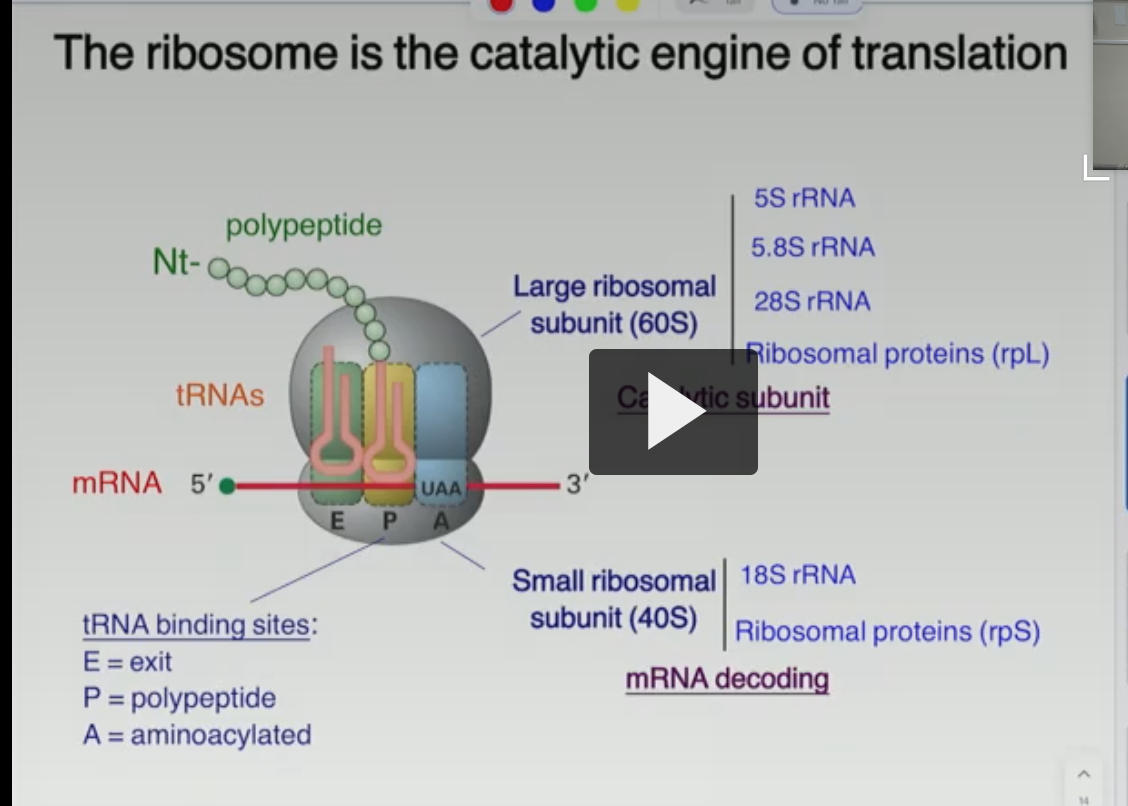
Translation machinery structure
GTP is the energy source
Stepwise synthesis of translation
Initiation, Elongation, Termination
Initiation (pre-Initiation complex)
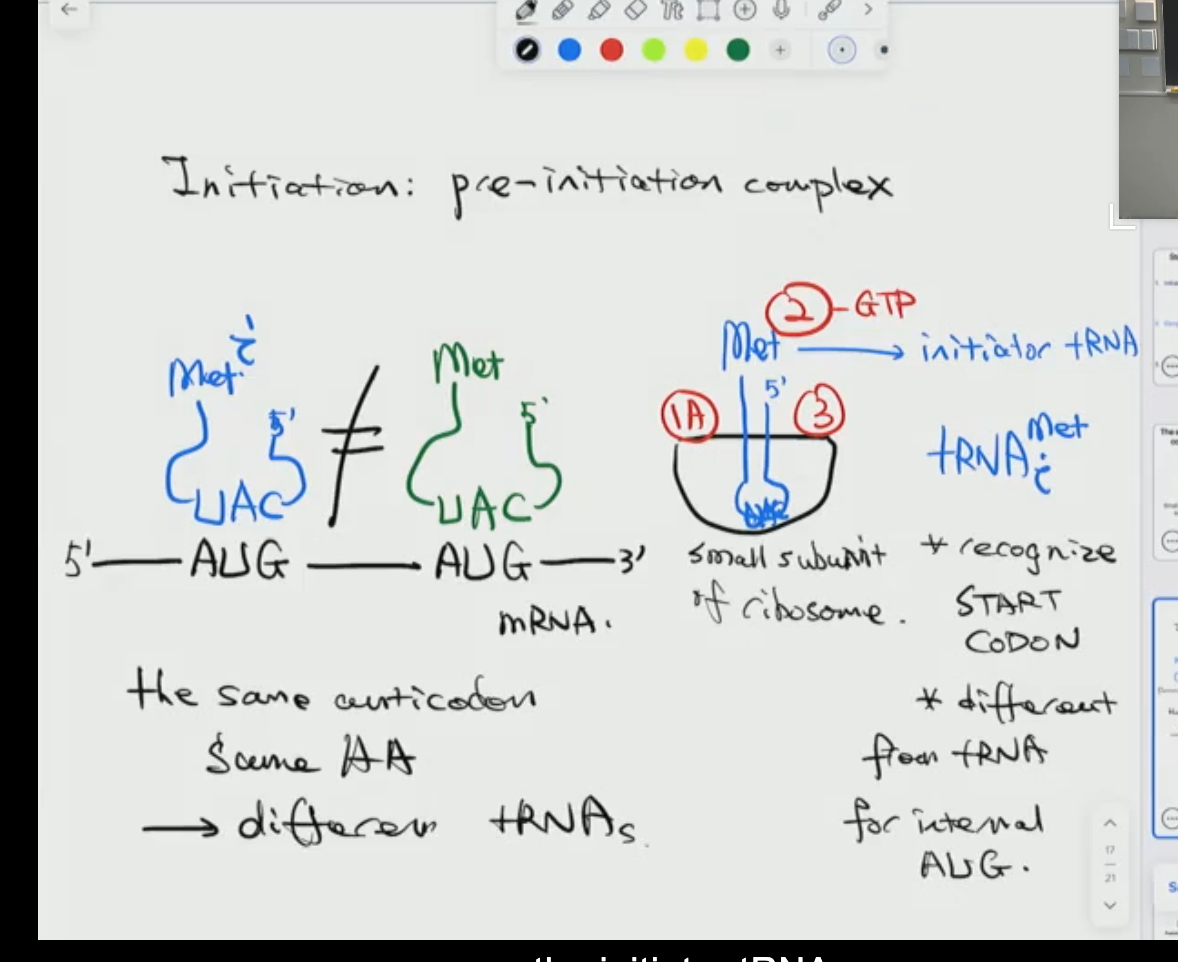
Translation Initiation process
Pre-initiation complex (small ribosomal unit) recruited by 5’ cap and poly A tail to mRNA
Starts at 5’cap and scan through mRNA and once meet start codon will stop there and recruit large subunit ribosome for Elongation
Translation elongation process
initiator tRNA found in P pocket, when P pocket matches with AUG (Met, start codon) and than will recruit next tRNA through elongation factor into pocket A, once tRNA in pocket A large subunit will catalyze reaction so first amino acid release from first tRNA and will be connected to second amino acid (thus connected to second tRNA), ribosome will move towards the right codon, first tRNA will enter E (exit pocket) and second tRNA moves to P pocket, and repeat
Translation termination process
A pocket matches with one of three stop codon, there will be a protein similar to tRNA that will enter A pocket called release factor 1 and 3 (why stop codon is not translated and instead ribosomal unit dissociates)