Pharmacokinetics/dynamics
 Call Kai
 Learn
Learn Practice Test
 Spaced Repetition
 Match
Match Flashcards
 Knowt Play
1/98

There's no tags or description
Looks like no tags are added yet.
Name | Mastery | Learn | Test | Matching | Spaced | Call with Kai |
|---|
No analytics yet
Send a link to your students to track their progress
99 Terms
What are the two types of administration for drugs?
Enteral and parenteral
Enteral
through the alimentary canal
Parenteral
through alternate routes
What are the advantages of oral administration?
Safe, easyW
What are disadvantages of oral administration?
Some drugs can be difficult to absorb or broken down too quickly, can cause stomach irritation, subject to first-pass effect, less predictable rate or absorption
First-pass effect
drug is absorbed from small intestine, transported to liver and metabolized before entering systemic circulation
Special case for oral administration
extended release formula
What is the saying for by mouth?
per orum or PO
What is sublingual or buccal administration?
drug placed under the tongue (sublingual) or between the cheek and gums (buccal) to be absorbed through the oral mucosa into venous system
What are the advantages of sublingual and buccal administration?
No first-pass effect, fast, easier than oral or rectal
What is a disadvantage of sublingual and buccal administration?
Limited amounts can be absorbed this way
What are advantages of rectal administration?
Useful if patient is unconscious or has profuse vomiting or for local conditions
What are disadvantages of rectal administration?
Some drugs are not absorbed well through rectum, rectal mucosa
What are the three types of enteral administration?
Oral, sublingual/buccal, and rectal
What are advantages of administration of drugs via inhalation?
Useful for drugs that are gases or in aerosol form, large surface area for absorption, fast entry into bloodstream
What are disadvantages of pulmonary administration?
Some drugs can irritate the respiratory tract or become trapped, difficult to predict how much drug will reach the target tissue, can be difficult to self-administer for some patients,
What are the four types of injection administration?
Intravenous (IV), intra-arterial, subcutaneous (SC or subQ), intramuscular (IM)
What are disadvantages of administration via injection?
Must maintain sterility, not all can be self-administered
Bolus
accurate quantity of drug, delivered in a short time
What are advantages of IV administration?
Reaches target site quickly with accurate concentration of drug
What is disadvantage of IV bolus administration?
Can result in more adverse reactions
What are advantages of IV drip administration?
Prolonged, steady infusion via IV cannula, maintains specific level without fluctuations
Why is intra-arterial administration considered dangerous and difficult?
High pressure
Risk of thrombosis, gangrene, ischemia, limb loss
Direct toxicity
Deep and painful access
Subcutaneous administration
Injection of medication directly beneath the skin used for local response or slow systemic release
What is an advantage of subQ administration?
Self-administration often feasibleWha
What is a disadvantage of subQ administration?
Amount of drugs is low
What are intramuscular administration useful for?
Local treatment or prolonged release
What is a disadvantage of intramuscular administration?
Can cause pain and muscle soreness
Intrathecal administration
delivery of medication within a sheath
What are examples of location for intrathecal administration?
Subarachnoid or epidural space
What does intrathecal administration allow for>
Local delivery to spinal cord, bypass of blood-brain barrier to treat CNS
What are advantages of topical or mucous membrane topical use?
Well-absorbed, useful for local conditions on skin
What are disadvantages of topical administration?
Often poorly absorbed through skin, can cause adverse systemic effects if large amount of drug is absorbed
Transdermal administration
applying drugs directly to surface of skin with intent of absorption through dermal layers and into subcutaneous tissues or peripheral circulation
What are methods of transdermal administration?
Patch, iontophoresis, phonophoresis
Iontophoresis
via electric current
Phonophoresis
via ultrasound
What is a disadvantage of transdermal administration?
Drug must penetrate skin and not degrade in dermis
Absorption
entry of drug into body
Bioavailability
extent to which the drug reaches the systemic circulation or percent of administered drug that reaches bloodstream
What are two variables that bioavailability depends on?
Route of administration and drug’s membrane permeability
Distribution
movement of drug to target site
What are factors affecting distribution?
Membrane/tissue permeability, blood flow, binding to plasma proteins, binding to subcellular compartments
Describe the equation for the volume of distribution
amount of drug administered over the concentration of drug in plasma
If the volume of distribution is equivalent to the body fluid volume, what would the concentration of drug in plasma be?
Uniform distribution
If the volume of distribution is less than the body fluid volume, what would the concentration of drug in plasma be?
retained in plasma
If the volume of distribution is greater than the body fluid volume, what would the concentration of drug in plasma be?
Sequestered in tissues
What are possible adverse consequences of drug storage?
Toxicity leading to local damage, reservoir effects, may not reach target or possible drug redistribution much later
Biotransformation
chemical changes that take place in the drug after administration
What is the altered version of the drug following biotransformation called?
Metabolite
Where does biotransformation primarily occur?
Liver
What are the three types of reactions that can occur in phase I of biotransformation?
Oxidation, reduction, hydrolysis
Oxidation
addition of oxygen or removal of hydrogen
Reduction
removal of oxygen or addition of hydrogen
Hydrolysis
water molecule reacts to breakdown chemical bonds
What reaction occurs in phase II of biotransformation?
Conjugation
Conjugation
coupling of drug or phase I metabolite to another substance
Enzyme induction
prolonged drug use enables enzymes to more easily break down the drug
What can enzyme induction result in?
Tolerance and need to take higher dose of drug to produce same effect
Elimination
needed to terminate drug’s effects and remove it from body
Excretion
removal of drug from body primarily by kidneys
How does biotransformation help excretion occur?
Creates polar, water-soluble metabolite
Clearance
systemic or organ-specific ability to eliminate a drug
Describe the systemic clearance equation
Rate of drug elimination divided by the concentration of the drug in plasma
Describe organ-specific clearance
The difference between the concentration of drug entering an organ and concentration leaving organ is multiplied by the blood flow to the organ and the product is divided by the concentration entering the organ
Half-life
amount of time necessary for 50% of drug remaining to be eliminated
What are factors that affect half-life?
Clearance and volume of distribution, can all be affected by disease states
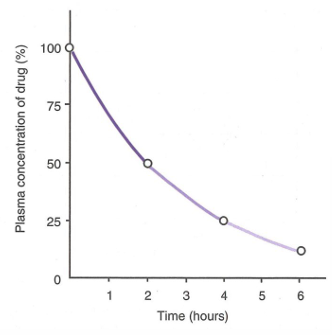
When would there be 25% of the drug left?
4 hours
Loading dose
a large initial dose to rapidly achieve a therapeutic level
What factors affecting drug response and elimination?
Genetics, disease, drug interactions, age, diet, sex, environmental
How may age affect drug response and elimination?
Elders have slower metabolism
Receptor
the component of a cell that interacts with a drug and initiates the chain of biochemical events leading to drug’s observed effects
Surface receptors linked directly to ion channels
Change membrane permeability and, when bound to drug, receptor activates and opens pore
Surface receptors linked directly to enzymes
extracellular receptor site and intracellular enzymatic component with a binding and catalytic domain
Surface receptors linked to regulatory (G) proteins
Receptor links to G protein to activate it and activated G protein alters activity of an intracellular effector
Intracellular receptors
Endogenous hormone or hormone-like drug binds to receptor in cytoplasm or nucleus, then the complex moves to nucleus to affect gene expression
What affect do intracellular receptors generally have?
On gene expression
Affinity
amount of attraction of drug for the receptor
How is affinity measured?
by amount of drug needed to bind to unoccupied receptors
Allosteric modulators
local regulators that can bind to receptor at a different site and change the affinity of a drug for the receptor
What factors do the drug’s ability to bind to a receptor depend on?
drug’s size and shape relative to receptor’s binding site
Describe the affect of a selective drug on cells/tissues and its response
Affects only one type of cell or tissue and produces a specific physiological response
Describe the affect a nonselective drug has on cells/tissues and its response
Affects multiple cells or tissue types and has beneficial effects and non-beneficial effects on
What is the dose-response curve shape related to?
Number of receptors bound by the drug
Agonist
drug that binds receptor and causes a change in the cell’s function
Differentiate between a full versus a partial agonist
Full agonist cause maximal response while partial agonist do not cause maximal response
Describe why the difference in efficacy between full agonists and partial agonists may be important
Since full agonists can achieve the maximum possible biological effect, they may be used for conditions requiring a significant physiological effect. Partial agonists only produce a submaximal response and are used to minimize side effects and maximize therapeutic benefits.
Antagonist
drug that binds receptor but does not cause a functional response
Competitive antagonist
competes with agonist to occupy same receptor
Noncompetitive antagonist
forms strong, permanent bond to receptor
Mixed agonist-antagonist
drug that acts as an agonist on some receptor subtypes and an antagonist on others (double agent)
Inverse agonist
drug that binds to the same receptor as agonist but has opposite effect on cellular function
Desensitization
brief, transient decrease in receptor responsiveness
What is an example of why desensitization may occur?
Receptor modification such as phosphorylation
What receptor regulation is the opposite of desensitization that allows for a brief transient increase in receptor responsiveness?
Super-sensitivity
Down-regulation
slower, more prolonged process that decreases number of available receptors
What are examples of why down-regulation may occur?
Increased removal of drug/receptor or decreased synthesis
What is the opposite of the process that decreases number of available receptors?
up-regulation
What are ways drugs may cause a response without binding to a receptor?
Alter synthesis of cell components, direct chemical reactions, direct alteration of enzyme function, chelation of harmful agents