MAME Exam 3 Review
 Call Kai
 Learn
Learn Practice Test
 Spaced Repetition
 Match
Match Flashcards
 Knowt Play
1/7

Earn XP
Description and Tags
Quizzes and In class discussions
Name | Mastery | Learn | Test | Matching | Spaced | Call with Kai | Chat |
|---|
No analytics yet
Send a link to your students to track their progress
8 Terms
Based on the introductory material in Chapter 6, and revisiting what you learned in Chapter 1, you should now know the main metabolic strategy of primary producers before cyanobacteria came to be. What was the metabolic strategy of these early primary producers 3,500,000,000 years ago?
anaerobic anoxygenic photosynthesis
Since the CBB cycle accounts for ~99% of global primary production, you can use that fact to "design" your strategy for finding out if a section of ocean is net autotrophic or net heterotrophic by using "omics" methodologies combined with other methods.
But if you want to use just nucleic acids methods to get a rough idea of the abundances and activity of photoautotrophs in the ocean, which one is the BEST strategy to get an idea of net autotrophy or net heterotrophy in the ocean at the time you collect the sample?
Collect all RNA, do a metaranscriptomics study to find all the expressed genes, focusing on the Rubisco gene sequence, and plot the relative abundance of the Rubisco transcripts compared to heterotorphy-related enzymes (e.g. chitinases). Plot and summarize data as in Laiolo et al. Figure 2 and Table 5.
Coccolithophorids are important contributors to the “hard” part of the biological pump because they produce calcium carbonate (CaCO₃) shells that sink to the deep ocean, whereas other phytoplankton mainly contribute to the “soft” carbon pump by producing organic matter. If ocean acidification reduces coccolithophorid success, what is the most likely consequence for the biological pump and long-term carbon sequestration?
The efficiency of the biological pump would decrease because less inorganic carbon (CaCO₃) would be transported to the deep ocean sediments.
As said by oceanographer A. Bigelow, “all fish is diatoms,” similarly to what was said in a poem by Walt Whitman (who took the line from the Bible, Isaiah 40:6, repeated by Peter, 1 Peter 1:24-25): "All flesh is grass, and all its beauty is like the flower of the field." Even though diatoms are responsible for most of the “spring blooms” in lakes, estuaries, and near shore, the coccoid cyanobacteria (Synechococcus and Prochlorococcus) are responsible for more global primary production than the diatoms. Photosynthetic picoeukaryotes, along with the coccoid cyanobacteria, make up the “picophytoplankton.” Picoeukaryotes are very small eukaryotic algae that also contribute greatly to oceanic primary production (see Fig. 6.12, panel A). Why are picoeukaryotes more successful than diatoms in the oligotrophic open ocean?
Picoeukaryotes have smaller cell sizes and higher surface area–to–volume ratios, giving them an advantage in acquiring scarce nutrients. This is especially important in oligotrophic ecosystems where nutrient concentrations are low.
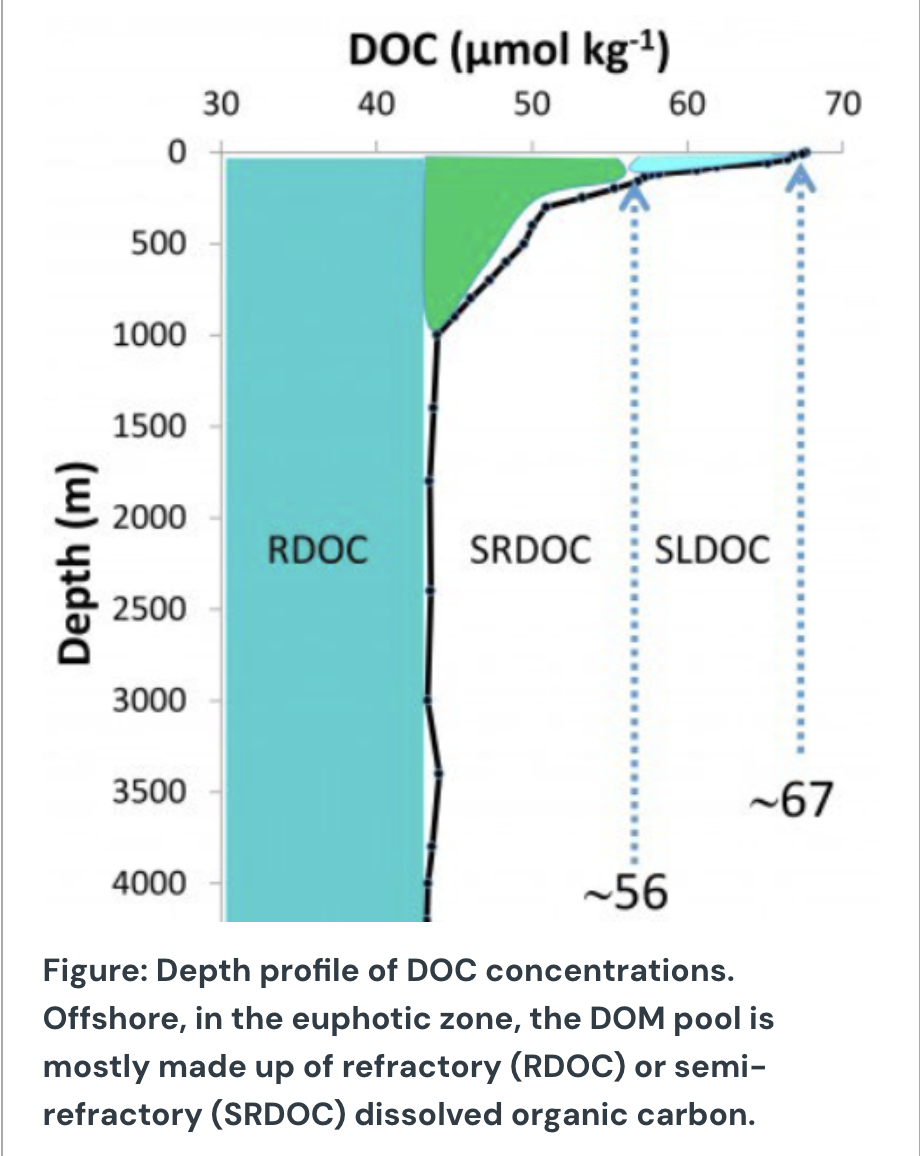
Estuarine waters are typically rich in labile organic matter from terrestrial and phytoplankton sources, while the pool of OM in offshore oceans is mostly made up of refractory material, since offshore, most newly-synthesized labile material is mineralized very quickly (see Figure).
Heterotrophic bacteria in both habitats use extracellular enzymes to break down complex organic molecules before uptake. Which of the following best explains how extracellular enzymatic activity in the bacterial communities, and their organic matter degradation rates, would differ (or be the same) between these environments?
Estuarine bacterial communities show higher extracellular enzyme activity and faster degradation rates because they encounter more labile substrates, while offshore bacterial communities have slower degradation rates due to the dominance of refractory carbon.
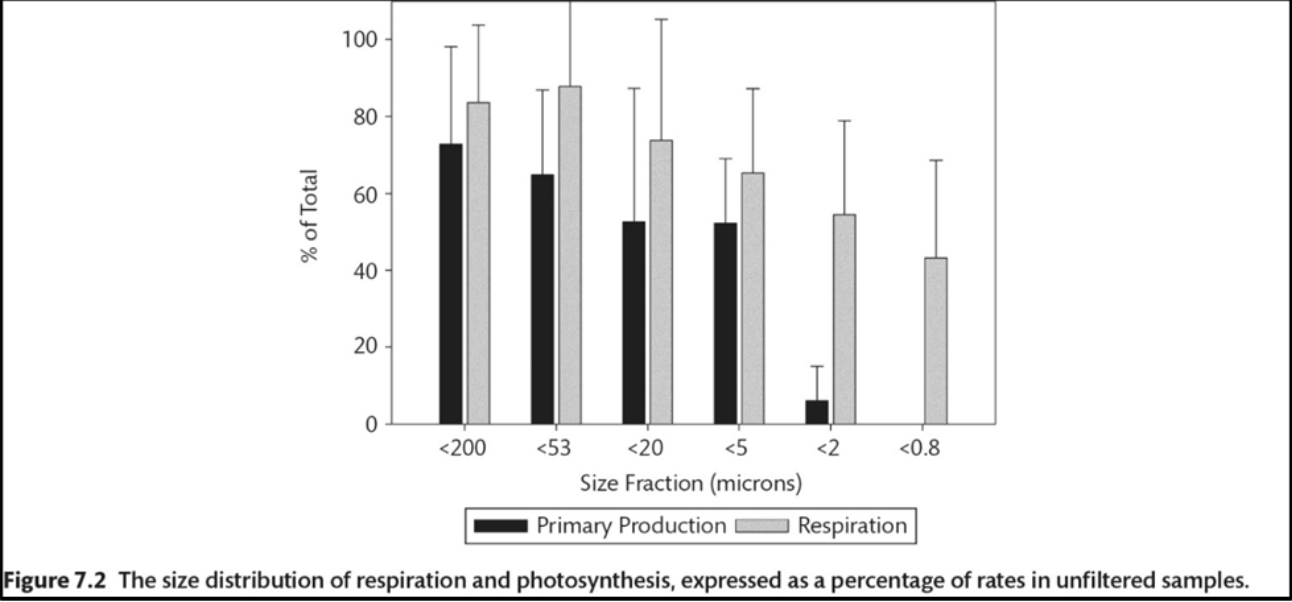
See figure below from the book. This shows the size distribution of respiration and photosynthesis, expressed as a percentage of rates in unfiltered samples. Knowing what you know about distribution of photoautotrophic microbes and size ranges of all types of microbes, then you know that the data are from ______________. Hint, remind yourself of the sizes of the various types of autotrophs by looking at the size ranges in Figure 1.8.
Open ocean environments, where primary production by cyanobacteria and small eukaryotic phytoplankton is high and where diatoms+dinoflagellates are less important to C fixation.
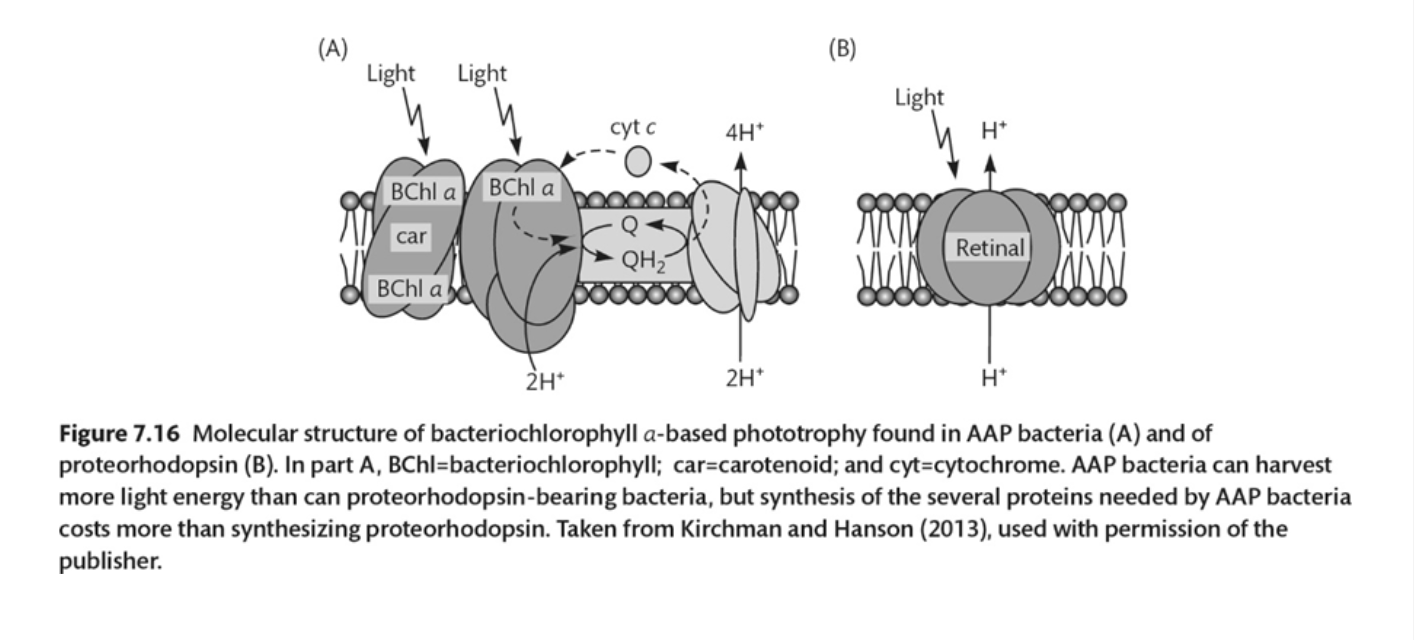
See figure below from the book. AAPB (AAP bacteria) are found in a wide range of aquatic habitats, but not in high abundances, except in estuaries. On the other hand, proteorhodopsin bacteria, such as many in the SAR11 clade, are also ubiquitous and abundant in most waters, including in the oligotrophic oceans. Why the difference, since both types use light for extra energy to support a heterotrophic lifestyle?
The per-cell energy gained by proteorhodopsin-based phototrophy is lower than the energy yield gained from light by the AAPB. However, the amount of energy required to make the proteorhodopsin molecule and the retinal is low, compared to energy needed to put together the transmembrane complex in AAPB
Biogeochemists and microbial ecologists collected microbial biomass from seawater samples near an oil rig, and extracted both DNA and RNA from the filters. Fortunately, they were able to collect samples from just prior to, and right after, a maajor offshore oil spill, so they went right to work on doing extensive analyses of the DNA and RNA to study microbial community responses to the oil spill. They used both metagenomic and metatranscriptomic analyses. How could comparing these datasets help evaluate functional gene diversity and metabolic redundancy among marine bacteria, and what would be the most informative interpretation?
Metagenomics reveals which metabolic genes are present, showing potential pathways for hydrocarbon degradation, while metatranscriptomics indicates which of those genes are actively expressed, allowing researchers to distinguish between redundant potential functions and actual functional responses after the spill.