lizards and snakes of Ontario
 Call Kai
 Learn
Learn Practice Test
 Spaced Repetition
 Match
Match Flashcards
 Knowt Play
1/13

There's no tags or description
Looks like no tags are added yet.
Name | Mastery | Learn | Test | Matching | Spaced | Call with Kai |
|---|
No analytics yet
Send a link to your students to track their progress
14 Terms
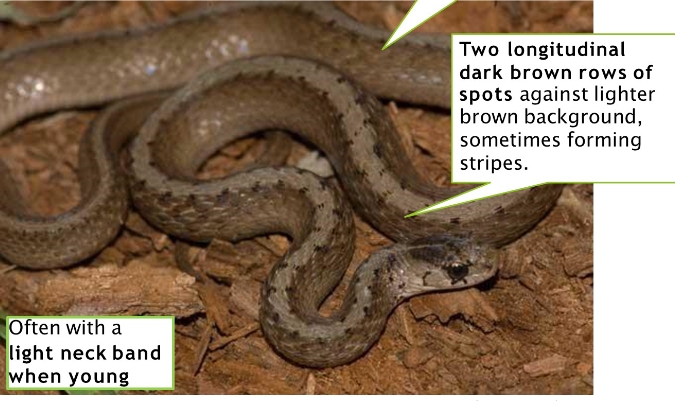
Common snake that occurs in forested regions
and can be found in diverse habitats:
• Forests
• Wetlands
• Forest clearings
• Edge habitats
• Urban areas.
• Spends much of its time under logs, rocks,
boards, leaves and other cover.
• Overwinter communally underground or in
building foundations.
• Primarily nocturnal, though they may be active
during the day.
• Eat a variety of food: invertebrates such as
insects, slugs and earthworms, and
occasionally small fish or amphibians
DEKAYS BROWNSNAKE
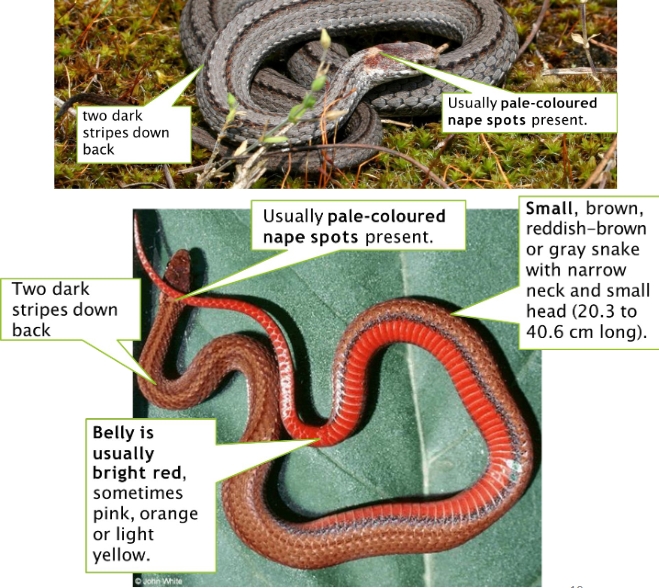
Generally found in forest edge habitat,
fields and meadows with abundant ground
cover, such as logs, rocks, scrap piles and
building foundations.
• Rarely occurs in areas with little forest
cover.
• Overwinter underground below the frost
line.
• Nocturnal.
• Eat invertebrates such as slugs,
earthworms, snails, grubs and insects.
• Will threaten potential predators by
exposing its bright red belly or flattening
itself and curling the edges of its mouth
outward.
• Warning colouration is called...aposematism
RED-BELLIED SNAKE
Slender, fast moving, diurnal snakes.
• Food is not constricted, rather a loop of
the body presses down on the prey.
• Eggs are coated with small nodules
resembling salt grains.
• Scales smooth and anal scale divided.
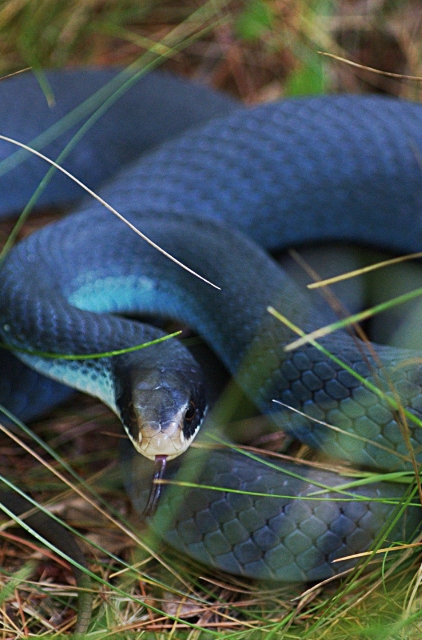
• One species in Ontario, the Blue Racer:
• Second largest snake in Ontario.
Only blue-coloured snake in
Ontario.
• Only found on Pelee Island in
recent years.
• Listed as Endangered (SARO and
SARA)
BLUE RACER
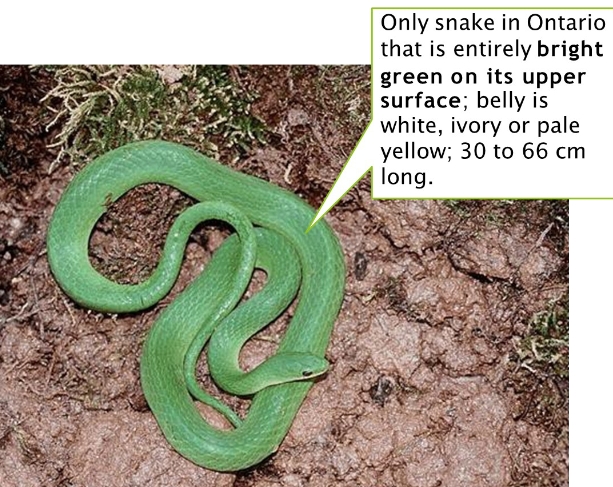
Found in a variety of habitats,
including prairies, meadows, fields,
wetland edges, forest clearings and
open woodlands.
• Arboreal, it can often be found
sunning itself on upper branches of
shrubs, also under cover, such as
logs, rocks and boards.
• Good reminder to look up
when doing snake surveys.
• An insectivore that eats caterpillars,
spiders, crickets, and other insects
SMOOTH GREENSNAKE
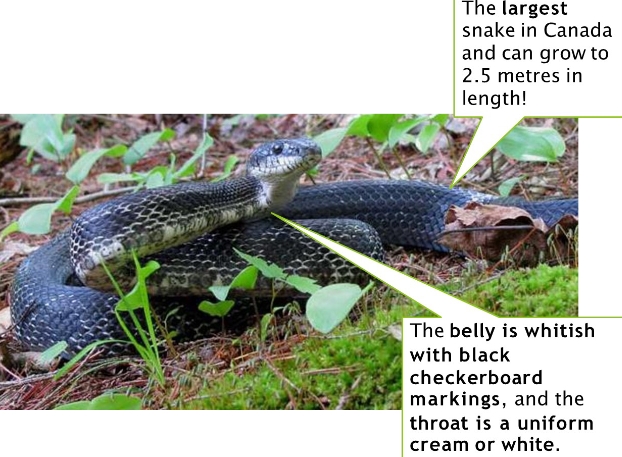
The largest snake in Canada and can
grow to 2.5 metres.
• Inhabits forests and wooded areas but
may spend part of the summer in open
areas, such as old fields or meadows.
• Frequently climbs trees to eat bird eggs
or nestlings. It also eats small mammals
and frogs. In eastern Ontario, ratsnakes
hibernate communally in rocky outcrops.
• Carolinian population listed as
Endangered (SARO and SARA).
• Frontenac Axis or Great Lakes/St.
Lawrence population is listed as
Threatened (SARO and SARA)
GRAY RATSNAKE
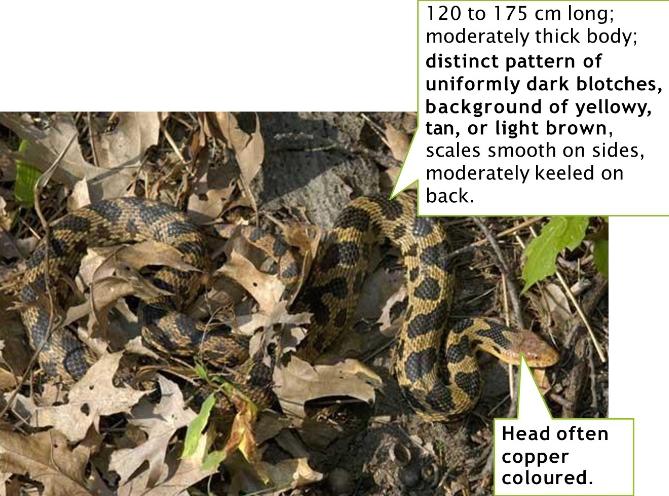
Found in habitats such as shorelines, prairies,
savannahs, rock barrens and wetlands, and are
most commonly found in shoreline edge habitats.
• Less arboreal than other ratsnakes, but can climb
trees and have been found up to 10 m above the
ground.
• Vibrates its tails when threatened which makes a
rattling sound when it contacts dry vegetation.
• Eat mainly small mammals, as well as bird eggs or
young birds.
• Overwinter in communal underground hibernacula
such as crevices, mammal burrows and in human-
made features such as old wells and foundations.
• Carolinian population listed as Endangered (SARO
and SARA).
• The Georgian Bay or Great Lakes/St. Lawrence
population is listed as Threatened (SARO) and
Endangered (SARA)
EASTERN FOXSNAKE
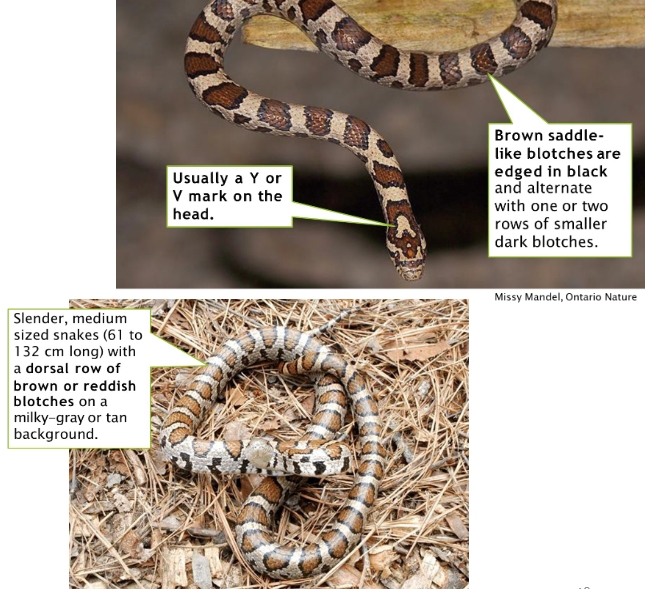
Found in a variety of habitats but tend to
use open habitats such as rocky
outcrops, fields and forest edges. In rural
areas, this snake may be common
especially around barns (they do not
consume milk!).
• Hibernates underground, in rotting logs
or in the foundations of old buildings.
• When threatened it will vibrate its tail
and when the tail comes into contact
with dry vegetation, a buzzing or
“rattling” sound may be made. This
behaviour, combined with the snake’s
blotchy patterning, causes many people
to mistake it for a rattlesnake.
• Listed as Special Concern (SARA)
EASTERN MILKSNAKE
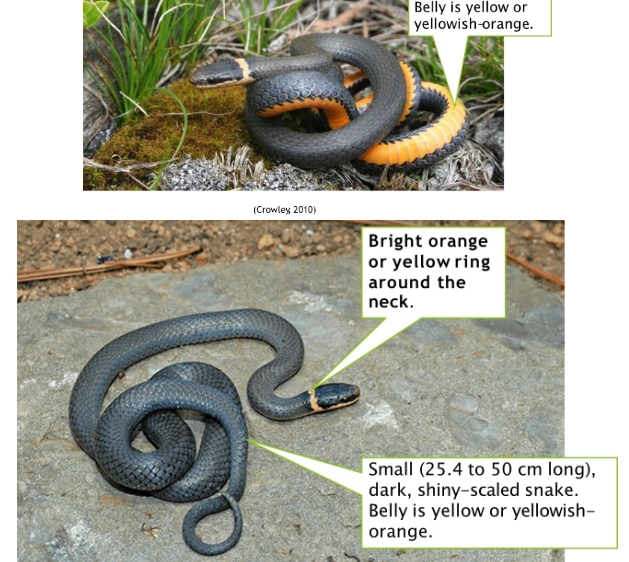
Found in forested areas, including
forest edges and clearings. Most
common in areas with shallow soil and
surface bedrock, where they are
frequently found under rocks, logs or
bark.
• Eat salamanders, specifically the Red-
backed Salamander, which they
suffocate through constriction. They
will also eat other amphibians, slugs,
earthworms and insects.
• Nocturnal.
• Hibernate underground and will also
retreat underground during especially
warm weather
NORTHERN RING-NECKED SNAKE
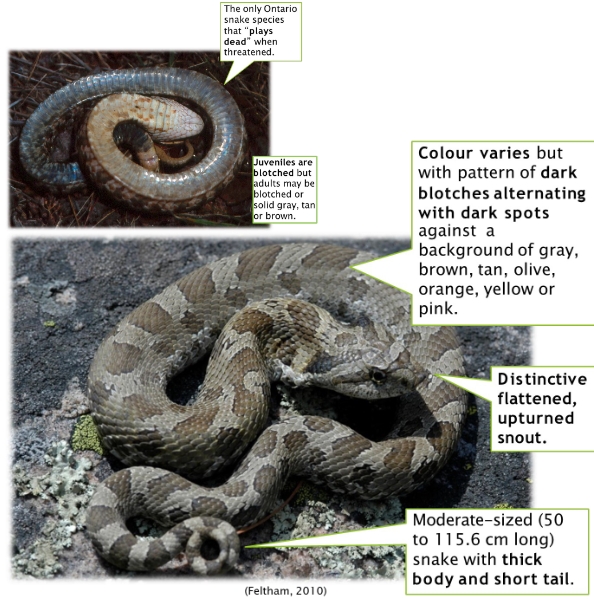
Inhabits fields, forests, shrubland,
beaches and old dune habitats with
sandy, well-drained soils, into which this
snake burrows.
• Commonly encountered on beaches due
to its affinity for open, sandy areas.
• Uses very mild venom to immobilize its
prey. As it swallows its prey, the snake
injects its venom through fangs at the
back of its mouth. This species cannot
inject venom into larger animals such as
humans unless allowed to hold on (e.g.,
to a hand or finger) for some time. Its
venom is not dangerous to humans.
• Listed as Threatened (SARO and SARA
EASTERN HOGNOSE SNAKE
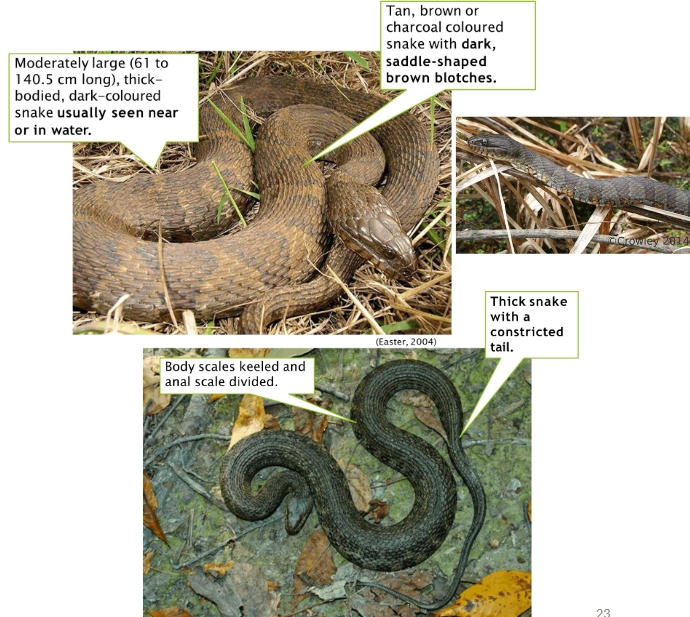
Found in and around almost any permanent body
of fresh water within its range, including lakes,
rivers and wetlands. Rarely far from shoreline
habitats.
• Hibernate underground in dens or crevices, or in
beaver lodges.
• Eats fish and amphibians, hunting for its prey along
the water’sedge or underwater. It is an excellent
swimmer.
• Frequently basks in the open, often in large groups
and is active dayand night.
• Harmless, but will bite in self-defence if they are
captured. Their bite can cause mild bleeding
because the snake’s saliva contains an
anticoagulant.
• One of two subspecies of Common Watersnake
found in Ontario
NORTHERN WATERSNAKE
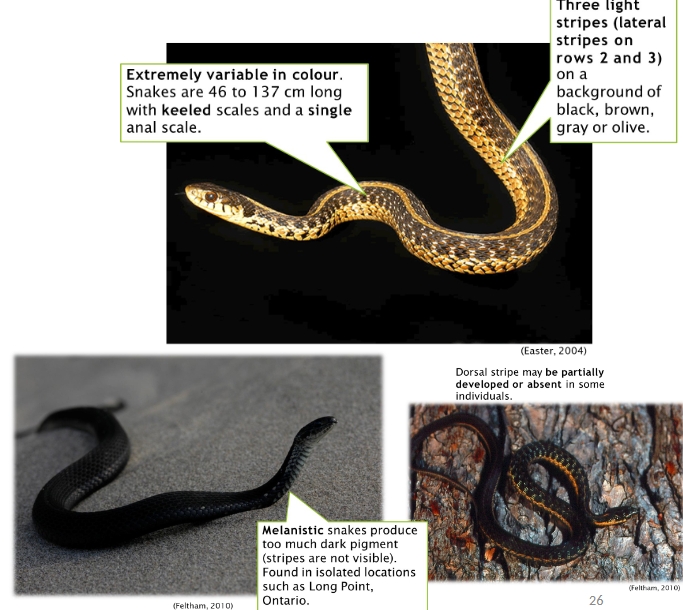
Habitat generalists: can be found in forests,
shrublands, wetlands, fields and rocky areas
and human-dominated landscapes.
• Most commonly encountered snake in most
parts of its range.
• Eat a wide variety of food, including frogs,
toads, salamanders, earthworms, small fish
and mice.
• Hibernate underground in burrows, rock
outcroppings or the foundations of old
buildings. In some areas, hundreds or even
thousands of Eastern Gartersnakes hibernate
communally.
• Eastern Gartersnake and the Red-sided
Gartersnake are subspecies of the Common
Gartersnake
EASTERN GARTERSNAKE
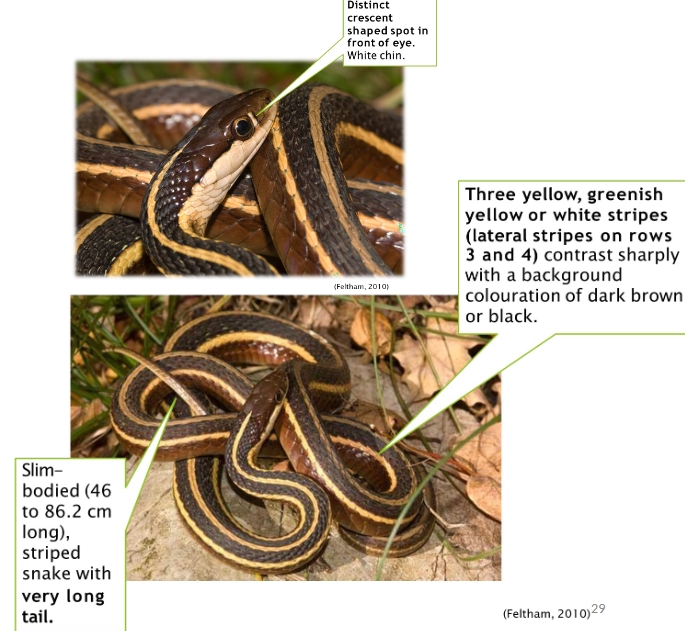
Semi-aquatic and is almost always found
close to water, such as wetlands and the
shorelines of lakes and rivers.
• Wetland and shoreline habitats generally
near forests are preferred and this species
tends to be absent from regions with little
to no forest cover.
• Active during the day and feed primarily on
amphibians, particularly frogs.
• An adult female gives birth to between five
and 12 live young in late summer. The
newly born snakes are independent and
begin hunting for insects to eat almost
immediately.
• Listed as Special Concern (SARO and SARA).
• Keeled scales and single anal scale
EASTERN RIBBONSNAKE
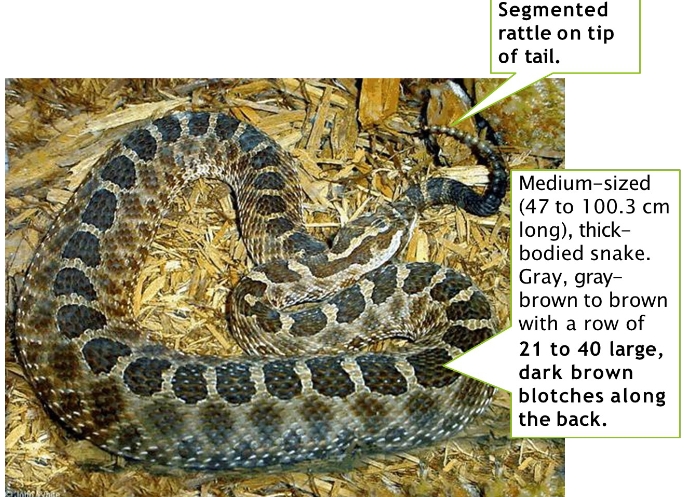
Pygmy rattlesnake (set of 9 plates on crowns of
head). Most adults are only 60 to 75 cm long.
• Can see thermal images of its environment using
two heat- sensitive pits between its eyes and
nostrils.
• Most easily identified by its rattle, which is made
up of interlocking segments that are added one by
one when the snake sheds its skin, one to three
times a year.
• Generally associated with water, are rarely found
more than 50 km from the Great Lakes, and often
inhabit wetlands near rivers.
• Frequently killed on sight, out of fear.
• The Carolinian population is listed as Endangered
(SARO and SARA).
• Great Lakes - St. Lawrence is listed as Threatened
(SARO and SARA)
MASSASAUGA (RATTLE SNAKE)
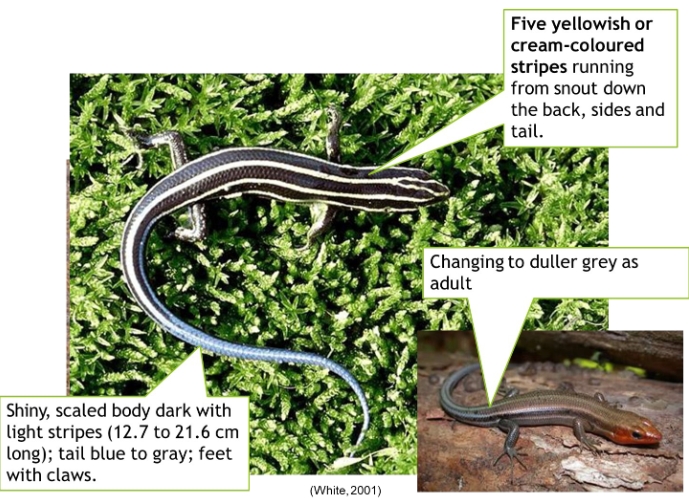
There is only one lizard species found in Ontario, the
Common Five-lined Skink.
• Most skinks are terrestrial and forage by day and take
shelter at night.
• Great Lakes–St. Lawrence population are typically
found in forest openings; specifically large rock
outcrops.
• Along the Lake Erie shoreline, where the Carolinian
population lives, they inhabit open forests, small
meadows, beaches and stabilized sand dunes.
• Skinks hibernate in groups under rocks or tree stumps
and in rotting wood. Like many lizards, if a predator
catches a skink by the tail, it will break off and begin to
thrash about.
• The Carolinian population is listed as Endangered
(SARO and SARA) and the Great Lakes-St. Lawrence
(Southern Shield) population is listed as Special
Concern
COMMON 5 LINED SKINK