Archea and Bactera Quiz Prep - Prokaryote
 Call Kai
 Learn
Learn Practice Test
 Spaced Repetition
 Match
Match Flashcards
 Knowt Play
1/69

There's no tags or description
Looks like no tags are added yet.
Name | Mastery | Learn | Test | Matching | Spaced | Call with Kai |
|---|
No analytics yet
Send a link to your students to track their progress
70 Terms
Prokaryote
A single-celled organism that lacks a nucleus and membrane-bound organelles.
Characteristics of Prokaryotes
Single-celled, no nucleus, no membrane-bound organelles, reproduce by binary fission.
Archaea (Archaebacteria)
Prokaryotes that often live in extreme environments and do not contain peptidoglycan in their cell walls.
Eubacteria (Bacteria)
Prokaryotes with peptidoglycan in their cell walls that are found in almost every environment.
Peptidoglycan
A molecule that gives bacterial cell walls strength and rigidity.
Difference between Archaea and Eubacteria
Archaea lack peptidoglycan; Eubacteria contain peptidoglycan.
Pathogenic Archaea
None are currently known.
Extremeophile
An organism that lives in extreme environmental conditions.
Methanogens
Archaea that produce methane gas from hydrogen and carbon dioxide.
Where are Methanogens found?
wamps, sewage, sediments, and the digestive systems of animals.
Halophiles
Archaea that live in very salty environments.
Where are Halophiles found?
Salt lakes, salt ponds, and highly salty soils.
Thermoacidophiles
Archaea that live in hot, acidic environments.
Psychrophiles
Archaea that live in very cold environments.
Examples of energy sources used by Archaea
Hydrogen, ammonia, sulfur compounds, and metals.
Autotroph
An organism that makes its own food.
Photoautotroph
Uses sunlight to make food.
Chemoautotroph
Uses chemical energy to make food.
Heterotroph
An organism that obtains food from other organisms.
Phototroph
Gets energy from sunlight.
Chemotroph
Gets energy from chemicals.
Capsule
A protective outer layer that helps bacteria avoid drying out and resist immune defenses.
Cell Wall
Provides shape and protection to the cell.
Cell Membrane
Controls what enters and leaves the cell.
Order of Bacterial Structures (outside to inside)
→ Capsule → Cell Wall → Cell Membrane.
Flagellum
A whip-like structure used for movement.
Function of Flagellum
Allows bacteria to move.
Endospore
A dormant, highly resistant structure formed by some bacteria during harsh conditions.
Purpose of Endospores
To survive extreme conditions and preserve genetic material.
Do Archaea form Endospores?
no
Do some Bacteria form Endospores?
yes
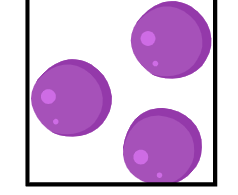
Coccus
Spherical bacterium.

Bacillus
Rod-shaped bacterium.

Spirillum
Spiral-shaped bacterium.
Diplo
Pairs of bacteria
Strepto
Chains of bacteria
Staphylo
Clusters of bacteria
Obligate Aerobe
Requires oxygen to survive.
Obligate Anaerobe
Is killed by oxygen.
Facultative Anaerobe
Uses oxygen when available but can survive without it.
Gram Stain
A method used to classify bacteria based on their cell wall structure.
Gram-Positive Bacteria
Have a thick peptidoglycan layer and stain purple.
Gram-Positive Cell Wall
Thick peptidoglycan, no outer lipid membrane.
Gram-Negative Bacteria
Have a thin peptidoglycan layer and stain pink.
Gram-Negative Cell Wall
Thin peptidoglycan and an outer lipid membrane.
Why is Gram Staining Useful?
Helps identify bacteria and determine appropriate treatments.
Binary Fission
Asexual reproduction where one bacterial cell divides into two identical cells.
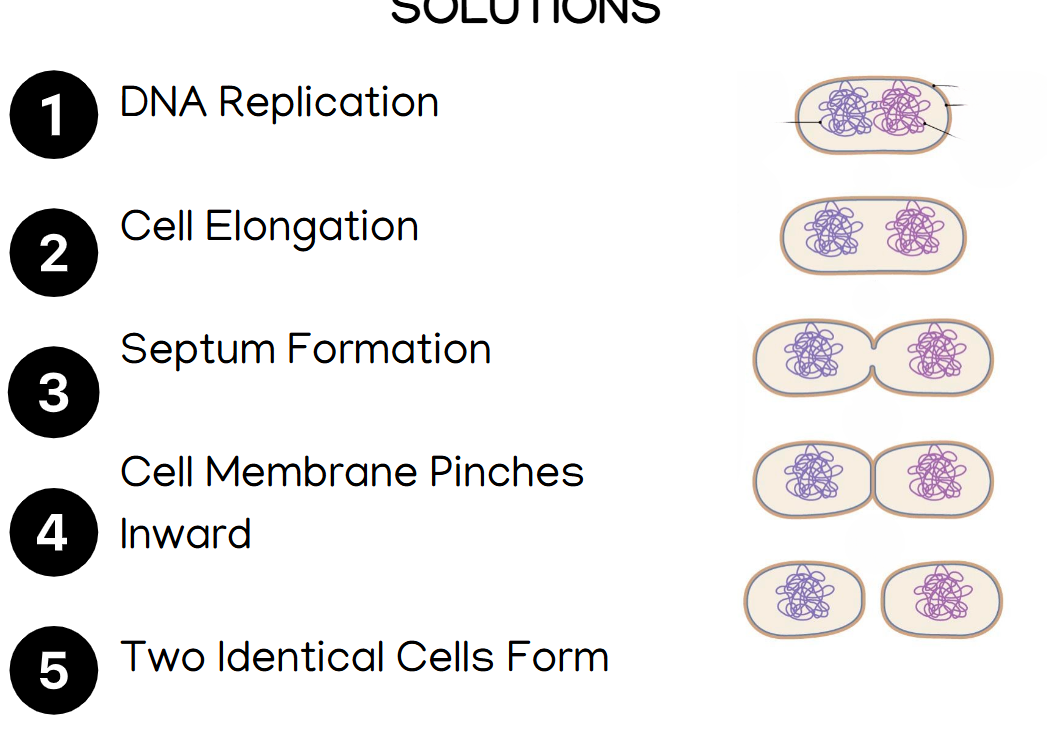
Steps of Binary Fission
Step 1 of Binary Fission → DNA replication.
Step 2 of Binary Fission → Cell elongation.
Step 3 of Binary Fission → Septum formation.
Step 4 of Binary Fission → Cytokinesis.
Result of Binary Fission → Two genetically identical daughter cells.
Asexual Reproduction
Reproduction involving only one parent and producing genetically identical offspring.
Conjugation
Transfer of DNA between bacteria through a pilus.
Pilus
A structure that connects two bacterial cells during conjugation.
Transformation
Uptake of free DNA from the environment.
Horizontal Gene Transfer
Movement of genetic material between organisms without reproduction.
Antibiotic Resistance
The ability of bacteria to survive exposure to antibiotics.
Why is Antibiotic Resistance Concerning?
→ Resistant bacteria survive, reproduce, and become harder to treat.
How Can Resistance Spread?
Through conjugation, transformation, and reproduction.
Which kingdom contains peptidoglycan in its cell walls?
Eubacteria.
Which kingdom often lives in extreme environments?
Archaea.
What are the three common bacterial shapes?
Coccus, bacillus, spirillum.
What structure helps bacteria move?
Flagellum.
What structure allows bacteria to survive harsh conditions?
Endospore.
What stain color indicates Gram-positive bacteria?
Purple.
What stain color indicates Gram-negative bacteria?
Pink.
How do prokaryotes reproduce?
Binary fission.
Which type of bacteria needs oxygen to survive?
Obligate aerobes.
Which type of bacteria is killed by oxygen?
Obligate anaerobes.
What is the main cell wall difference between Archaea and Eubacteria?
Eubacteria have peptidoglycan; Archaea do not.
What are the differences between gram negative and gram positive bacteria?
Gram-positive bacteria have a thick peptidoglycan layer and no outer lipid membrane, staining purple. Gram-negative bacteria have a thin peptidoglycan layer and an outer lipid membrane, staining pink.
Distinguish the 3 different oxygen requirements bacteria can have.
Obligate aerobes need oxygen to survive. Facultative anaerobes use oxygen when available but can survive without it. Obligate anaerobes are killed by oxygen.
Why do bacteria make endospores?
The formation of endospores is initiated by nutrient deprivation. It allows the bacterium to become dormant and highly resistant, preserving genetic material in extreme conditions.