CPrac A - General
 Call Kai
 Learn
Learn Practice Test
 Spaced Repetition
 Match
Match Flashcards
 Knowt Play
1/15

There's no tags or description
Looks like no tags are added yet.
Name | Mastery | Learn | Test | Matching | Spaced | Call with Kai |
|---|
No analytics yet
Send a link to your students to track their progress
16 Terms
Titration table
Titration number | 1 | 2 |
Final burette reading / cm^3 | ||
Initial burette reading / cm^3 | ||
Volume of _ used / cm^3 | ||
Best titration results (✔) |
Mass reading recording
Mass of salt used = 2.300g (tared)
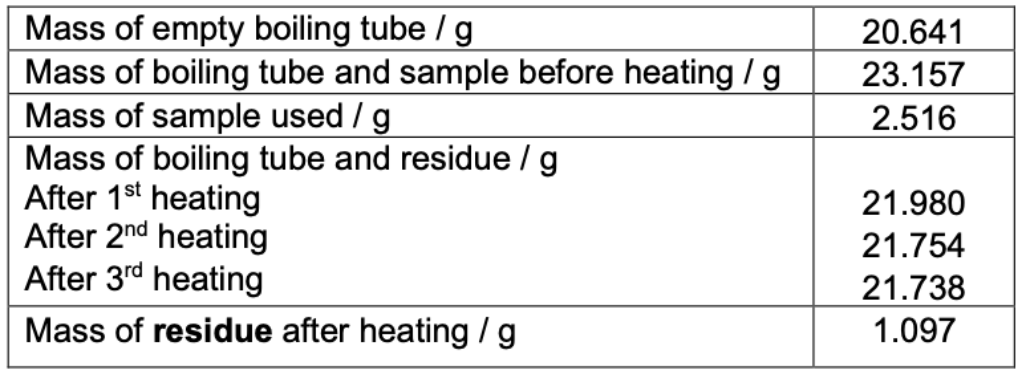
Heating (water of crystallisation) table
Temperature change table
Highest / lowest temperature reached / degrees | |
Initial temperature / degrees | |
Temperature change / degrees |
ALL temp related graph , origin is a point
Line : does NOT mean straight line , can be CURVE or STRAIGHT
Draw a straight line of best fit
How to find gradient and average rate, which variables on which axis
Dependent variable : y-axis
Independent variable : x-axis
Finding gradient : choose 2 points far apart -> reduce % uncertainty in calculation of gradient
Average rate OVER 7 min (find gradient at 7 min DO NOT draw tangent)
Describing error: time taken for reaction (what is measured?) is subjective as it is difficult determining exact movement when insert is obscured NOT it is subjective
Describe error stopwatch + modification
Human reaction time (NOT
human error) when starting and stopping the stopwatch leading to inaccurate time measurementModification: repeat -> average -> reduce % of human reaction time error
Describe error % purity
The impurities inside sodium hydroxide might react with the hydrochloric acid and this will result in higher volume of hydrochloric acid recorded. The percentage purity would have been higher than the expected percentage purity
Describe error Heat loss to surrounding + modification
To reduce heat loss to the surroundings, the boiling tube can be insulated
This can be done by wrapping the boiling tube with a towel and holding it using a rubber band (NOT
wet towel)
Use a lid to cover the cup to prevent heat loss from the top -> ∆T measured -> enthalpy change of neutralisation be more accurate
Switch off the fans and stand the apparatus in a metal shield to reduce heat loss due to draughts
Impurities reduce the actual amount of Na2CO3, lowering the concentration of Na2CO3 -> larger volume of FA 3 is required to react with the H2SO4
Attach a syringe to the conical flask
H2O2 and ethanoic acid safety hazard
H2O2 and ethanoic acid are corrosive chemicals, so gloves and safety goggles should be worn during the experiment to minimise contact of chemicals with our skin and eyes
Those how this method value is lower than true value
1 step at a time: lower temperature recorded -> lower heat change -> lower enthalpy
Describe test to find purity of substance
Heat a small sample of the substance to determine the melting point. If the solid has a fixed melting point , it is pure. If it melts at a temperature lower than melting point or over a range of temperature , it is not pure
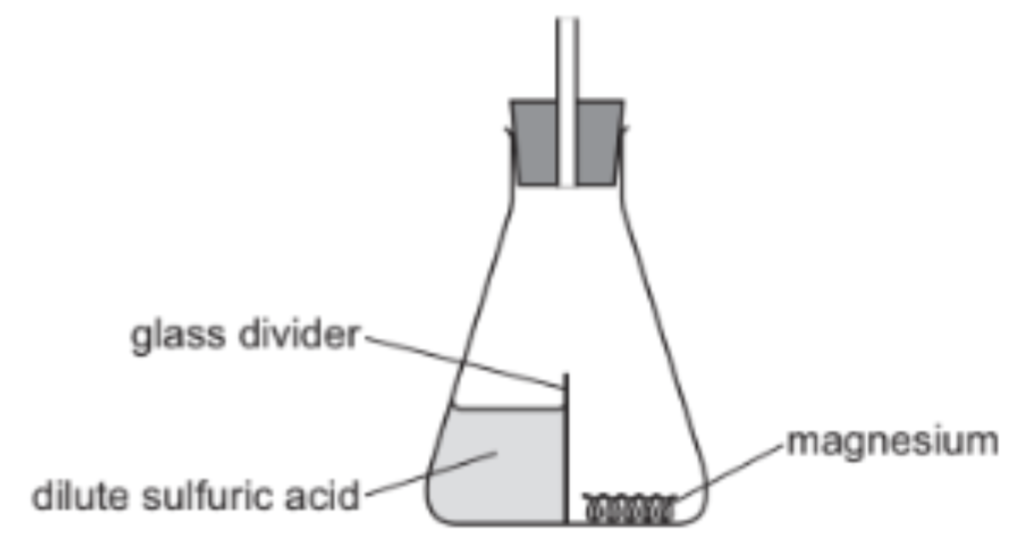
Suggest the advantage of using this modified conical flask instead of the original one
The reaction can be started by tipping the flask, thus do not have to replace the bung and no gas escapes -> all H2 gas produced can be accurately collected and measured
Check for purity
Solid sample -> check for mp NOT
chromatographyLiquid sample -> check for bp