Test 2 Homework Answers (ch 11 need)
 Call Kai
 Learn
Learn Practice Test
 Spaced Repetition
 Match
Match Flashcards
 Knowt Play
1/110

There's no tags or description
Looks like no tags are added yet.
Name | Mastery | Learn | Test | Matching | Spaced | Call with Kai |
|---|
No analytics yet
Send a link to your students to track their progress
111 Terms
Granulation is caused by:
a. sunspots
b. rising and sinking gases below the photosphere
c. shock waves in the corona
d. the solar wind flowing away from the corona
e. heading in the chromosphere
b. rising and sinking gases below the photosphere
Most of the visible light we see coming from the Sun originates from the:
a. chromosphere
b. photosphere
c. corona
d. sunspots
e. magnetic field
b. photosphere
The _____ coincides with the period known as the “little ice age” of Europe and North America. This provides one piece of evidence that suggests a link between solar activity and the amount of solar energy Earth receives.
a. Maunder sunspot minimum
b. Babcock sunspot model
c. coronal hole
d. Coulomb barrier
e. weak solar force
a. Maunder sunspot minimum
_____ occur about 130 km above Earth’s surface near the polar regions when energy in the solar wind guided by Earth’s magnetic field excites gases in the upper atmosphere.
a. coronas
b. flares
c. auroras
d. coronal holes
e. nuclear fission
c. auroras
Astronomers can use _____ to measure magnetic fields on the Sun.
a. helioseismology
b. perhloroethylene (C2Cl4)
c. neutrino detectors
d. a magnetic carpet
e. the Zeeman effect
e. the Zeeman effect
Sunspots are known to be magnetic phenomena because:
a. Doppler shifts in spectral lines are observed
b. the Zeeman effect is observed in sunspots
c. collisional broadening is observed in spectral lines
d. infrared observations indicate that the sunspots are cooler than their surroundings
e. observations during eclipses reveal a very extensive photosphere
b. the Zeeman effect is observed in sunspots
One sees differences in _____ depending on the time in the sunspot cycle.
I. the latitude at which most sunspots occur
II. the number of sunspots that are visible
III. the rotation rate of the Sun’s equator
IV. the magnetic polarity of the sunspot pair members in a hemisphere
a. I & II
b. I & IV
c. II & III
d. I, II, & III
e. I, II, & IV
e. I, II, & IV
Sunspots are dark because:
a. regions of the photosphere are obscured by material in the chromosphere
b. shock waves move through the photosphere
c. the Sun rotates differentially
d. they are cooler regions than the photosphere
e. they radiate their energy into space faster than the rest of the photosphere
d. they are cooler regions than the photosphere
A recent sunspot maximum occurred in 2013. What is the year of the sunspot maximum that immediately follows the 2013 maximum if the solar cycle continues?
a. 2017
b. 2019
c. 2022
d. 2024
e. The last cycle started a Maunder minimum and the next maximum cannot be predicted
d. 2024
A _____ is believed to occur when energy, stored in a twist in the solar magnetic field above a sunspot, is suddenly released.
a. solar flare
b. supergranule
c. spicule
d. coronal hole
e. none of the others
a. solar flare
The proton-proton chain needs high temperature because:
a. of the ground state energy of the hydrogen atom
b. of the presence of helium atoms
c. the protons must overcome the Coulomb barrier
d. of the need for density
e. the neutrinos carry more energy away than the reaction produces
c. the protons must overcome the Coulomb barrier
Why is the temperature at the region of a sunspot cooler than the photosphere?
a. They are holes in the photosphere that reveal the lower temperature gases in the deeper layers
b. They represent points where streams of cool gas from the corona lower the temperature in those regions of the photosphere
c. Powerful magnetic fields in the sunspots act upon the atoms of the photosphere to prevent them from emitting light
d. Powerful magnetic fields inhibit the convective flow of the gases of the photosphere downward, allowing them to cool for longer than would normally be permitted
d. Powerful magnetic fields inhibit the convective flow of the gases of the photosphere downward, allowing them to cool for longer than would normally be permitted
Sunspots occur in _____ with the leading spot and the trailing spot having _____ magnetic polarity.
a. singles, same
b. pairs, opposite
c. singles, opposite
d. pairs, same
e. none of the others
b. pairs, opposite
Most of the energy emitted by the Sun is generated in the:
a. corona
b. photosphere
c. chromosphere
d. core
d. core
Fusion is promoted in the core of the Sun by the _____ there.
a. low temperature and low density
b. high temperature and high density
c. low temperature and high density
d. high temperature and low density
b. high temperature and high density
______ of hydrogen atom nuclei in the core replace the heat the Sun _____ to keep it in equilibrium.
a. Nuclear fusion reactions; loses into space
b. Nuclear fusion reactions; gains from empty space
c. Chemical reactions; loses into space
d. Chemical reactions; gains from empty space
e. Nuclear fission; loses into space
a. Nuclear fusion reactions; loses into space
A neutrino is _____.
a. a photon of light
b. a positively charged particle
c. a subatomic particle
d. a negatively charged particle
c. a subatomic particle
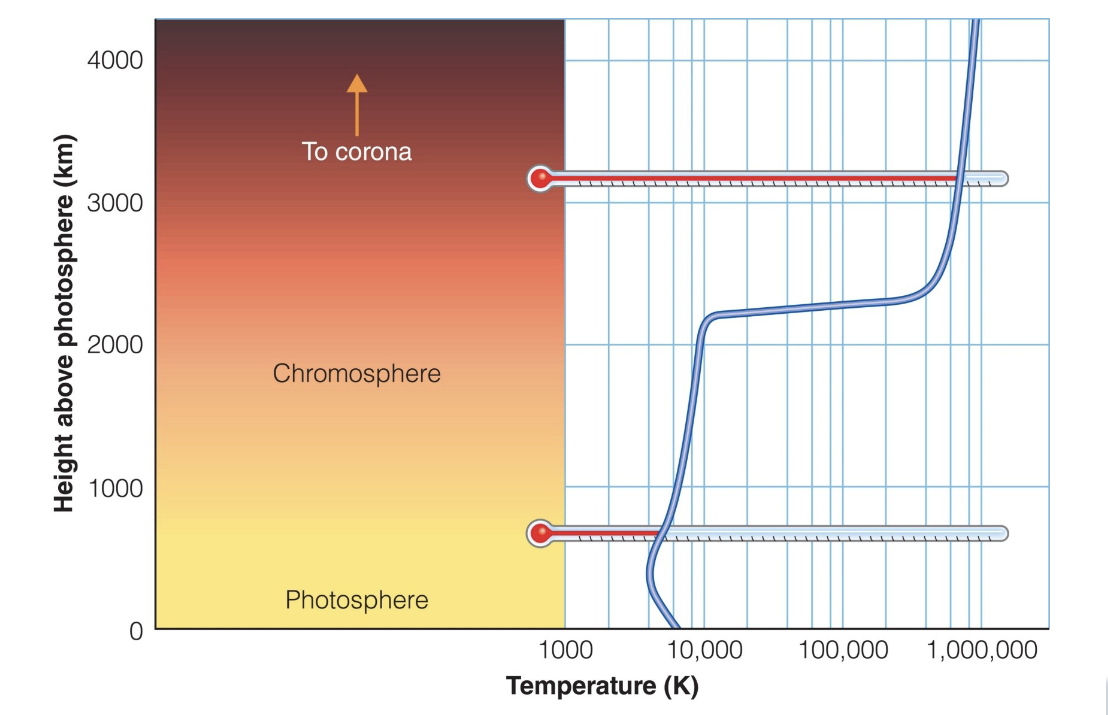
The associated picture shows the Sun’s change in temperature with elevation into the Sun’s atmospheric layers. The region from 10,000-70,000 K is known as the _____.
a. photosphere
b. chromosphere
c. corona
d. transition zone
d. transition zone
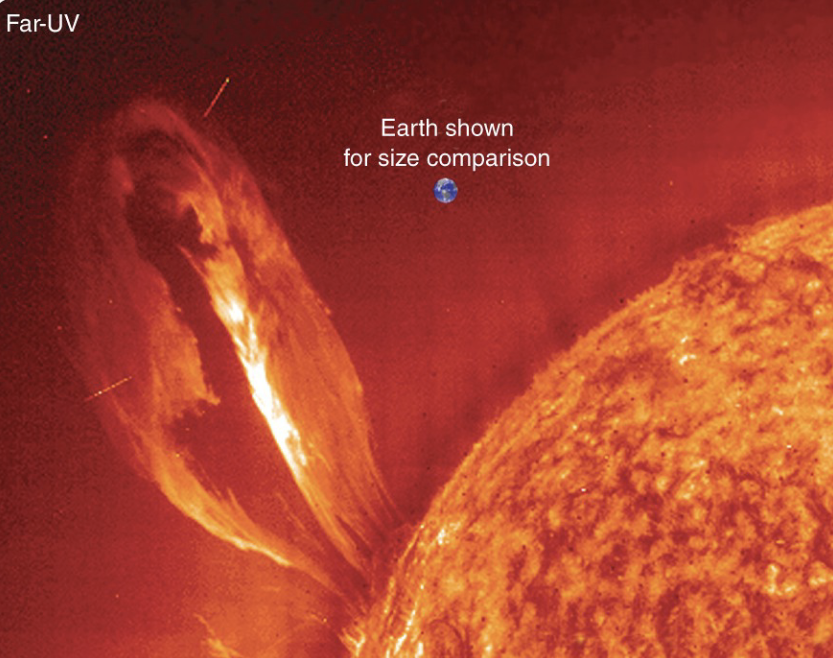
The associated picture shows a prominence mostly in the _____ atmospheric layer of the Sun. Because of the far-ultraviolet (FUV) image, we know the _____ layer of the Sun’s atmosphere is shown.
a. chromospheric, chromospheric
b. photospheric, photospheric
c. corona, corona
d. corona, chromospheric
d. corona, chromospheric
_____ is to the Sun as _____ is to Earth.
a. asteroseismology, geology
b. helioseismology, seismology
c. seismology, volcanology
d. astrology, astrobiology
b. helioseismology, seismology
_____ has the most tightly bound nucleus.
a. Uranium
b. Iron
c. Helium
d. Hydrogen
b. Iron
The centers of granules:
a. are hot material rising to the photosphere from below
b. are cool material falling from the photosphere to the regions below
c. are fainter and hotter than their surroundings
d. are brighter and cooler than their surroundings
e. show strong Zeeman effects
a. are hot material rising to the photosphere from below
Parallax would be easier to measure if:
a. Earth’s orbit was larger.
b. The stars were farther away.
c. Earth moved faster along its orbit.
d. Earth’s orbit was larger, the stars were further away, and Earth moved faster along its orbit.
e. None of the other choices are correct.
a. Earth’s orbit was larger.
Absolute visual magnitude is:
a. The apparent magnitude of a star observed from Earth.
b. The luminosity of a star observed from a distance of 1,000 pc.
c. The apparent magnitude of a star observed from a distance of 10 pc.
d. The luminosity of a star observed from Earth.
e. The apparent magnitude of a star observed from a distance of 10 pc and the luminosity of a star observed from Earth.
c. The apparent magnitude of a star observed from a distance of 10 pc.
A star's luminosity depends only on the star's:
a. distance and diameter.
b. temperature and distance.
c. distance.
d. temperature and diameter.
e. apparent magnitude.
d. temperature and diameter.
In an H-R diagram, stars with the smallest radius are found in the _________ of the diagram.
a. center
b. upper left corner
c. upper right corner
d. lower left corner
e. lower right corner
d. lower left corner
In the H-R diagram, roughly 80 percent of all stars are:
a. in the giant region.
b. in the supergiant region.
c. among the B stars.
d. among the G stars.
e. on the main sequence.
e. on the main sequence.
Red giant stars are:
I. More luminous than the Sun
II. Larger in diameter than the Sun.
III. Cooler than B stars.
IV. Located above the main-sequence stars in the H-R diagram.
a. I & II
b. II & IV
c. II, III, & IV
d. II, III, & IV
e. I, II, III, & IV
e. I, II, III, & IV
Compared with the spectral lines in the solar spectrum, lines in a supergiant star’s spectrum are:
a. narrower.
b. broader.
c. weaker.
d. stronger.
e. broader and weaker.
a. narrower.
The star named Sheet is of M2 II spectral type and luminosity class. Based on this information, which of the following are true?
I. Sheet has a surface temperature less than the Sun.
II. Sheet has a diameter that is greater than that of the Sun.
III. Sheet is more luminous than the Sun.
IV. Sheet is located near the upper let-hand corner in the H-R diagram.
a. I & II
b. II & IV
c. II, III, & IV
d. I, II, & III
e. I, II, III, & IV
d. I, II, & III
The star named Circini has the spectral type and luminosity class of O 8.5 V. Based on this information, which of the following are true?
I. Circini has a surface temperature less than the Sun.
II. Circini has a diameter that is greater than that of the Sun.
III. Circini is more luminous than the Sun.
IV. Circini is located near the upper left-hand corner in the H-R diagram.
a. I & II
b. II & IV
c. II, III, & IV
d. I, II, & III
e. I, II, III, & IV
c. II, III, & IV
In a binary system, the more massive star:
a. is at the center of mass.
b. is farthest from the center of mass.
c. is nearest the center of mass.
d. follows the largest orbit.
e. shows a larger Doppler shift in its spectral lines.
c. is nearest the center of mass.
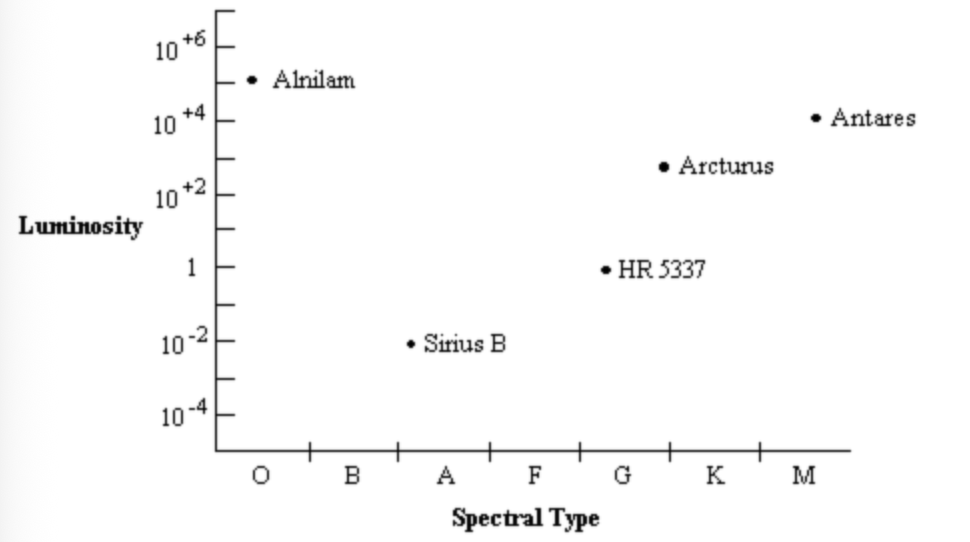
Use the H-R diagram to answer this question. Which star is most like the Sun?
a. Alnilam
b. Antares
c. Arcturus
d. HR 5337
e. Sirius B
d. HR 5337
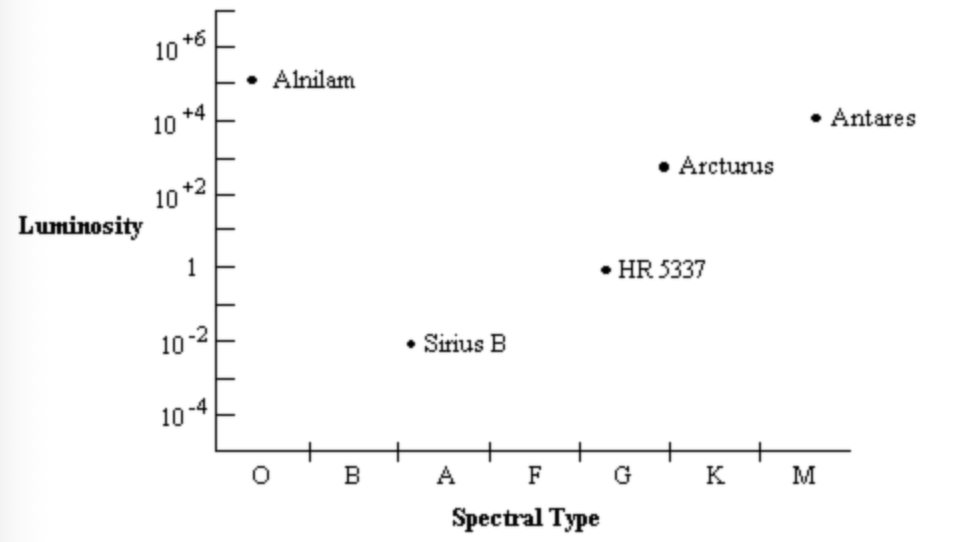
Use the H-R diagram to answer this question. Which star has the greatest surface temperature?
a. Alnilam
b. Antares
c. Arcturus
d. HR 5337
e. Sirius B
a. Alnilam
If we can solve the orbital motion of an eclipsing binary, we can find:
a. The mass of each star.
b. The diameter of each star.
c. The distance to the binary.
d. All of the other choices.
e. The mass of each star and the diameter of each star.
e. The mass of each star and the diameter of each star.
Which of the following kinds of stars best obey the mass-luminosity relation?
a. Main-sequence stars
b. Giant stars
c. Supergiant stars
d. White dwarfs
e. All of the other choices are correct.
a. Main-sequence stars
Which of the following kind of stars is the most dense?
a. A supergiant star
b. A main sequence star
c. A giant star
d. A white dwarf
e. The Sun
d. A white dwarf
Stars on the main sequence with the greatest mass
a. are spectral type M stars.
b. are spectral type O stars.
c. are located at the bottom of the main sequence in the H-R diagram.
d. have masses very similar to the Sun.
e. are spectral type O stars and are located at the bottom of the main sequence in the H-R diagram.
b. are spectral type O stars.
The total mass of a binary system can be calculated from:
a. The ratio of the angular separation from the center of mass of each of the stars.
b. The distance of the binary and its radial velocity.
c. The semi major axis and period of the orbit.
d. The radial velocities the two stars.
e. The time required for the smaller star to eclipse the larger star.
c. The semi major axis and period of the orbit.
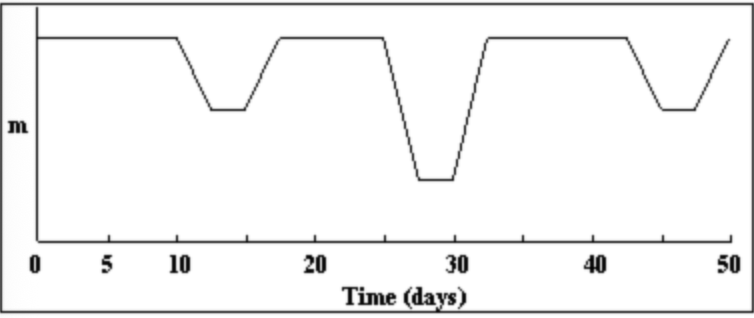
In the light curve, what is the period of the eclipsing binary?
a. 5 days
b. 32.5 days
c. 7.5 days
d. 42.5 days
e. 50 days
b. 32.5 days
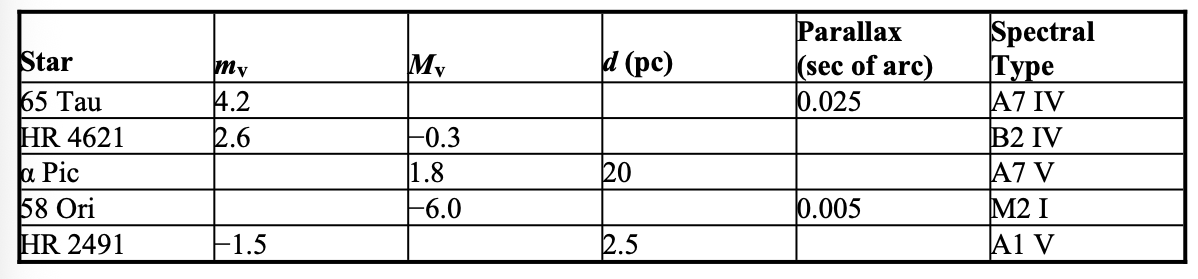
From the data given, which star in the table would appear the faintest in the night sky?
a. 65 Tau
b. HR 4621
c. α Pic
d. 58 Ori
e. HR 2491
a. 65 Tau
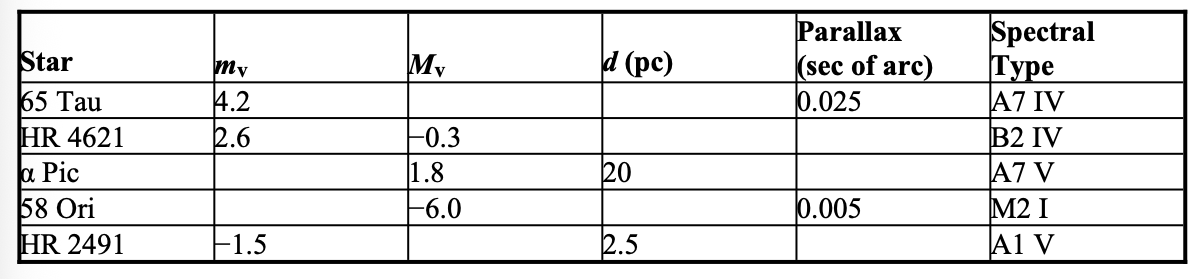
From the data given, which star in the table has the greatest surface temperature?
a. 65 Tau
b. HR 4621
c. α Pic
d. 58 Ori
e. HR 2491
b. HR 4621
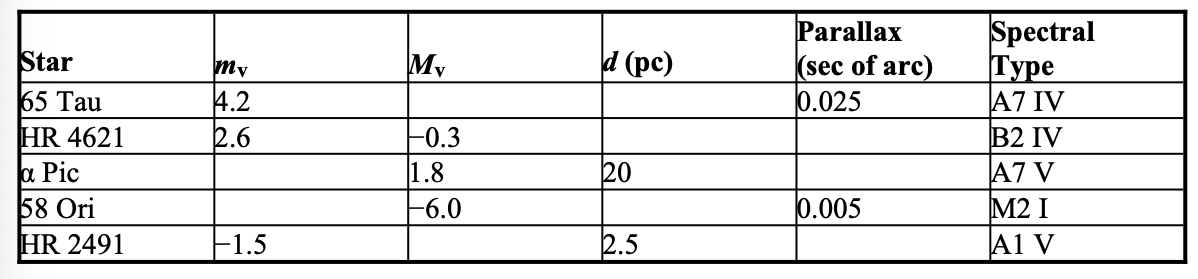
From the data given, which star in the table has the greatest diameter?
a. 65 Tau
b. HR 4621
c. α Pic
d. 58 Ori
e. HR 2491
d. 58 Ori
Which stars always have large positive absolute magnitude?
a. Stars of high luminosity
b. Stars of low luminosity
c. Nearby stars
d. Distant stars
e. Not enough information given
b. Stars of low luminosity
Why don’t we see hydrogen Balmer lines in the spectra of stars with temperatures of 3,200 K?
a. There is no hydrogen in stars this cool.
b. The stars are hot enough that most of the hydrogen is ionized and the atoms cannot absorb energy.
c. These stars are so cool that nearly all of the hydrogen atoms are in the ground state.
d. Stars of this temperature are too cool to produce an absorption spectrum.
e. Stars of this temperature are too hot to produce an absorption spectrum.
c. These stars are so cool that nearly all of the hydrogen atoms are in the ground state.
Why don’t we see hydrogen Balmer lines in the spectra of stars with temperatures of 45,000 K?
a. There is no hydrogen in stars this cool.
b. The stars are hot enough that most of the hydrogen is ionized and the atoms cannot absorb energy.
c. These stars are so cool that nearly all of the hydrogen atoms are in the ground state.
d. Stars of this temperature are too cool to produce an absorption spectrum.
e. Stars of this temperature are too hot to produce an absorption spectrum.
b. The stars are hot enough that most of the hydrogen is ionized and the atoms cannot absorb energy.
Protostars are difficult to observe because:
a. the protostar stage is very short
b. they are surrounded by cocoons of gas and dust
c. they radiate mainly in the infrared
d. the protostar stage is very short, they are surrounded by cocoons of gas and dust, and they radiate mainly in the infrared
e. they are all so far away that the light hasn’t reached us yet
d. the protostar stage is very short, they are surrounded by cocoons of gas and dust, and they radiate mainly in the infrared
Interstellar gas clouds may collapse to form stars if they:
a. have very high temperatures
b. encounter a shock wave
c. rotate rapidly
d. are located near main sequence spectral type K and M stars
e. All of the other choices are correct
b. encounter a shock wave
The visual pink glow of the Great Nebula of Orion:
a. is a Herbig-Haro
b. is a reflection nebula of dust
c. is an emission nebula of thin gas
d. contains only young low mass stars
e. is believed to be about 5 billion years old
c. is an emission nebula of thin gas
_____ are star-like objects that contain less than 0.08 solar masses and will never raise their core temperatures high enough that the proton-proton chain can begin. Other minor fusion reactions do occur in these objects. They fall in a gap between the low-mass M dwarf stars and the massive planets in which nuclear fusion never occurs.
a. Brown dwarfs
b. Herbig-Haro objects
c. Bok globules
d. T-Tauri star
e. Main-sequence stars
a. Brown dwarfs
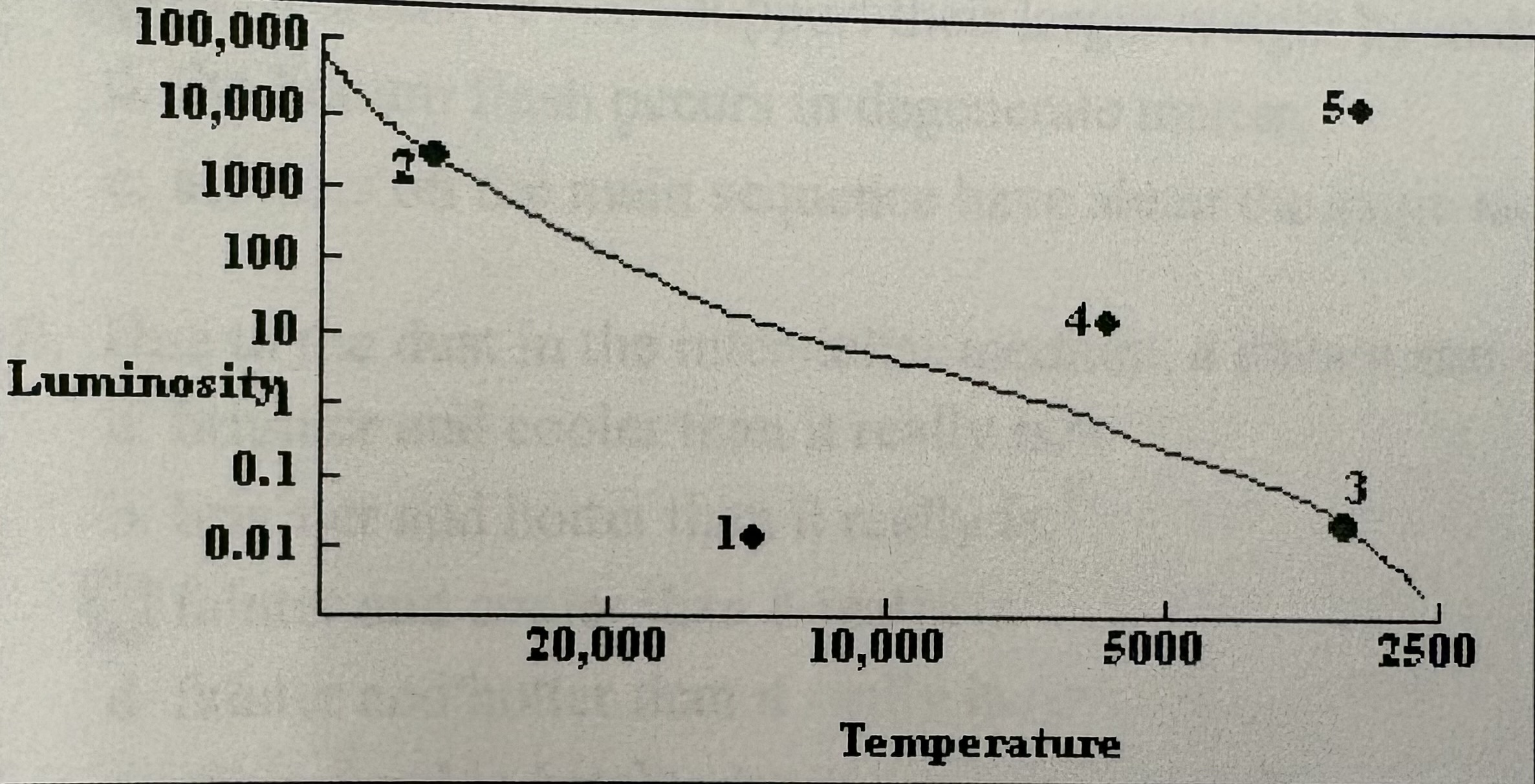
The diagram is an H-R diagram. The line indicates the location of the main sequence. Which of the five labeled locations on the H-R diagram indicates a luminosity and temperature similar to that of a T-Tauri star?
a. 1
b. 2
c. 3
d. 4
e. 5
d. 4
What causes the outward gas pressure that balances the inward pull of gravity in a main-sequence star?
a. the rapid outward flow of gas
b. the rapid inward flow of gas
c. the high temperature of the gas
d. the high density of the gas
e. the high temperature and the high density of the gas
e. the high temperature and the high density of the gas
_____ occurs when most of the material collapsing to form a protostar has fallen into a disk around the star and a strong wind from the warm protostar ejects material from its poles.
a. An emission nebula
b. Hydrostatic equilibrium
c. The proton-proton chain
d. The thermonuclear fusion of hydrogen
e. A bipolar outflow
e. A bipolar outflow
The H-R diagram main-sequence of stars has a limit at the lower-mass or energy-output because:
a. low-mass stars form from the interstellar medium very rarely
b. low-mass objects are composed primarily of solids, not gases
c. pressure does not depend on temperature in degenerate matter
d. the lower limit represents when the radius of the star would be zero
e. there is a minimum temperature for hydrogen nuclear fusion (the definition of a star)
e. there is a minimum temperature for hydrogen nuclear fusion (the definition of a star)
There is a main-sequence mass-luminosity relation because:
a. helium fusion produces carbon
b. stars expand when they become giants
c. more massive stars support their larger weight by making more energy
d. the helium flash occurs in degenerate matter
e. all stars on the main sequence have about the same radius
c. more massive stars support their larger weight by making more energy
Due to the dust in the interstellar medium, a distant star will appear to an observer on Earth to be:
a. brighter and cooler than it really is
b. brighter and hotter than it really is
c. fainter and cooler than it really is
d. fainter and hotter than it really is
e. unchanged in brightness or apparent color
c. fainter and cooler than it really is
The creation of _____ require(s) that a young star (T ~= 25,000 K) be relatively nearby.
a. emission nebulae
b. HI regions
c. molecular clouds
d. the cool gas of the interstellar medium
e. 21-cm radiation
a. emission nebulae
_____ are small dark nebulae about 1 light-year in diameter that contain 10 to 1,000 solar masses.
a. HI regions
b. HII regions
c. Emission nebulae
d. Bok Globules
e. Reflection nebulae
d. Bok Globules
Stars are born in:
a. reflection nebulae
b. dense molecular clouds
c. HII regions
d. the intercloud medium
e. the Local Bubble
b. dense molecular clouds
Absorption lines due to interstellar gas:
a. are wider than the lines from stars because the gas is hotter than most stars
b. are narrower than the lines from stars because the gas has a lower pressure than stars
c. indicate that the interstellar medium contains dust
d. indicate that the interstellar medium is expanding away from the Sun
e. None of the other choices are correct
b. are narrower than the lines from stars because the gas has a lower pressure than stars
What is the lifetime of a 10-solar-mass star on the main sequence?
a. 3.2 × 10⁷ years
b. 320 years
c. 3.2 × 10¹² years
d. 1 × 10⁹ years
e. 1 × 10¹¹ years
a. 3.2 × 10⁷ years
The H-R diagram of a young star cluster shows:
a. that high-mass stars have not yet reached the main sequence yet
b. that low-mass stars have not yet reached the main sequence yet
c. mainly giant stars
d. no stars since none have reached the main sequence yet
b. that low-mass stars have not yet reached the main sequence yet
As a star beings to form, the initial energy source is from:
a. nuclear fusion
b. nuclear fission
c. gravitational potential energy
d. magnetic fields
c. gravitational potential energy
What must occur for an object to be considered a main-sequence star?
a. hydrostatic equilibrium
b. nuclear fusion reaction in the core
c. protostar life begins
d. hydrostatic equilibrium and nuclear fusion reaction in the core
d. hydrostatic equilibrium and nuclear fusion reaction in the core
Star clusters are important to study the stellar evolution because stars in a given cluster have the same:
a. temperature
b. mass
c. age
d. luminosity
c. age
What characteristic of a star is primarily determines its location on the main sequence?
a. age
b. distance from the galactic center
c. mass
d. space motion
e. radius
c. mass
The youngest stars in the Orion Nebula and other star-forming regions also show:
a. circumstellar disks
b. jets
c. circumstellar disks and jets
c. circumstellar disks and jets
Which of the following is a method of energy transport?
a. convection
b. radiation
c. conduction
d. all of the other choices are correct
d. all of the other choices are correct
You would like to see through the dust in a cloud to find protostars. Which band of the electromagnetic spectrum would you need to look in?
a. infrared
b. visual
c. UV
d. X-ray
a. infrared
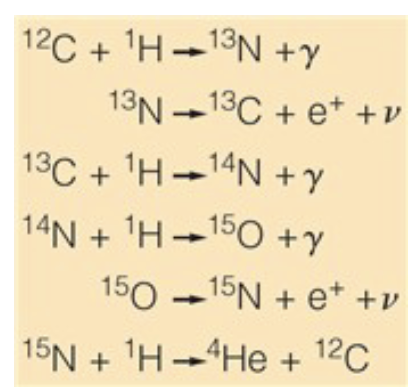
The associated picture of the reactions are of the _____.
a. proton-proton fusion chain
b. hydrogen-hydrogren fusion chain
c. CNO cycle
d. All of the other choices are correct
c. CNO cycle
The interstellar medium is made of _____.
a. gas
b. dust
c. gas and dust
d. none of these choices are correct
c. gas and dust
You would use the 21-cm radio emission line to map out _____.
a. the interstellar medium
b. molecular clouds
c. atomic hydrogen clouds
d. All of the other choices are correct
c. atomic hydrogen clouds
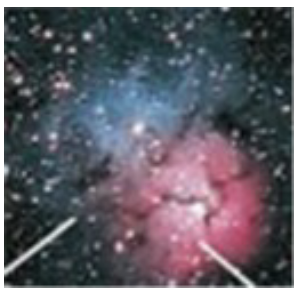
In the associated picture, the blue color is from a/an _____ nebula whereas the pink color is from a/an _____ nebula.
a. dark, reflection
b. reflection, emission
c. emission, dark
d. emission, reflection
b. reflection, emission
As a Sun-like main sequence star exhausts hydrogen in its core, it next becomes:
a. a protostar
b. a red giant star
c. a white dwarf star
b. a red giant star
A Sun-like star will experience a helium flash in the core if:
a. it is less massive than about 3 solar masses
b. it has become a red giant star
c. it has formed a helium core
d. the material in the core has gradually become degenerate
e. All of the other choices are correct
e. All of the other choices are correct
Giant and supergiant stars are rare because:
a. they do not form as often as main-sequence stars
b. the star blows up before the giant or supergiant stage is reached
c. the giant or supergiant stage is very short
d. the giant or supergiant stage is very long
c. the giant or supergiant stage is very short
The _________ stars are giant stars fusing helium in their cores and then in their shells.
a. turnoff-point
b. main-sequence
c. turnon-point
d. hydrogen-flash
e. horizontal-branch
e. horizontal-branch
Mass is transferred from a normal star in a close binary system toward a white dwarf. The material that is transferred to the white dwarf forms a rapidly growing whirlpool of material known around the white dwarf known as a(n):
a. accretion disk
b. Lagrangian point
c. Algol paradox
d. planetary nebula
e. supernova remnant
a. accretion disk
_________ is a form of electromagnetic radiation produced by rapidly moving electrons spiraling through magnetic fields.
a. Lagrangian radiation
b. Accretion
c. Ultraviolet radiation
d. Synchrotron radiation
e. Infrared radiation
d. Synchrotron radiation
Star clusters are important to our study of stars because
a. all stars formed in star clusters
b. the Sun was once a member of a globular cluster
c. they give us a method to test our theories and models of stellar evolution
d. they are the only objects that contain Cepheid variables
e. All of the other choices are correct
c. they give us a method to test our theories and models of stellar evolution
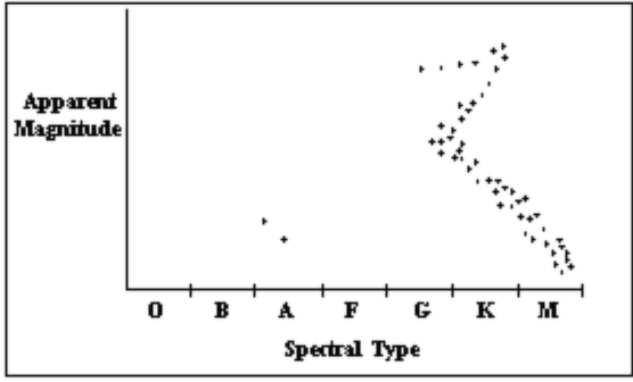
What is the approximate age of the star cluster in the H-R diagram below? (Hint: Main sequence stars of spectral types between A and B have core supplies of hydrogen sufficient to last about 250 million years, between A and F about 2 billion years, type G about 10 billion years, and between K and M about 30 billion years.)
a. 200 million years
b. 2 billion years
c. 10 billion years
d. 30 billion years
e. The age of the cluster cannot be estimated from an H-R diagram of the cluster
c. 10 billion years
The triple-alpha process:
a. controls the pulsations in Cepheid variable stars
b. is the nuclear fusion of hydrogen to helium in massive stars
c. is the process that produces the neutrinos we receive from the Sun
d. requires a temperature of about 5,000,000 K to operate
e. occurs during helium flash
e. occurs during helium flash
Stars in a star cluster:
a. all have the same age
b. all have the same chemical composition
c. all have the same luminosity
d. all of the above
e. all have the same age and all have the same chemical composition
e. all have the same age and all have the same chemical composition
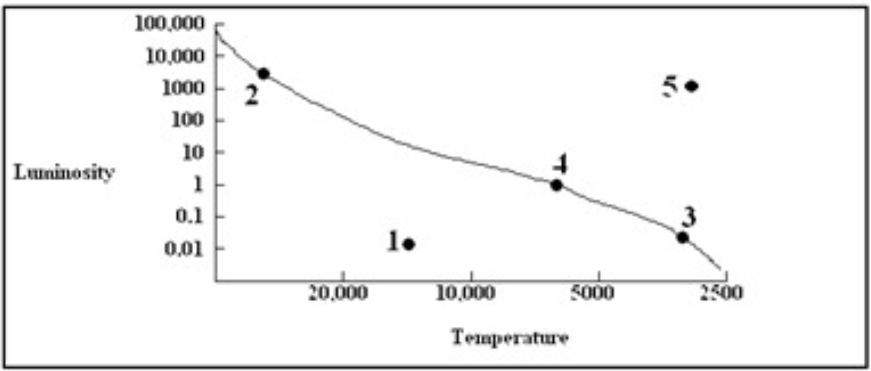
In the associated diagram, which point indicates the location on the H-R diagram of a one-solar-mass star when it undergoes helium flash?
a. 1
b. 2
c. 3
d. 4
e. 5
e. 5
A planetary nebula is:
a. the expelled outer atmosphere of a medium-mass star
b. produced by a supernova explosion
c. produced by a nova explosion
d. a nebula within which planets are forming
e. a cloud of hot gas surrounding a planet
a. the expelled outer atmosphere of a medium-mass star
The Chandrasekhar limit tells us that:
a. accretion disks can grow hot through friction
b. neutron stars of more than 3 solar masses are not stable
c. white dwarfs more massive than 1.4 solar masses are not stable
d. stars cannot travel through space too fast
e. stars with a mass less than 0.5 solar masses will not go through helium flash
c. white dwarfs more massive than 1.4 solar masses are not stable
A Type Ia supernova is believed to occur when:
a. the core of a massive star collapses
b. hydrogen detonation occurs
c. a white dwarf exceeds the Chandrasekhar limit
d. the cores of massive stars collapse
e. neutrinos in a massive star become degenerate and form a shock wave that explodes the star
c. a white dwarf exceeds the Chandrasekhar limit
A type II supernova:
a. occurs when a white dwarf's mass exceeds the Chandrasekhar limit
b. is the result of helium flash
c. is characterized by a spectrum that shows hydrogen lines
d. occurs when the iron core of a massive star collapses
e. is characterized by a spectrum that shows hydrogen lines and occurs when the iron core of a massive star collapses
e. is characterized by a spectrum that shows hydrogen lines and occurs when the iron core of a massive star collapses
A white dwarf is composed of:
a. hydrogen nuclei and degenerate electrons
b. helium nuclei and normal electrons
c. carbon and oxygen nuclei and degenerate electrons
d. degenerate iron nuclei
e. a helium burning core and a hydrogen burning shell
c. carbon and oxygen nuclei and degenerate electrons
About how long will a 0.5-main sequence star spend on the main sequence?
a. 6 billion years
b. 62 billion years
c. 620 million years
d. 6 million years
e. 600 thousand years
b. 62 billion years
For a star of Sun-like mass, what is the last stage of the nuclear fusion?
a. Hydrogen to helium
b. Helium to carbon and oxygen
c. Carbon to magnesium
d. Fusion goes all the way up to iron
b. Helium to carbon and oxygen
What are the two longest stages in the life of a one-solar-mass star?
a. Protostar, pre-main-sequence
b. Protostar, white dwarf
c. Protostar, main-sequence
d. Main-sequence, white dwarf
d. Main-sequence, white dwarf
As a star like the Sun exhausts hydrogen in its core, the outer layers of the star:
a. become hotter and more luminous
b. become cooler and more luminous
c. become hotter and less luminous
d. become cooler and less luminous
e. become larger in radius and hotter
b. become cooler and more luminous
Which of the following nuclear fuels does a twenty-solar-mass star NOT fuse over the course of its entire evolution?
a. hydrogen
b. carbon
c. nitrogen
d. oxygen
e. iron
e. iron
Star clusters are important to our study of the lives of high-mass versus low-mass stars because:
a. stars in each cluster all formed at about the same time all with the same mass
b. the Sun was once a member of a globular cluster
c. stars in each cluster all formed at about the same time but with differing masses
d. stars in each cluster all formed at different times with differing masses
e. All of the other choices are correct
c. stars in each cluster all formed at about the same time but with differing masses
A white dwarf whose red giant companion dumps hydrogen onto it may:
a. show no effect
b. explode recurrently as a nova
c. blow up as a type I supernova
d. explode recurrently as a nova or blow up as a type Ia supernova
d. explode recurrently as a nova or blow up as a type Ia supernova
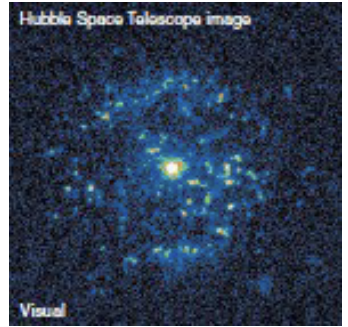
The HST visual wavelength image shown above is an example of a __________, where gaseous material is blown off the surface of a white dwarf.
a. planetary nebula
b. supernova
c. nova
d. None of the other choices are correct
c. nova
The size of a neutron star is:
a. about the same as that of our Solar System
b. about the same as that of the Sun
c. about the same as Earth
d. smaller than any of these
d. smaller than any of these
The density of a neutron star is:
a. about the same as that of a white dwarf
b. about the same as that of the Sun
c. about the same as an atomic nucleus
d. zero
c. about the same as an atomic nucleus
The _____ of a black hole is the radius from a black hole at which the escape velocity is approximately equal to the speed of light.
a. Roche limit
b. Lagrangian point
c. Chandrasekhar limit
d. Hubble radius
e. event horizon
e. event horizon