Cog Test 4 (Memory)
 Call Kai
 Learn
Learn Practice Test
 Spaced Repetition
 Match
Match Flashcards
 Knowt Play
1/24

There's no tags or description
Looks like no tags are added yet.
Name | Mastery | Learn | Test | Matching | Spaced | Call with Kai |
|---|
No analytics yet
Send a link to your students to track their progress
25 Terms
Atkinson & Shiffrin's Modal Model of Memory
A theory that describes memory as a process involving three distinct stages: sensory memory, short-term memory, and long-term memory, each with specific functions and durations.
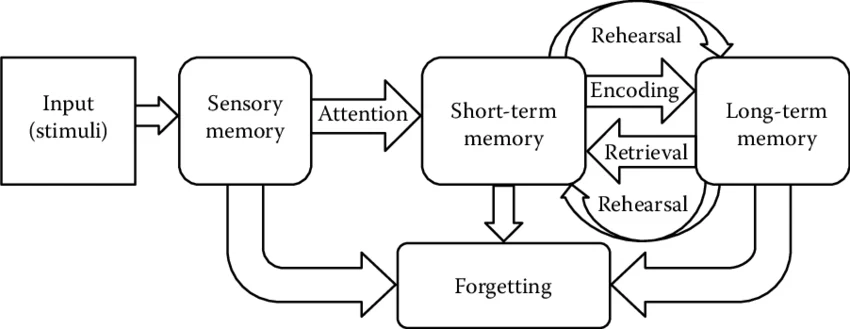
Sensory Memory
A brief storage system that holds incoming sensory information for a fraction of a second before it is processed.
Short-Term / Working Memory
A type of memory that temporarily holds information for processing and manipulation, usually lasting for seconds to minutes. It is essential for reasoning, decision making, and behavior.
Long-Term Memory
system that is responsible for storing information for long periods. One way to describe LTM is as an “archive” of information about past events in our lives and knowledge we have learned.
Explicit Memory (Declarative)
A type of long-term memory that involves the conscious recall of facts and experiences. It can be further divided into semantic memory and episodic memory.
Implicit Memory (Non-Declarative)
A type of memory that influences our thoughts and behaviors without conscious awareness, often acquired through repetition and practice. This includes skills, habits, and conditioned responses.
Episodic Memory
long term. personal experiences and events
Semantic Memory
facts and concepts. long term
Procedural Memory
automatic, unconscious performance of a motor or a cognitive skill
Priming
a psychological phenomenon where exposure to a specific stimulus (word, image, or event) influences an individual's response to a subsequent, related stimulus without conscious awareness
Autobiographical Memory
Autobiographical memory
is memory for specific experiences from our life, which can include both episodic and semantic components (seeChapter 6). For example, an autobiographical memory of a childhood birthday party might include images of the cake, people at the party, and games being played (episodic memory); it might also include knowledge about when the party occurred, where your family was living at the time, and your general knowledge about what usually happens at birthday parties (semantic memory)
1) multidimensional
2) we remember some events in our lives better than others.
Reminiscence Bump
The empirical finding that people over 40 years old have enhanced memory for events from adolescence and early adulthood, compared to other periods of their lives.
Self-Image Hypothesis
proposes that memory is enhanced for events that occur as a person’s self-image or life identity is being formed (Rathbone et al., 2008).
Cognitive Hypothesis
proposes that periods of rapid change that are followed by stability cause stronger encoding of memories. Adolescence and young adulthood fit this description because the rapid changes, such as going away to school, getting married, and starting a career, that occur during these periods are followed by the relative stability of adult life.
Cultural Life Script Hypothesis
distinguishes between a person’s life story, which is all the events that have occurred in a person’s life, and a cultural life script, which is the culturally expected events that occur at a particular time in the life span. (love at 16, college at 22, marriage at 27)
Youth Bias
the tendency for the most notable public events in a person’s life to be perceived to occur when the person is young.
Music-Enhanced Autobiographical Memories (MEAMs)
Memories elicited by hearing music are called
music-enhanced autobiographical memories (MEAMS)
These MEAMS are often experienced as involuntary memories because they occur as an automatic response to a stimulus
Nostalgia
A memory that involves a sentimental affection for the past
Proust Effect
A phenomenon in which olfactory (smell) stimuli trigger vivid and emotional memories.
Flashbulb Memories
Memory for the circumstances that surround hearing about shocking, highly charged events. It has been claimed that such memories are particularly vivid and accurate.
Narrative Rehearsal Hypothesis
The idea that memory can be affected by what happens after an event is the basis of Ulric Neisser and colleagues (1996)
narrative rehearsal hypothesis
, which states that we may remember events, such as the terrorist attacks of September 11, 2001, not because of a special mechanism but because we rehearse these events after they occur.
Memory Construction
The idea that what people report as memories are constructed based on what actually happened plus additional factors, such as expectations, other knowledge, and other life experiences.
Misinformation Effect
Misleading information presented after a person witnesses an event that changes how the person describes that event later.
False Memory / Memory Creation
suggestion can create false memories for long-ago events that never actually happened (eyewitness)
Eyewitness Testimony
Research tells us that witness descriptions are often not very accurate unless carried out under ideal conditions. Unfortunately, “ideal conditions” do not always occur, and there is a great deal of evidence that many innocent people have been convicted based on erroneous eyewitness identification.