Weather Hazards
 Call Kai
 Learn
Learn Practice Test
 Spaced Repetition
 Match
Match Flashcards
 Knowt Play
1/72

There's no tags or description
Looks like no tags are added yet.
Name | Mastery | Learn | Test | Matching | Spaced | Call with Kai |
|---|
No analytics yet
Send a link to your students to track their progress
73 Terms
Global Atmospheric Circulation
Worldwide system of winds moving heat from the equator to the poles to reach a balance in temperature
Air moves due to difference in air pressure (area of high pressure to low pressure) which generates wind
This pressure difference is because the sun heats the earth surface unevenly
Insolation that reaches the Earth's surface is greater at the equator than at the poles due to Earth's curvature and angle of the Earth's tilt
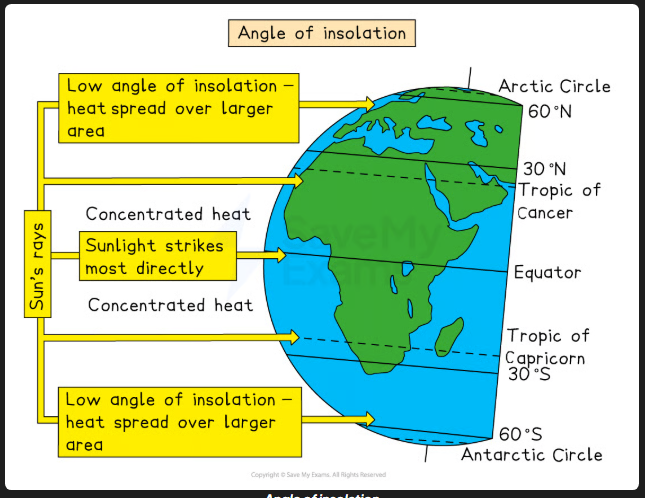
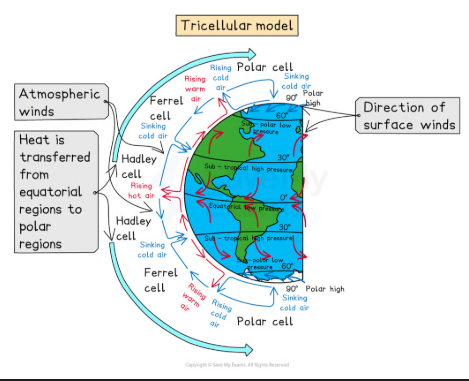
3 Cell atmospheric wind model
The sun warms the earth at the equator causing the air to rise
This creates a low pressure belt
As that air rises it cools and moves away from the equator
30 north and south of the equator cool air sinks creating a high pressure belt
At the ground surface the cool air moves either back to the equator (trade winds) or towards poles (westerlies)
60 north and south of the equator the warmer surface wind meet colder air from the poles
The warmer air rises creating low pressure
Some of the air moves back towards the equator and the rest moves towards the poles
At the poles cool air sinks creating high pressure
The high pressure air is then drawback to equator
Where is each cell in atmospheric circulation model located?
Hadley Cell - Located near the equator (0° to 30°)
Ferrel Cell - Found in the mid-latitudes (30° to 60°)
Polar Cell - Situated near the poles (60° to 90°)
Moves surplus heat
Coriolis Effect
Each cell has prevailing winds associated with it
These winds are influenced by the Coriolis effect
The Coriolis effect is the appearance that global winds and ocean currents curve as they move
The curve is due to the Earth's rotation on its axis, and this forces the winds to actually blow diagonally
The Coriolis effect influences wind direction around the world in this way:
In the northern hemisphere, it curves winds to the right
In the southern hemisphere, it curves them left
exception is low pressure systems where wind flow in reverse (anticlockwise in northern clockwise is southern)
Global wind belts: surface winds
The trade winds: Blow from the subtropical high-pressure belts (30 degrees N and S) towards the Equator's low-pressure zones and are deflected by the Coriolis force
The westerlies: Blow from the sub-tropical high-pressure belts to the mid-latitude low areas but, again, are deflected by the Coriolis force
The easterlies: Polar easterlies meet the westerlies at 60 degrees S
Name the major global surface winds.
Trade winds (0°–30°)
Westerlies (30°–60°)
Polar easterlies (60°–90°)
How does global circulation influence climate?
Rainforests are near Equator
Deserts are at 30°
UK is wet and mild
Poles are cold and dry
Why does air rise at 60° latitude?
Warm air from Ferrel cell meets cold polar air
Warm air is forced to rise
Creates low pressure
Frequent storms
: Why is the UK wetter than 30° regions?
Located around 50°–60°
Rising air at Polar Front
Low pressure systems
Frequent rainfall
Why are there deserts around 30° latitude?
Air rises at Equator
Moves poleward
Cools and sinks at 30°
Sinking air = high pressure
Little cloud formation
Dry conditions
What is a tropical storm?
A large, rotating low-pressure system that forms over warm tropical oceans, bringing very strong winds, heavy rainfall, storm surges, and sometimes tornadoes.
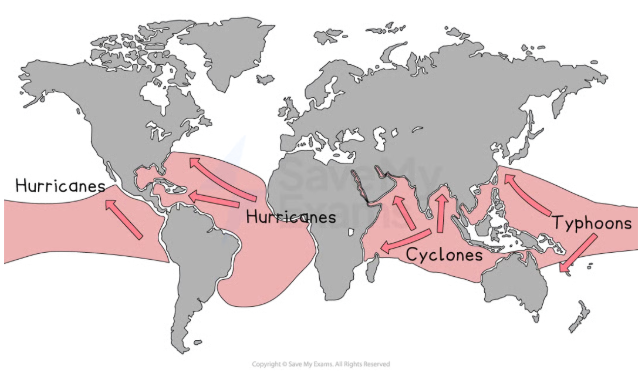
Why are they called hurricanes / typhoons / cyclones?
A: Same hazard, different regions:
Hurricanes = Atlantic + NE Pacific
Typhoons = NW Pacific (East Asia)
Cyclones = Indian Ocean + SW Pacific (e.g., Australia)
Where do tropical storms form globally (latitudes)?
Over warm tropical oceans
Between 5° and 30° north and south of the equator
When winds converge (meet) near the ocean surface
There is low vertical wind shear
Three main structural components of a tropical storm
The eye - Central zone up to 50 km wide with very low pressure, light winds, clear skies, no rain, and high temperatures
The eyewall - Surrounds the eye with spiralling air, extremely strong winds (around 160 km/hour), dense clouds, and torrential rain → most destructive
Outer edges - Beyond the eyewall with decreasing wind speeds, scattered clouds, less rainfall, and rising temperatures
How do tropical storms form?
warm surface water evaporates rises and condenses into clouds
This releases huge amount of energy producing powerful storms
The rising air creates an area of low pressure which increases surface winds
Low wind shear prevent clouds breaking up as they rise so storm stays intact
Easterly wind near the equator move tropical storms toward the west
Storms spin due to coriolis effect
as storm moves over ocean the energy from the warm water strengthens the storm so wind speeds increase
storms lose strength when the move to land or cooler water because their energy supply from the warm water is cut off
How might climate change affect distribution/frequency/intensity of tropical storms?
Global temperatures are set to rise as a result of global warming
More of the world's oceans will be above 27° C, therefore, more places across the world will experience tropical storms
Oceans will stay at 27°C or higher for longer during the year, which will increase the annual number of tropical storms
Higher temperatures will mean storms will be stronger and more frequent and cause more damage
What are Primary effects and secondary effect
Primary effects are the immediate impacts of strong winds, high rainfall and storm surges
Secondary effects are the impacts that occur later on, after the storm has passed
Primary impacts of tropical storms
Buildings and bridges are destroyed
Roads, railways, ports, and airports are damaged
Electricity lines are damaged/destroyed
Gas lines broken
Sewage overflows
Rivers and coastal areas are flooded
Businesses destroyed
Secondary impacts of tropical storms
lack of shelter leaves people homeless - distress/poverty/ill helath/death
cost of rebuilding can be expensive and some people may not have insurance
Blocked or destroyed roads prevent rescue and emergency vehicles and aid from getting through
Life support systems, hospitals, shops and homes left without power supplies
Clean water supplies are contaimnated - increase of waterborne diseases and death
Crops livestock and habitats are destroyed leading to shortage of food and famine
What are immediate responses?
Immediate response
When a tropical storm is forecasted (predicted) to hit an area
As the tropical storm is happening
Immediately after the tropical storm has passed
What are long term responses?
Long-term responses are:
Restoring an area to its past conditions
Reducing the impact of future storms
Immediate responses to tropical storms
Evacuation of people before the tropical storm arrives
Rescue people before the storm cuts people off from flooding and treat injured people
Temporary shelters for the homless and post notices where they are being housed for missing family members
Provide temporary supplies for power/food and water and restore communication systems
Overseas aid may be sent in the form of workers, supplies, equipment or financial donations
Long term responses to tropical storms
Improve long-term forecasting techniques to give people more time to evacuate in the future
Repair and improve flood defences – floodgates, levees, etc.
Provide aid, grants or subsidies to residents to repair and strengthen their properties
Repair, replace and improve infrastructure
Improve building regulations so that more buildings withstand the impacts of tropical storms or change planning rules to restrict homes being built in risk areas
How does monitoring and prediction reduce effect of tropical storms?
storms can be monitored using radar satellites and aircraft
computer models can then be used to calculate storms predicted path
predicted where and when tropical storm is going to happen gives people time to evacuate and protects homes and businesses
eg. Typhoon Haiyan predicted storm path and helped authroties dcide which areas need to be evacuated
How does planning reduce effect of tropical storms?
future devleopment eg. enw house can avoid high risk areas such as low lying costal zones
government can plan evacuation routes to ensure people can get away quickly
emergency services can prepare for disasters by practising rescuing people from flooded areas
eg. Typhoon Haiyan volunteer started resuce simulation to prepare for future storms
How does protection reduce effect of tropical storms?
building can be designed to withstand tropical storms
buidling can also be put on stilts so they are safe from flood water
flood defences can be built along rivers (levees and sea walls)
eg. mangrove forests are being planted in Philippines to act as natural flood defence
Five types of air masses that bring different weather to the UK
Air Mass | Weather |
|---|---|
Polar Maritime | Cold and wet |
Arctic Maritime | Very cold and wet |
Polar Continental | Cold and dry |
Tropical Continental | Warm and dry |
Tropical Maritime | Warm and wet |
Extreme weather in the UK (all)
Depressions
very wet unstable low pressure weather
form when warm air meet cold air and strongest wind and heaviest rain are in autmn as summer heat meets polar air
Anticyclones
very cold or very hot stable high pressure dry weather
winter anticyclones bring longer periods of cold foggy weather
UK weather hazards
strong winds
heavy rainfall
heatwaves
thunderstorms
drought
snow and ice
Weather Hazard - Strong Winds
Strong gales (winds) damage properties and cause general disruptions
Uprooted trees and debris can injure or kill
Winds are strongest in coastal areas, particularly the west coast and upland areas
eg. Storm Ali 2018 - 100mph winds blew over several trees
Weather Hazard - Heavy Rainfall
Flooding causes damage to homes and possessions, disrupts transport networks
Costs for recovery can cost millions of pounds
eg. South Wales flooded in 2018 after over 180mm of rain feel in 48 hours during Storm Callum
Weather Hazard - Snow and Ice
Causes injury through slips and falls
Death through the cold
Closures have an economic impact on businesses, transportation, and schools
eg. Beast from the East brough up to 50cm of snow causing major disruption to traffic and schools
Weather Hazard - Drought
Water supplies run low
Causes economic impacts through loss of crops, death of animals, loss of wildlife
Water supply restrictions and hosepipe bans impact people
eg. 2022 drier that the average year for UK 62% of the usual summer rainfall ground water levels were also very low
Weather Hazard - Thunderstorms
Heavy rain, lightning and strong winds
Most common in summer in the south and east of the UK
Lightning strikes can kill and can also cause fires and damage properties and the environment
july 2014 - series of thunderstorms struck south and central england with lightning strikes causing power cuts/delaying flights
Weather Hazard - Heatwaves
Long periods of extremely hot weather cause breathing difficulties, death and heat exhaustion
Roads can melt and rails buckle under the heat, which disrupts transport
Tourism may benefit from good weather
eg. 2022 was one of the hottest summer on record with temperature exceeding 40C Lincolnshire
Prediction that weather in UK is becoming more extreme
IPCC has warned temp will increase during this century
Global warming increases the frequency and intensity of extreme weather events through increased evaporation and rainfall
Scientists believe UK will continue to experience higher amount of rainfall and increased temperatures (1980s extreme winter rainfall has increased)
Uk temp has increased about 1C since 1980
Evidence that weather in UK is becoming more extreme
UK ten warmest years have occurred since 2002
2018 was joint hottest summer on record
Extreme colt event are more frequent with seven of the UKs eleven coldest recorded temperature since 1980 and December 2010 was the coldest month for over a 100 years
More rainfall record were broken between 2010-2014 than in any decade on record
Major flooding events have become more frequent over the past 10 years
December 2015 was the wettest month ever recorded and sever flooding occurred in many areas of the UK
Evidence of climate change - earth is getting warmer
Quaternary period span from about 2.6 million year ago to present day
Last ice age ended approximately 12000 years ago
Global temperature has shifted between cold glacial periods that last about 100000 years to warmer interglacial periods that last around 10000 years
The last glacial period was 15k years ago since then earth has been warming
Global warming is the term used to describe sharp rise in global temperatures over the last century
Evidence of climate change - Ice and Sediment Cores
Ice sheets are made up of layers of ice one layer is formed each year
Drill into ice sheets to get long cores of ice
Analyse gases trapped in layer of ice we can predict temperature each year
Remains of organisms found in cores taken from ocean sediments can also be analysed
These extend temperature record back at least 5 million years
Evidence of climate change - Pollen Analysis
Pollen from plants get preserved in sediment
Scientists can identify and data preserved pollen to show which species were living at that time
Scientists know the conditions that plants live in now so preserved pollen from similar plants shows that climate conditions were similar
Evidence of climate change - Tree rings
Tree ring grows - new ring each year the tree ring are thick in warm wet conditions
Scientists take cores and count the rings to find the age of the tree
The thickness of each ring shows what climate is like
Reliable source of evidence of climate change for past 10k years
Climate change causes
greenhouse effect
allow short wave radiation to pass through and reach earth surface
earth surface absorbs this and releases it as long wave radiation
ghgs then abosrb this and re radiate it in all directions
maintain earth temp/increasing earth temperature
Greenhouse gases from natural sources
Water vapour: Evaporation from the oceans/seas and plants
Carbon dioxide: Volcanic eruptions, wildfires and respiration
Methane: Emitted from oceans and soils as part of decomposition, termites also emit methane
Nitrous oxide: Soils and oceans
Causes of natural climate change
Milankovitch Cycles (Orbital changes)
Volcanity activity
Solar output
Atmospheric dust
Causes of natural climate change - Orbital Changes
Affect how much solar radiation the earth receives
More energy = more warming
Variations in the way earth orbits around the sun
Strech - earth orbit around sun varies from circular (cooler) and ellipitcal warmer) change happens ever 100000 years - eccentricity
Tilt - Axis tilted at an angle (40k years) greater the tilt the hotter the summer the cooler the winters
Wobble - every 24k years earth wobbles on its axis (precession) this affect seasonal temp
Could have caused the glacial and interglacial cycles of the Quaternary period
Causes of natural climate change - Volcanic Activity
Large scale eruptions lead to vast quantities of ash being ejected into the atmosphere
Ash in the atmosphere blocks solar radiation leading to a decrease in temperatures
Solar Output
Suns energy output isnt constant and changes in short cycles (11 years)
Reduced solar output means that the Earth climate may become cooler in some areas
Solar output isn’t thought to have major effect on global climate change
Causes of natural climate change - Human Activity Examples
GHGs
Fossil Fuels
Agriculture
Construction
Deforestation
Causes of natural climate change - Fossil Fuels
Fossil fuels account for almost 50% of global greenhouse gas emissions
Fossil fuels are used in transportation, construction, heating, manufacturing and energy production
Causes of natural climate change - Agriculture
Farming livestock produces lots of methane
Rice paddies contribute to global warming because flooded fields emit methane
Deforestation to clear land for grazing reduced plant to do photosynthesis
When trees are cut down they stop taking CO2
CO2 is also released into the atmosphere when trees are burnt as fuel
The production of fertilisers and pesticides uses fossil fuels
Causes of natural climate change - Construction + Transport
The manufacture of cement releases CO2 - it is made from limestone which contains carbon
The increasing global population has led to increased numbers of cars, lorries and planes
Most transport uses petrol/diesel which comes from oil as fuel this releases CO2
Effect of climate change - Social effects
Health
Increased temp and lack of precipitation lead to spread of diseases
eg. Italy since 2017 when it was previously malaria free
Heatwaves more common
Heat stroke/dehydration/sunburn
Respiratory diseases affected
Loss of Jobs due to changes in tourism and agriculture
Homes - Increased flooding due to sea level rise and increase frequency/severity of storms will lead to displacement of large numbers of people
Effect of climate change - Economic Effects
Agriculture
Farmers may need to change the crop they grow if climate conditions become unsuitable
Reduced water availability mean irrigation is limited
Food shortages will lead to malnutrition and famine
Employment
Job opportunites may change or decrease
Tourism may decline in some areas (ski resorts have less reliable snow)
Farmer may have to change crop they grow or leave farming
Agirculture/Fishing may decline due to rising temp and rainfall patterns
Settlements
In low lying Ares may have to be abandoned or need additional defences against sea level rise (costly)
Effect of climate change - Environmental Effects
Sea level rise
Warmer temp cause the water in sea to expand increasing sea level
Melting ice
Average sea level has risen from 23cm to 1880
Sea levels are forecast 30cm by 2050
Low lying costal areas are in high risk of flooding (eg. Maldives)
Beach erosion will increase so greater coastal erosion
Mitigation strategies to reduce climate change
Planting trees
Carbon Capture
Alternative Energy Production
International Agreements
Mitigation Climate Change - Planting trees
Planting trees increases the removal of CO2 from the atmosphere
Oxygen is created during photosynthesis
Increased transpiration increases cloud formation which reduces incoming solar radiation
Mitigation Climate Change - Alternative Energy Production
Replacing fossil fuels with nuclear/renewable energy resources to reduce GHGs emissions eg. Offshore wind farms/tidal project/nuclear pp
They are becoming cheaper
Renewable energy is not as efficient as fossil fuels
Mitigation Climate Change - Carbon Capture CCS
Captures and removes CO2 before it is emitted:
The CO2 is then compressed and stored underground
This is an expensive process and is not economically viable yet
It is unknown whether the CO2 will be able to be stored long term
Mitigation Climate Change - International Agreements
Paris Agreement 2015 - reduce ghg emission and limit global warming
Global agreement to limit global warming to 2C (preferable 1.5C) above pre industrial levels
Argument also includes reducing CO2 emission by at least 60% by year 2050
Signed by 196 countries
encourages developed countries to help developing countries put mitigation strategies in place
each country has submitted a pledge which indicates how much they will try reduce GHGs emission by (UK said at least 68% by 2030 from 1990)
Adaptation Climate Change
Responding to effects of climate change
Changing Agricultural systems
Managing water supply
Coping with rising sea levels
Adaptation Climate Change - Changing Agricultural systems
Changing rainfall patterns and higher temp will affect productivity of existing systems
It may be necessary to plant new crop types that are more suited to climatic conditions
Biotechnology is being used to create new crop varities which are more resistant to extreme weather events
Development of drought-resistant crops (Millet In Kenya for example)
Adaptation Climate Change - Managing Water Supplies
Reducing demand through the use of water-efficient appliances and devices (shower heads, dual flush toilets)
Increasing supply through desalinisation
Water storage facilities
Improved irrigation systems which waste/use less water
Adaptation Climate Change - Coping with rising sea levels
Construction of sea walls as in the Maldives
Mangrove forest restoration which protects the land from coastal flooding
Raised homes on stilts and embankments in LICs
Construction of artificial islands up to 3m high
Flood barriers such as the Thames Barrier
Predicted to rise between 0.28m - 1.01m by 2100
Hadley Cell
Largest cell
Extends from the equator 30 and 40 north and south
Air flows towards higher latitudes where it becomes cooler and sinks over subtropical regions
Dry cloudless → warmed by sun as it descends climate is warm and dry
Mechanisms of why we get variations of temperatures
Volcanic eruptions can dim global for about a year (eject ash into the sku → jet sream can circulate around the world → global dimming)
Solar flares can affect global temperatures for years and sometimes pules (sunspots)
Incoming solar radiation (insolation)
Ferrel Cell
Middle cell
Occurs from edge of Hadley cell 60-70 degrees north and south of the equator
Tropical Storm Features
ITCZ - south of tropic of cancer and north of tropic of capricorn
between 5 degrees and 30 degrees north and south of the equator
High Insolation (direct sunlight) → High temperatures
Temp above 27C
Sea depth = 60-70m
Require heat and moisture from warm air to rise
Low pressure
Latent Heat is released which power tropical storm
Low “Shear” Wind →
“Season” is between 1st June and 30 Nov
Formation of Storm
Warm air from the sea rises and the air rushes in to the area below it
Warm air rises from the sea -> condenses and forms clouds which make the walls of the tropical storm
Cold air descends near the centre creating a calmer atmosphere known as the eye of the storm (also heavy rainfall cause of this)
The rotation of the earth causes the storm to begin spiraling
How do tropical storms develop?
Tropical storms form between approximately 5° and 30° latitude. Because of easterly winds they initially move westward.
The air above the warm ocean is heated. Once the ocean water reaches at least 27°C, the warm air rises quickly, causing an area of very low pressure.
As the air continues to rise quickly it draws more warm moist air up from above the ocean leading to strong winds.
The rapidly rising warm air spirals upwards, cools, condenses and large cumulonimbus clouds form.
These clouds form the eye wall of the storm and produce heavy rainfall.
In the centre of the storm, cold air sinks forming the eye of the storm - here, conditions are calm and dry.
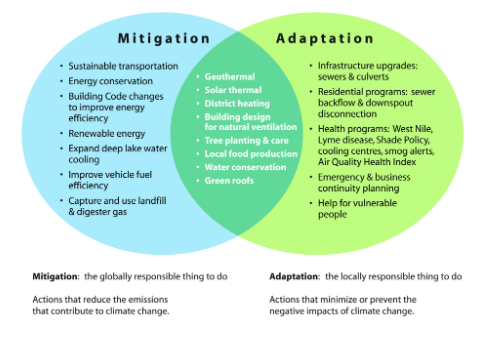
Mitigation
Reducing greenhouse gas emissions, therefore reducing future warming
Adaptation
Changing the way we live so we can thrive/survive in the changing global climate.
Mitigation vs Adaptation Examples