Topic 2: Ecology (2.1 Ecosystems; 2.2 Energy FLOWS/Biomass; 2.3 Biogeochemical cycles; 2.4 Climate + Biomes; 2.5 Zonation, succession, ecosystem transformation)
 Call Kai
 Learn
Learn Practice Test
 Spaced Repetition
 Match
Match Flashcards
 Knowt Play
1/26

There's no tags or description
Looks like no tags are added yet.
Name | Mastery | Learn | Test | Matching | Spaced | Call with Kai |
|---|
No analytics yet
Send a link to your students to track their progress
27 Terms
Taxonomy
Taxonomy used describe/classify organisms:
Domain
Kingdom
Phyllum
Class
Order
Genus
Species
Ecosystems
Ecosystem = made all living + non-living things within environment
Species
species = group organisms share CHARACTERISTICS + can breed, FERTILE offspring (not mule!!)
“KEYSTONE species”; species w/ critical role maintaining ecosystem (ex. Otters eat urchins, protect kelp!!)
Population
Population = group ONE single species living SAME AREA, interbreed
(*one species living in TWO ponds NOT population; two separate populations)
population DENSITY —> average # individuals per given area; based birth/death rates, migration, etc.
LIMITING FACTORS
LIMITING FACTORS slow population growth; carrying capacity
biotic; lack food, predation, no mates, inter/intra-species competition
abiotic; lack water, oxygen, low light, freezing temperatures, natural disasters
density-dependent (as population ⬆); predation, intra-species competition, disease, waste
density-independent; natural disasters, human affects
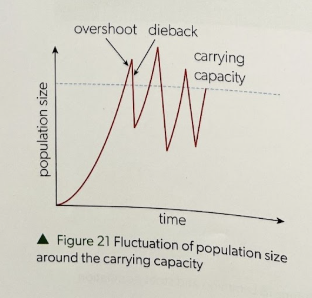
cause population fluctations
LIMITING FACTORS cause population fluctuation —> cyclical oscillations
MODELS;
j-curves; exponential growth, no LIMITING FACTORS = sudden “dieback”
s-curves; standard—exponential growth into LIMITING FACTORS to carrying capacity
==> ‘idealized’ j + s-curve is what populations usually look like;
**NOTE: CARRYING CAPACITY is pop STABILIZES. NOT always highest point.
Human carrying capacity? — ISSUES Measuring
a) too many resources used
*imported resources — outside direct niche
b) varying lifestyles too much
c) technology goofs
Niche
set all biotic + abiotic factors where species LIVES
milk, honey, etc. are BIOTIC — *products count as biotic
Fundamental niche vs. REALIZED niche
FUNDAMENTAL niche is ALL possible conditions species could survive/reproduce
REALIZED niche is where ACTUALLY survives/reproduce (bc predation, limited resources + competition)
**NOTE: [environmental] niche vs. ECOLOGICAL niche (specie’s role in ecosystem)—NO two species can inhabit same role (@ same time/place)
community
community; group two or more species living same area—communities share habitats!
Inter + Intra-species competition
Interspecies comp
based territorial (resources), mates
Intraspecies comp
resources—either share OR one DOMINATES
“competitive exclusion”; dominant species coexist w/o wiping lesser species
RELATIONSHIPS (between species)
Predation
Carnivore
Herbivore
Parisitism — lives off host; ex. leech, fleas, etc.
Mutualism —BOTH benefit; ex. clownfish and sea anemone
Saprotrophism — saprotroph feeds dead organics, recycling nutrients
↳ scavengers (vultures) eat decaying flesh
↳ + detritivores (fungi, bacteria); no “eat”, secrete enzymes break down
Disease
higher population density ⬆ disease spread
(+ warmer, humid climates)
pathogens, bacteria, viruses, fungi
First Law of Thermodynamics
First Law of Thermodynamics = energy CAN’T be CREATED or DESTROYED.
(thus, energy just flows around the system!)
1) Photosynthesis
~plants; carbon dioxide + water → glucose + oxygen (cellular respiration)
sunlight used split water to combine to glucose
2) Cellular respiration
EVERYTHING (animals, plants, etc.) cellular respiration!!
Cellular respiration = food/glucose broken down to ENERGY.
*note—heat generated bc respiration loses energy (entropy, energy unavailable do work)
aerobic (w/ oxygen) + anaerobic (w/o oxygen) respiration
heterotrophs, autotrophs, etc.
side note: heterotrophs (consumers—animals) vs. autotrophs (make own food—plants), photoautotrophs (photosynthenetic bacteria), chemoautotrophs (bacteria near deep sea vents w/o sun)
Second Law of Thermodynamics
Second Law of Thermodynamics = entropy ALWAYS increases (or constant)
bc energy transferred/transformed→ degrades to less useful/efficient form (i.e. heat), ⬆ entropy
food chain
food chain points flow energy one organism → next; single hierarchy
producers (autotrophs) make own food w/ photosynthesis :3
consumers (heterotrophs) gain food other organisms
==> Food webs made intertwined/complex food chains
trophic levels
trophic level = within food chain, level organism
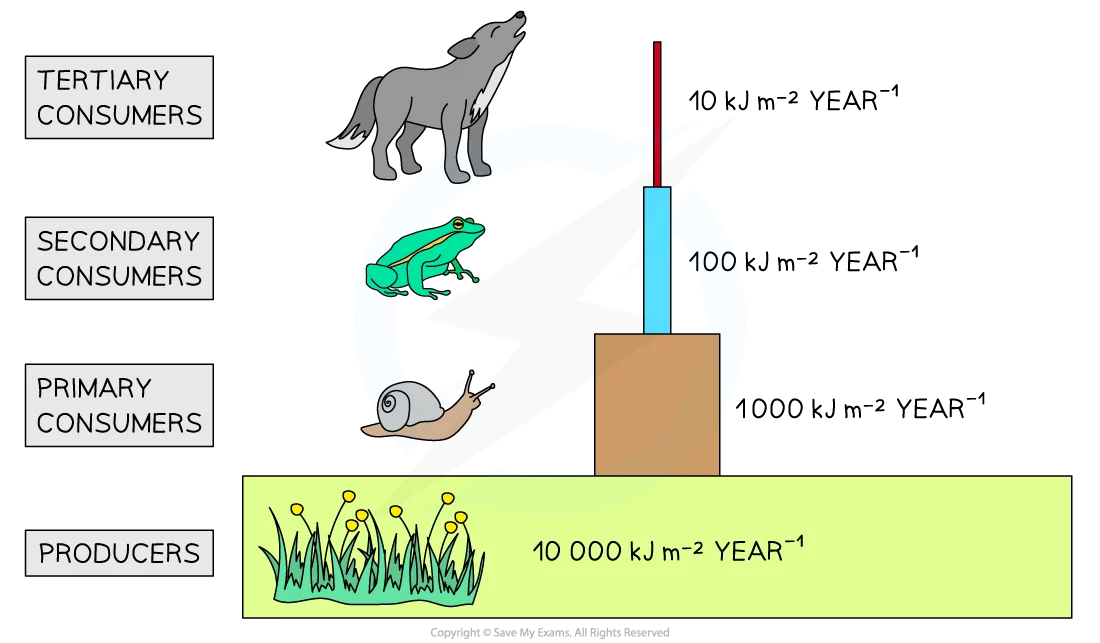
producers (plants) →primary consumers → secondary consumers →tertiary consumers
*note: only ~10% energy transferred per level—rest lost respiration/heat
POSSIBLE reasons TROPHIC ‘loss’:
a) (mainly) lost respiration/heat
b) not all eaten (bones, etc. + die natural causes)
c) varies 5-20% between species bc warm-blooded use more energy

productivity
productivity ⇒ rate ecosystems generate biomass (energy/mass per area per time)
gross productivity (GP) = total biomass intake by organism
net productivity (NP) = net biomass intake - respiration
Max sustainable yield (MSY)
Max sustainable yield (MSY) is net productivity species/trophic lvl harvested w/o reducing future supply
Ecological pyramids (+instead food webs/chains)
Ecological pyramids model qualitiative (biomass, productivity, etc.) differences between trophic levels
PROS:
document energy transfer/loss
shows what eats what
reflect ecosystem balance?
—TYPES—
'A. number pyramids’ — # organisms per level
easy overview
BUT disregards size/juvenile + LOTS counting
biomass pyramids’ — biomass per level
considers size per indiv
BUT must kill to measure, only sample masses anyways
‘energy pyramids’ — productivity/energy per level
over time, diff. ecosystems, second law of thermo
BUT must measure growth over time, where detritivores ?
bioaccumulation
as result chain/web/pyramid, biocides (ex. pesticides) “bioaccumulate” in ecosystem—"biomagnification” upwards chain (bc consumer eats LOT grass, even if small amount per grass)
Biogeochemical cycles
biogeochemical cycles (hydrological, carbon, etc) cycles keep the world running!!
involve:
1) stores (storages) = organic + inorganic equilibrium w/ environment ;steady-state equilibrium
2) sinks = net accumulates
3) sources = net released
THE CARBON CYCLE — (biogeochemical cycle!)
carbon CYCLING:
per definition, carbon cycles through living + non-living things
a) carbon fixation = living organisms sequester carbon naturally bc absorb carbon dioxide + convert to biomass
FAST vs. S L O W carbon cycles…
FAST— biotic, one animal/lifetime → land/atmosphere/ocean
S L O W—abiotic, millions years; soil→rocks →ocean
==> [sinks? stores? source?] WHERE “DYNAMIC” CARBON CYCLE?!??
carbon STORES (inflow/outflow/steady-state equilib.):
LIVING — living things (humans, animals, plants, etc.)
NON-LIVING — atmosphere, rocks/soil, oceans (and shells!!)
Agriculture
sinks: ‘regenerative’ methods—crop rotation, polyculture, cover crops, etc.
source: excessive tilling, monoculture
stores: long-time croppage = store (ig equal-ish cycling)
Forests
sinks: gud forest! = sink (carbon sequestration w/ photosynthesis)
source: forest fires, decomposition
stores: also forest bc photosynthesis (inhale) —> some respiration (exhale)
Oceans
sinks: sequester ~25% atmospheric carbon…BUT ocean acidification