Psych week 6&7 memory
 Call Kai
 Learn
Learn Practice Test
 Spaced Repetition
 Match
Match Flashcards
 Knowt Play
1/31

There's no tags or description
Looks like no tags are added yet.
Name | Mastery | Learn | Test | Matching | Spaced | Call with Kai |
|---|
No analytics yet
Send a link to your students to track their progress
32 Terms
memory
the process that allows us to record, store and later retrieve experiences and infromation
involves taking something that we have observed and converting it into somthing that we can store retrive and use
3 memory systems
sensory
short term/ working
long term
sensory
a breif store of information
sensory info that we attend to is them passed onto short term memory
has endless capacity can hold for ½ a second
short term memory
makes a greater impression
passive stage
average of 7 pieces of information
2 types of rehearsal
elaborative - understanding what you are rehearsing
maintenance - repeating something over and over in your head.
working memory
storing
involves activly processing and manipulaitng the memory
long term memory
a perminent store
unlimited capasity
can decay over time
3 stages of memory
encoding
storage
retrieval
encoding
sensory information that is transferred into short term memory with rehearsal attuning to it
2 catagroies of encoding
shallow and deep
effortgful and automatic
shallow encoding
only superficial peices of information are learned
rote learning used
deep encoding
attention to the meaning of the material
gaining a conceptual understanding
easy to retrieve
effortful encoding
requires attention and effort at different levels
e.g memorising notes for an upcoming exam
semantic encoding
encoding the deepest level, relating the meaning to ourselves
storage
storing info in the brain.
being able to retain it for varoius lengths of time
retrieval
taking info out of the long term memory to be used by the short term memory and the working memory
involves reactivating stored info for usage.
recognition
already been provided with awnser making retreival easier
tip of the tongue phenomenon
temporary inability to recall infromation you know
priming
prior exposure to learned material effecting the processing of new material
retrieval cues
reminders of information that we would otherwise not recall.
guides where we should look for information
context effects
memory works better in context to origonal learning e.g environment, mood and state.
mood concurrent memory
state dependant memory
storage long term memory types
declaritve and non decrative
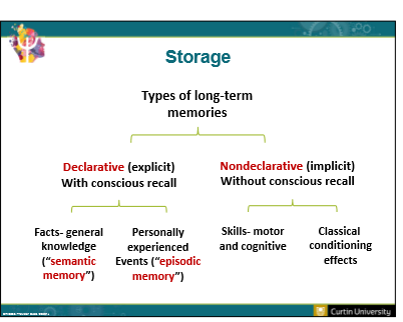
declarative (explicit)
occures with conous recall
2 types of declarative (explicit) memory
semantic
episodic
semantic memory
facts and general knowledge
episodic memory
personally experienced events
nondeclarative (implcit memory)
occures without concoius recall
2 types of implicit memory
skills both motor and congitive
and classical conditioning effects
prospective memory
for things that need to be done in the future
procedural memory
for skills and procedures
retrograde amnesia
inability to remeber events that occurred prior to brain trauma
anterograde amnesia
inability to remember events after brain trauma.