4.8 Space physics
 Call Kai
 Learn
Learn Practice Test
 Spaced Repetition
 Match
Match Flashcards
 Knowt Play
1/25

There's no tags or description
Looks like no tags are added yet.
Name | Mastery | Learn | Test | Matching | Spaced | Call with Kai |
|---|
No analytics yet
Send a link to your students to track their progress
26 Terms
How many stars are in our solar system?
There is only one star in our solar system: the sun, which sits at the centre
Describe what makes up our solar system
Our solar system is heliocentric; the sun is in the centre.
One star, the Sun
Eight planets that orbit the sun
Their natural satellites (moons)
Dwarf planets which orbit the sun
Asteroids
Comets
Name all the planets in our solar system in order of closest to the sun
Eight planets: Mercury, Venus, Earth, Mars, Jupiter, Saturn, Uranus, Neptune
My very educated mother just served us nachos (planets)
What galaxy is our solar system a part of?
The milky way
What are the difference between planets and moons?
Planets orbit stars, whereas moons are natural satellites that orbit planets.
What are nebulas?
Clouds of gas and dust
Describe how stars (eg. the sun) are formed
Nebulas (clouds of gas and dust) are formed in the galaxy.
The gravitational attraction between the gas and dust particles of the nebula pull them closer together, forming a protostar.
As the particles get closer, the protostar becomes denser and the gas and dust particles collide more frequently with each other,
more energy is transferred from gravitational potential energy to thermal energy, causing the temperature and pressure of the protostar to increase.
Eventually the temperature and pressure of the protostar becomes so great that lighter nuclei (mainly hydrogen nuclei) undergo nuclear fusion
to form helium nuclei.
This releases large amounts of energy, which keep the core of the star hot.
The force exerted by pressure due to the energy released by nuclear fusion balances the inward force of gravity.
which leads to an equilibrium between the gravitational collapse of the star and the expansion of the star.
This means that a star has formed; the star enters a long stable period
In the stable period it is called a main sequence star, and it typically lasts several billion years
What does the life cycle of a star depend on?
Its size
Draw the life cycle of a star
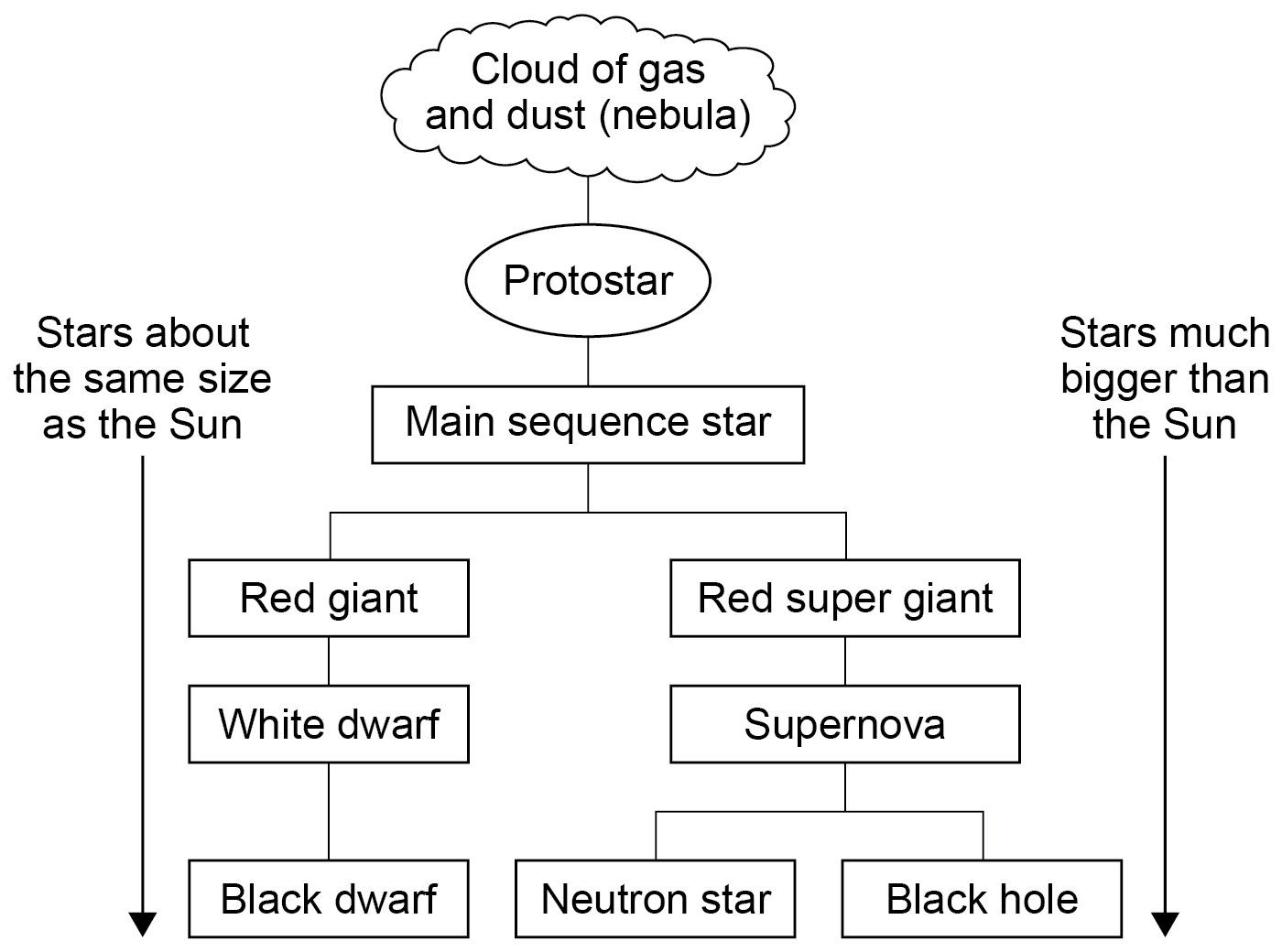
State the life cycle of a star about the same size as our Sun
Cloud of gas and dust (nebula)
Protostar
Main sequence star
Red giant
White dwarf
Black dwarf
State the life cycle of a star much bigger than our Sun
Cloud of gas and dust (nebula)
Protostar
Main sequence star
Red super giant
Supernova
Neutron star or black hole
How are naturally occurring elements produced?
By fusion processes in stars
Describe the life cycle of a star about the same size of our Sun after it has become a main sequence star
The main sequence star will carry on undergoing fusion reactions until the hydrogen runs out in the core
When the hydrogen runs out, fusion can no longer occur so the star is no longer at equilbrium; it will collapse
As the star collapses, the temperature and pressure of its core increases, meaning heavier elements can fuse together
Helium nuclei → carbon, iron
As the star fuses the heavier elements, it releases more energy which causes the star to swell
As the surface of the star gets further away from its core, its surface cools, forming a red giant
Once all fusion stops, the forces are unbalanced again
the red giant becomes unstable and collapses
and ejects its outer layer of dust and gas
This leaves behind a hot, dense solid core - a white dwarf
Over millions of years, the white dwarf will cool down and emit less and less energy
When it no longer emits a significant amount of energy, it becomes a black dwarf
Describe the life cycle of a star much larger than our Sun, after it has become a main sequence star
The main sequence star will carry on undergoing fusion reactions until the hydrogen runs out in the core
When the hydrogen runs out, fusion can no longer occur so the star is no longer at equilbrium; it will collapse
As the star collapses, the temperature and pressure of its core increases, even meaning heavier elements can fuse together (helium nuclei), forming even heavier elements (eg. carbon, oxygen)
As the star fuses the heavier elements, it releases more energy which causes the star to swell
The main sequence star will then form a red super giant as the surface of the star cools
The red super giant continues to glow brightly and undergo more fusion reactions, releasing more energy
expanding and contracting several times
and forming elements as heavy as iron in various fusion reactions
Eventually, once all fusion has occurred, the star is too large to be stable so collapses and rebounds on its centre, exploding to produce a supernova
The supernova forms elements heavier than iron and ejects them into the universe, allowing them to form new planets and stars
Once the supernova has exploded, the leftover core will be called a neutron star, or if the star was very large it will become a black hole
Explain how new elements are formed
Fusion reactions that occur in stars form new elements (eg. at very high temperatures hydrogen nuclei fuse to form helium)
When large stars form red super giants, even heavier elements can form due to higher core temperatures (eg. iron) in fusion reactions
When stars explode into supernovas, even heavier elements can form
They are distributed when the star explodes into the supernova, as it ejects them into the universe
What is acceleration?
The rate at which the velocity of an object changes
What causes planets and satellites to maintain orbits?
Gravity provides the force that allows planets and satellites (both natural and artificial) to maintain their circular (or almost circular) orbits
Describe the similarities and differences between the planets, their moons and artificial satellites
Planets:
Natural
Orbit a star
Almost circular (eliptical)
Moons:
Natural
Orbit a planet
Circular
Artificial satellites:
Made by humans
Orbit a planet (usually Earth)
Circular
Explain and describe the motion of a body in orbit
The force of gravity holds bodies in their orbit
Constant speed
But changing velocity
As velocity is a vector quantity that measures the speed and direction of an object
And the direction of an object in circular orbit is always changing
Explain the relationship between the radius of an object’s orbit and its speed
The force due to gravity is dependent on distance
The smaller the distance, the greater the gravitational attraction
The greater the gravitational attraction, the greater the acceleration of the object in orbit
Must move faster to maintain its orbit and not crash into the object it is orbiting
For an object in stable orbit, if the speed of the object changes, the radius of its orbit must do so to.
Faster orbit = smaller radius
Slower orbit = larger radius
What is the red shift?
There is an observed increase in the wavelength of light from most distant galaxies
The further away the galaxies, the faster they’re moving away and the bigger the observed increase in wavelength
This is the red shift - as the wavelengths are longer then they should be, this means that they have shifted to the red end of the spectrum
This shows that the universe is expanding
What does the red shift provide evidence for?
That space itself (the universe) is expanding
This supports the big bang theory
Describe the big bang theory
The big bang theory suggests that the universe began from a very small region that was extremely hot and dense
At some point there was a ‘big bang’ when the hot, dense area of matter exploded
The matter all began to move away from each other, meaning that the universe at that point was expanding
Not much is understood about the universe; give examples of concepts that are still not understood
Dark mass
Dark energy
What galaxies have the greatest red shift and why?
Very distant galaxies have a very large red shift as they are moving away at a faster rate than galaxies closer
Explain why the velocity of satellites change as they orbit the Earth
Force of gravity causes the satellite to accelerate towards Earth
The acceleration causes a change in direction
Velocity changes because direction changes