Stage 3 Lesson 11
 Call Kai
 Learn
Learn Practice Test
 Spaced Repetition
 Match
Match Flashcards
 Knowt Play
1/106

There's no tags or description
Looks like no tags are added yet.
Name | Mastery | Learn | Test | Matching | Spaced | Call with Kai |
|---|
No analytics yet
Send a link to your students to track their progress
107 Terms
What is Newtons First Law of Motion?
Law of Inertia
An object remains at rest or in motion unless acted on by an external force.
Example: An airplane stays parked until thrust moves it. Once moving, it continues moving unless forces such as drag or braking act on it.
What is Newton’s Second Law of Motion?
Force = Mass × Acceleration (F = ma)
Example: More thrust produces greater acceleration, while a heavier aircraft requires more force to achieve the same acceleration.
Larger aircraft requires more power to get off the ground versus a small aircraft needs less force to get off the ground
What is Newton’s Third Law of Motion?
For every action, there is an equal and opposite reaction.
Example: A propeller or jet engine pushes air backward, and the reaction force pushes the aircraft forward.
What is Bernoulli’s Principle? How does it relate to aircraft?
States that as the velocity of a moving fluid (liquid or gas) increases, the pressure within the fluid decreases.
This principle explains what happens to air passing over the curved top of the airplane wing.
As the wing moves through the air, the flow of air across the curved top surface increases in velocity creating a low-pressure area above the wing, below the wing the air travels at a normal speed across the surface creating a higher pressure lifting upward
What are the different parts of an Airfoil? Draw it.
Leading edge: Rounded front edge facing airflow
Trailing edge: Narrow, tapered rear edge
Chord line: Straight line from leading to trailing edge
Camber: Curvature of the airfoil surfaces
What is the main purpose of an airfoil
To generate a reaction force from air as it moves over or past it
Its primary purpose in aircraft is to produce lift
What are some design tradeoffs of Airfoils? (High-lift vs streamline?)
High-lift shapes (more curved) increase lift but reduce speed efficiency
Streamlined shapes reduce drag but may not generate enough lift
Modern wings balance both needs depending on aircraft purpose
How does adding flaps affect the airfoil? (Ask to draw cord line, flaps and no flaps, with relative wind, and AOA)
As you extend the flaps it makes the wing surface larger creating more lift. It also changes the cord line in relation to the relative wind.
What are the four forces acting on the Aircraft?
Thrust, Drag, Lift, and Weight.
What is thrust?
The forward force produced by the powerplant/propeller or rotor. It opposes or overcomes the force of drag.
As a general rule, it acts parallel to the longitudinal axis. However, this is not always the case, as explained later.
What is Drag?
a rearward, retarding force caused by disruption of airflow by the wing, rotor, fuselage, and other protruding objects.
As a general rule, drag opposes thrust and acts rearward parallel to the relative wind.
What is lift?
a force that is produced by the dynamic effect of the air acting on the airfoil, and acts perpendicular to the flight path through the center of lift (CL) and perpendicular to the lateral axis.
What is Weight?
the combined load of the aircraft itself, the crew, the fuel, and the cargo or baggage. Weight is a force that pulls the aircraft downward because of the force of gravity.
It opposes lift and acts vertically downward through the aircraft’s center of gravity (CG).
In relation to the four forces acting on the aircraft what does it mean when an aircraft is in straight and level flight?
the sum of these opposing forces is always zero. (They are all equal)
What are the two types of Drag?
Parasite Drag and Induced Drag
Explain Induced Drag
Explain Parasite Drag
What are wingtip vortices? When is it the strongest?
the rapidly rotating air that spills over an airplane’s wings during flight.
Heavy, clean and slow
Describe how wingtip vortices form.
A wing producing lift creates high pressure below the wing and low pressure above the wing. (Bernoulli’s Principle)
Air moves from high pressure to low pressure around the wingtip.
This airflow curls around the tip, creating a wingtip vortex.
The vortices trail behind the aircraft and create induced drag
What is Ground Effect?
the conditions of slightly increased air pressure below an airplane wing that increases the amount of lift produced
It exists within approximately one wing span from the ground.
It results from a reduction in upwash, downwash and wingtip vortices, and produces a corresponding decrease in induced drag.
What are the Axis of an Aircraft?
Three imaginary lines that pass through an aircraft's center gravity.
imaginary axles around which the aircraft pivots around
The axis form the nose to tail is the longitudinal axis (Pitch)
The axis that passes from wingtip to wingtip is the lateral axis (Roll)
The axis that passes vertically through the center of gravity is the vertical axis (Yaw)
What is Moment?
the product of the weight of an item multiplied by its arm.
What is Datum Plane?
What is Station?
What is Arm?
What is Moment arm?
the distance from a reference point (datum) or CG to where the force acts.
Aircraft designers position the CG and tail surfaces to minimize unwanted pitching moments.
What is stability?
the quality of an airplane to correct for conditions that may disturb its equilibrium, and to return or to continue on the original flight path
It is primarily an airplane design characteristic.
what is Static Stability? What are the three types (give the ball example)?
Initial response after a disturbance (describes the aircraft's immediate reaction)
Positive Static Stability: Returns toward the original position (ball in a halfpipe)
Neutral Static Stability: Stays in the new position (ball down hill)
Negative Static Stability: Continues moving away from the original position (ball on upside down halfpipe)
What is Dynamic Stability? What are the three types (draw the waves)?
Response over time after a disturbance
Positive Dynamic Stability: Oscillations decrease and return to equilibrium
Neutral Dynamic Stability: Oscillation remains constant
Negative Dynamic Stability: Oscillations increase and diverge from equilibrium
What is maneuverability? What factors affect it?
The Ability of an aircraft to change directions along a flight path and withstand the stresses imposed upon it.
Weight – Lighter aircraft are generally easier to maneuver.
Inertia – Resistance to changes in motion.
Size and Flight Control Location – Affects how quickly the aircraft responds.
Structural Strength – Must withstand forces created during maneuvers.
Powerplant Performance – More power can improve maneuvering capability.
What is controllability?
Measure of the response of an aircraft relative to the pilot’s flight control input
It determines how effectively a pilot can change flight path and aircraft attitude (pitch, roll, and yaw)
How the aircraft response to pilot input, if the aircraft fights your controls it is less controllability
What is a planform?
The shape or form of a wing as viewed from above.
It may be long and tapered, short and rectangular, or various other sharps.
It affects airflow in three dimensions and strongly influences aircraft performance.
Speaking of effects of wing planform, what are the key design factors?
Aspect ratio = wingspan ÷ chord
High AR → less drag, better climb
Low AR → more drag, higher stall speed
Taper ratio = Decrease in chord (thickness) from root to tip
Reduces weight and drag
Improves efficiency at higher speeds.
Sweepback = rearward angle of the wing
Common in high-speed aircraft
Affects handling, especially at slow speeds.
Why are the performance affects of high aspect ration and low aspect ration?
High aspect ratio wings (glider, trainers)
Efficient lift, better low-speed performance
More forgiving flight characteristics
Low aspect ratio wings (Fast Jets)
Strong Structure, high-speed performance
Higher stall speed, more demanding control
What are three types of Wing designs?
Elliptical wing: Most efficient lift, but abrupt stall behavior
Rectangular wing: Stable stall, good warning, easier control (common in trainers)
Tapered wing: Balance of efficiency and structural weight
What is a stall?
A rapid decrease in lift caused by the separation of airflow from the wing’s surface, brought on by exceeding the critical angle of attack.
A stall can occur at any pitch attitude or airspeed
What is a propeller?
a rotating wing that converts engine power into thrust
Consists of 2 or more blades attached to a central hub, Each blade is an airfoil (similar to an aircraft wing), the engine provides rotational power;
propeller converts it into forward thrust.
Why Propellers Are Twisted
Blade tips travel faster than the blade roots.
Twisting keeps the blade operating at an efficient AOA along its entire length.
This helps produce more uniform thrust and improves efficiency.
What are the four left turning Tendencies?
1. Torque Reaction
2. Corkscrewing Slipstream
3. Gyroscopic Precession
4. P-Factor
What is Torque?
The reaction force created when the engine turns the propeller. As the propeller rotates in one direction, the airplane tends to roll in the opposite direction.
Newton’s Third Law: For every action, there is an equal and opposite reaction.
As the engine and propeller rotate clockwise (viewed from the cockpit in a 172), the aircraft tends to rotate counterclockwise.
What is Corkscrewing Slipstream?
the airflow created by the rotating propeller creates a spiraling (corkscrew) airflow behind the aircraft.
This rotating air is called the slipstream.
The spiraling slipstream strikes the left side of the vertical stabilizer.
This pushes the tail to the right and causes the nose to yaw left.
What is Gyroscopic Precession
when a force is applied to a spinning propeller, the resulting force occurs 90° ahead in the direction of rotation.
Most noticeable in tailwheel airplanes during takeoff.
Raising the tail applies a force to the top of the propeller disc. Due to gyroscopic precession, the force acts 90° ahead. The result is a yawing moment to the left.
What is P-factor?
A tendency for an aircraft to yaw to the left due to the descending propeller blade on the right producing more thrust than the ascending blade on the left.
Blade angle between the ascending (less) vs descending (greater)
What is Load Factor?
the ratio of lift to weight and is measured in Gs.
1 G = normal straight-and-level flight.
We weigh what we weigh
2 Gs = the aircraft structure supports twice its weight.
Excessive load factors can damage the aircraft structure and Increased load factors increase stall speed.
What are the aircraft designed limit load factor for Normal Category?
3.8 G to -1.52 G
our planes are tested for load factors of 150% above the demonstrated amount/ recommended range.
What is the aircraft designed limit load factor for Utility Category?
4.4G-1.76G
our planes are tested for load factors of 150% above the demonstrated amount/ recommended range.
What is the aircrafts designed limit load factor for acrobatic category?
6.0G-3.0G
our planes are tested for load factors of 150% above the demonstrated amount/ recommended range.
What is Maneuvering Speed?
VA, Protects the aircraft from structural damage during sudden maneuvers
Do not make full or abrupt control movements above this speed
Below VA → aircraft protects itself (stalls first)
Above VA → aircraft can be overstressed before stalling
VA decreases with lower weight
What is the Green Arc in our Airspeed indicator?
Normal Operating Range (48 - 129 KIAS)
Safe range for most flight operations
Lower limit: VS1 (stall speed in clean configuration)
Upper limit: VNO (maximum structural cruising speed - 129 KIAS)
What is the White Arc in our Airspeed indicator?
Flap Operating Range (40 - 85 KIAS)
Used for operations with flaps extended
Lower limit: VS0 (stall speed in landing configuration)
Upper limit: VFE (maximum flap-extended speed - 10° flaps → 110 KIAS, 10°-30° Flaps → 85 KIAS)
Approaches and landings are typically flown within this range
What is the Yellow Arc in our Airspeed indicator?
Caution Range (129 - 163 KIAS)
Fly only in smooth air
Use caution due to increased structural stress rise
What is the Red Line in our Airspeed Indicator?
VNE (Never Exceed Speed - 163 KIAS)
Maximum allowable airspeed
Exceeding this speed can cause structural damage or failure
What is VLO?
Landing Gear Operating Speed
Maximum speed for extending or retracting landing gear
What is VLE
Landing Gear Extended Speed
What is VX?
Best Angle-of-Climb Speed
Greatest altitude gain over the shortest horizontal distance
Used for obstacle clearance during short-field takeoffs
What is VY?
Best Rate-of-Climb Speed
Greatest altitude gain in the shortest amount of time
Provides maximum climb performance
Why do Power Plants have Limitations?
It provides safe operating ranges for an aircraft’s engine(s), propeller, and related systems to prevent engine damage and ensure reliable performance.
What kind of engine do we have in our planes?
Engine Manufacturer: Textron Lycoming.
Engine Model Number: I0-360-L2A.
Maximum Power: 180 BHP rating.
(Brake horse power)
What is our engines operating limits for takeoff and continuous operations?
Maximum Engine Speed: 2700 RPM.
What is the static RPM range at full throttle?
2300-2400RPM
What is the max Oil Temp?
245°F (118°C)
What is the oil pressure range?
Minimum: 20 PSI
Maximum: 115 PSI
What is the Propeller on our planes?
McCauley Propeller Systems.
Propeller Model Number: 1A170E/JHA7660.
Propeller Diameter Maximum 76 inches.
Minimum: 75 inch minimum.
What are the Weight Limits for normal category?
Maximum Ramp Weight: 2558 lbs.
Maximum Takeoff Weight: 2550 lbs.
Maximum Landing Weight: 2550 lbs.
Maximum Weight in Baggage Compartment:
Baggage Area 1 - Station 82 to 108: 120 lbs.
Baggage Area 2 - Station 108 to 142: 50 lbs.
NOTE: The maximum combined weight capacity for baggage areas 1 and 2 is 120 lbs.
What are the weight limits for Utility Category?
Maximum Ramp Weight: 2208 lbs.
Maximum Takeoff Weight: 2200 lbs.
Maximum Landing Weight: 2200 lbs.
Maximum Weight in Baggage Compartment: In the utility category, the baggage compartment must be empty and rear seat must not be occupied.
What is the Maneuvering Limits for a Normal Category?
The normal category is applicable to aircraft intended for non aerobatic operations.
NORMAL CATEGORY MANEUVERS AND RECOMMENDED ENTRY SPEED*
Chandelles → 105 Knots
Lazy Eights → 105 Knots
Steep Turns → 95 Knots
Stalls (Except Whip Stalls) → Slow Deceleration
Abrupt use of the controls is prohibited above 105 KIAS.
What are the Maneuvering limits for a Utility Category?
What are the Kinds of Operations Limits for our plane?
The airplane as delivered is equipped for day VFR and may be equipped for night VFR and/or IFR operations.
FAR Part 91 establishes the minimum required instrumentation and equipment for these operations.
The reference to types of flight operations on the operating limitations placard reflects equipment installed at the time of Airworthiness Certificate issuance.
Flight into known icing conditions is prohibited.
How much fuel can our planes hold?
Total Fuel: 56 U.S. gallons (2 tanks at 28.0 gallons each).
Usable Fuel (all flight conditions): 53.0 U.S. gallons.
Unusable Fuel: 3.0 U.S. gallons (1.5 gallons each tank).
What is the proper way to refuel the tanks?
To ensure maximum fuel capacity and minimize cross-feeding when refueling, always park the airplane in a wings-level, normal ground attitude and place the fuel selector in the Left or Right position.
What is some additional fuel limitations?
Takeoff and land with the fuel selector valve handle in the BOTH position.
Maximum slip or skid duration with one tank dry: 30 seconds.
Operation on either LEFT or RIGHT tank limited to level flight only.
With 1/4 tank or less, prolonged uncoordinated flight is prohibited when operating on either left or right tank.
Fuel remaining in the tank after the fuel quantity indicator reads 0 (red line) cannot be safely used in flight.
Approved Fuel Grades (and Colors):
100LL Grade Aviation Fuel (Blue).
100 Grade Aviation Fuel (Green).
What is the Fuel system in our Cessna 172S?
Fuel selector, Fuel reservoir, Aux. Fuel pump, Fuel straining, engine pump, Fuel distributor, check Valve
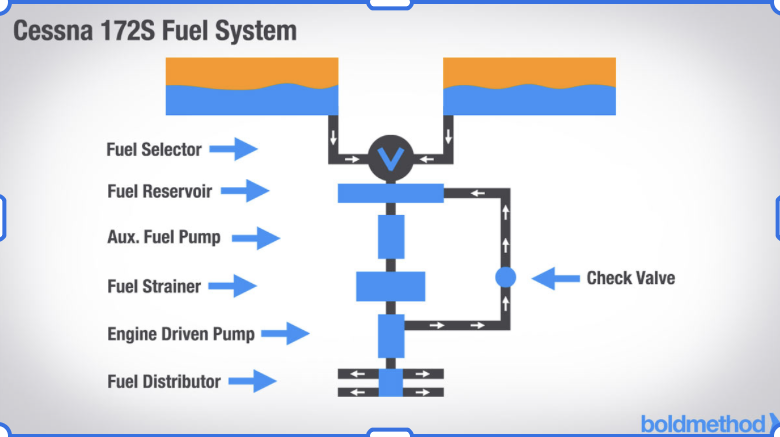
What are some other Limitations for our aircraft?
FLAP LIMITATION:
Approved Takeoff Range: 0° to 10°
Approved Landing Range: 0° to 30°
Why is weight control important? What are some factors?
Ensures the aircraft remains within certified weight limits, maintaining safe performance and structural integrity.
Fuel loading
Fuel Burn
Equipment changes
How can excessive weight impact the aircraft?
Excess weight can:
Increase takeoff and landing distances, Reduce climb performance, Increase stall speed, Reduce safety margins during emergencies
What is Arm (Moment arm)
the horizontal distance in inches from the reference datum line to the CG of an item. The algebraic sign is plus (+) if measured aft of the datum and minus (–) if measured forward of the datum.
What is the Basic empty weight (GAMA)
the standard empty weight plus the weight of optional and special equipment that have been installed.
What is Center of gravity (CG)
the point about which an aircraft would balance if it were possible to suspend it at that point. It is the mass center of the aircraft or the theoretical point at which the entire weight of the aircraft is assumed to be concentrated. It may be expressed in inches from the reference datum or in percent of MAC. The CG is a three-dimensional point with longitudinal, lateral, and vertical positioning in the aircraft.
What is CG Limits?
the specified forward and aft points within which the CG must be located during flight. These limits are indicated on pertinent aircraft specifications.
What is CG Range?
The distance between the forward and aft CG limits indicated on pertinent aircraft specifications.
What is Datum (reference datum)?
an imaginary vertical plane or line from which all measurements of arm are taken. The datum is established by the manufacturer. Once the datum has been selected, all moment arms and the location of CG range are measured from this point.
What is Delta
a Greek letter expressed by the symbol (Triangle) to indicate a change of values. As an example, (triangle)CG
indicates a change (or movement) of the CG.
What is Floor load limit?
the maximum weight the floor can sustain per square inch/foot as provided by the manufacturer.
What is Fuel Load?
the expendable part of the load of the aircraft. It includes only usable fuel, not fuel required to fill the lines or that which remains trapped in the tank sumps.
What is Licensed Empty Weight?
the empty weight that consists of the airframe, engine(s), unusable fuel, and undrainable oil plus standard and optional equipment as specified in the equipment list. Some manufacturers used this term prior to GAMA standardization.
What is Maximum landing Weight?
the greatest weight that an aircraft is normally allowed to have at landing.
What is Maximum ramp Weight?
the total weight of a loaded aircraft including all fuel. It is greater than the takeoff weight due to the fuel that will be burned during the
taxi and run-up operations. Ramp weight may also be referred to as taxi weight.
What is maximum Takeoff Weight?
the maximum allowable\ weight for takeoff.
What is maximum Weight?
the maximum authorized weight of the aircraft and all of its equipment as specified in the TCDS for the aircraft.
What is Maximum zero fuel weight (GAMA)
the maximum weight, exclusive of usable fuel.
What is Mean aerodynamic chord (MAC)
the average distance from the leading edge to the trailing edge of the wing.
What is Moment?
the product of the weight of an item multiplied by its arm. Moments are expressed in pound-inches (in-lb). Total moment is the weight of the airplane multiplied by the distance between the datum and the CG.
What is Moment Index (or Index)?
a moment divided by a constant such as 100, 1,000, or 10,000. The purpose of using a moment index is to simplify weight and balance computations of aircraft where heavy items and long arms result in large, unmanageable numbers.
What is Payload (GAMA)
he weight of occupants, cargo, and baggage.
What is Standard empty weight (GAMA)
Aircraft weight that consists of the airframe, engines, and all items of operating equipment that have fixed locations and are permanently installed in the aircraft, including fixed ballast, hydraulic fluid, unusable fuel, and full engine oil.
What is Standard Weight?
established weights for numerous items involved in weight and balance computations. These weights should not be used if actual weights are available. Some of the standard weights are:
Gasoline.................................................. 6 lb/US gal
Jet A, Jet A-1. ....................................... 6.8 lb/US gal
Jet B. ......................................................6.5 lb/US gal
Oil. .........................................................7.5 lb/US gal
Water. ................................................. 8.35 lb/US gal
What is Station?
a location in the aircraft that is identified by a number designating its distance in inches from the datum. The datum is, therefore, identified as station zero. An item located at station +50 would have an arm of 50 inches.
What is useful load?
the weight of the pilot, copilot, passengers, baggage, usable fuel, and drainable oil. It is the basic empty weight subtracted from the maximum allowable gross weight. This term applies to general aviation (GA) aircraft only.
How do we calculate Moment?
Weight x Arm
How do you calculate CG?
Total Arm / total Weight