LING: lesson 2 (typology pt 2)
 Call Kai
 Learn
Learn Practice Test
 Spaced Repetition
 Match
Match Flashcards
 Knowt Play
1/26

There's no tags or description
Looks like no tags are added yet.
Name | Mastery | Learn | Test | Matching | Spaced | Call with Kai |
|---|
No analytics yet
Send a link to your students to track their progress
27 Terms
types of linguistic typologies?
morphological typology
word order typology
complement structures
passive and cuasative structures
phonological typology (and tones)
What is morphological typology?
classifying languages according to its morphological structures (analytic vs synthetic)
What are analytic languages?
= isolating languages
one word has one morpheme
e.g. Chinese, Vietnamese, Thai, Lao
what is a morpheme?
the smallest meaningful constituents within a linguistic expression and particularly within a word
e.g.: unbreakable: morphemes are un- and -able
What are synthetic languages?
when more than one morpheme per word
e.g. European languages
What are polysynthetic languages?
languages wich combine a multitude of morphemes into one word
e.g. Inuit, Native American languages, …
What are the two main types of synthetic languages?
agglutinating
flective/ inflective
What is an agglutinating language?
a synsthetic language where:
one morpheme has one meaning
morpheme does not adapt to root, it is unchanging
boundary between morphemes are obvious
use of affixes and suffixes
What is a flective/ inflection language?
synthetic language with:
accumulation of morphemes
morphemes can have several meanings (e.g. -s can be plural or genitive)
fusing of morphemes
introflection: sound changes in morphemes
What is accumulation?
a characteristic of fusing synthetic languages
one suffix multiple meanings
e.g. Spanish: abl-o = 1st person present tense AND 3rd person past tense
What is fusion?
a characteristic of fusing synthetic languages
e.g.: English: your + possesive -es → fusion to yours
what is introflection/ inflection?
a characteristic of fusing synthetic languages
the vowel inside the word changes to show something, ROOT CHANGE
e.g.: German: gehen; ging; gegangen
how many morphemes in the word “singers”?
sing (ROOT) + er + s
→ 3 morphemes
5 character traits of analytic languages:
predominantly monosyllabic morphemes (and sometimes words)
extensive use of tonemes
extensive use of function words
relatively fixed word order
less rigid grammatical rules
What is the difference between Northern and Soutern sinitic languages (morphological typology)?
north is influenced by agglutinating languages
south is influenced by isolating/ analytic languages
What are the morphological characteristics of Chinese?
no inflection
S en O are often optional
function words are often optional
word boundaries and sentence boundaries are fuzzy
apart from the noun-verb distinction, word class distinctions are fuzzy (but often determined by word order!)
contextualized (pragmatically determined)
topic prominence
serial verb constructions
great number of discourse final perticles
classifier language
What is the word order typology for Chinese?
SVO (but not purely)
has Rel-N and prepositional phrase - V structures!!
and A-not-A question patterns
SOV order is possible with 把
use of prepositions (在,从,。。。) and postpositions (到,里,之前,。。。)
coverbal phrases precede the verb
What question does the typology of word order of Chinese raise?
wether there has been a change from SOV to SVO in the history
evidence: pronominal objects appear before verb in Ancient Chinese
but: 94% of oracle bones in SVO
Was the ancestral language of Chinse SOV?
What are the two main types of complement structures?
Verb-framing
Sattelite framing
What is verb-framing?
when certain features are encoded in the verb, such as motion, direction,…
e.g.: enter, exit, entrar,…
What is sattelite-framing?
The use of other mechanisms (instead of encoding in the verb) to express motion, direction,….
use of prepositions: e.g. uitgaan
What about the typology of complement structures in Chinese?
very special because of its complex complement structures
uses sattelite-framing to give extra meaning to the verb
probably a development from verb-framing to sattelite framing
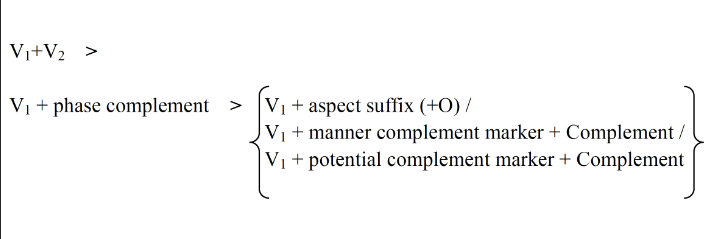
2 examples of verbs evolving into passive markers
V [+ suffer] > instrumental > passive marker
V [+ give] > V [+ causative] > passive marker
![<p>V [+ suffer] > instrumental > passive marker</p><p>V [+ give] > V [+ causative] > passive marker</p>](https://assets.knowt.com/user-attachments/4a93c1ff-25d6-4c06-88f3-b1b338af3624.png)
how are causatives marked in Southern Min language?
tone alternation: e.g. break (tng7) - cause to break (tng2)
initial alternation: e.g. ascend (chiu7) - cause to ascend (chhiu7)
non-aspirated - aspirated contrasts
reflects Middle Chinese voiced - non-voiced contrasts
with ho 與
how are causatives marked in Chinese?
with 让:
als transitief ww betekent het toestaan/ afstaan
张三让李四哈哈大笑。
als transitief ww met twee objecten in het semantische veld van geven: 把。。。让给。。。
what is 让 used for in Chinese?
causative
long passive: zelfde functie als 被
那本书让张三借走了
那本书让张三给借走了
NOOIT ZONDER AGENS: 那本书让借走了 IS FOUT
What is phonological typology?
involves comparing languages according to the number or type of sounds they contain
tries to establish phonological patterns and contrasts them in different languages/ dialects
e.g.: multilateral systems ( /p/ , /ph/, /b/, and /bh/) vs bilateral systems ( /p/ and /b/)