Light Waves
 Call Kai
 Learn
Learn Practice Test
 Spaced Repetition
 Match
Match Flashcards
 Knowt Play
1/6

There's no tags or description
Looks like no tags are added yet.
Name | Mastery | Learn | Test | Matching | Spaced | Call with Kai |
|---|
No analytics yet
Send a link to your students to track their progress
7 Terms
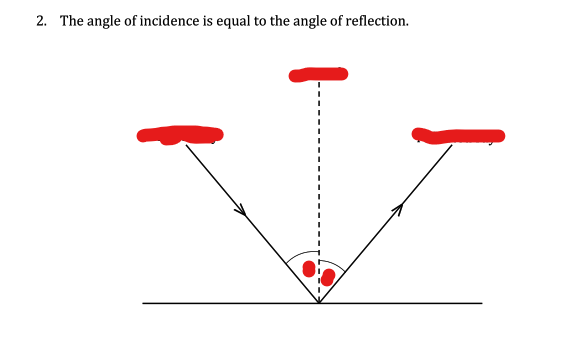
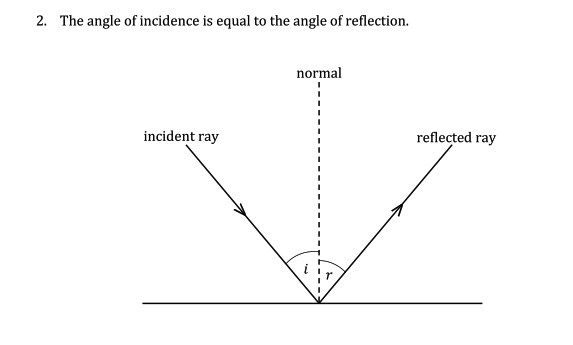
Laws of Reflection
1) The incident ray, the reflected ray and the normal , at the point of incidence, are all on the same plane.
2) The angle of incidence is equal to the angle of reflection
Laws of Refraction
1) The incident ray, the refracted ray, and the normal, at the point of incidence, are all on the same plane.
2) The ratio sin i ÷ sin r is constant for a given pair of media where i is the angle of incidence and r is the angle of refraction.
Formula: n= Sin i / Sin r
n= Refractive index
i= angle of incidence
r= angle of refraction
Refractive Index of Travelling Light Speeds
n= speed of light in medium 1 ÷ speed of light in medium 2
Refractive Index of Depth
n= Real depth ÷ apparent depth
Critical Angle (Defination)
The critical angle is defined as the angle of incidence that makes an angle of refraction that is 90° degrees
Critical Angle (Formula)
sin c = 1 / n
c= critical angle
n= refractive index
Total Internal Reflection
Total internal reflection occurs when the angle of incidence is greater than the critical angle for light travelling from a dense to a less dense medium. the ray of light is reflected into the more dense medium.