MCAT General Chemistry
 Call Kai
 Learn
Learn Practice Test
 Spaced Repetition
 Match
Match Flashcards
 Knowt Play
1/39

There's no tags or description
Looks like no tags are added yet.
Name | Mastery | Learn | Test | Matching | Spaced | Call with Kai |
|---|
No analytics yet
Send a link to your students to track their progress
40 Terms
Rutherford Model
1911, electrons surround the nucleus
Bohr model
1913, orbits with energy levels with more energy in further energy levels
heisenbug uncertainty
impossible to know momentum and position at the same time
Hund’s rule
electron only doubles up in orbitals if all orbitals have 1 electron
Pauli exclusion principle
Paired electrons must be +1/2 and -1.2
Avogadros Number
6.022 × 1023 = 1 mol
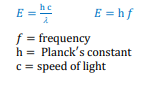
Planck’s constant
6.026 × 10⁻³⁴J*s
speed of light
3 × 10⁸ m/s
Light Energy
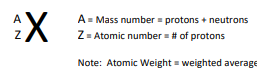
Atomic format
Diamagnetic
All electrons are paired and repelled by an magnetic field
paramagnetic
1 or more unpaired electrons and pulled into external magnetic field
Quantum numbers
n, l, mi, ms
n
Principal and shows energy level. Only for s and p
l
azimuthal, shape of orbital
mi
magnetic and orbital subtype 1,+-1,+-5, +-7
ms
spin, electron spin only +-1/2
Free radical
atom or molecule with unpaired electron
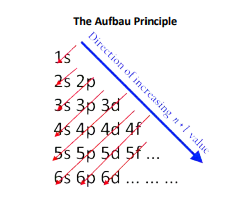
Aufbau principle
Zeff
pull between nucleus and valence electrons and increases along period
Ionization energy
Energy needed to release electrons. Increases across period and decreases down group
Electronegativity
Force atom exerts on electron in a bond. Increases across period and decreases down group
Electron affinity
Ability to gain electrons and increases along period
Covalent bond
sharing of electrons
Bond order
type of bond, gets stronger and shorter with more bonds
Nonpolar bonds
<0.5
Polar bonds
Between 0.5 and 1.7
Coordinate covalent bonds
single atom providing both bonding electrons
Ionic bond
transfer of electrons with it greater than 1.7
H bonding
Strongest with OH, NH, or FH
Dipole-Dipole
Polar non hydrogen bond
LDF
Temporary non polar
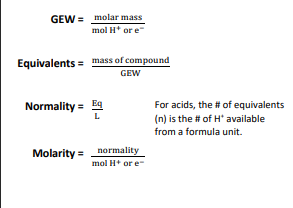
Equivalent Mass
mass of an acid that yields 1 mole of H+ or mass of base that reacts with one mole of H+
Equivalents and normality
Types of reactions
combination
decomposition
combustion
single displacement
double displacement
neutralization
0 order

1 order

2 order

Arrhenius equation

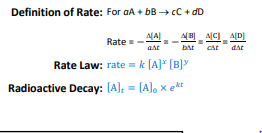
Rate law misc