Particle size analysis and separation
 Call Kai
 Learn
Learn Practice Test
 Spaced Repetition
 Match
Match Flashcards
 Knowt Play
1/18

There's no tags or description
Looks like no tags are added yet.
Name | Mastery | Learn | Test | Matching | Spaced | Call with Kai |
|---|
No analytics yet
Send a link to your students to track their progress
19 Terms
What are the reasons to reduce particle size?
To increase drug surface area and therefore facilitate dissolution
The product may require it - aerosol products (mean size of 3 microns)
To improve suspension stability
To produce a more homogeneous mixture (very important with low dose products)
To improve powder flow for solid dosage form production
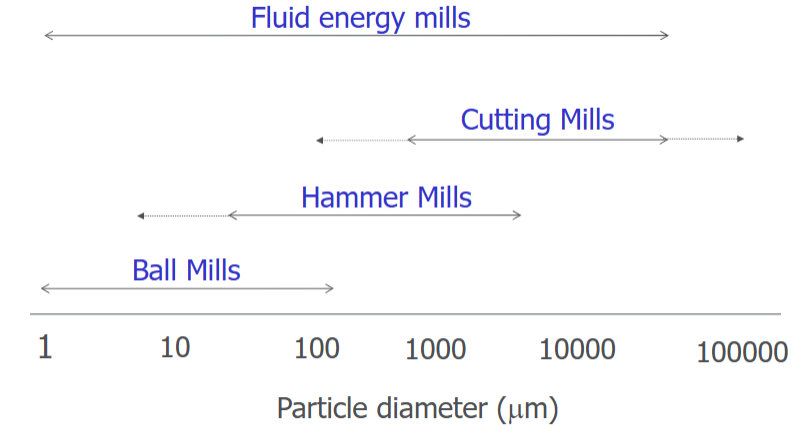
What are the 4 techniques to reduce size and the diameters the range in?
What are the methods to evaluate particle size and distribution?
Microscopy
Laser scanning
Sieving
These can be used to characterise the particle system
What is microscopy useful for and what is its downside?
Routinely used to study particle morphology
Provides useful data on shape and size
Does not cover the range of particle size distribution
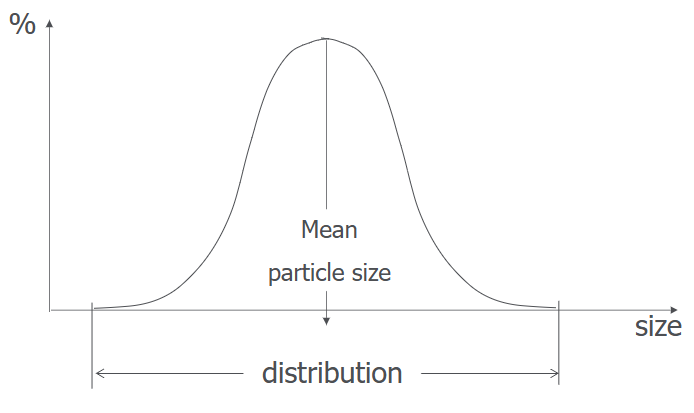
What does the mean particle size distribution curve show?
Graphical representation showing the relative amounts of particles present, sorted by size (e.g., diameter).
It displays the range of sizes, from smallest to largest, and the corresponding cumulative percentage (by weight, volume, or number) of material that is smaller than or equal to a given size, typically plotted on a logarithmic scale.
What is laser diffraction?
Suspend particle in a laser and its gets diffracted
Pattern is recorded and its unique for its size
Using the sample scattering pattern the average particle size and distribution can be calculated.
Materials can be characterised in the range of 0.04 to 2000 μm and dispersion can be made in water, organic liquid as well as air
What is the interaction between particles and light is
mainly dependent on?
Particle size, shape, surface roughness and refractive indices of material and dispersing medium
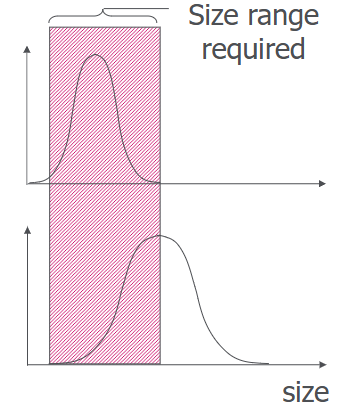
How can a specific size range of particles be calculated?
For controlled systems you will require a certain size range. You have two options:
Reduce particle size so that all particles fall below the required size range
Separate particles at or below required size range form out sized particles
What is the aim of size separation and the methods?
To classify powders into separate particle size ranges
Sieving
Fluid classification - sedimentation, centrifugation
Elutriation methods
Cyclone separation methods
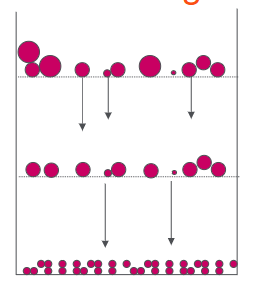
What is sieving features and size range?
Size range 5 – 10000µm
British Standard Sieves should be:
Uniform circular cross-section
Strong enough to avoid distortion
Resistant to chemical action with any material being sifted.
Commonly made from stainless steel
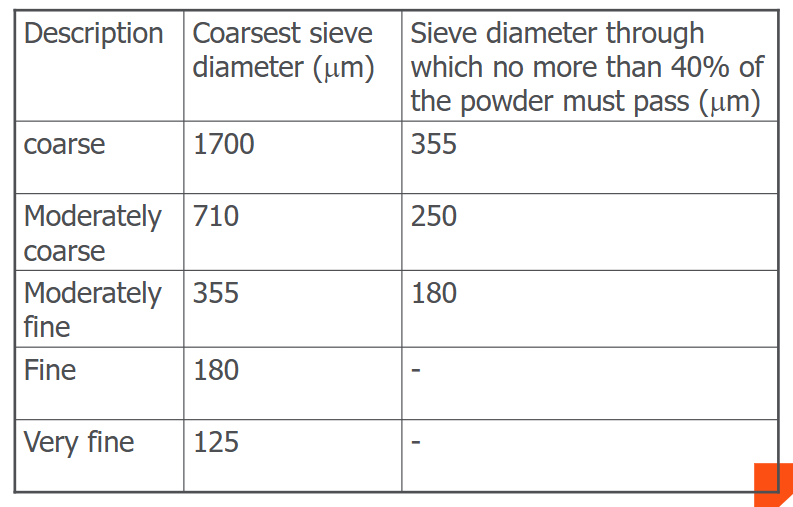
What are the standards for powders based on sieving?
The degree of coarseness or fineness of a powder is differentiated and expressed by reference to the nominal mesh aperture size of the sieves used
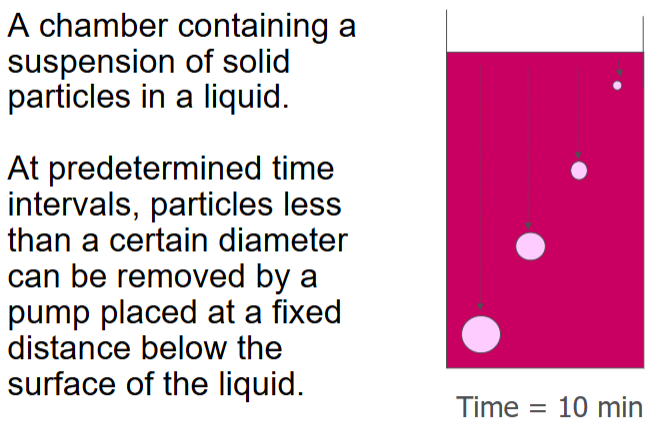
What are the principles of sedimentation?
Particles of different diameter settle (sediment) at different rates
The velocity at which a particle sediments is directly proportional to its diameter
The bigger the particle the faster it sediments
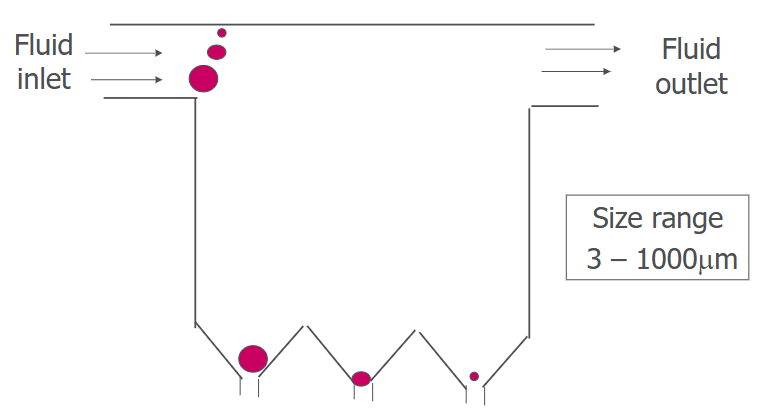
What are the aims of a continuous settling chamber?
Particles separated into different hoppers can be removed continuously
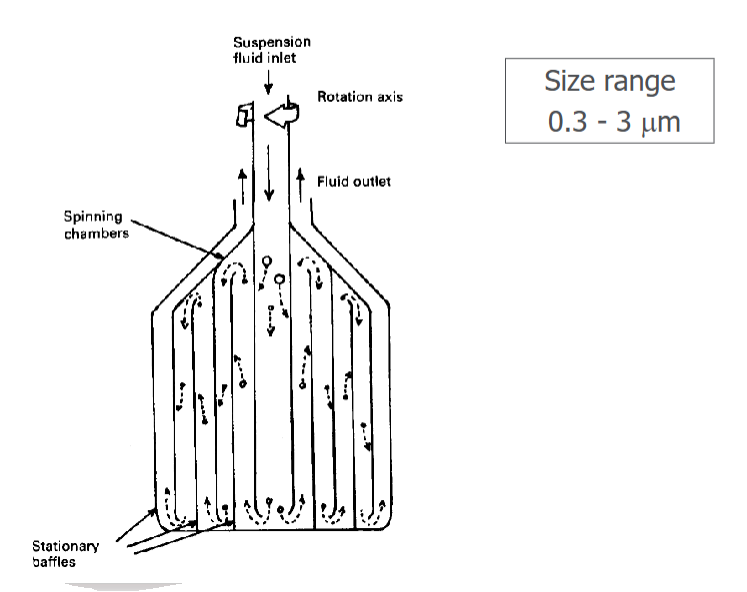
What are the aims of increasing the speed of centrifugation?
Rotating pushed different sizes into different outlet
Increasing the speed will decrease the particle size which is recovered at the fluid outlet
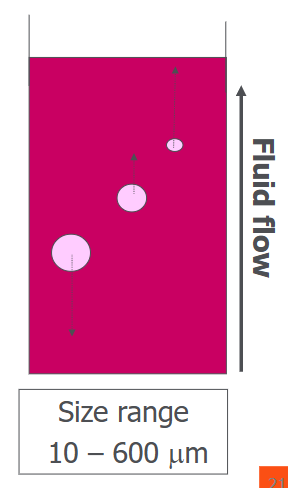
What is elutriation?
Fluid flow in the opposite direction to the sedimentation movement
Therefore depending on the fluid flow larger particles will settle downwards and smaller particles will move upwards with the fluid flow
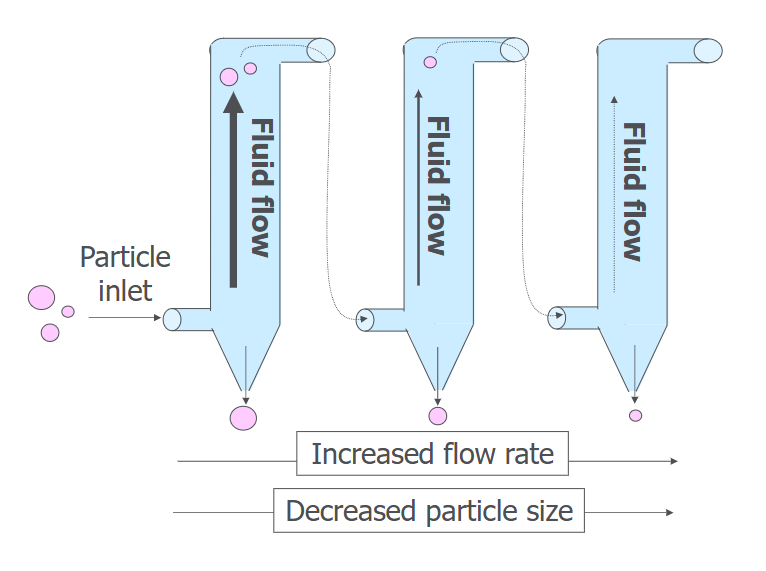
What is a multi stage elutriator?
Continuous system
Material flows in the opposite direction of the fluid
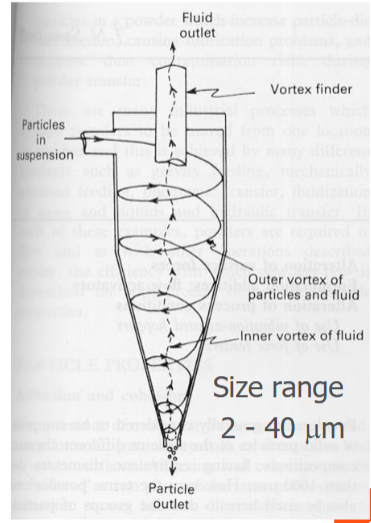
What is cyclone separation?
The most common type used is the reverse-flow cyclone.
Particles are introduced at the top of the cyclone
Larger particles are pushed to the outer section of the vortex
Finer particles remain entrapped in the fluid stream and are removed via the vortex finder
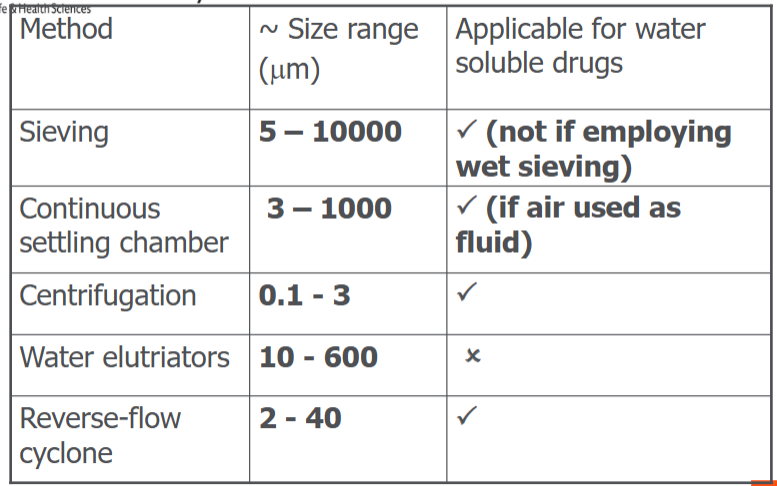
How is the size separation process selected?
Based on pharmacopoeial requirements, efficiency, and water solubility
Each separation method is most efficient over a particular size range.
Oversized material removed via these processes can be returned for further size reduction
What are the size ranges for the particle separation methods?