Chemistry Module 2
 Call Kai
 Learn
Learn Practice Test
 Spaced Repetition
 Match
Match Flashcards
 Knowt Play
1/61

There's no tags or description
Looks like no tags are added yet.
Name | Mastery | Learn | Test | Matching | Spaced | Call with Kai |
|---|
No analytics yet
Send a link to your students to track their progress
62 Terms
How do you define relative atomic mass (Ar)?
The weighted mean mass of an atom or an element, relative to one twelfth of the mean mass of an atom of the carbon-12 isotope
Takes into account the relative abundances of the different isotopes of an element
Ar = mean mass of an atom of an element / 1/12 x mean mass of C-12 isotope
How do you define relative isotopic mass?
The isotopic mass of an isotope relative to one twelfth of the mean mass of an atom of the carbon-12 isotope
How do you define relative molecular mass (Mr)?
The weighted mean mass of a molecule of a compound, relative to one twelfth of the mean mass of an atom of the carbon-12 isotope
What is a binary compound?
A compound containing only two elements
What is a polyatomic ion?
An ion that contains more then one atom
What is Avogradro’s constant?
6.02 × 10²³
There are 6.02 × 10²³ particles in every mole of a substance
Number of particles = moles x 6.02 × 10²³
What is the empirical formula?
Simplest whole number ratio of atoms of each element present in a compound
Eg: C2H6 = CH3 (in empirical formula)
What is the molecular formula?
The number and type of atoms of each element in a molecule
True number of each atom in the molecule
What is an anhydrous / hydrated substance?
Anhydrous: contains no water of crystallisation
Hydrated: contains water of crystallisation
What is the water of crystallisation?
Water that is part of the crystalline structure
The molecules are stoichiometrically bonded into the crystal structure
What is a standard solution?
A solution of known concentration
What is the limiting reagent?
The reactant that is not in excess
It will be used up first, causing the reaction to stop
In calculations, use the moles of the limiting reactant
What is the ideal gas equation?
UNDER STANDARD CONDITIONS:
pV = nRT
p = pressure (Pa)
V = volume (m³)
T = temperature (K)
n = moles (n) = m / Mr
m = mass (g)
R = ideal gas constant = 8.31-1mol-1
How do you calculate percentage yield?
(Experimental mass / Theoretical mass) x 100
Why is percentage yield usually below 100%?
Reaction being incomplete
Loss of products on equipment
Unwanted side reactions
What is the formula for atom economy?
(Mr of desired product / Mr of reactants) x 100
Why is it desirable to have a high atom economy?
Little / no waste product
Process is more economically viable
Helps preserve raw materials
How do you measure mass in an experiment?
Use a digital mass balance
Use a balance with a suitable resolution
How do you measure a volume of a solution in an experiment?
Use a measuring cylinder
If you are making up a standard solution, use a volumetric flask of the required volume
How do you measure the volume of gas produced in an experiment?
Use a gas syringe
OR
Measure the mass lost on a balance > use this value to calculate the moles of gas produced during the reaction
What is the definition of an acid?
A species that donates a proton (H+)
They neutralise bases
What is the definition of a base?
A species that accepts a proton (H+)
They neutralise acids
What is the difference between an alkali and a base?
They both neutralise acids
An alkali is a water soluble base - when dissolved, they release OH- ions
What is the difference between a strong and weak acid?
A strong acid fully dissociates in an aqueous solution
A weak acid partially dissociates in an aqueous solution
What is neutralisation?
The reaction of an acid with a base
Ionic equation: H+(aq) + OH-(aq) > H2O (l)
Acid + carbonate >
Salt + water + carbon dioxide
Acid + metal oxide >
Salt + water
Metal + acid >
Salt + hydrogen
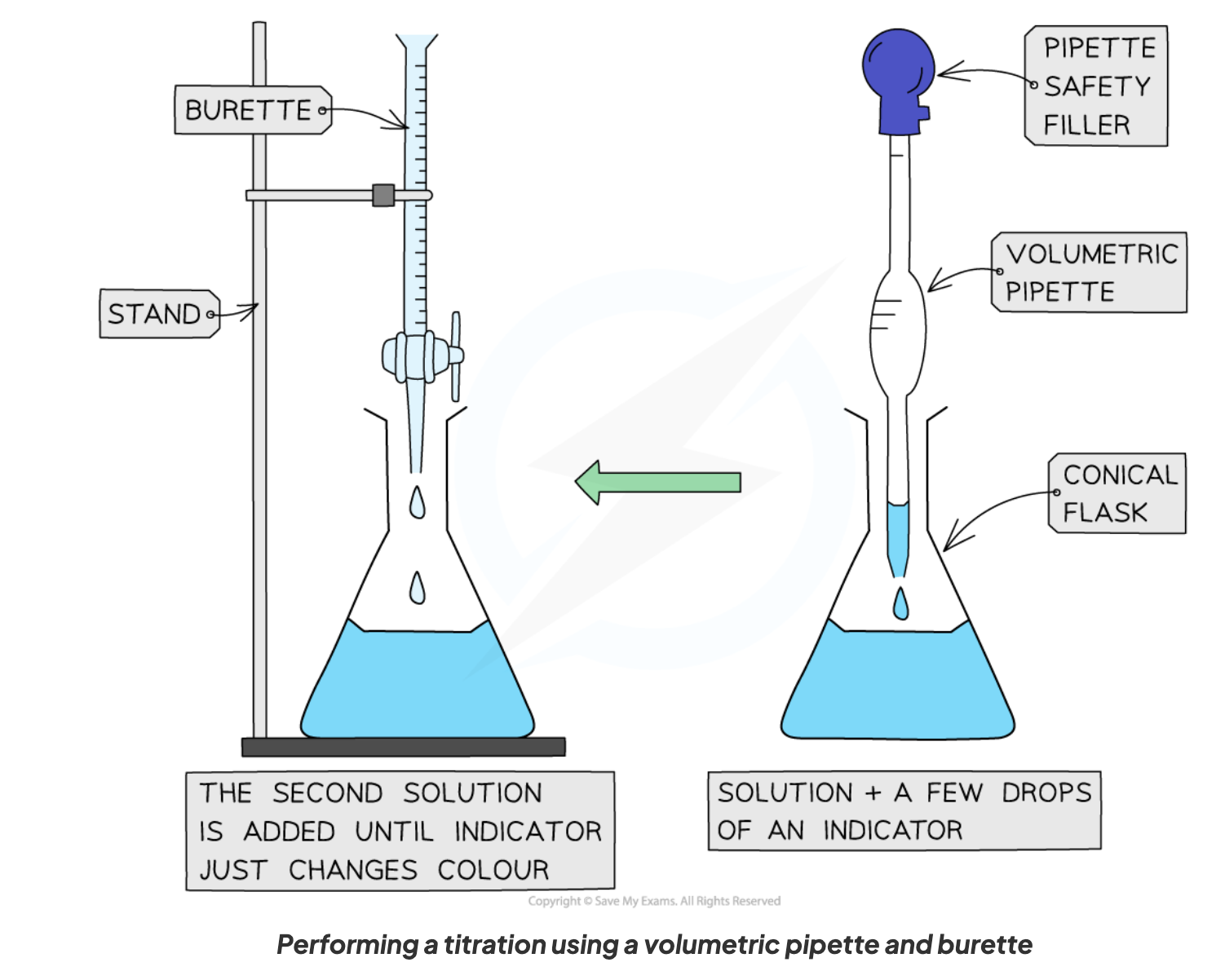
In a titration, what are the steps to making up the standard solution?
Weigh the sample bottle containing the solid on a balance
Transfer solid to beaker and reweigh bottle
Record difference in mass (this is the mass of solid)
Add distilled water and stir with a glass rod until all the solid has dissolved
Transfer to a volumetric flask with washings
Make up to the 250cm3 mark with distilled water
Shake flask
In a titration, once you have the standard solution, what are the steps to completing the titration?
Fill the burette with the standard solution of known concentration, ensuring the jet space in the burette is filled and doesn’t contain air bubbles
Use a pipette filler and pipette to transfer 25cm3 of the solution with unknown concentration into a conical flask
Add 2/3 drops of indicator into the conical flask
Record the initial burette reading
Titrate the contents of the conical flask by adding the solution to it from the burette until the indicator undergoes a definite, permanent colour change (use a white tile)
Record the final burette reading (endpoint) and calculate the titre volume (find the difference)
Repeat until at least 2 concordant results are obtained (within 0.1cm3 of each other)
How can you reduce the uncertainty of a titration?
Increase the titre volume needed for the reaction
This can be done by increasing the volume and concentration of the substance in the conical flask (unknown solution) OR by decreasing the concentration of the substance in the burette (standard solution)
Titration equipment
Oxidation number rules
Element = 0
Neutral compound = add up to 0
Charged compound = total charge
Hydrogen = +1
Oxygen = -2
Halogens = -1
Group 1 = +1
Metal hydrides = hydrogen is -1
Peroxides = oxygen is -1
What is oxidation and reduction?
Oxidation is the loss of electrons > oxidation number becoming more positive
Reduction is the gain of electrons > oxidation number becoming more negative
Use the acronym OILRIG
What is a redox reaction?
When oxidation and reduction occur in the same reaction
What does an oxidising agent do?
Accepts electrons from the species that is being oxidised
Gains electrons and is reduced > reduction in oxidation number
What does an reducing agent do?
Donates electrons to the species being reduced
Loses electrons and is oxidised > increase in oxidation number
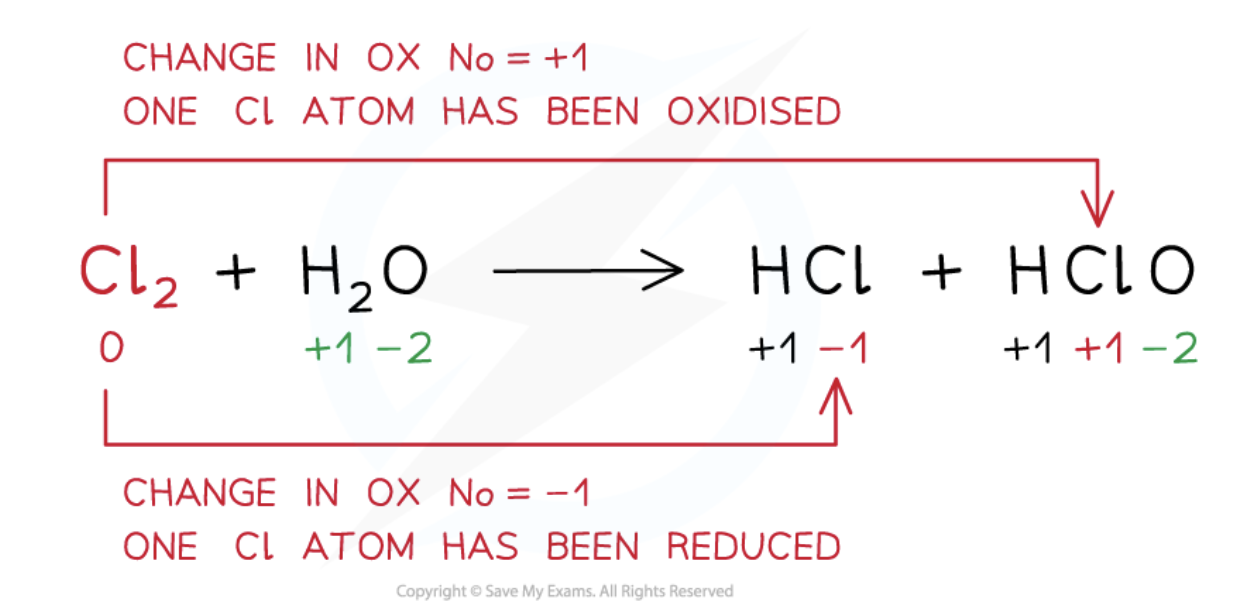
What is a disproportionation reaction?
Where a species is both oxidised and reduced in the same reaction
What is an electron shell?
Electrons orbiting the nucleus in different energy levels, which are an increasing distance from the nucleus
They are made up of atomic orbitals
What is an atomic orbital?
A region around the nucleus that can hold 1 electron, or 2 electrons with opposite spins
Shells are made up of atomic orbitals
What are the 4 types of orbitals?
s
p
d
f
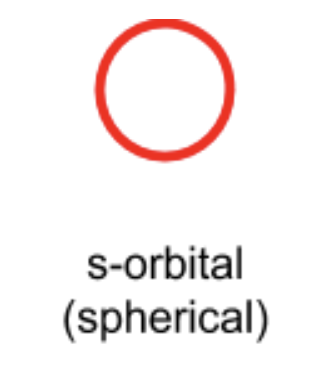
What is the shape of an s orbital?
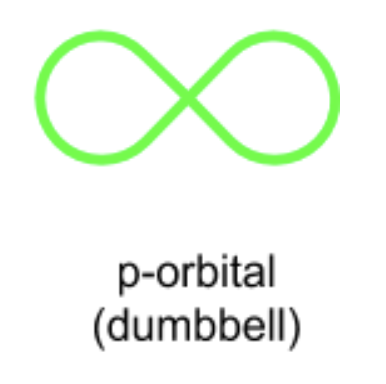
What is the shape of a p orbital?
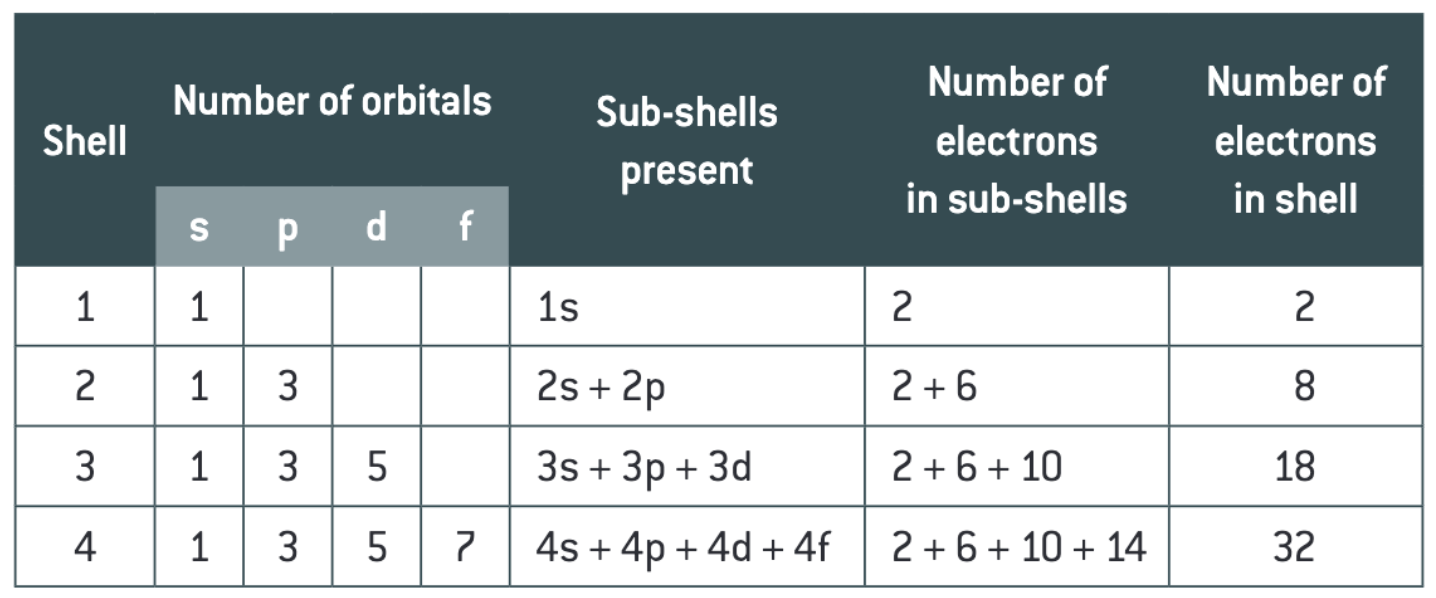
What is the maximum number of electrons that can be held in each electron shell?
n: 1 = 2
n: 2 = 8
n:3 = 18
n:4 = 32
Formula = 2n2
How are orbitals arranged within shells?
Each shell from n = 1 contains one s orbital
Each shell from n = 2 contains three p orbitals
Each shell from n = 3 contains five d orbitals
Each shell from n = 4 contains seven f orbitals
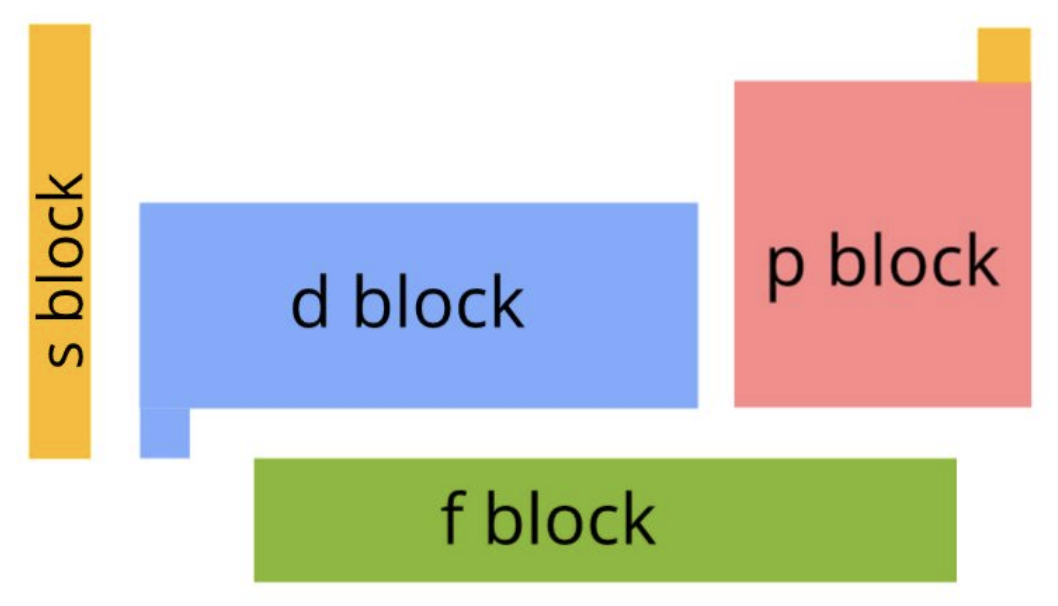
How can you tell what orbital outer electrons are in?
What is the order of filling orbitals?
The energy of the orbitals increases from s to p to d to f > fill in that order (s > p > d > f)
ONE EXCEPTION: 4s has a lower energy than 3d > 3d is filled before 4s
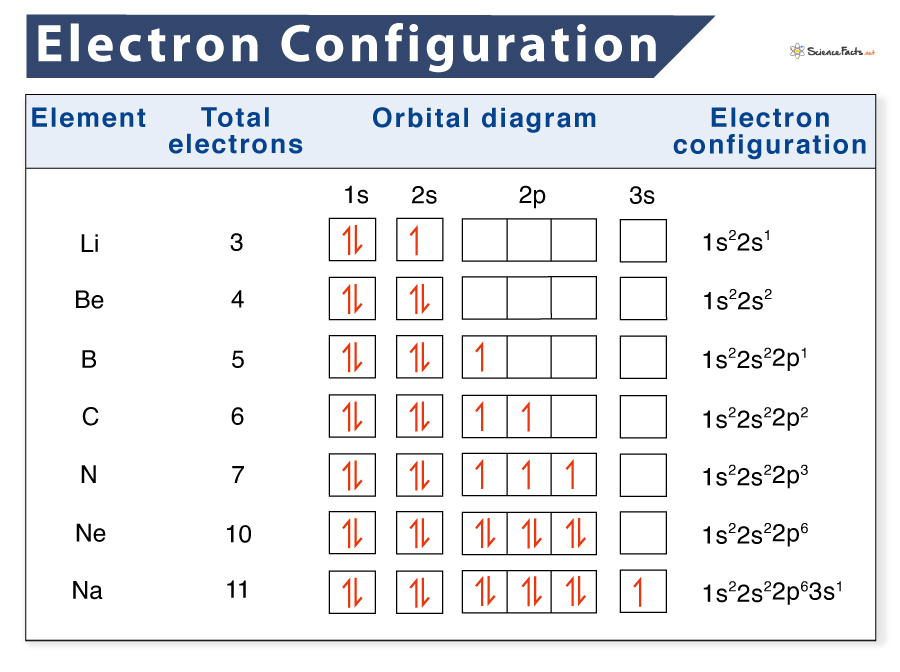
How do you draw electron orbital diagrams?
Up arrow is always first
Only 2 electrons per box
Must complete all the up arrows first before going onto the down arrows
Must fill an orbital completely before moving on
What is ionic bonding?
Electrostatic attraction between positive (cation) and negative (anion) ions
Occurs between a metal and non metal
Electrons are transferred from the metal to the non metal to achieve full outer shells
When electrons are transferred, it creates charged particles called ions
How do you know the relative strength of ionic bonds?
Ions with a greater charge will have a greater attraction to the other ions resulting in stronger forces of attraction, and therefore stronger ionic bonding
Larger ions that have a greater ionic radius will have a weaker attraction to the oppositely charged ion as the attractive forces have to act over a greater distance
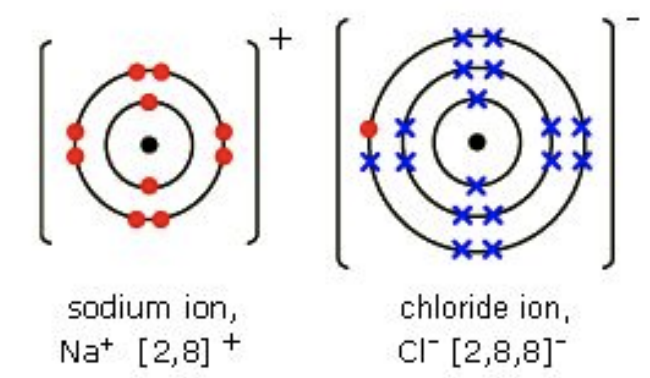
How can you represent an ionic bond using a dot and cross diagram?
Electron(s) transferred from the cation are seen on the outer shell of the anion
What is the melting / boiling point of ionic structures and why?
High > electrostatic forces holding the ionic lattice together are strong and require a lot of energy to overcome
When can ionic structures conduct / not conduct electricity and why?
When molten / aqueous (in solution) > ions separate and are no longer held in a lattice > ions are free to move and carry charge > can conduct electricity
When solid > ions are in fixed positions with no mobile charge carriers > cannot conduct electricity
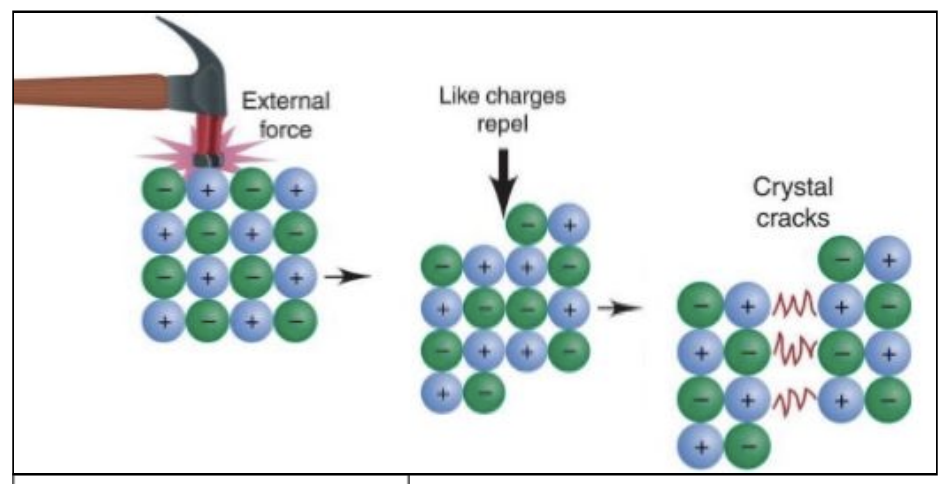
Are ionic structures brittle?
Yes - when layers of alternating charges are distorted, like charges repel, breaking apart the lattice into fragments
What is a covalent bond?
The strong electrostatic attraction between a shared pair of electrons and the nuclei of the bonded atoms
Form between 2 non metals
Electrons are shared between the 2 outer shells to achieve a full outer shell
How can you represent covalent bonding using dot and cross diagrams?
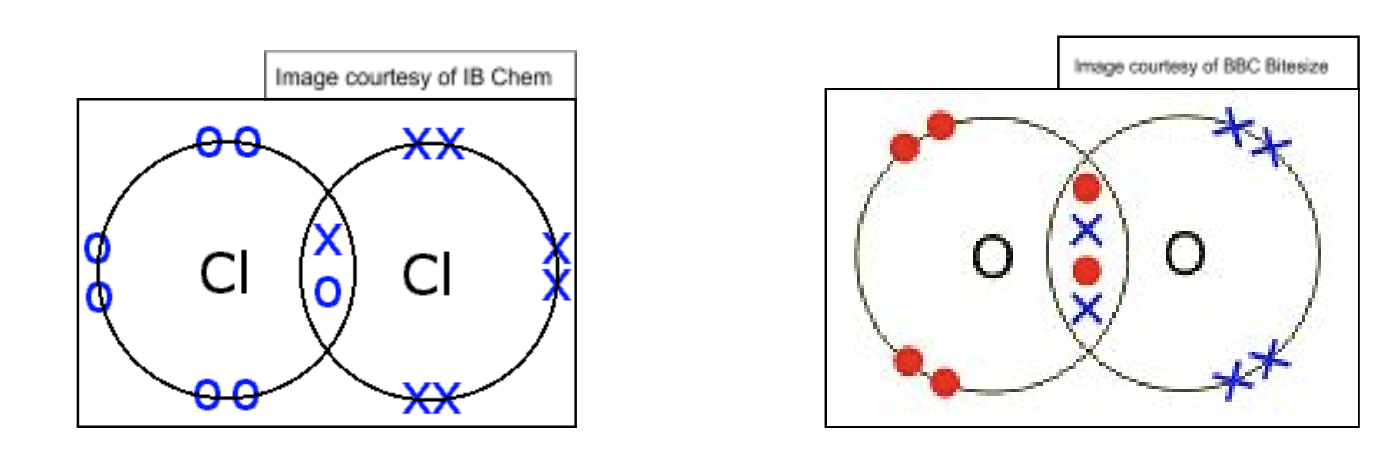
How is the length of a covalent bond linked to its strength?
Shorter bonds tend to be stronger as the atoms are held closer together > forces of attraction are greater, requiring more energy to overcome
Double / triple bonds are shorter than single covalent bonds
What is a dative bond?
When both electrons from a covalent bond are supplied from a single atom
When calculating bond angles, how does a lone pair influence the bond angle?
Each lone pair reduces the bond angle by 2.5o
What are the steps to determining the bond angle of a molecule?
Find the number of electron pairs
Determine how many of the lone pairs are bonding regions / lone pairs
Remember the table.
What is a linear shape?
2 bonding regions
0 lone pairs
Bonding angle = 180o
What is a bent shape?
2 bonding regions
2 lone pairs
Bond angle = 104.5o