Energy Needs and Energy Utilization
 Call Kai
 Learn
Learn Practice Test
 Spaced Repetition
 Match
Match Flashcards
 Knowt Play
1/64

There's no tags or description
Looks like no tags are added yet.
Name | Mastery | Learn | Test | Matching | Spaced | Call with Kai |
|---|
No analytics yet
Send a link to your students to track their progress
65 Terms
What are the two concepts of energy balance?
positive energy balance
negative energy balance
What is positive energy balance?
energy intake is more than energy expended
weight gain from increased muscle mass and adipose tissue
periods of growth: pregnancy, childhood, adolescence
What is negative energy balance?
energy expended is more than energy intake
food intake is reduced, more energy expended through activity or both
results in weight loss
fat loss
muscle loss
loss of glycogen and bound water
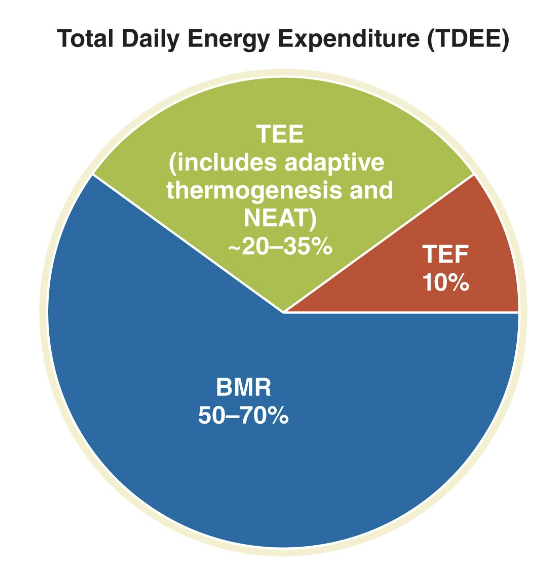
What are the body’s energy needs for each individual based on?
Varies for each individual based on:
basal metabolic rate (BMR)
thermic effect of exercise (TEE)
thermic effect of food (TEF)
adaptive thermogenesis
What is thermogenesis?
production of heat by the body
adaptive thermogenesis: body regulation of heat production
What does energy expenditure provide?
energy expenditure provides the basis for energy balance to maintain weight or gain/lose weight
What is BMR?
Basal metabolic rate (BMR) is the energy that needs to be met for the body’s basic physiological needs
Why does BMR have a wide interperson variability?
a lot of factors can influence one’s BMR
How does body composition affect BMR?
body composition: how much our tissue are muscles vs adipose. higher amount of muscle will increase BMR
How does age affect BMR?
age: BMR declines with age in adult years and mostly because change in body composition, not necessarily activity
How does pregnancy affect BMR?
pregnancy: BMR increases because an energy-expensive period of time
How does biological sex affect BMR?
biological sex: biological males have higher BMR than females due to larger body size and lean muscle tissue
How does body size affect BMR?
body size: larger the body, the more energy needed because more surface area and more heat loss
How does genetics affect BMR?
Similar metabolic rates within families based on genes
How does emotional and physical stress affect BMR?
energy and protein needs are elevated during times of sickness and stress, which increase BMR
How do thyroid hormones affect BMR?
low thyroid hormone levels: lower BMR
high thyroid hormone levels: higher BMR
How does nutritional status affect BMR?
starvation and fasting lower BMR
if not getting enough energy, the body will try to dial down the amount of energy needed to keep one alive by compromising some mechanisms
How does environmental temperature affect BMR?
body heat regulation is metabolically expensive
How does caffeine and nicotine intake affect BMR?
Caffeine will not significantly change how much energy needed for a day
But nicotine and other stimulants can have more of an effect on BMR
How can you estimate one’s BMR?
BMR is difficult to precisely measure, so resting metabolic rate (RMR) is used to estimate
In what ways does physical activity require energy?
Thermic effect of exercise (TEE)
increase in muscle contraction that occurs during physical activity
Non-exercise activity thermogenesis (NEAT)
energy expended from activities not considered exercise
What do the kcals needed for TEE depend on?
depends on the activity performed, duration of activity, and how much you weigh
What is Thermic Effect of Food used for?
Energy used for digestion and absorption
Used to process the macronutrients and extract kcals from food
What is TEF influenced by?
Meal composition and nutrients consumed
fat (lowest) < carbohydrate < protein (highest)
can be because of the structures (protein is more complex)
athletic training decreases TEF
weight status due to insulin sensitivity
How do we measure energy expenditure?
direct calorimetry
indirect calorimetry
How does direct calorimetry measure energy expenditure?
measures energy expenditure by assessing body heat loss within a metabolic chamber (not accessible because $$)
How does indirect calorimetry measure energy expenditure?
estimates energy expenditure by measuring oxygen consumed and CO2 produced with a metabolic cart
How can estimating energy expenditure be done mathematically?
based on age, biological sex, height, weight, and level of physical activity
Mifflin-St. Joer Equation to estimate RMR
based on biological sex, height, weight, and age
multiply this by the physical activity factor
What are involved in energy utilization?
hormones are involved in signaling energy storage vs. usage
What does glucagon promote in energy utilization?
glycogenolysis (in the liver)
breaking down glycogen to glucose to be used
lipolysis
breakdown of adipose tissue to mobilize substrates used for energy
gluconeogenesis
make new glucose out of non-carb substrates
What does insulin promote in energy utilization?
glycogenesis
increasing storage in the liver and muscle by creating glycogen
use of glucose by the cells, and if not used, will be stored
lipogenesis
converting glucose to triglyceride
What is hunger?
sensation indicating the physiological need for food
What is appetite?
desire to eat with or without the presence of hunger
What is satiety?
satiety is the sensation of fullness after eating
What are hunger and satiety controlled by?
hunger and satiety are controlled by hormones:
leptin: stimulates satiety and produced by adipocytes
ghrelin: stimulates hunger and produced by the stomach (growling ghrelin)
Which hormones stimulates satiety?
insulin
leptin
peptide (YY)
cholecystokinin (CCK)
incretins (GLP-1 and GIP)
GLP-1 receptor agonists
Which hormones stimulates hunger?
neuropeptide Y
ghrelin
What are the processes involved in regulating satiety?
physiological cues prompt the release of hormones
leptin quantity influenced by quantity of fat stores
ghrelin stimulates neuropeptide Y’s impact on hypothalamus
ghrelin levels are higher between meals and during sleep
How do the release of hormones regulate satiety?
stomach distension: stretch receptors are triggered
detection of entrance of protein, fat, CHO into the small intestine
hormones communicate systemically to signal satiety to the hypothalamus
What are the five components of physical fitness?
cardiorespiratory endurance
muscular strength
muscular endurance
flexibility
body composition
What is cardiorespiratory endurance?
ability to sustain cardiorespiratory exercise for an extended length of time
What is muscular strength?
ability to produce force for a brief period of time
What is muscular endurance?
ability to exert force over a longer period of time without fatigue
What is flexibility?
range of motion around a joint
What is body composition?
the proportion of muscle, fat, water, and other tissue in the body
What are the research-supported benefits of exercise
impact on body composition
reduced risk of chronic NCDs (non-communicable disease)
improves BP
increases HDL cholesterol
lowers risk of cardiovascular disease
improves insulin sensitivity
reduced risk of some cancers
bone health
improved immune system functioning
improved sleep quality
improved mental well-being
Which kind of exercise is the best?
includes activities based on all components of fitness:
cardiorespiratory endurance
muscular strength and endurance
flexibility
tailored and individualized according to needs
consistent
enjoyable
What is cardiorespiratory exercise?
typically aerobic exercise
involves continuous activities that use large muscle groups
measured by VO2 max
What does strength training improve? Why is it important to rest between sets?
Improves muscle strength, muscle endurance, and body comp
to increase muscle strength: lower number of reps, heavier weights
to increase muscle endurance: higher number of reps, lighter weights
usually anaerobic, so important to rest
What are the two principles for planning and improving?
FITT acronym
frequency, intensity, time, and type
progressive overload principle
body gradually adapts to activities via conditioning
gradually increase exercise demands by modifying F/I/T/T component
What is anaerobic energy used for? What are examples of exercises? What is the anaerobic capacity?
fuel quick and intense bursts of exercise
ex: strength (lifting weights), speed/sprinting, jumping
anaerobic capacity is ~10 secs of maximal effort
creatine phosphate
What does aerobic ATP production require?
requires oxygen → heavier breathing increases intake
slower pace
no longer maximal effort
sustains long-term
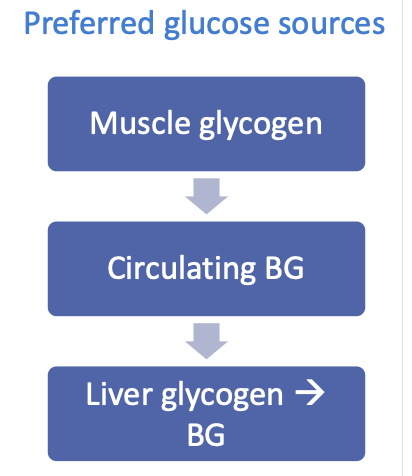
What are the preferred glucose sources?
muscle glycogen
circulating BG
liver glycogen → BG
What is the primary energy source during high-intensity exercise?
carbohydrates
BG
stored glycogen → depleted with exercise
dietary CHO
What are the use of glucose and glycogen affected by?
intensity of exercise
duration of exercise
conditioning
What happens when you deplete glycogen stores?
“hitting the wall”
What are the carbohydrate type(s) for exercise?
eat simple CHO during and immediately after activity
absorbed quickly and enters bloodstream
sport drinks, gels, bananas, bagels/bread (not whole grain or high fiber)
eat whole-grain and complex CHO several hours beforehand
absorbed more slowly
sustained source of fuel
too much fiber pre-workout can cause GI symptoms/discomfort
When does fat emerge as an energy source?
fat emerges as energy source for low- to moderate-intensity activity
What does fat as an energy source require?
requires availability of oxygen
What is protein needed for?
primarily for muscle repair
small quantities of protein (amino acid) used for energy
exercise increases cortisol, stimulating protein turnover
insufficient kcal & CHO intake
What is the timing intake relative to exercise?
pre-activity
allow sufficient time for food to digest before exercise
during exercise
not needed
but if exercise > 1hr, food intake required to maintain BG levels
post-activity
recovery
consume CHO to replenish glycogen stores
consume protein + CHO to increase muscle protein synthesis
What does adequate fluid intake prevent?
prevents dehydration and electrolyte imbalances
Why is fluid needed for exercise?
exercise induces greater losses of water and electrolytes
When is fluid loss greater?
greater losses occur in hot, humid weather
increased risk of heat exhaustion → heat stroke
If activity is longer than 60 minutes, what fluid is recommended?
sports drinks for longer durations