CFA - Quant 1
 Call Kai
 Learn
Learn Practice Test
 Spaced Repetition
 Match
Match Flashcards
 Knowt Play
1/91

There's no tags or description
Looks like no tags are added yet.
Name | Mastery | Learn | Test | Matching | Spaced | Call with Kai |
|---|
No analytics yet
Send a link to your students to track their progress
92 Terms
Effective Annual Rate (EAR)
*Rate and Returns
Rate of interest that an investor can earn (or pay) in a year after taking into consideration compounding
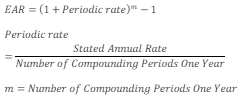
Nominal Risk-Free Rate
*Rate and Returns

Holding Period Return (HPR)
*Rate and Returns
Return on an asset/portfolio over the period during which it was held
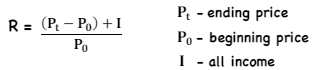
Multi-Period HPR
*Rate and Returns

Arithmetic Mean
*Rate and Returns
When it's used: Used to estimate E(R) over one period

Geometric Mean
*Rate and Returns
When it's used: Used to estimate average E(R) per period over multiple periods, use for returns
RG <= RA
FV = PV(1 + RG) - measures an investment’s terminal value over multiple periods

Harmonic Mean
*Rate and Returns
Reduces the effect of outliers & underweight their impact
When it’s used: Multiples/ratios, dollar-cost averaging, average price per unit
Relationship w other means: RA (overweight) x X-barH (underweight) ~ RG²

Trimmed Mean & Winsorized Mean
*Rate and Returns
Trimmed: Remove a percentage from both largest and smallest, e.g. 8% trimmed - 16% total (common with CPI)
Winsorized: Replacing values at both ends with cutoff value
Money-Weighted Return (IRR, YTM)
*Rate and Returns
Discounting CFs
What your money earned, not the typical $1
More sensitive to the timing and amount of withdrawals/additions to the portfolio (e.g. if you committed more money to a poor performance year, your mwrr < RA)
Time-Weighted Return
*Rate and Returns
= RG (same as geometric mean)
Represents growth of $1 over a given period
Method
Break investment period into holding periods
Calculate each HPR, compound HPRs, express annually
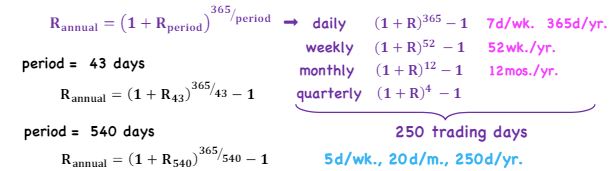
Annualized Return
*Rate and Returns
All rates/returns are quoted annually
Can be misleading - assumes that returns can be repeated
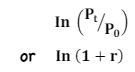
Continuously-Compounded Return
*Rate and Returns
Continuously compounded return is equivalent to its annual counterpart
To get back to annual rate: erc - 1
Gross v. Net Return
*Rate and Returns
Gross: What the fund earns - return before deductions for management. exp, custodial fees, taxes… BUT after trading expenses
Net: What the investor earns
Real Return
*Rate and Returns
After-tax real return - Investor measure of growth in purchasing power of portfolio

Leveraged Return
*Rate and Returns
Use leverage when return on portfolio Rp > cost of debt rd (if you’d earn more an more in an investment than you would from borrowing money)
RL = RP/PE = [RP x (Total Value) - (Debt Value x rb)]/Equity Value
RL = RP + VB/VE*(Rp - rd)
![<p>Use leverage when return on portfolio R<sub>p</sub> > cost of debt r<sub>d</sub> (if you’d earn more an more in an investment than you would from borrowing money)</p><p>R<sub>L</sub> = R<sub>P</sub>/P<sub>E</sub> = [R<sub>P</sub> x (Total Value) - (Debt Value x r<sub>b</sub>)]/Equity Value</p><p>R<sub>L </sub>= R<sub>P</sub> + V<sub>B</sub>/V<sub>E</sub>*(R<sub>p</sub> - r<sub>d</sub>)</p>](https://knowt-user-attachments.s3.amazonaws.com/273b968d-43bc-4c33-a221-d90a3867e16d.png)
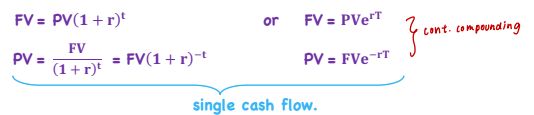
Zero-Coupon Bond/ZCB (Single CF)
*TVM - Fixed Income
Sold at a discount, matures at par
Ex. T-bills
Coupon Bond
*TVM - Fixed Income
Investor receives a number of interest payments over time and par at maturity
Ex. Notes, bonds

Fully Amortizing Bonds
*TVM - Fixed Income
Investor receives level payments of both interest and principal
Ex. Mortgage, auto loan
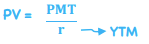
Perpetuity
*TVM - Fixed Income
Ex. bonds, preferred shares
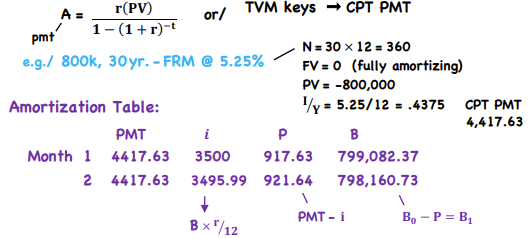
Annuity
*TVM - Fixed Income
Ex. mortgage, car loans
Perpetuity (Constant Dividend)
*TVM - Equity
Ex. Many REITs

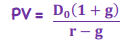
Growing Perpetuity (Constant Growth Dividend)
*TVM - Equity
Ex. Commercial real estate - to calculate property value
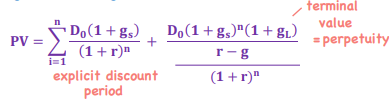
2-Stage Model (Growth Moving to Value)
*TVM - Equity
Rate of growth will slow down in the long-term
Explicit discount period - Similar to coupon bonds
Terminal value - Perpetuity (discount terminal value to this PV)
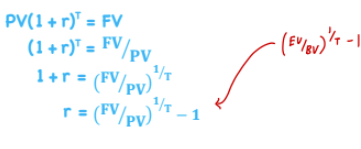
Implied Return on Fixed Income
*TVM - Fixed Income
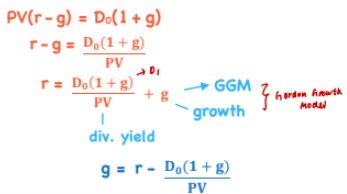
Required Return and Implied Growth of Equity
*TVM - Equity
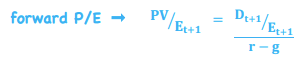
Forward PE
*TVM
PE formula: Constant growth dividend formula / Equity
Numerator becomes dividend payout ratio (DPR), D0 / E
Forward dividend payout ratio = DPR * (1 + g)
If forward dividend OR growth rate (g) is expected to increase, the stock/index will trade a higher forward multiple
Higher required return (r) leads to lower multiple (greater denominator)
Principle of No Arbitrage
*TVM
Cash flow additivity - 2 economically equivalent strategies should have the same price
Calculate PV of two CFs, select the higher one OR take the difference in CFs (A-B), if PV>0, choose A, else B
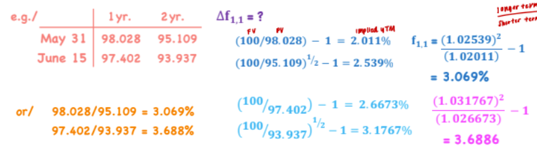
Implied Forward Rate
*TVM
fwhen, what — f3,4 = forward rate that begins in 3 years and lasts 4 years
Can also just divide the two PV’s to get implied forward rate

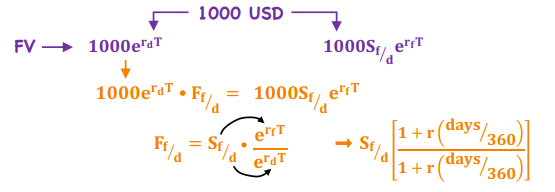
Forex - Foreign Exchange Rate
*TVM
Ff/d = Forwards/futures price
Sf/d = Spot rate (foreign/domestic)
rd = Domestic rate
rf = Foreign rate
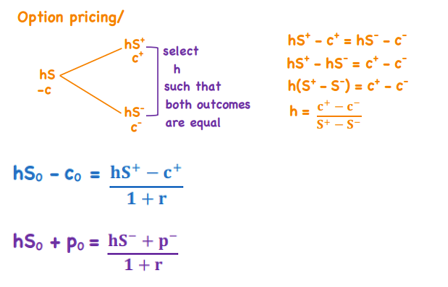
Option pricing
*TVM
h = Hedge ratio
Short a call (-)
Long a put (+)
Notations for X and Y Terms
X-bar/Y-bar = Sample mean
X-hat/Y-hat = Estimate
Xi/Yi = Specific values of X/Y
Dispersion
*Statistical Measures of Asset Returns
Variability around the central tendency
A measure of risk or uncertainty
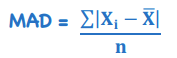
Mean (of the) Absolute Deviation
*Statistical Measures of Asset Returns - Dispersion
Average distance between each data point and the mean
Sample Variance
*Statistical Measures of Asset Returns - Dispersion
Average/expected deviation from the mean
Square root of sample variance = sample SD
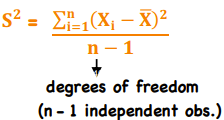
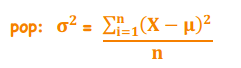
Population Variance
*Statistical Measures of Asset Returns - Dispersion
Square root of population variance population SD
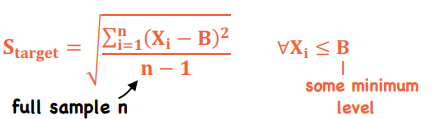
Downside Deviation (ex. Target Semideviation)
*Statistical Measures of Asset Returns - Dispersion
A measure of the risk of being below a certain target B
As B increases, Starget also increases
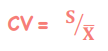
Coefficient of Variation (CV)
*Statistical Measures of Asset Returns - Dispersion
Measure of relative dispersion
For returns, CV measures the risk per unit of return
Lower = better, since it indicates less uncertainty, tighter distribution
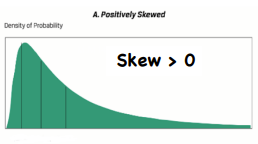
Positive Skew
*Statistical Measures of Asset Returns - Distribution
Mean > median > mode (highest point of distribution)
Ex. Long options portfolio - a lot of small losses & a few large gains
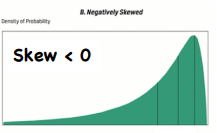
Negative Skew
*Statistical Measures of Asset Returns - Distribution
Mean < median < mode (highest point of distribution)
Ex. Short options portfolio - a lot of small gains & a few big losses
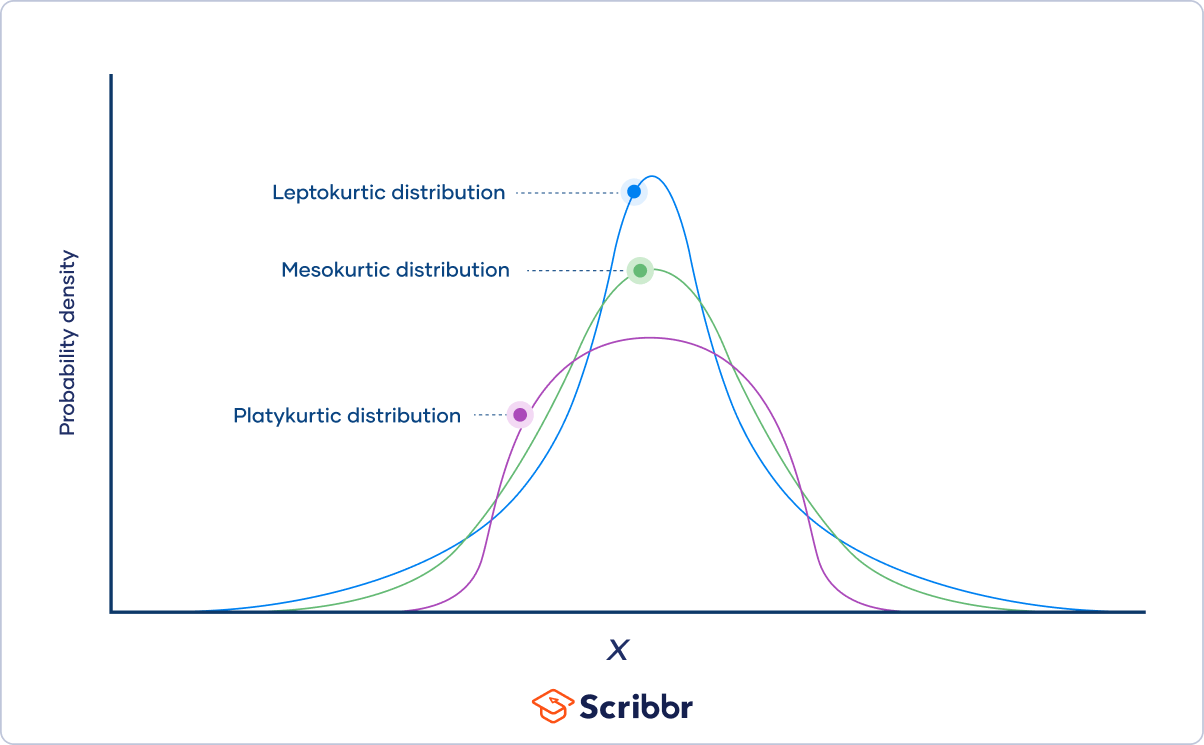
Kurtosis
*Statistical Measures of Asset Returns - Distribution
Measures how much of a probability distribution falls in the tails instead of its center (Normal distribution has K = 3)
Types:
Leptokurtic (K > 3, Ke > 0) - More observations around the mean with more weight in the tails
Mesokurtic (K = 3, Ke = 0)
Platykurtic (K < 3, Ke < 0) - Few observations around the mean with less weight in the tails
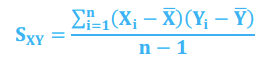
Covariance
*Statistical Measures of Asset Returns - Correlation
Joint variability of two random variables
SXY > 0 when the variables covary together (observation of X above its mean & observation of Y above its mean, vice versa with observations below means)
Correlation
*Statistical Measures of Asset Returns - Correlation
Measures linear association between two variables
Maximum diversification - No linear relationship (r = 0)
Perfect replication - Perfect positive correlation (r = 1)
Perfect hedge - Perfect negative correlation (r = -1)
Limitation: Spurious correlation - chance relationship with a third variable a (X/a, Y/a, still correlation rXY)
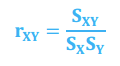
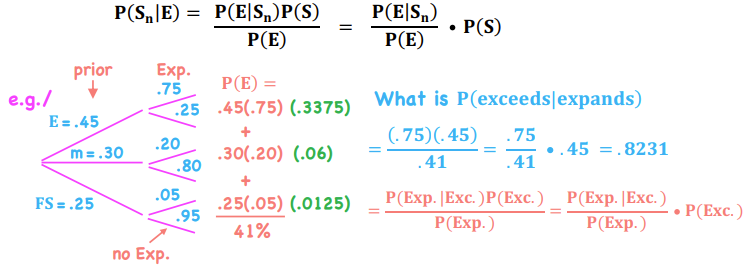
E(X) - Expected Value of a Random Variable
*Probability Trees and Conditional Expectations
Probability-weighted average of the possible outcomes - estimation of the ‘true’ population mean based on a sample

Variance/SD of a Random Variable (σ2/σ)
*Probability Trees and Conditional Expectations

Probability Tree
*Probability Trees and Conditional Expectations
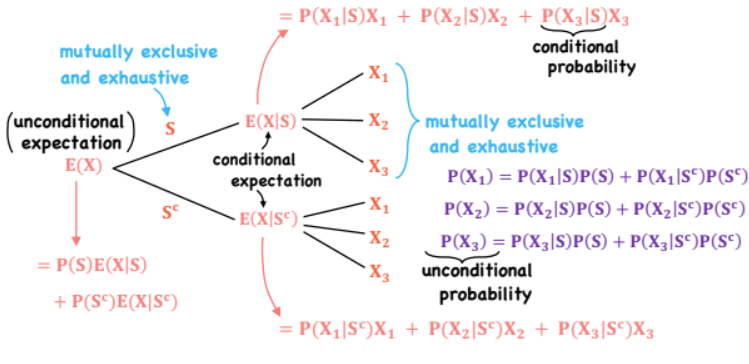
Bayes’ Formula
*Probability Trees and Conditional Expectations
Definition - A method for updating prior probabilities based on new information (switching conditionals)
Method:
1) Find total probability of the condition
2) Find each sub component that makes up the condition
3) Divide sub-component by total to update all prior probabilities
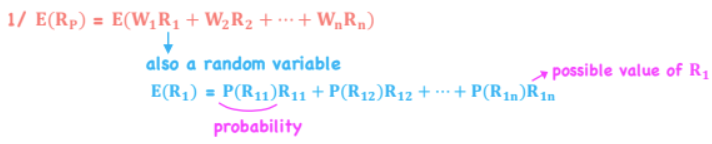
E(Rp) - Expected Value of Return
*Portfolio Mathematics
Portfolio Return - measure of expected reward
Portfolio Variance
*Portfolio Mathematics
Covariance of portfolio with 2 asset classes i and j = wi2(Ri) x wj2(Rj)× 2wiwjCov(RiRj)
For n securities/asset classes, there are:
n variances (ex. n = 5)
n2 - n covariances (ex. 25 - 5 = 20 cov)
(n2- n)/2 distinct covariances (ex. 20/2 = 10 unique cov)
Portfolio risk is lowered by selecting assets with 0 or negative covariance
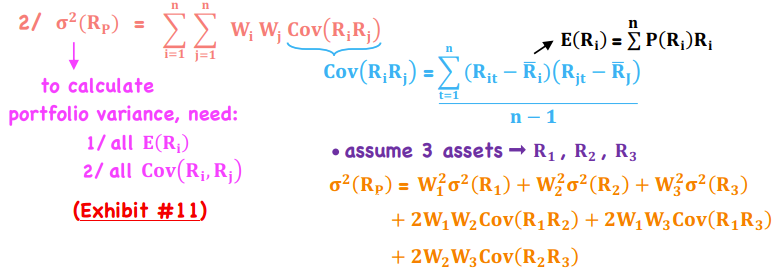
Correlation
*Portfolio Mathematics

Covariance as a Joint Probability Function for Returns
*Portfolio Mathematics
Moving away from having expected return of an asset class to having expected returns based on possible scenarios (need joint probability)
Product of Deviations x Probability of Condition
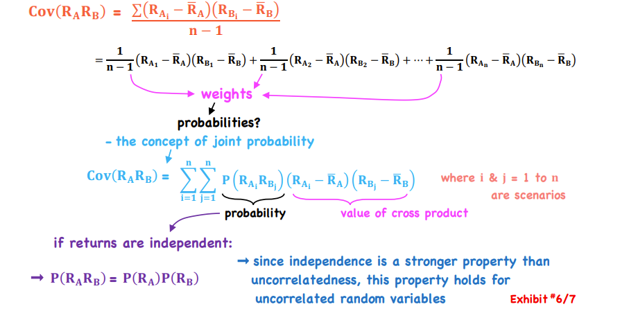
Shortfall Risk
*Portfolio Mathematics
Definition: The risk a portfolio value (or return) will fall below some minimum acceptable level over some time horizon
Objective is to maximize this ratio - Optimal portfolio minimizes N(-SFRatio)
NORM.S.DIST(-SFRatio, df) - Result is the probability that the portfolio will earn less than RL
If RL = Rf then SFRatio = Sharpe Ratio
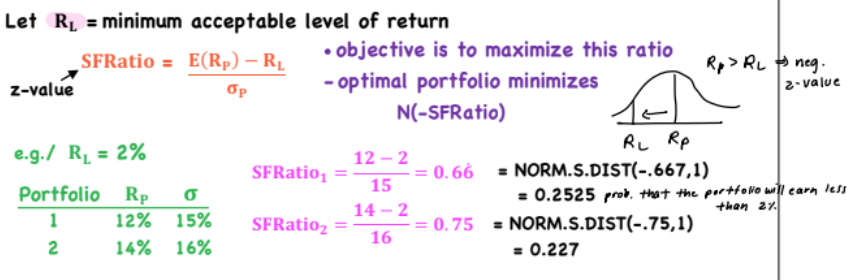
Lognormal Distribution
*Probability Distributions
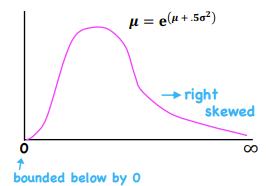
Used to model the probability distribution of asset prices - described by the mean and variance of its associated normal distribution
Relationship between lognormal and normal distribution - A variable Y follows a lognormal distribution if LN(Y) is normally distributed
Lognormal Distributions - Return
*Probability Distributions
Used to model asset prices when using continuously compounded asset returns - cannot be negative (bounded below by 0)
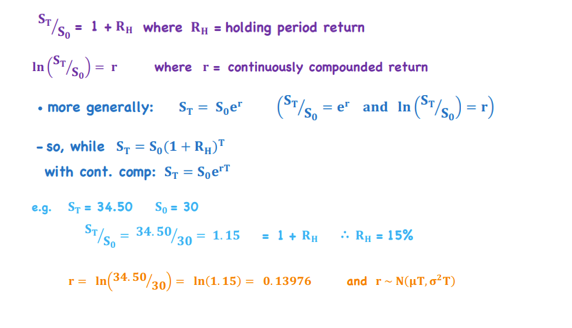
Lognormal Distribution - Volatility
*Probability Distributions
Annualized SD of the continuously compounded daily returns of the underlying asset

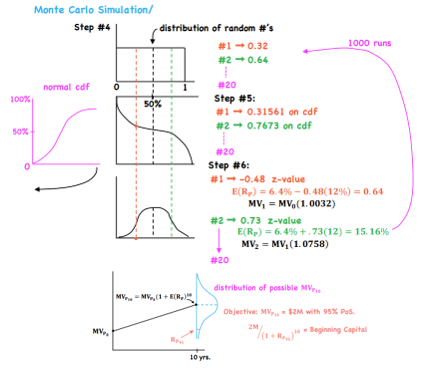
Monte Carlo Simulation
*Probability Distributions
Situation: We have a number of variables & we know how they behave since some common probability distributions describe the behavior of these variables - What are some other possible pathways of meeting my goals in the future with my portfolio return and SD?
Method:
1) Specify quantity of interest (ex. MVp in 10 years)
2) Specify a time grid - K sub-periods with time increment over the full time horizon (time increment = 6 months, 20 sub-periods)
3) Specify distributional assumptions for the key risk factors - E(Rp) & σ
4) Draw standard normal random numbers for each key risk factor over each K sub-periods (random number generator produces a distribution of random numbers from 0 to 1, all equally likely)
5) Map area under cdf (flip it?)
6) Obtain z-values to map out (approx. 1,000 runs)
7) Simulation will produce a distribution of outcomes around the point estimate of expected return at a certain time
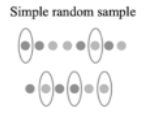
Simple Random Sampling
*Estimation - Probability Sampling
Definition: A subset of a larger population such that each element has an equal probability of being selected
Sample size = n, 1/n probability of being selected
Useful when data are homogenous
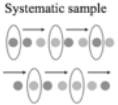
Systematic Sampling
*Estimation - Probability Sampling
Definition: Select every Kth element until the desire sample size is reached
No logical ordering/selection process, used when the population is too large to code
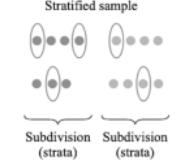
Stratified Random Sampling
*Estimation - Probability Sampling
Definition: Population is sub-divided into sub-populations based on one or more classifications. Simple random samples are drawn from each sub-population, which is pooled to form main sample
Each sub-sample is proportionate to the size of it’s sub-population, guaranteeing representation & more precision
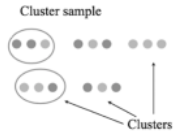
Cluster Sampling
*Estimation - Probability Sampling
One-stage cluster sampling: Population is divided into clusters, and some of these clusters are randomly selected into your sample
Two-stage cluster sampling: Sub-samples are selected from each cluster
Cost & time efficient, but usually results in lowest precision
Sampling Error
*Estimation and Sampling
Definition: Difference between observed values of a statistic and population parameters as a result of using just a subset of the population. Deviations of sample drawn from true population
Tapers at around n=200
Non-Probability Sampling
*Estimation and Sampling
Types:
Convenience sampling - Observations are selected that are easy to obtain or accessible (ex. prof uses students)
Judgemental sampling - Select observations based on experience and knowledge (ex. auditor selectively reviewing accounts)
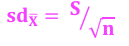
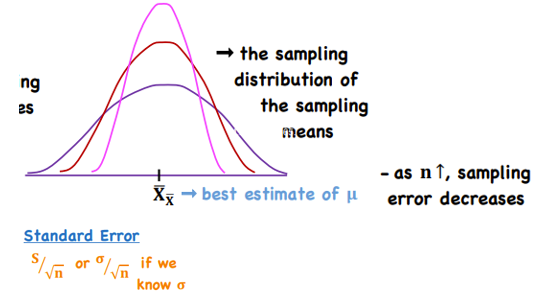
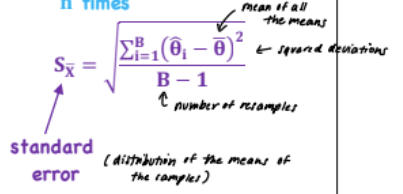
Standard Error
*Estimation and Sampling
Definition - Standard deviation of sample means around population means
Central Limit Theorem - Sampling distribution of the mean will always be normally distributed, as long as the sample size is large enough (tapers at around n=200)
z-values
60% = 1
90% = 1.64
95% = 1.96
99% = 2.58
Bootstrap Method
*Estimation - Resampling
Method - Draw 1 observation, record & replace n times to create a distribution (rather than estimating)
Uses computer simulation
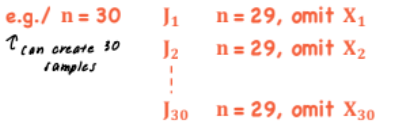
Jackknife Method
*Estimation - Resampling
Method - Omit one observation from a sample, one at a time
Will produce similar results from sample to sample
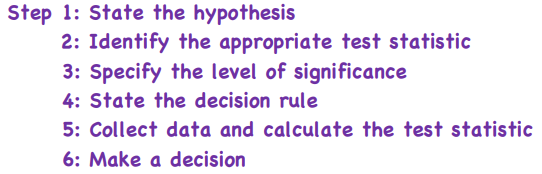
Hypothesis Testing
Test to see whether a sample statistic is likely to come from a population with the hypothesized value of the population parameter - Does X-bar = μ0?
*Typically want to reject null, and accept alternative
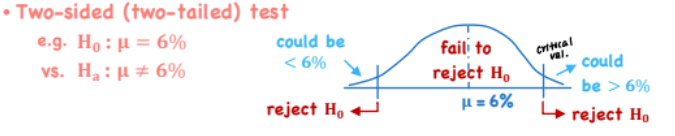
Two-sided (Two-Tailed) Test
*Hypothesis Testing
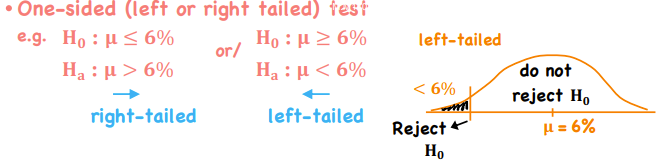
One-sided (Left-Tailed or Right-Tailed test) Test
*Hypothesis Testing
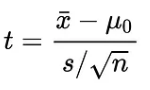
Test of a Single Mean
*Hypothesis Testing - t-Distributed Test Statistic
df = n - 1
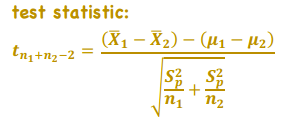
Test of the Difference in Means
*Hypothesis Testing - t-Distributed Test Statistic
Are X-bar1 and X-bar2 from the same population or different populations?
df = n1 + n2 - 2
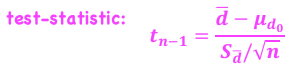
Test of the Mean of Differences (Paired-Sample t-Test)
*Hypothesis Testing - t-Distributed Test Statistic
Is the mean difference between two sets of observations 0?
df = n - 1
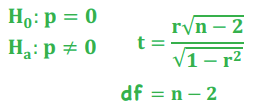
Test of a Correlation
*Hypothesis Testing - t-Distributed Test Statistic
*Parametric Test of Correlation
Is there a statistically significant correlation between two variables?
df = n - 2
Test of a Single Variance
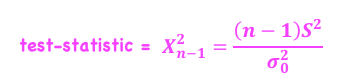
*Hypothesis Testing - Chi-square-Distributed Test Statistic
Is the variance of the population equal to a specific value?
Test of Independence
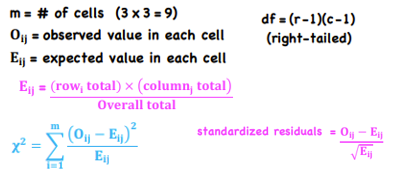
*Hypothesis Testing - Chi-square-Distributed Test Statistic
*Non-Parametric Test of Independence
Categorical Data - Values that describe a quality or characteristic (nominal, ordinal)
Are these classification types independent? ex. Are growth stocks likely to be any size or are they more likely to be large-cap stocks?
Test of the Difference in Variances
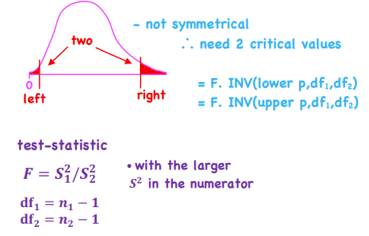
*Hypothesis Testing - F-Distributed Test Statistic
Are the variances of two populations equal? ex. Comparing the volatility of two funds
Level of Significance
*Hypothesis Testing
Alpha & beta have an inverse relationship - Only way to decrease both is by increasing n
Type I error: False positive
Type II error: False negative
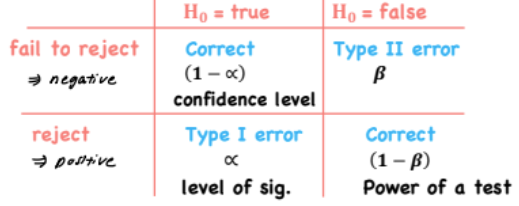
Decision Rules + Excel Formulas
*Hypothesis Testing
NORM.S.INV( ) - probability in, critical value out
NORM.S.DIST( ) - critical value in, probability out
OR
T.INV (p, df) - probability in, critical value out
T.DIST (val, df) - critical value in, probability out
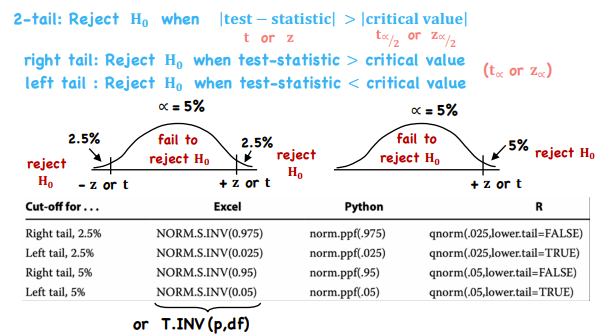
Non-Parametric Testing
When data do not meet distributional assumptions (n <30), population is non-normal)
When there are outliers (test of median vs mean)
When data are given in ranks or use ordinal scale (NO IR)
Hypothesis doesn’t concern a parameter (ex. Is a sample random?)
Spearman Rank Correlation Coefficient (rs)
*Non-Parametric Test of Correlation
Definition - Essentially a correlation calculated on rank values, not on the actual values of the observation
Method:
1) Rank all X from largest to smallest (1 - n). If there’s a tie, put in an average rank
2) On original data set, calculate di2 = (rank Xi - rank Yi)2
3) Calculate rs
4) If n > 30, test rs
Total Sum of Squares (SST)
*Linear Regression
The sum of all squared differences between the mean of a sample and the individual values in that sample

Sum of the Squares Error (SSE) or Residual Sum of Squares (RSS)
*Linear Regression
The sum of difference between observed and predicted values
Goal of regression is to compute a line of best fit that minimizes the sum of the square deviations between observed and predicted values of Y
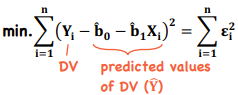
Linear Regression (components)
Linear Regression Assumptions
*Linear Regression
1) Linearity - The relationship between X&Y is linear in the parameters b0 and b1 (IV is not random)
2) Homoscedasticity - Variance of the dependent variable is the same for all observations
3) Independence - The pairs (X,Y) are independent of each other; error term is uncorrelated across observations (no serial correlation - ability to predict likelihood of next error being +/-)
4) Normality - Error term is normally distributed
Total Sum of Squares (SST)
*Linear Regression - Analysis of Variance
SST (total SS) = SSE (unexplained SS)+ SSR (explained SS)
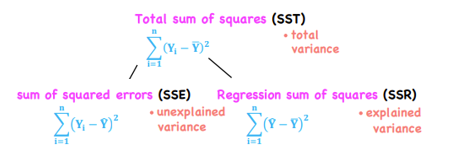
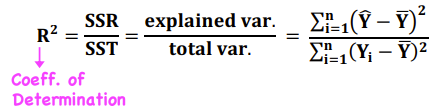
Coefficient of Determination
*Linear Regression - Analysis of Variance
Measures the fraction of the total variation in the DV that is explained by the IV (goodness of fit measure)
NOT a statistical test
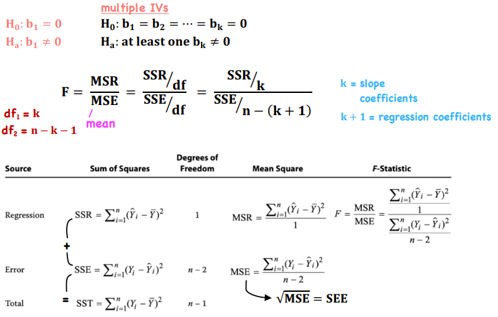
Statistical Test - ANOVA test
*Linear Regression - Analysis of Variance
F-Stat Excel Function - F.INV(prob, SSR df, SSE df)
Standard Error of the Estimate/Regression (SEE) = (MSE)1/2 - The smaller the SEE, the more accurate the regression
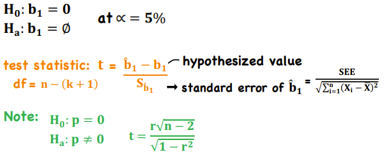
Hypothesis Tests of b-hat1
*Linear Regression - Hypothesis Test
Test - Is it significantly different from 0?
t-stat Excel Function - T.INV (prob, n-k-1)
Hypothesis Tests of b-hat0
*Linear Regression - Hypothesis Test

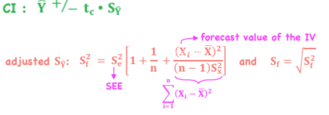
Prediction Interval for Y-hat
*Linear Regression
2 sources of error that we need to account for in the :
Y residuals
b-hat0 and b-hat1 are estimated with error
Properties
1) The better the fit of the regression model. the lower Se2, the lower Sf2 (SE of forecast)
2) Larger n = smaller Sf2
3) The closer Xf is to X-bar = smaller Sf2
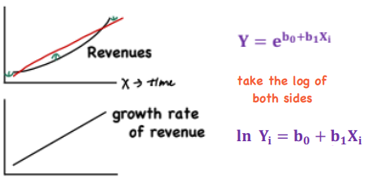
Log-Lin Model
*Linear Regression - Functional forms of the regression model
Relative change in Y for absolute change in X
Lin-Log Model
*Linear Regression - Functional forms of the regression model
Absolute change in Y for the relative change in X
Ex. Y = Percent, X = $B in Revenue

Log-Log Model
*Linear Regression - Functional forms of the regression model
Relative change in Yi for a relative change in Xi
