Post-Prelim Content (Reading + Lectures 19-24)
 Call Kai
 Learn
Learn Practice Test
 Spaced Repetition
 Match
Match Flashcards
 Knowt Play
1/56

There's no tags or description
Looks like no tags are added yet.
Name | Mastery | Learn | Test | Matching | Spaced | Call with Kai |
|---|
No analytics yet
Send a link to your students to track their progress
57 Terms
READINGS
Fletcher et al: Key points of romantic love on pages 23-25?
universal across cultures
suppress search for other mates (ppl in highly committed relationships perceive attractive individuals less appealing)
has distinct emotional, behavioral, hormonal, & neuropsych features + evolution from attachment system pair bonding
attachment system in humans reg by oxytocin but oxytocin & relationship satisfaction evidence mixed; also NT in dopamine system
single men have more testosterone (drive sexual arousal) then married b/c turn into fathers
*pair-bonding predict better health/survival for offspring & adults
Fletcher et al: What are the 4 challenges the authors cite about their theory that romantic love is an evolved adaptation to promote pair-bonding and conclusions on the four challenges?
arranged marriages
problem: arranged marriages bypass romantic love so love maybe not necessary for pair-bonds
for-evidence: parents choose partners = pair-bonding w/o love
against-evidence: arranged marriages in Sri Lanka indirectly let parents know who they like = couples have some choice, unhappy marriage = seek other romantic relationships, parent & children mate pref similar so match may be someone they would choose themselves
conclusion: arranged marriages don’t invalidate thesis b/c love occur before/during/after marriage
polygamy
problem: humans may not be monogamous
for-evidence: 84% of cultures allow polygamy
against-evidence: but only 5-10% of men in these cultures have more than 1 wife = not commonly practice, polygynous relationships unstable & conflict-prone (wives often jealous & report emotional distress), dominant marital arrangement is monogamy
conclusion: romantic love still monogamous/thesis holds b/c polygamy rare/tense
divorce
problem: show romantic love not a commitment device/doesn’t create long-term pair-bonds
for-evidence: divorce peaks when first-child ~4, divorce rates high in hunter-gatherer cultures
against-evidence: most marriages in Western countries don’t actually divorce (assume 50% but actually 35%), divorce probability dec over time = weed out unsuccessful long-term relationships
conclusion: even if divorce occurs doesn’t undermine thesis
infidelity
problem: extramarital sex defy exclusivity of romantic love
for-evidence: 20-25% men & 10-15% women in US report extramarital sex during their marriage, put primary relationship at risk
against-evidence: extra-pair sex due to dissatisfaction w/current relationship, conception rate = 3% so extra-pair paternity in humans lower than other species, sexual behaviors due to maintaining long-term relationships not sperm competition which has weak evidence
conclusion: humans primarily monogamous species so don’t undermine thesis
*even if ppl short-term mate/divorce/embrace polygamy none of the 4 challenges undermine proposition that romantic love evolved to promote pair-bonding b/c long-term & sexual fidelity is more common, romantic love exists in all culture & offspring share similar partner criteria w/parents
Diamond: What does abstract say about why sexual desire & romantic love are distinct subjective experiences? What’s role of oxytocin?
sexual desire evolved from sexual mating whereas romantic love evolved from pair bonding (infant-caregiver attachment)
oxytocin in love & desire may explain why women report more interconnections b/t love & desire than men
Diamond: According to “evolutionary origins of love & desire”, explain why love & desire independent via 3 studies. If so, why do humans fall in love with partners that they’re sexually attracted?
love & desire independent b/c evolved for infant-caregiver attachment not reproductive mating
Bowlby: attachment formed to keep infants close to caregivers
Hazan & Zeifman: adult pair bonding exaptation from attachment, which share heightened desire for proximity, resistance to separation, & partner = comfort/security
Carter: mother-infant & adult affectional bonding mediated by same opioid & oxytocin neural pathways
culture (shape what feelings/behaviors normal for these relationships) + attachments form w/extensive proximity so sexual desires are a motive for this extended context
Selcuk et al: What were the results?
Results from Self-Report (subjective PQSI scores)
ppl who perceive partner as responsive had less sleep problems indirectly via less anxiety & dep (not directly)
Results from Actigraph (objective)
partner responsiveness not directly associated w/actigraph sleep efficiency/duration but partner responsiveness indirectly predicted greater objective sleep efficiency via lower anxiety (lower wake after sleep) but not dep
*both indirect associations still significant after controlling for emotional support, agreeableness, demographic, & health covariates (BMI)
Feeney & Collins: According to Table 1, what are the 5 well-beings for thriving?
Hedonic: happiness, life satisfaction, pleasent affect, etc.
Eudaimonic: having purpose/meaning in life, progressing toward goals, etc.
Psychological: positive self-regard/acceptance, optimism, absence of mental health disorders
Social: deep, meaningful human connections & positive interpersonal expectancies
Physical: physical fitness, illness/disease absence, longevity
Feeney & Collins: According to Table 2, what are the definitions and 4 components of source of strength (SOS) support & relational catalyst (RC) support?
SOS Support: promote thriving thru adversity via being a buffer & emerge from stressor stronger
provide safe haven, fortification, assist reconstruction process & redefining adversity for positive change
RC Support: promote thriving thru full participation in life opportunities in absence of adversity
nurture desire to get opportunities for growth, provide perceptual assistance in viewing opportunities, help prep engagement in them, & help implement by serving as launch function
Holt-Lunstad et al: What did authors want to investigate (intro) & conclusions?
evidence that social relationship predict health outcomes/is determinant of health by WHO but why not acknowledged as national public health priority
conclude social connection crucial from cradle to grave (birth→death) & need to acknowledge as multifaceted public health prob at micro & macro level
Holt-Lunstad et al: What are the 3 factors that determine the seriousness of public health issue & how does loneliness relate?
urgency: if problem getting worse over time; avg size of core social networks declined by 1/3, avg household size dec & 10% inc in single-occupant houses, dec marraige rates & less children per household, loneliness inc as ppl age = Americans less socially connected
severity: social connection = 50% reduction in early death across gender, age, culture; comparable to other risk factors for mortality as loneliness highest (more than obesity)
economic loss: social support improve QoL, lower health care costs (i.e. breast cancer patients, newborns) & maybe due to greater adherence to medical recs if socially connected
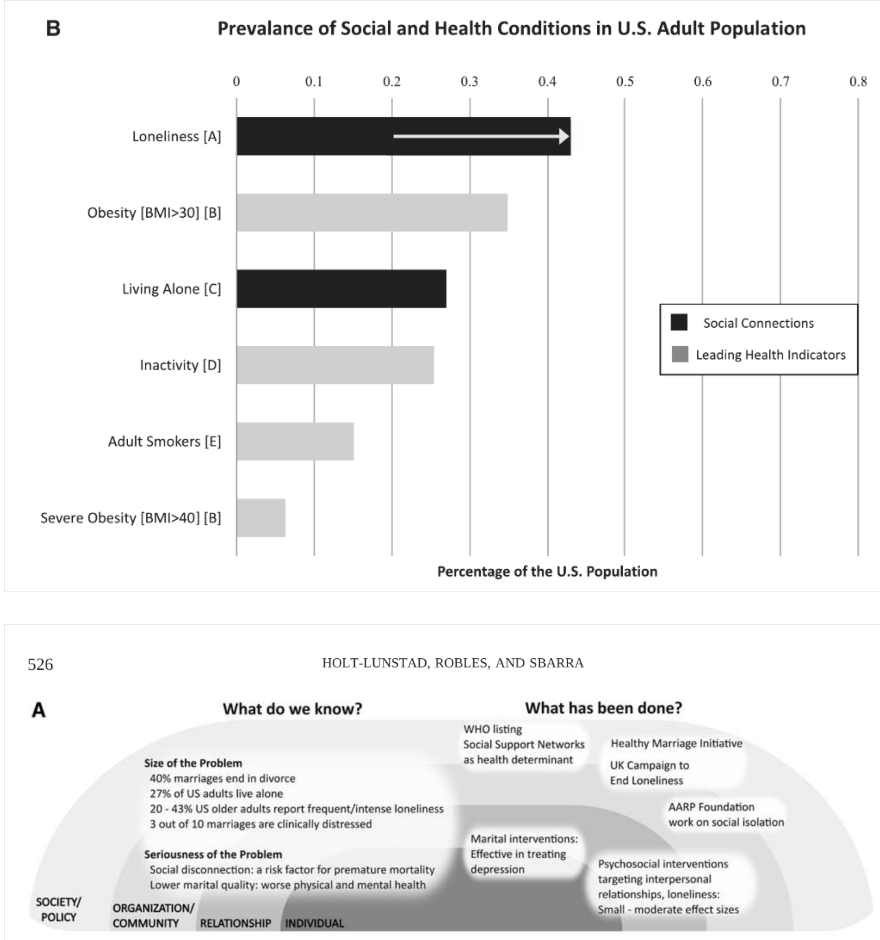
Holt-Lunstad et al: What are rec & future policies?
early efforts generated evidence-based rec for how much social connection + implement/improve surveillance risk factors to intervene at specific settings & assemble capability for large-scale change
relationships & health science in SEM at individual (psychosocial interv), relationship (marital interv), org (AARP), & society/policy level (WHO)
Sbarra & Borelli: In introduction, what are the 2 types of common challenges when relationships breakup? What are the 2 aspects of attachment theory that relate to how people cope w/marital separation?
interpersonal vs. intrapersonal (both understood as attachment processes)
normative attachment reorganization (how ppl psych restructure their relationship w/former partner in wake of breakup) vs anxious/avoidant attachment
Sbarra & Borelli: What does successful reattachment organization look like? What are the 2 key dimensions of normative attachment reorganization?
shift from coreg (we/us) to indp reg (me = secure w/o that one person)
1) attached to ex/greater we-talk initially = greater self-concept disturbance; ppl who came into lab to just talk about it had less self-concept disturbance
2) cognitive adaptation (coherent narrative = more psych resolved)
Sbarra & Borelli: Key points in how normative reorganization is also shaped by indv diffs in attachment anxiety/avoidance.
high attachment avoidance use deactivating strategies while high in anxiety use hyperactivation reg strats
ppl low on both are secure
immediately after sep, high attachment anxiety = maladaptive b/c heightened bp
mixed for avoidant where some studies found highly avoidant better at emotion reg suppression short-term but also (+) associated w/psych distress 4 yrs after initial sep
LECTURES 15-24
What are findings from Participation Polls 9 & 10?
Poll 9
60% most recent romantic interest from in person, next thru mutual friends
88% exp infatuation, 22% exp it for 2+ simult / non-sexual infatuation
90% exp preoccupation & psych arousal when you had crush
monitor social media, look at old posts, overanalyzd interactions top 3 actions when had crush ; avoid & joined class/activity for them least
politics, cringe/weird, values, smoking/partying, girls dec attraction on social media & hobbies, singing, personality, funny, friends inc attraction
Poll 10
What are the 5 symptoms of romantic infatuation/limerence? (L15)
acute onset: sudden, rapid emergence of intense romantic obsession
physiological arousal: physical “rush” like rapid heart rate
mental preoccupation: *most telling symptom, take up mental space & try to figure out what other person is thinking
mood dependency: mood influenced by whether you feel liked by person you’re infatuated with
idealization: *most dangerous, downplay ignore problematic aspects of person you’re infatuated with
*single target = some argue you can also be infatuated w/1 person
4 FAQs for Romantic Infatuation (L15): 1) Is it nuts or normal?
normal b/c common exp but not rational
universal across cultures where love sickness considered a legit medical condition
cultural diff where other parts of world think it’s crazy like in US it’s good thing (rom coms) but in. China its problematic/grouped w/negative emotions
4 FAQs for Romantic Infatuation (L15): 2) How long does it last or what is the average duration/time course of romantic infatuation? What shortens/lengthens this timeline?
initial, sudden onset has most infatuation, peak @ 6 months, wane up until end of 2 yrs, after 2 yrs (green line) relation ends or mutual attachment where infatuated w/partner forever but never same intensity
quick cohabitation shorten timeline while delayed sex & long distance lengthens
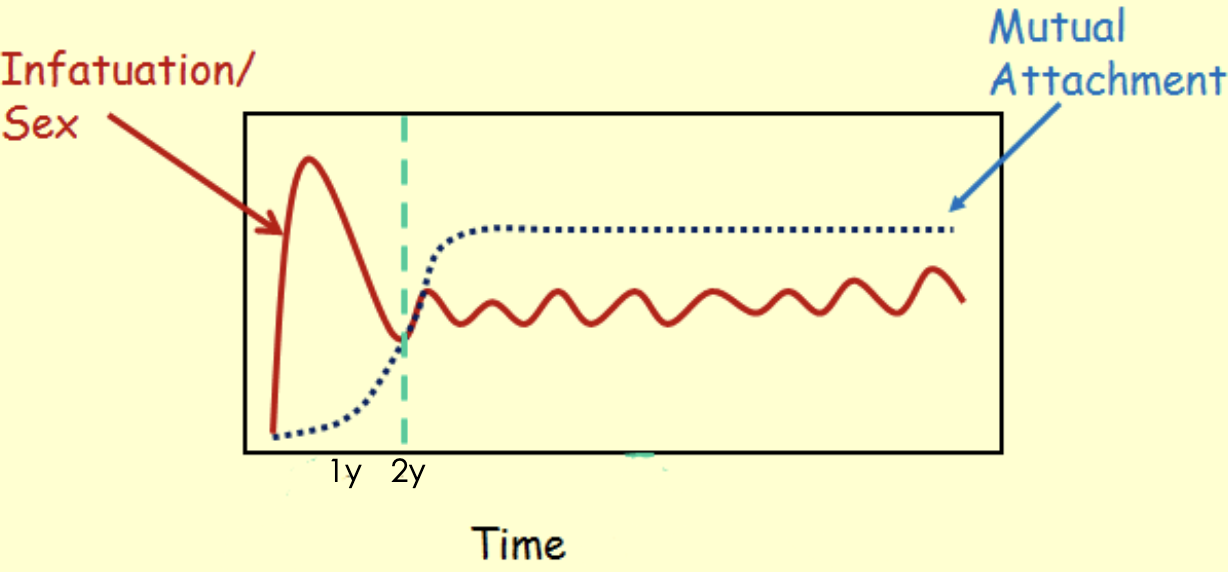
4 FAQs for Romantic Infatuation (L15): 3) Is romantic infatuation just lust/sexual desire (evidence for/against)?
evidence for being same: time courses & primary targets same
evidence for being diff: phenomenological (subjective) exp where ppl don’t want sex but rather reciprocal liking & pre-pubertal infatuation (Hatfield et al’s passionate love scale found ppl as young as 4-6 report early forms of infatuation w/o reaching sexual maturity)
4 FAQs for Romantic Infatuation (L15): 4) What is its function?
to promote pair bonding b/t reproductive partners b/c repeated sex w/same person foster attachment, may result in offspring who is more likely to survive if parents pair bonded
What is the role of uncertainty in romantic infatuation (Whitchurch et al)? (L15)
attraction highest for ppl who “like you a lot or avg amount” b/c uncertainty keeps you aroused/interested
eliminating uncertainty reduces mental hook which is risky but effective
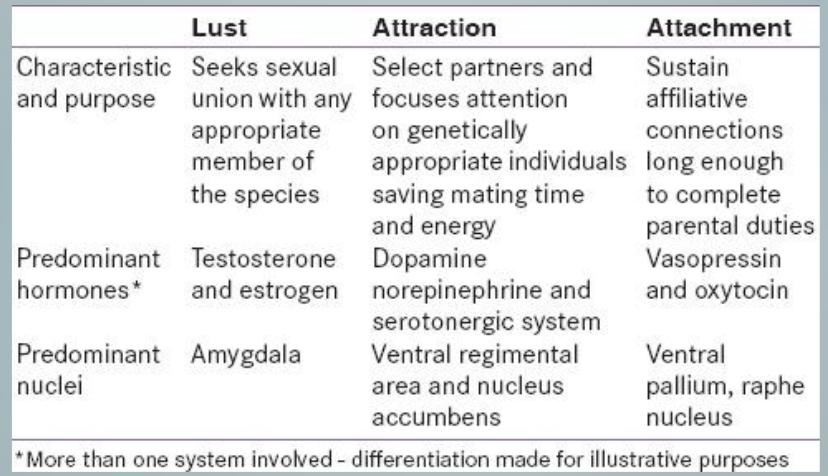
What are the characteristics/purpose, hormones, & nuclei for lust, attraction, & attachment? according to Seshadri’s neuroendocronology of love? (L17)
What is role of dopamine, opiates, oxytocin, norepinephrine in underlying neurochemistry of pair-bonding? What is each boosted/blocked by? What effect does oxytocin have on the other two? (L17)
Dopamine: appetitive/wanting/motivation/approach system to make you feel wanting, desiring, hungry for; prod in ventral tegmental area & substantia nigra; released before/during sex; drives wanting not liking; habituation so need more to get same affect & released by cues
*boosted by cocaine, aderall, ritalin & blocked by haloperidol, haldol
Opiates: consummatory reward/liking system to make you feel sated, satisfied, content; prod in subcortical structures; released during & after sex
*boosted by heroin, oxycodone & blocked by narcan
Oxytocin: cuddle chemical (closeness, comfort, trust); trigger labor/milk-letdown/care; peak during sexual orgasms; prev addiction hyperdopaminergic states b/c sensitize to dopamine & inhibit opiate habituation
*boosted by intranasal oxytocin & blocked by stress/social exclusion?
Norepinephrine: attention/salience marker; prod in locus coeruleus; modulate signal-to-noise & explain mental preoccupation of infatuation
*boosted by scary exp & blocked by beta-blockers
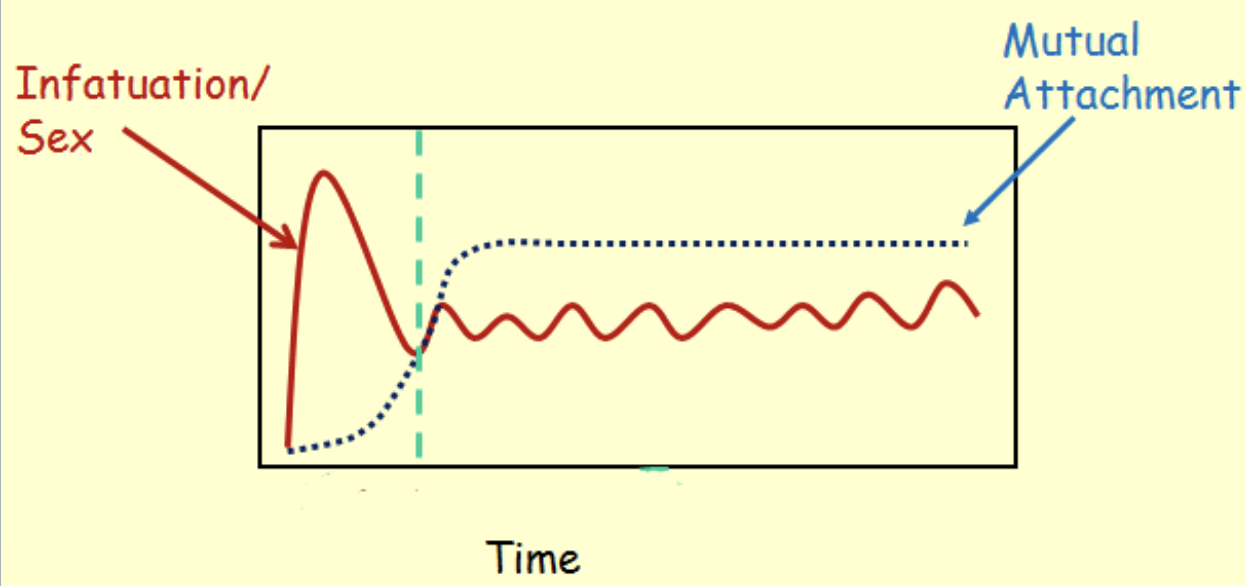
Underlying neurochemistry of dopamine & opiate for romantic infatuation? (L17)
dopamine dominant (red line) in early phase & opiate dominant later (blue line) as attachment develops
relationship end during dopamine phase/early = feel like letdown/crash
relationship end during opiate phase = anxiety b/c attachment formed
What is advantage of pair bonding for offsprings?
inc survival rate for offspring when reproductive partners pair bonded
What are some statistics on recent decline in sexual frequency? What are general effects of time & age on it? What are some facts about Gen Z that might account for sexual drought? (L17)
Twenge et al: sexual freq dec as age
Ueda et al: sexual freq in men & women who respond not at all/weekly or more has dec but 1-3 per month for men inc = nuanced
teen births rates are dec (b/c of birth control?)
Gen Z more likely to live w/parents (even college grads), read romance (85% readership women), poorer health at younger age (92% inc in anxiety, inc in self-harm hospital admissions, type 2 diabetes)
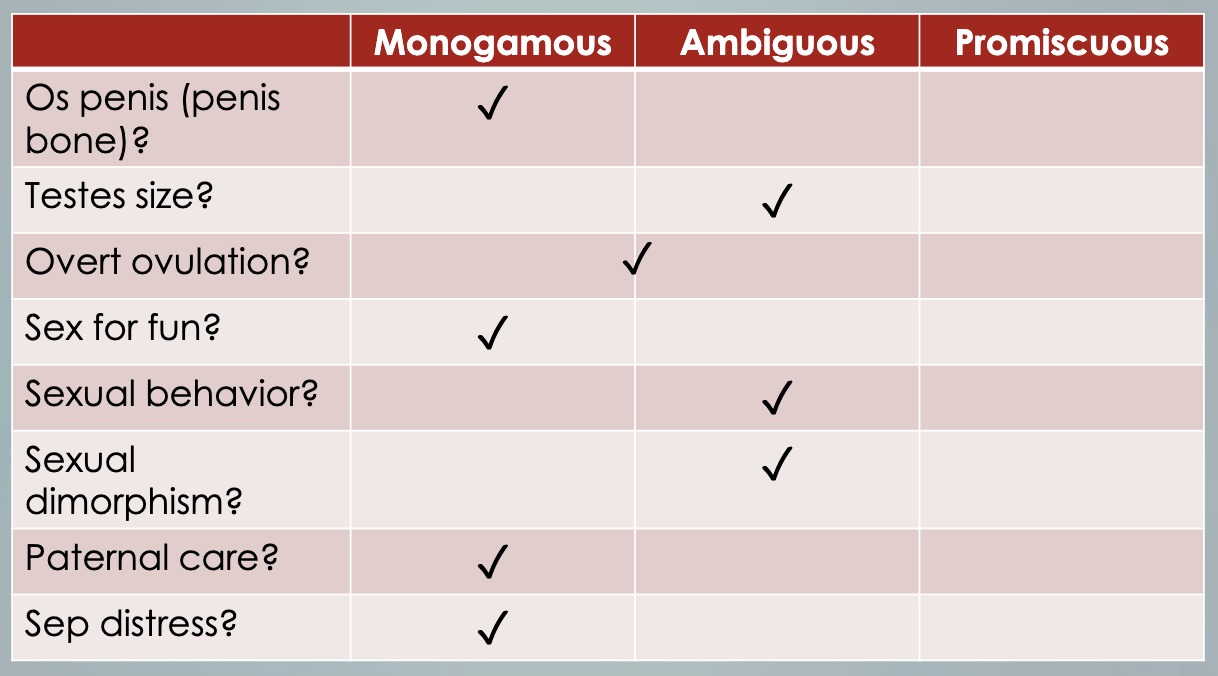
What the 8 features ethologists use to determine if species is monogamous/ambiguous/promiscuous? How are humans categorized for each of the features and what can concluded? (L18)
humans don’t have os penis/penile bone = req arousal for mating = monogamous mating
promiscuous species have larger testes size for sperm competition but humans medium = ambiguous
overt ovulation (like baboons) = pair up only during ovulation period but covert = need to continuously pair up for successful reproduction ; humans ambiguous b/c not as covert i.e. wear red, olfactory cues, etc
sex just for fun/beyond reproduction = monogamous
sexual behavior: as ppl get older, wider gender cheating gap = ambiguous
greater sexual dimorphism = promiscuous mating but humans not clearly either b/c pre-puberty little/no diff but also men on avg heavier than women
parental care = monogamous
separation distress = monogamous
conclusions: humans socially monogamous but sexual monogamy less clear due to varying gender, sexual orientation, culture, norms, values, etc.
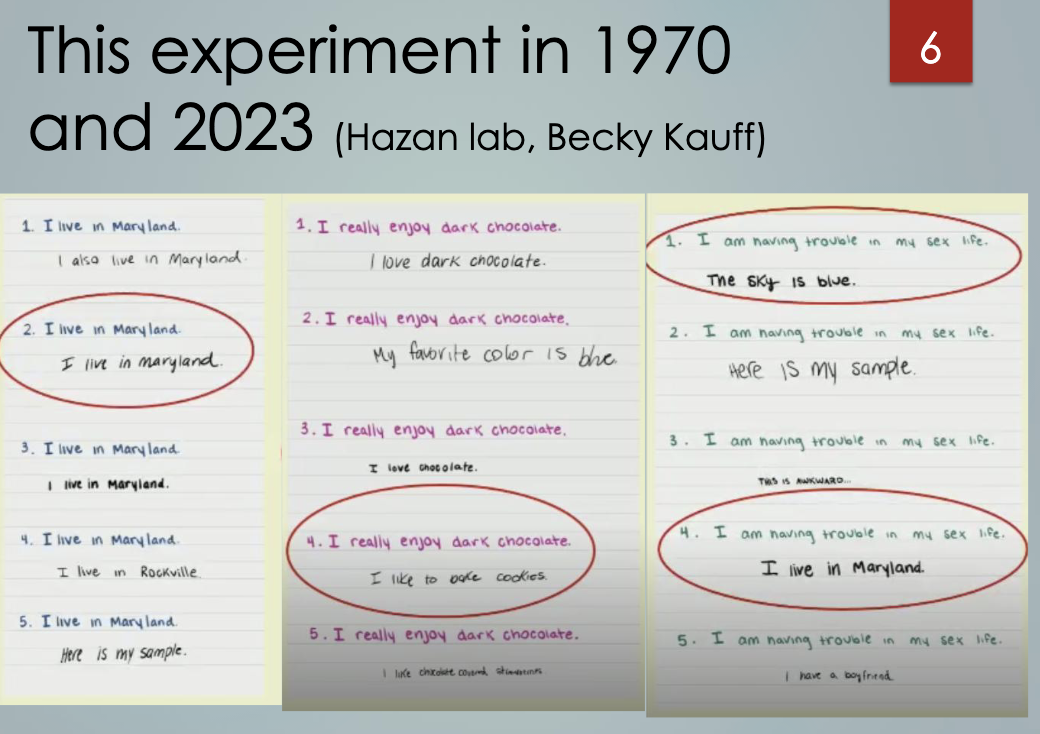
What is this Hazan lab/Becky Kauff study? (L19)
ppl asked to copy same sentence for first 4 lines & 5th write any sentence
copying intimate/self-threatening sentences = wrote safe, identity-affirming truths = show discomfort w/intimacy
Intimacy is to _ and is an interpersonal process that applies to all types of interpersonal relationships, which develops over time & req at least 2 ppl. Also strongest predictor of relationship satisfaction. (L19)
make the innermost self known to another
What are the 5 intimacy factors? (L19)
Verbal Self-Disclosure: must be reciprocal, gradual, & need acceptance/validation to promote & reveal intimacy = bidirectional
Kinesics or body-language i.e. defended vs undefended posture (gender diff where women might cross arms & men cover testes) ; flirtatious behavior has universal seq - look up, down, smile, check if watching, preen, giggle; bidirectional
Proxemics or physical spaces
public → social → personal → intimate space (distance gets smaller & vary by country/culture)
incursions immediately noticed & intimidate or build intimacy, moderated by eye contact where little/no eye contact = stop closer
physical touch waist up, pat/stroking, brief & Dunbar et al found 75-90% accuracy in identifying ± relationships content w/o audio & 43-53% accuracy in identifying 8 relationship types
bidirectional
Paralinguistics or speaking manner via elevated/varied pitch, sing-song, infant-directed speech; bidirectional
Settings: priv/public, small/large group, interruption possibility, end time specificity, eating & sleeping together, dim/bright lighting
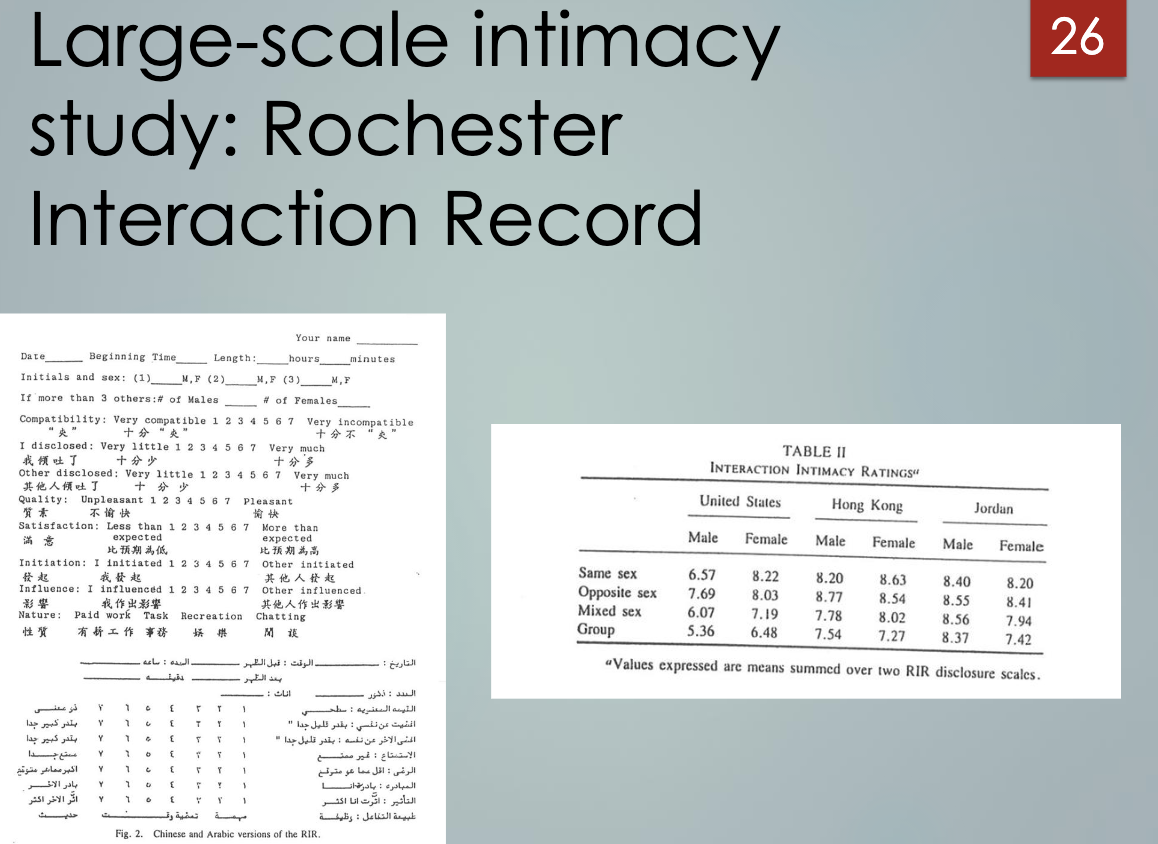
What did the Rochester Interaction Record show ? (L19)
higher intimacy ratings for same-sex interactions among F in US & Kong Kong
Jordan had high same & opposite sex intimacy for M & F
mixed sex & group lowest
thus show gender & cultural diff in intimacy levels
What is the “essence” of intimacy? How is disgust a caveat of intimacy? (L19)
vulnerability & feeling accepted + validated
disgust = evolutionary protection mech to not share body fluids but override by intimacy b/c intimate relationships improve recovery from illness
What are the 3 studies about intimacy conclusions shown in class? (L19)
Holt-Lunstad, Robles, Sbarra 2018: loneliness has impact on health as bad/worse than smoking, bad diet, inactivity
Rakel et al 2009: ppl w/perfect CARE recover faster from cold than sub-perfect CARE (closeness, attention, responsiveness, empathy)
Howe, Goyer, & Crum 2020: (+) expectations after histamine prick = on avg smaller rxn size than (-) expectations
What is sociosexual orientation (SOI)? (L19)
degree of connection b/t love & sex
Schmitt 2005: SOI range from restricted (sex only within committed relationships) to unrestricted & differ by gender/sexual orientation where men have higher unrestricted scores & bi women highest among women
How is commitment defined? (L20)
intention to continue a relationship (apply to all interpersonal relationships)
What are the 3 types of commitment? (L20)
personal commitment: “I want to…” = +/rewarding relationship
moral commitment: “I ought to…" = promised/obligation
structural commitment: “I have to…” = can’t leave b/c legal/social pressure
What is social exchange theory and what are 2 things that tell if your relationship is good level? (L20)
ppl stay in relationships when positives outweigh negatives
comparison level (CL) = standard that you think you deserve ; outcome higher = satisfied
comparison level for alternatives (CLalt) = guess at whether you could be doing better ; high = unstable relationship
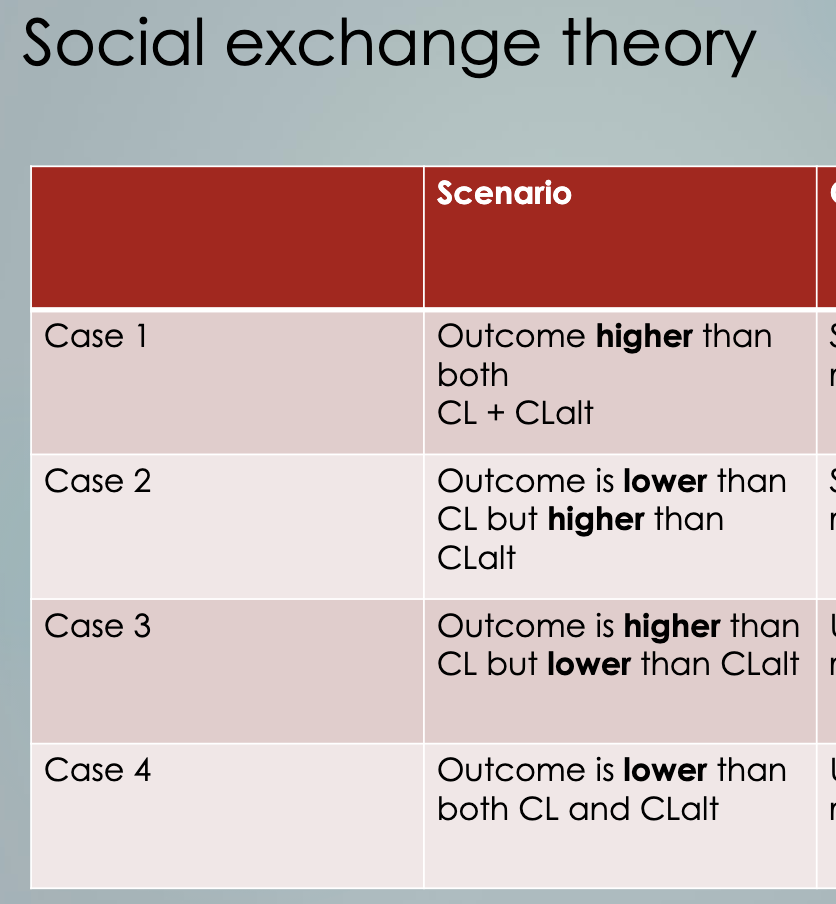
What are the outcome for each social exchange scenario? (L20)
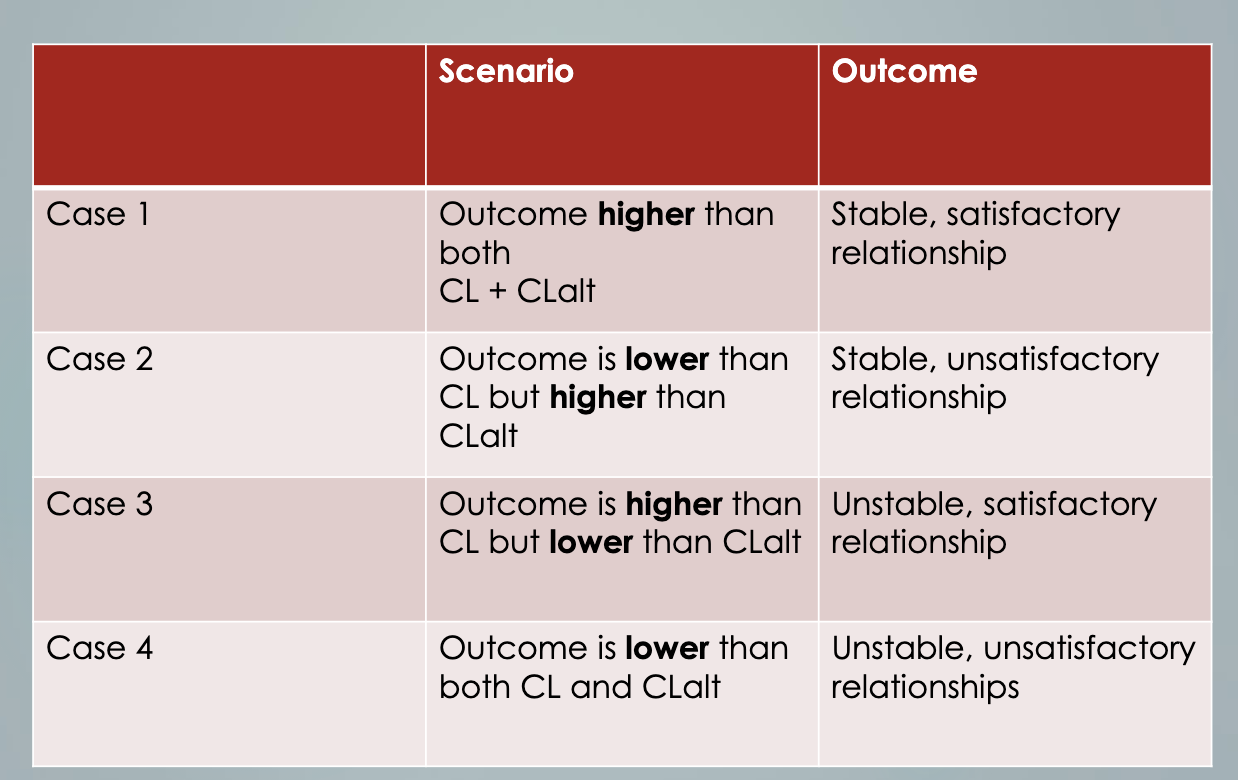
What are other factors in commitment? (L20)
investments of time & E/making sacrificies
going public b/c trigger accountability
using we/i language
sharing gains & losses
making future plans
_ alone is sufficient to sustain a relationship but can’t make it satisfying so need _ to make relationship more satisfying (L20)
commitment ; attachment
What are the CABs of attachment style? What are the answers to the 3 attachment styles secure, anxious, & avoidant? (L20)
Cognition: can I count on AF to be responsive?
Affect: how does it make me feel?
Behavior: what should I do to feel secure?
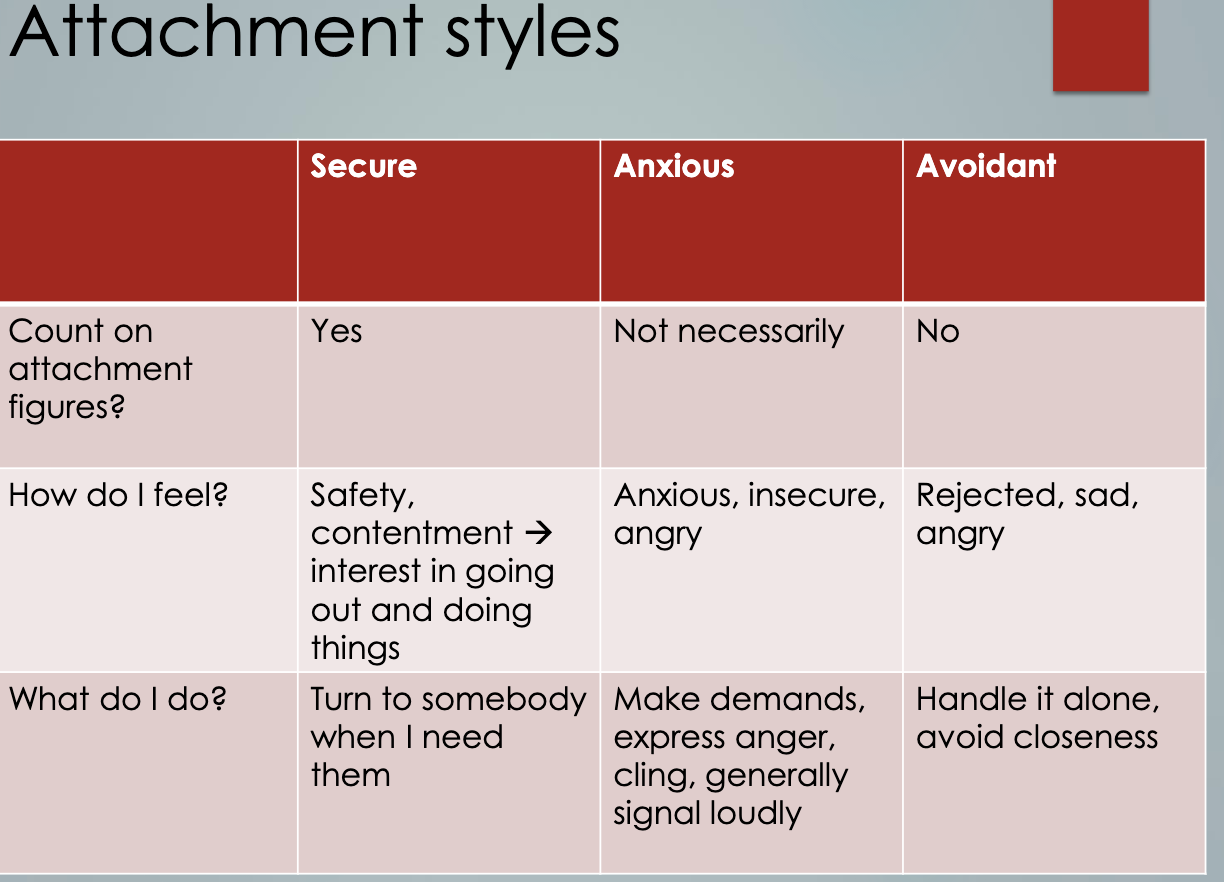
What are the 3 studies that show extent that attachment style in infancy predict adult attachment style/has lasting effects? (L20)
Zayas et all/Barnard Study: responsive caregiving at 18 months dec insecure attachment in romantic relationships while controlling caregiving inc it in early 20s
Overall & Simpson/Minnesota Study: secure attachment at 12 months carries over to peer competence in grades 1,3 & higher friendship quality at 16 = adult romantic relations more positive emotion, less negative behavior, & better conflict res
Dugan et al/SECCYD Study: found maternal caregiving directly affects adult close relationships w/less anxiety & avoidance of parents, friends, & romantic partner but also indirectly by inc peer relationship quality
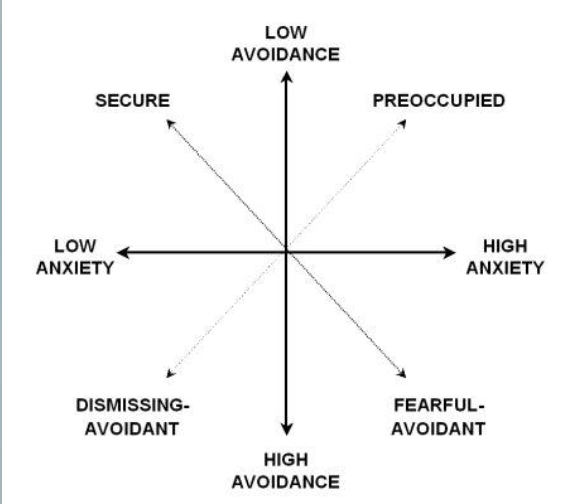
What are the 4 attachment dimension styles? (L20)
low anxiety/avoidance = secure
low anxiety + high avoidance = dismissing avoidant
high anxiety + low avoidance = preoccupied
high anxiety/avoidance = fearful-avoidant
Early relationships/attachment exert their influence via ANS & HPA axis that shape our expectations, exp, behavior. What is the HPA axis & ANS? What is the study that show how early caregiving change HPA axis? (L20)
HPA axis = stress response & normally operates thru - FB loop to dec stress
early maternal care in rats via licking strengthen - FB loop vs early stress activates HPA axis by strengthen its connection to amygdala (stress-detector)
ANS has sympathetic (fight or flight) & parasympathetic (rest & digest) branches where locus coeruleus release norepinephrine
prolonged stress = hyper-responsive locus coeruleus & more connected to amygdala = frequent sympathetic NS activity (fight/flight)
but vagus nerve activity can mimic safety signals = dec stress
*2 groups of 8 yr olds (normative/abused) asked to identify adult facial exp & found that control could distinguish emotions, neglected saw less distinctions, & physically abused show most variance
*change by consciously changing exp/behaviors = new exp aka security priming where expose ppl to cues of secure attachment
How are prairie voles used to test theories about pair bonding? What kind of experiments were done? (Guest Lecture 21)
prairie voles socially monogamous as prefer partner over stranger, selective aggression against stranger M/F, & bi-parental care
inc V1aR in promiscuous meadow voles made them more monogamous like prairie voles
more vasopressin allele in men dec pair bonding
even within same species prairie voles diff in RSC & levels of V1aR = diff mating tactics of residents (pair bonds) vs wanderers (single)
dopamine inc when vole seeking partner (press lever & door open to partner) while separation reduce dopamine
2-hit model where1st hit = biparental care or parental deprivation & 2nd hit = chronic stress where all show stress phenotypes & stress susceptible voles huddle more
What are the 3 theoretical models of mate choice in judging who is most appealing? What do they predict & associated studies/what’s supported by empirical evidence? (L22)
Sexual Strategies Theory: predict diff in mating strategies/prefs b/c sex diff in parental investment where M want many partners + fertile & F want 1 + status/resources but Coventry et al found sex diff in mate pref actually slight & depend on chooser’s sex not target sex
Likes Attract Hypothesis: predict ppl who strongly possess a particular trait will make stronger demands for same trait in partner (i.e. F have wealth & status = want M w/wealth & status) & is true IRL
Adventitious Model: if human mating follow lawful choice then predict you & clone/twin should be attracted to same ppl/end up w/similar mates; Lykken & Tellegen found that monozygotic twins more similar to each other/pref than dizygotic/strangers but NOT more likely to be attracted to cotwin’s mate (twins make similar choices EXCEPT mate choice) = show mate choice is adventitious (based on chance/propinquity)
What did Eastwick & Finkel study find about how prior pref predict who they will like most in a speed-dating scenario? (L22)
ppl claim that attractiveness is/is not important lower than actual importance ratings
women say they care significantly about partner earning but actual lower & similar to men’s actual (even if predicted lower)
men rate physical attractive more important & women rate wealth/status more important but don’t actually see sex diffs
thus concluded what you say you like doesn’t predict actual attraction
What are the 3 common characteristics of breakups? (L23)
it’s a process not sudden (initiator thought about it at least 2 yrs before initiating)
unilateral = has initiator vs partner
9 stages
What are the 9 stages of pair bond breakups? (L23)
private doubts: fluctuations in personal commitment only by initiator = reversible & common
indirect expression: indirectly exp unhappiness/priv doubts; partner’s see it as trivial complaint = ignore but initiator see partner as not getting it/understanding; reversible & common
turning outward: seek external satisfaction like new friends, interest, activities w/o partner = inc propinquity w/potentially new partners; reversible & common
rewriting history: opposite of romantic idealization, tell themselves they were mismatched from beginning & justify breakup, reversible
public expression: tell someone/disrespect partner = may no longer be reversible!!
exploring single life: still get benefits from partner but spend more time w/single friends, interest in other breakups, don’t wear ring, reluctant to make future plans w/partner
taking action: provoke partner to break up & make plans post-breakup = partner finally aware
trying: partner try to repair but initiator convince it can’t be
separating: initiator determined to end relationship but afraid of being frank = say need break/space/time to think
What are Gottman’s Four Horsemen of the Apocalypse (& their opposites)? (L23)
global criticism (“you always…” = impugn their character) b/c opposite of idealization
defensiveness b/c opposite of intimacy
contempt = disgusted w/each other = opposite of attraction
stonewalling = somebody disengages, gender diff where M get - quicker & F persist on discussing, b/c opposite of commitment
What are effective ways of avoiding/interrupting Gottman’s Four Horsemen + method/main findings of Markman’s intervention program? (L23)
even if global criticism/defensiveness can stop before contempt using validation, affection, humor
Method: recruited newly engaged couples & either received training how to avoid 4 horsemen or diff topic (mortgage/parenting)
Findings: effective in 1980 where less violence/negative interactions = better communication/+ interaction but in 2013 couples divorce after PREP if start out negatively
*study on army couples that PREP training had 2% divorce rate 2 yrs later vs control 6%
What’s the “magical” ratio of positive to negative interpersonal interactions and its effect on relationship satisfaction? (L23)
5:1 ratio positive to negative (10:1 ideal = more is better not magic ratio)
true w/friends, teachers, parents, coworkers but beware that Gottman’s data from specific context (married couples in lab seeting) & thus may be overextended beyond what data actually supports
When are the 4 times breakups occur? Within the year & professions? (L23)
2 yr mark (end of infatuation), 4 yrs (modal divorce), 7 yrs (median divorce), when oldest is 14 (parental strain where marital satisfaction dec after birth of first child & inc when last child leaves home)
peak in Mar/Aug, lowest in Dec
lowest = drs, scientists, leg, clergy; highest = dancers, casino, bartenders
What’s definition, prevalence, 4 determinants/causes (i.e. SST), & impact of infidelity? (L24)
secret sexual/romantic activity w/someone other than exclusive partner (consensual non-monogamy & polyamory doesn’t count)
more prevalent while cohabiting then married, highest in middle management, gender cheating gap wider as adults get older (men'‘s inc while women’s inc & then dec)
What determines who’s unfaithful?
social norms: more likely to cheat if family/friends do, harsher for women
evolutionary pressure (sexual strategy theory): men should be more likely to cheat but when women do it’s b/c in fertile phase (no clear evidence), partner has similar MHS, cheat up to someone w/higher status/attractiveness (Gentle et al found less likely to cheat on attractive partners)
individual diffs: unrestricted sociosexual orientation, narcissism/psychopathy, ambiguous behavior inc infidelity probability
relationship factors: intimacy, commitment, mate similarity, satisfaction dec probability
Impact on marriages?
Betzig found adultery most frequent cause for marriage dissolution but not always immediate cause = look at proximal/distal causes
Selterman et al found that highest motivations for affair were autonomy, low commitment, & sexual dissatisfaction not anger at spouse, situation, & neglect = infidelity not about relationship satisfaction
What does SST predict about jealousy (2 studies)? What does most research suggest? (L24)
should be sex diffs in how jealousy works where M should be more jealous about sexual involvement b/c cost of paternity uncertainty & F about emotional involvement b/c lose partner resources
Tagler & Jeffers found among college students 81% women say emotional affair worse & 52% men say sexual affair worse = theory partly correct but weak
one study found M & F distress ratings for sexual affair only slightly higher than emotional
recent suggest jealousy not gender/age specific but related to human bonding
What’s definition of jealousy & what situations provoke jealousy, who experiences it, and what are the potential consequences? (L24)
happen when you’re attached & value bond
babies
infidelity & jealous leading causes of spousal battery/homicide (huge gender diff in severity (men 4x more likely to kill intimate partner, main reason = self-defense) but not overall prevalence, stalking